B2B customer experience is the way business customers experience every interaction with a company before, during, and after purchase. It includes sales conversations, onboarding, product use, support, account management, renewals, and post-purchase service.
In the USA, B2B buyers often compare vendors across digital channels, sales calls, peer recommendations, demos, support quality, and long-term account relationships. A good product can win attention, but a poor experience can still lose the account.
What is a B2B customer experience?
B2B customer experience is the full journey a business customer has with a company across all touchpoints. It includes how easy it is to research, buy, use, get help, renew, and expand a product or service.
B2B CX is different from a single transaction. A business customer may include several people, such as users, buyers, finance teams, legal teams, procurement teams, and executives. Each group may care about different parts of the experience.
A strong B2B experience helps customers feel understood, supported, and confident that the vendor can help them reach their business goals.
Why is B2B customer experience important?
B2B customer experience is important because it shapes how customers judge the full relationship, not just the product. A smooth experience can make customers more likely to stay, renew, expand, and recommend the company to others.
Strong B2B CX can help companies improve:
- Retention: Customers are more likely to stay when the experience is consistent and useful.
- Renewals: A smoother journey can reduce friction before contract renewal.
- Referrals: Satisfied customers are more willing to recommend the company.
- Account growth: Customers are more likely to expand when they see clear value.
- Customer trust: Reliable support, clear communication, and strong follow-through build confidence.
Poor B2B CX often appears in small ways before customers complain. Slow responses, confusing onboarding, weak documentation, or unclear pricing can create friction across the account.
That is why B2B companies should not treat customer experience as a support issue only. Sales, product, marketing, implementation, customer success, and leadership all shape the customer’s experience.
Learn more about: What is customer retention Rate and how to obtain it?
Step-by-step guide to build a B2B customer experience strategy
A B2B CX strategy is a plan for improving how business customers interact with your company across the full relationship, from first contact to renewal. It helps you understand customer needs, reduce friction, and turn feedback into action.
Guide to build a B2B customer experience strategy
Step 01
Define which customers you are building for
Step 02
Map the full B2B customer journey
Step 03
Find the moments that affect trust
Step 04
Collect feedback at the right touchpoints
Step 05
Connect feedback to ownership
Step 06
Track progress and adjust the strategy
1. Define which customers you are building for
Start by identifying the customer segments that matter most. In B2B, one account can include users, buyers, executives, procurement teams, and support contacts.
Do not build the strategy for a generic “customer.” Define who you are trying to improve the experience for and what each group needs.
2. Map the full B2B customer journey
Look at every major customer touchpoint, from first website visit to sales calls, onboarding, product use, support, renewal, and account growth.
Pay close attention to handoffs between teams. Many B2B experience problems happen when sales, onboarding, support, and customer success are not aligned.
3. Find the moments that affect trust
Not every touchpoint has the same impact. Focus on the moments where customers decide whether your company is easy to work with.
These often include:
- Demo requests
- Pricing conversations
- Contract reviews
- Onboarding
- First support ticket
- Product adoption
- Renewal discussions
If these moments feel slow, confusing, or disconnected, the whole relationship can suffer.
4. Collect feedback at the right touchpoints
Use B2B customer feedback to understand what customers experience at each stage. Do not wait until renewal to ask what went wrong.
Collect feedback after key moments, such as onboarding, support interactions, product milestones, and quarterly business reviews. The goal is to catch issues early, before they become churn risks.
5. Connect feedback to ownership
Feedback only helps when someone is responsible for acting on it. Assign clear ownership to the teams responsible for fixing each issue.
For example:
- Product handles feature gaps.
- Support handles response-time issues.
- Customer success handles adoption risks.
- Sales handles expectation gaps.
- Marketing handles unclear messaging.
This keeps feedback from becoming another report that nobody uses.
6. Track progress and adjust the strategy
A B2B CX strategy should change as customers, products, and markets change. Review your metrics regularly and look for patterns across accounts.
Track signals such as customer satisfaction, NPS, customer effort, support trends, renewal rates, product adoption, and account health.
The strategy is working when customers experience fewer blockers, teams respond faster, and customer feedback leads to visible improvements.
Learn about: A guide to customer feedback management
How can B2B companies improve customer experience?
B2B companies can improve customer experience by understanding customer needs, mapping the journey, removing friction, collecting feedback, offering self-service, and supporting customers after purchase.
The goal is not to make every interaction flashy. The goal is to make the experience easier, clearer, and more useful for the customer. A strong B2B customer experience strategy should answer three questions:
- What do customers need to succeed?
- Where do they face friction?
- What can the company improve now?
How is B2B customer experience different from B2C customer experience?
B2B customer experience is different from B2C because B2B purchases usually involve more people, longer buying cycles, higher contract value, and more post-sale relationship management.
| Area | B2B customer experience | B2C customer experience |
|---|---|---|
| Buyer type | Businesses, teams, and buying committees | Individual consumers |
| Decision process | Longer and more complex | Usually shorter and more personal |
| Main relationship | Ongoing account relationship | Often transaction-based |
| Purchase value | Usually higher | Usually lower |
| Key touchpoints | Sales, demos, procurement, onboarding, support, renewals | Website, store, checkout, delivery, support |
| Success measure | ROI, adoption, retention, expansion | Satisfaction, repeat purchase, loyalty |
| Feedback focus | Account health, product use, support, stakeholder needs | Product satisfaction, service, convenience |
This difference matters because B2B companies cannot improve CX only by making a website look better. They need to improve the full relationship, from first conversation to renewal.
10 best practices for improving B2B customer experience
The best B2B customer experience practices focus on understanding customers, reducing friction, and acting on feedback across the full customer journey.
- Understand your B2B customers better
Study customer goals, pain points, roles, and buying pressures across users, decision-makers, and account contacts.
- Build a customer-focused culture
Make the customer experience part of sales, product, support, customer success, and leadership decisions.
- Approach customer interactions with empathy
Listen first, understand the customer’s business pressure, and avoid generic responses.
- Improve website usability and accessibility
Make product details, demos, resources, support options, and contact paths easy to find.
- Provide relevant and personalized experiences
Use role, industry, account stage, and product usage to make communication more useful.
- Offer useful self-service options
Provide help centers, FAQs, tutorials, documentation, and portals for simple questions.
- Use automation tools carefully
Automate routine tasks, but keep human support available for complex or sensitive issues.
- Collect customer feedback and act on it
Gather feedback after key moments and close the loop by showing customers what changed.
- Provide proactive assistance
Use account signals to identify risks early and offer help before customers escalate issues.
- Support customers after purchase
Make onboarding, check-ins, training, renewals, and account support part of the experience.
How can QuestionPro Customer Experience help improve B2B customer experience?
QuestionPro Customer Experience can help B2B companies collect, analyze, and act on customer feedback across the customer journey.
B2B CX depends on knowing what customers feel at different moments, such as onboarding, product use, support, renewals, and account reviews. A CX platform helps you organize that feedback and turn it into clearer action.
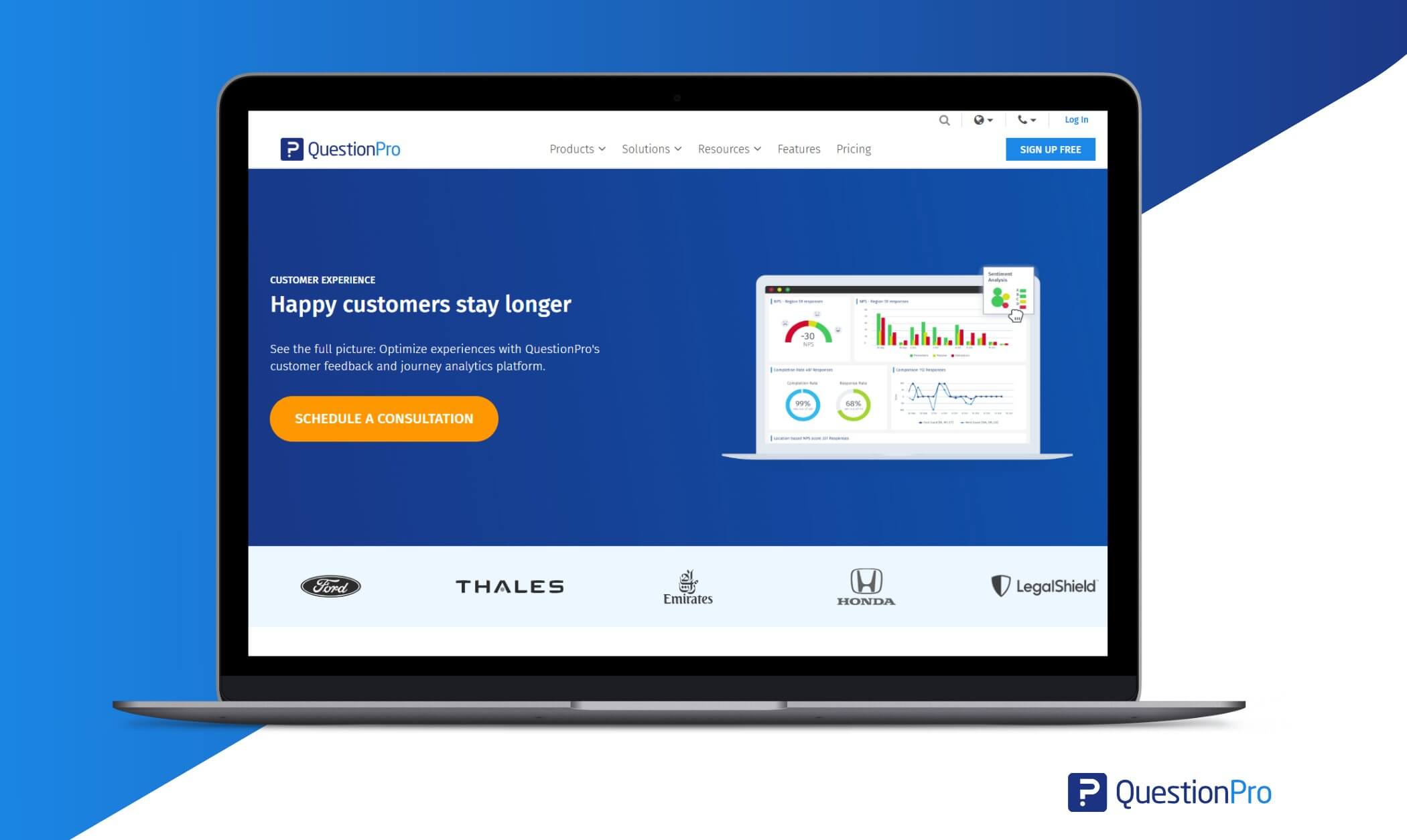
With QuestionPro Customer Experience, you can:
- Collect customer feedback across key touchpoints
- Run NPS, CSAT, CES, and relationship surveys
- Track customer sentiment over time
- Segment feedback by account, role, product, or journey stage
- Identify recurring pain points
- Share reports with customer success, support, sales, and leadership
- Close the feedback loop with customers
Conclusion
B2B customer experience is about making every part of the customer journey easier, clearer, and more useful for business buyers.
The strongest B2B companies do not stop at closing deals. They keep learning from customers, remove friction, support users after purchase, and use feedback to build stronger account relationships.
Frequently Asked Questions (FAQs)
B2B customer experience is important because it affects retention, renewals, referrals, account expansion, and long-term customer relationships.
B2B customer experience usually involves longer buying cycles, multiple decision-makers, higher-value contracts, and more complex post-purchase support.
You can measure B2B CX through NPS, CSAT, customer effort score, account health scores, support data, renewal rates, and customer interviews.
Customer feedback helps B2B companies identify pain points, understand account needs, improve services, and prioritize customer experience improvements.