The Amazon smart home market rests on one idea. Pair low-cost Echo hardware with the Alexa voice assistant, then add Ring, Blink, and eero so Alexa sits at the center of the home. The result wins on device breadth, price, and daily habit.
That strategy started in 2014 and has only deepened. In 2018, a QuestionPro survey found that 48% of respondents planned to use voice assistants to make their homes smart. This article explains how Amazon built its lead, how Google and Apple compare, and how researchers can measure where the market goes next.
What does it mean to “own” the smart home market?
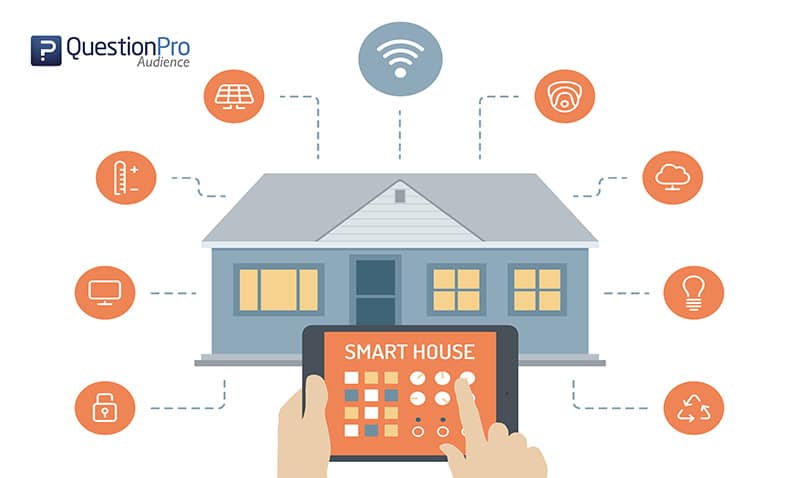
Owning the smart home market means controlling the hub that other devices connect to, not just selling the most gadgets. A smart home is a house where lights, locks, cameras, and appliances connect to the internet. An app or a voice command controls them.
The hub matters because it decides which devices people buy next. If your speaker or display runs Alexa, you tend to choose lights, plugs, and cameras that work with Alexa. Over time, one platform collects the household’s routines, and switching gets harder.
Market researchers can split ownership into three layers.
- Hardware share: How many of the devices in a home come from one brand.
- Assistant share: Which voice assistant people actually use each day.
- Service share: Which subscriptions (like a shopping or security plan) are tied to the platform.
How did Amazon build its smart home lead?
Amazon built its lead in four moves. It launched Echo early, sold it cheaply, bought home-security and network brands, and opened Alexa to outside makers. Each move made the next one easier.
The Echo speaker arrived in 2014, years before Google and Apple had a matching product. Amazon then spent heavily on the home. According to CNBC, the purchases came in three steps:
- Ring (2018): Amazon bought the video doorbell maker for $1 billion.
- Blink (2018): Amazon bought the camera maker for $90 million, three months later.
- eero (2019): Amazon paid $97 million for the mesh Wi-Fi brand.
Those purchases gave Alexa a camera, a doorbell, and the home network. Alexa also became a platform for other brands. That is why many third-party plugs, bulbs, and thermostats work with it out of the box.
What Amazon announced at its 2018 event
The original version of this article covered Amazon’s September 2018 launch of about 15 Alexa-enabled products. The most talked-about were:
- Alexa-enabled microwave: Alexa reached the kitchen.
- Echo Auto: Alexa reached the car.
- Alexa Guard: Alexa reached home security.
- Alexa Hunches: Alexa began suggesting actions based on your habits.
Looking back, the lineup shows the plan. Put Alexa in every room so the habit forms everywhere. Apple and Sonos were behind then, and the pattern still shapes the market.
How big is the Amazon smart home market in the US?
The US smart home market was worth nearly $113 billion in 2021, up 20% from 2020, according to IDC data reported by CNBC. In that same report, Amazon shipped 11.5% of US smart home devices in 2021, ahead of Google at 6.5% and Samsung at 5.8%.
Smart speakers show an even stronger lead. Industry estimates put Amazon Alexa at about 62% of the US smart speaker installed base. Google Nest sits near 26.5% and Apple HomePod near 11.5%. Our smart speaker statistics guide covers adoption and usage in detail, so this article focuses on strategy.
Share figures differ by source, product category, and whether they count shipments, revenue, or installed devices. Treat any single number as one view, not a fixed fact.
Amazon vs Google vs Apple: how do the smart home platforms compare?
Amazon leads on device breadth and price, Google on assistant features, and Apple on privacy and tight integration. The table summarizes how the three approaches differ.
| Platform | Core strength | Main limit |
|---|---|---|
| Amazon Alexa | Widest range of compatible devices and low-cost hardware | Privacy concerns about data collection |
| Google Home | Strong assistant features and search knowledge | Smaller device catalog than Alexa |
| Apple Home | Privacy focus and tight device integration | Smaller accessory catalog |
The cross-platform Matter standard is narrowing these gaps. Matter lets one device work with Alexa, Google Home, and Apple Home, so buyers rely less on a single ecosystem. Many Echo speakers can act as Matter controllers, which keeps Alexa useful even in mixed homes.
For a closer look at one rival, see how consumers reacted to the Apple HomePod and its steep price tag. For earlier context on the category, read how smart speakers were expected to evolve.
What is Alexa+ and why does it matter?
Alexa+ is Amazon’s generative AI assistant, and it is the biggest change to Alexa since launch. It holds longer conversations, remembers context across days, and can handle tasks like booking reservations and flagging unusual activity from Ring cameras.
Amazon says Alexa+ is free for Prime members and $19.99 per month for everyone else. A limited free chat option also exists. Free access for Prime members ties the smart home to the Prime subscription, which is a loyalty lever few rivals can match.
The shift raises questions Amazon cannot answer alone. Will people pay for a smarter assistant? Do they trust it with cameras and calendars? Those are research questions, and they are covered below.
Why does Amazon’s ecosystem keep customers loyal?
Amazon’s ecosystem keeps customers loyal because every new device makes the others more useful. Routines, voice shortcuts, and shared settings pile up inside one account, so leaving means rebuilding them.
Four forces drive the lock-in:
- Low entry price.
Cheap Echo Dot speakers often get a household started, and the first purchase sets the default assistant. - Connected services.
Shopping, music, video, and Prime benefits all link to the same account. - Device breadth.
Many third-party devices work with Alexa, so shoppers rarely hit a compatibility wall. - Habit.
Daily voice commands such as timers, music, and lights become automatic.
Privacy is the counterweight. Amazon says it does not sell customer data from devices and services and uses it only to improve its connected ecosystem. Regulators and advocacy groups have still scrutinized the Ring, eero, and iRobot deals, so trust remains a live issue for buyers.
How can researchers measure smart home ecosystem preference?
Researchers measure ecosystem preference with surveys that track ownership, daily usage, switching intent, and trust across the same questions over time. Because the market moves fast, one-time polls age quickly, and repeated waves show the real direction.
A solid study covers five areas:
- Ownership: Which brands and device types are in the home today.
- Usage: Which tasks people run by voice each week.
- Intent: What they plan to buy in the next 12 months and why.
- Barriers: Privacy, cost, setup effort, and compatibility worries.
- Loyalty: Whether they would stay with the same ecosystem or switch.
Sample quality matters as much as the questions. Weight results to known US population figures, and define “smart home device” clearly so respondents do not count a phone as a hub.
Example: a quick ecosystem tracker
A consumer electronics brand could field a short quarterly survey to 500 US households. The survey would ask three things:
- Assistant.
Which voice assistant do you use most? - Devices.
Which smart home devices do you own? - Switching.
What would make you switch ecosystems?
Comparing waves shows whether a feature like Alexa+ changes preference, instead of guessing from sales alone.
How QuestionPro helps you research the smart home market
QuestionPro helps teams run this kind of study without stitching tools together. With Market Research Software, you can build the survey, set quotas for device owners, and compare waves in one place.
When you need the right respondents, QuestionPro Audience gives you access to a panel of consumers for ownership and intent studies. You can screen for smart speaker owners, then follow up with open-ended questions about trust and privacy.
Turning those answers into action is the job of customer intelligence. Pair behavior data with survey responses to see why people bought, not just what.
- Track change: Watch market research trends, since the voice assistant landscape shifts every year.
- Segment: Compare Alexa, Google, and Apple households side by side.
What Amazon’s smart home lead means for brands and researchers
Amazon’s lead is less about any single gadget and more about being the default layer inside the home. Brands that sell connected products now have to decide whether to build for Alexa first, support Matter, or both.
The safest approach is to ask customers directly. Which assistant do they use, and what would make them trust a new one? Evidence from your own audience beats headlines, especially as generative AI reshapes what people expect.
Frequently Asked Questions (FAQs)
Amazon leads the US smart home market. IDC data reported by CNBC showed Amazon shipping 11.5% of US smart home devices in 2021, ahead of Google at 6.5%. In smart speakers, industry estimates put Alexa at roughly 62% of the installed base.
Amazon’s smart home ecosystem includes Echo speakers and displays, the Alexa assistant, Ring doorbells and cameras, Blink cameras, and eero Wi-Fi routers. Alexa ties them together, so a household can control lights, locks, and cameras from one app or by voice.
Alexa+ is free for Amazon Prime members in the US. Customers without Prime can pay $19.99 per month for unlimited access. Anyone can also use a limited text-based chat at Alexa.com or in the Alexa app.
Often yes, through the Matter standard. A Matter-certified device can connect to Alexa, Google Home, and Apple Home at the same time. Older devices may still work with only one platform, so check the packaging before you buy.
Define what counts as a smart home device, screen for owners, and ask the same questions each wave. Cover ownership, usage, switching intent, and privacy concerns, then weight the sample to US population figures so results reflect the wider market.