Customer involvement is the practice of inviting customers to help shape what a company builds, sells, and supports, instead of only asking them to buy it. Done well, it turns buyers into contributors and gives teams a steady supply of ideas that match real needs.
The term also has a second meaning in marketing: how much effort a shopper puts into a purchase. A loaf of bread takes seconds. A laptop can take weeks. In this guide, we’ll define both meanings, compare the types, walk through examples, and show how to measure and run a program.
What is customer involvement?
Customer involvement is the practice of inviting customers to take part in shaping a company’s products, services, marketing, or support, instead of only buying them. It treats customers as contributors who hold knowledge the company does not have.
Teams apply it in product development, marketing, sales, and service. A company might ask customers to vote on features, test a prototype, or join an advisory board. Researchers call the broader method customer involvement management. It goes a step beyond customer relationship management by finding ways for customers to take part in business and product development.
Marketing textbooks use the same phrase for a second idea: purchase involvement. It describes how much time, effort, and thought a shopper puts into a buying decision. Bread is low involvement. A laptop or a couch is high involvement, because cost and risk push people to research and compare. Houston and Rothschild (1978) split it into three kinds:
- Enduring involvement. Lasting interest in a category, built on past experience.
- Situational involvement. Interest that appears in a moment, such as buying a drink when thirsty.
- Response involvement. The depth of information gathering before choosing a brand.
The consumer decision journey shows how shoppers move through that effort. This guide focuses on the first meaning, where the company invites the customer in.
How is customer involvement different from customer engagement and co-creation?
Customer involvement is the umbrella term for any activity where customers take part in company decisions. Related terms sit under or beside it, and teams often mix them up.
Customer engagement describes the ongoing emotional and behavioral bond between a customer and a brand. Customer co-creation is one specific form of involvement, where customers help build the offering itself.
| Term | What it means | Customer’s role | Example |
|---|---|---|---|
| Customer involvement | Any way customers help shape company decisions | Contributor | Joining an advisory board |
| Customer engagement | Ongoing emotional and behavioral connection with a brand | Active follower | Opening emails, joining a loyalty program |
| Customer co-creation | Customers and company build an offering together | Co-builder | Submitting a product idea that gets produced |
| Customer feedback | Customers report their experience | Reporter | Answering a post-purchase survey |
| Purchase involvement | Effort a shopper puts into a buying decision | Buyer | Researching a laptop for weeks |
A program can show high engagement and low involvement. A company may never ask a loyal fan, even one who opens every email, for an opinion. Involvement adds the invitation to influence.
Why does customer involvement matter?
Customer involvement matters because it replaces guesswork with direct evidence of what customers need, and it gives customers a reason to stay. Five benefits stand out.
- Sharper understanding of needs.
McKinsey found that 71 percent of consumers expect companies to deliver personalized interactions, and 76 percent get frustrated when that does not happen. Involvement shows you what “personal” means to your own customers.
- Higher satisfaction and loyalty.
Gallup reports that fully engaged customers represent an average 23% premium in share of wallet, profitability, revenue, and relationship growth. Gallup measures engagement, and involvement is one practical way to build it.
- More innovation.
Customers use products in ways staff never see. Their workarounds point to features worth building.
- A stronger brand reputation.
Customers who see their idea ship have a story to tell. That story carries more weight than an ad.
- Lower risk of product failure.
Testing concepts with customers before launch catches problems while they are still cheap to fix.
What are the types of customer involvement?
Customer involvement comes in five common types. They differ in how much work customers do and how much control they hold.
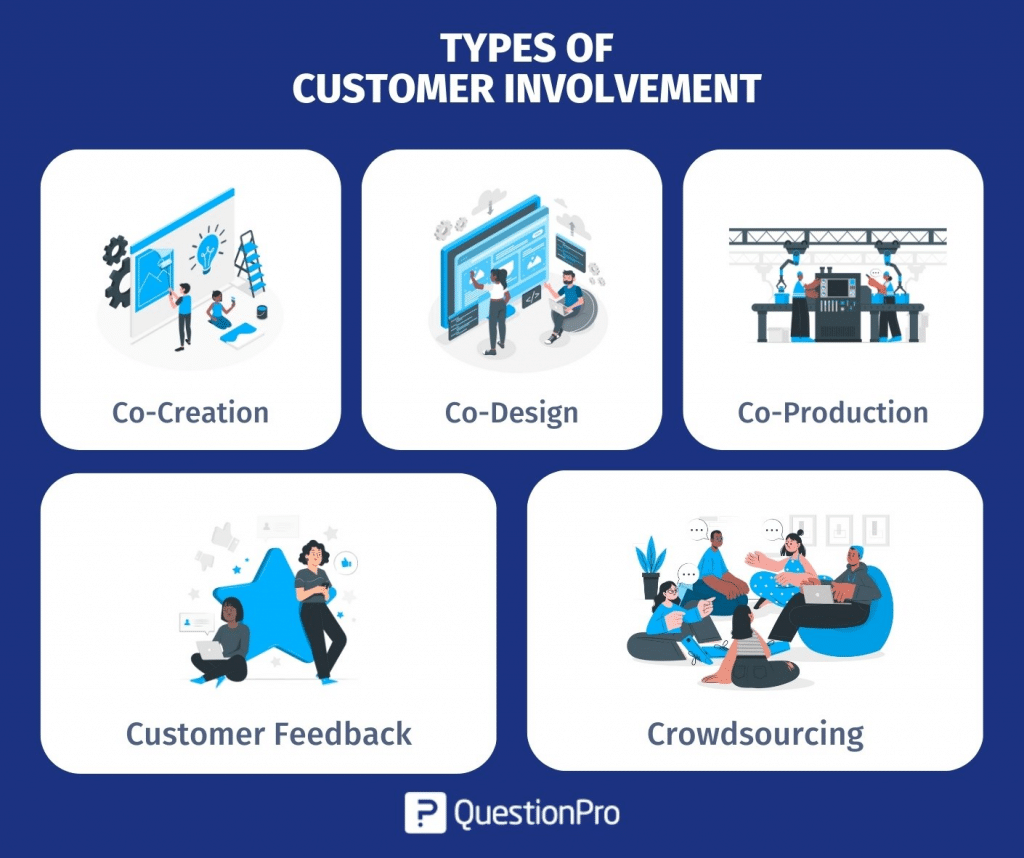
- Customer feedback: Customers share opinions through surveys, reviews, and support conversations. The company still makes the call, and the effort for customers is low.
- Crowdsourcing: The company puts a question or challenge to a large group, such as a naming contest or an idea vote.
- Co-design: Customers work with designers on specifics, through workshops, prototype tests, or usability sessions.
- Co-creation: Customers and the company build an offering together, from first concept to launch.
- Co-production: Customers do part of the work of delivering the service themselves, such as self-checkout or a build-your-own order.
Most mature programs run several types at once. They use feedback for everyday signals and co-design for big bets.
What are some real examples of customer involvement?
Customer involvement shows up in consumer brands and in business software. The three examples below span three types and three levels of control.
| Example | Type | What customers do | What the company gains |
|---|---|---|---|
| LEGO Ideas | Crowdsourcing and co-creation | Submit set designs and rally votes | Products with proven fan demand |
| Nike By You | Co-design | Choose colors and materials | Personalized products and preference data |
| Customer advisory board (illustrative) | Co-design and feedback | Review roadmap mockups | Fewer wrong bets |
LEGO Ideas
LEGO Ideas lets fans submit their own set designs and gather support. Two numbers define the model:
- A project needs 10,000 supporters to be considered for production as a real LEGO set.
- If the set ships, the creator receives 1% of its total net sales.
Both figures come from the LEGO Ideas how-it-works page. The supporter threshold works as a built-in demand test. The royalty rewards the contributor, which keeps new ideas coming.
Nike By You
Nike By You, formerly called NikeiD, lets shoppers choose colors, materials, and details on selected shoes. The customer becomes a co-designer within the limits the brand sets. Each order also shows which combinations people pick when given free choice, a signal that a survey question rarely captures as well.
A customer advisory board in B2B software
This is an illustrative scenario, not a real client. A mid-size US project-management software company recruits 12 customer administrators. Every quarter, the board does three things:
- Reviews roadmap mockups
- Ranks the top pain points in the current product
- Tests beta builds before release
After one cycle, the product team drops two planned features that the board ranked low. It ships the reporting fix that ranked first.
How do you choose the right level of customer involvement?
Match the level of involvement to the decision. The more a choice depends on customer knowledge and the harder it is to reverse, the higher the level should be. The International Association for Public Participation (IAP2) publishes a five-step participation spectrum for public decisions, and the same ladder adapts well to business.
| Level | Customer’s role | Use it when | Example method |
|---|---|---|---|
| Inform | Receives updates | The decision is already made | Release notes |
| Consult | Gives opinions | The choice is low-stakes and easy to reverse | Short survey |
| Involve | Tests and reacts | A concept needs real-world use | Beta test |
| Collaborate | Shapes the solution | Roadmap bets or redesigns | Advisory board, co-design workshop |
| Empower | Decides the outcome | Customers hold the best knowledge | Public idea vote |
Start at consult for small choices, such as the wording of a help article. Move up to collaborate when a wrong call would cost months of work.
Step-by-step guide to involving customers
A simple seven-step process gets a program running without a large budget.
- Pick one decision to improve.
Choose a call your team must make this quarter, such as which feature to build next.
- Set the level.
Use the spectrum above to decide whether you are consulting customers or collaborating with them.
- Recruit a mixed group.
Include power users, new customers, and people who nearly left. Test your assumptions in real conversations, as the customer development method recommends.
- Choose the right method.
Short surveys suit consult-level input. Interviews and communities suit deeper work. Any online survey software can run the first round.
- Promise only what you can deliver.
Tell participants how you will use their input before they give it.
- Close the loop.
Write back within weeks and say what changed and what did not.
- Review every quarter.
Check the measures below and drop methods that do not earn their keep.
How do you measure customer involvement?
Measure customer involvement on three layers: participation, impact, and business outcomes. Set baselines in the first quarter, then track each measure monthly or quarterly.
- Participation rate: Customers who took part divided by customers invited. A rising rate means invitations feel worthwhile.
- Repeat participation: The share of participants who join a second activity within 90 days. It shows whether the first experience felt rewarding.
- Idea adoption rate: Ideas shipped divided by ideas submitted. A very low rate suggests the program collects ideas the company cannot use.
- Feedback loop time: Days between a customer’s input and your reply. A 30-day target is a reasonable one to test.
- Outcome gap: Compare retention, repurchase, or Net Promoter Score (NPS, a 0 to 10 likelihood-to-recommend rating) between participants and non-participants. Read the gap with care, since volunteers are often happier to begin with.
Pair these numbers with open-ended voice of the customer analytics, which explains why the numbers move.
What are the most common customer involvement mistakes?
The most common mistake is asking for input and never showing what happened to it. Four others follow close behind.
- Surveying only fans: Happy customers are easy to recruit and rarely challenge you. Add critics and churned customers so the program hears hard truths.
- Asking too often: Participants burn out when every email is a request. Cap invitations per person and rotate members.
- Skipping the rules: Decide ahead of time who owns submitted ideas and how contributors earn credit or pay. LEGO Ideas states its 1% royalty up front, which removes doubt.
- Treating involvement as marketing: If the goal is applause, customers notice. Give them real choices with real stakes.
How QuestionPro supports customer involvement
QuestionPro supports customer involvement with a standing customer panel and feedback tools. Those tools route what customers say to the people who can act on it. Two capabilities do most of the work.
- Insight communities.
QuestionPro Communities lets teams build online research communities where members join forums, interest groups, and discussions, answer targeted surveys, and earn gamified rewards. Panel management tools target specific segments, and a dashboard tracks community health.
- Closed-loop feedback.
QuestionPro Customer Experience collects feedback from surveys, tickets, and reviews and uses AI to surface themes. It routes detractor responses to owners with suggested fixes. Role-based dashboards track NPS, customer satisfaction (CSAT), and customer effort score (CES).
Customer involvement works when customers see what changed
Customer involvement is a trade. Customers give time and knowledge, and the company gives influence and a visible result. When either side of that trade is missing, participation fades.
The programs that last start small. They pick one decision, invite a mixed group, and report back on what changed. A team might run a ten-person advisory board or a public idea platform. The test is the same either way. Can a customer point to something that exists because they spoke up?
Frequently Asked Questions (FAQs)
Many teams start with 8 to 15 customers. That size keeps every voice heard and sessions manageable. Mix segments, tenure, and satisfaction levels, include a few critics, and rotate members each year so the ideas stay fresh.
Pay for time-heavy work like interviews or workshops, where gift cards are common in the US. Lighter input can earn points, early access, or public credit. Check incentive and sweepstakes rules with legal counsel before launching any rewards program.
Without written terms, ownership can become unclear. Set terms before collecting ideas, covering who owns or licenses each submission and whether contributors receive credit or payment. Have your legal team review the language, especially for public idea platforms.
Yes. Start with five customer interviews, one short survey, and a public list of changes you made because of feedback. Low-cost survey tools handle the collection, and the discipline of reporting back matters more than budget.
Yes. B2B programs involve fewer, higher-value accounts, so advisory boards, beta groups, and one-to-one interviews work best. B2C programs reach thousands, so communities, voting, and surveys scale better. Both need clear scope and a visible follow-up.