Imagine being able to predict how your customers will react before launching a product, pricing a service, or running a marketing campaign. That’s exactly what a digital twin for market research allows you to do.
By combining survey data, behavioral insights, and AI-powered simulations, you can create a virtual replica of your market. This digital twin reflects reality but allows you to experiment, test, and optimize strategies safely.
In this blog, we’ll explore how digital twins work, why surveys are critical to building them, and how you can leverage this technology to stay ahead of the competition.
What Is a Digital Twin for Market Research?
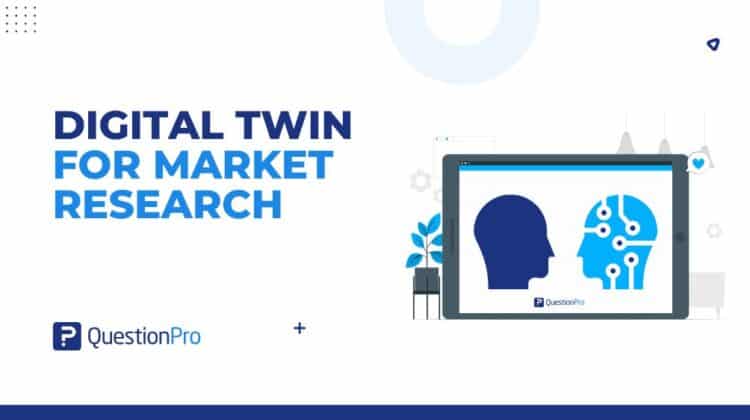
A digital twin for market research is essentially a virtual model of your market, customers, or products. Unlike traditional reports or static dashboards, a digital twin evolves as new data comes in, giving you continuous, real-time insights.
Think of it as a living lab for your business decisions. You can simulate scenarios, forecast trends, and test strategies without any risk. Here are the key points:
- It uses survey responses, CRM data, and analytics to mirror real-world behavior.
- AI and machine learning enable predictive insights.
- It’s continuously updated as new information flows in.
By understanding your digital twin, you can anticipate customer needs, optimize campaigns, and reduce costly trial-and-error decisions.
Role of Surveys in Building a Digital Twin for Market Research
Surveys are the foundation of any successful digital twin for market research. While behavioral data tells you what customers do, surveys reveal the why behind their actions. Without this qualitative insight, your digital twin is essentially a reflection of past behavior, missing the nuance of customer motivations, preferences, and intentions.
By integrating surveys into your digital twin, you can predict how customers will respond to changes in products, pricing, or messaging with far greater accuracy. It can help you understand:
- What drives decisions?
- How do customers feel about your brand or product?
- Will they adopt a new feature or service?
Without survey data, a digital twin is incomplete. Surveys give your virtual model the depth and context it needs to simulate real-world outcomes. By combining surveys with analytics and AI, you turn your digital twin into a predictive engine that guides strategic decisions, reduces risk, and helps you anticipate customer needs before they arise.
Learn More: QuestionPro AI, build surveys in seconds!
How to Build a Digital Twin for Market Research
Creating a digital twin might sound complex, but it’s easier than you think. It involves three main steps:
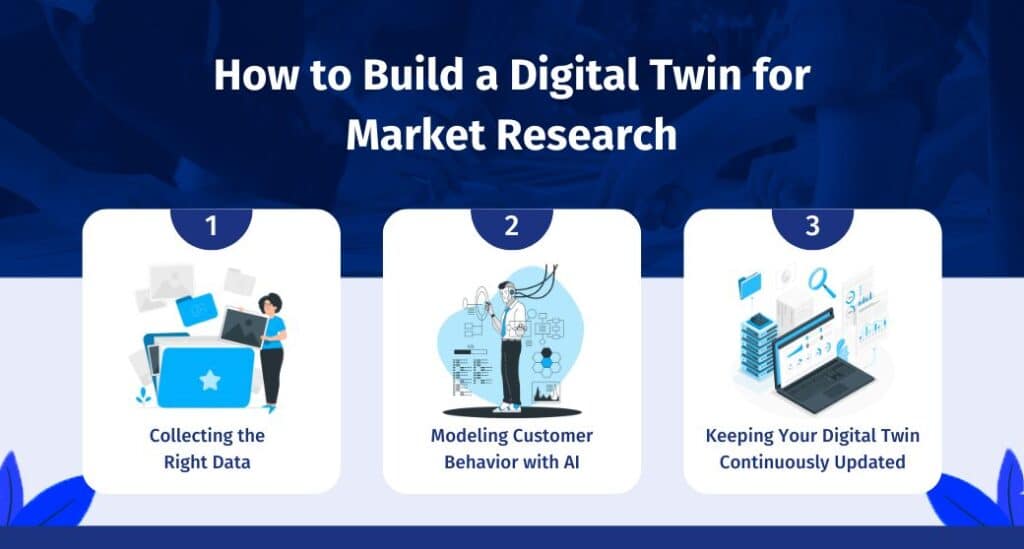
1. Collecting the Right Data
The first step in creating a digital twin is collecting the right data. Your model is only as strong as the inputs you provide, and in market research, that means pulling together multiple data sources that give a complete view of your customers and market.
Here are the key data types:
- Survey responses for customer sentiment and intent
- Behavioral data like clicks, purchases, or product usage
- CRM data and sales analytics
- Social listening or external market trends
Collecting this mix of quantitative and qualitative data ensures your digital twin is representative, robust, and predictive, rather than just a static snapshot.
2. Modeling Customer Behavior with AI
Once your data is collected, the next step is modeling customer behavior using AI and machine learning. This is where your digital twin truly comes to life. By analyzing patterns, correlations, and trends in the data, AI algorithms simulate how different segments of your audience are likely to respond in various scenarios.
With AI-driven modeling, you can predict adoption rates and customer reactions before the product even hits the market. Also, you can test different marketing strategies and identify potential risks before they happen.
This stage transforms your digital twin from a simple model into a predictive tool that can anticipate market behavior instead of merely reflecting the past.
3. Keeping Your Digital Twin Continuously Updated
A digital twin is an evolving model. Every new survey, click, or transaction updates the model and keeps your insights fresh and actionable. This continuous feedback loop allows you to:
- Make agile decisions based on the latest market conditions
- Monitor shifts in customer sentiment or behavior as they happen
- Refine strategies iteratively without waiting for months of traditional research
By keeping the model dynamic, a digital twin turns market research from a reactive process into a proactive, forward-looking strategy.
Uses of Digital Twins for Market Research
A digital twin for market research is a powerful tool you can use to solve real business challenges. Let’s explore the most impactful ways digital twins are applied in market research today.
Product Concept Testing
Wondering if your new product will succeed? One of the most valuable applications of a digital twin is testing product concepts before they reach the market.
With a digital twin, you can:
- Use survey data to identify customer needs and preferences
- Simulate how different product features or designs might perform
- Predict adoption rates across different customer segments
For example, if you’re planning a new mobile app feature, your digital twin can forecast which user groups are most likely to adopt it and which features may need refinement. You can do it all without risking a failed launch.
Customer Segmentation
Traditional customer personas are static and often outdated. Digital twins allow you to create dynamic, evolving segments that reflect real-time customer behavior and preferences.
This enables you to personalize marketing campaigns, product offers, and communications for each segment with higher accuracy and relevance.
Pricing Optimization
Pricing decisions can be risky, but with a digital twin, you can simulate multiple pricing scenarios before going live. Let’s look at how you can predict, analyze, and test pricing in a structured, actionable way.
Start by feeding your digital twin with survey data and behavioral insights. Use surveys to ask your customers questions like:
- Which price point would make you likely to purchase?
- Would you prefer a basic version at a lower price or a premium version with extra features?
Integrate historical sales and purchase behavior to see how past pricing influenced adoption. Analyze how competitors’ pricing changes impact your market share. Observe how your customer segments react to competitors’ moves in the simulation.
Now, test bundling or discount strategies to find the optimal approach. Digital twins allow you to experiment with creative pricing strategies safely. After running simulations, choose the pricing strategy that the twin predicts will maximize adoption and revenue.
Brand Health Tracking
Your brand’s reputation evolves constantly, and a digital twin helps you track brand health over time. Combine survey feedback with behavioral analytics to measure customer perception and sentiment over time.
Demand Forecasting
Understanding future demand is critical for inventory, marketing, and resource planning. By utilizing a digital twin, you can predict future demand using historical data, survey insights, and market trends. Your decisions become data-driven and informed, and reduce guesswork.
Benefits of Using Surveys with Digital Twins
When you integrate survey data into a digital twin for market research, you unlock a range of powerful benefits that traditional research alone can’t provide.
Surveys act as the human insight layer and give your digital twin the context it needs to predict behaviors, preferences, and market reactions accurately. Let’s break down the key advantages:
- Faster Insights
Traditional market research often takes weeks or even months to deliver actionable results. With surveys feeding your digital twin, insights are updated in real time.
- Risk-Free Testing
A digital twin allows you to simulate scenarios before taking real-world action. By combining survey insights with behavioral and transactional data, you can experiment safely, avoiding costly mistakes while identifying the most promising paths forward.
- Continuous Feedback
Surveys integrated with your digital twin provide continuous feedback, so you’re always aware of how these changes impact your customers.
- Smarter Decisions
Combining qualitative and quantitative data helps you understand the “why” behind customer actions and make data-driven decisions with confidence.
- Personalization
You can personalize campaigns or products for specific segments or even individual customers. insights and actions
When you use surveys as the foundation of your digital twin, you’re essentially turning your market research into a predictive decision-making engine.
How QuestionPro Helps You Build a Digital Twin for Market Research
Creating a digital twin for market research might feel complex at first. You need reliable data, clean signals, and a seamless way to turn insights into actionable strategies. QuestionPro enables you to collect, validate, integrate, and activate survey data, turning your digital twin into a predictive, continuously evolving model of your market.
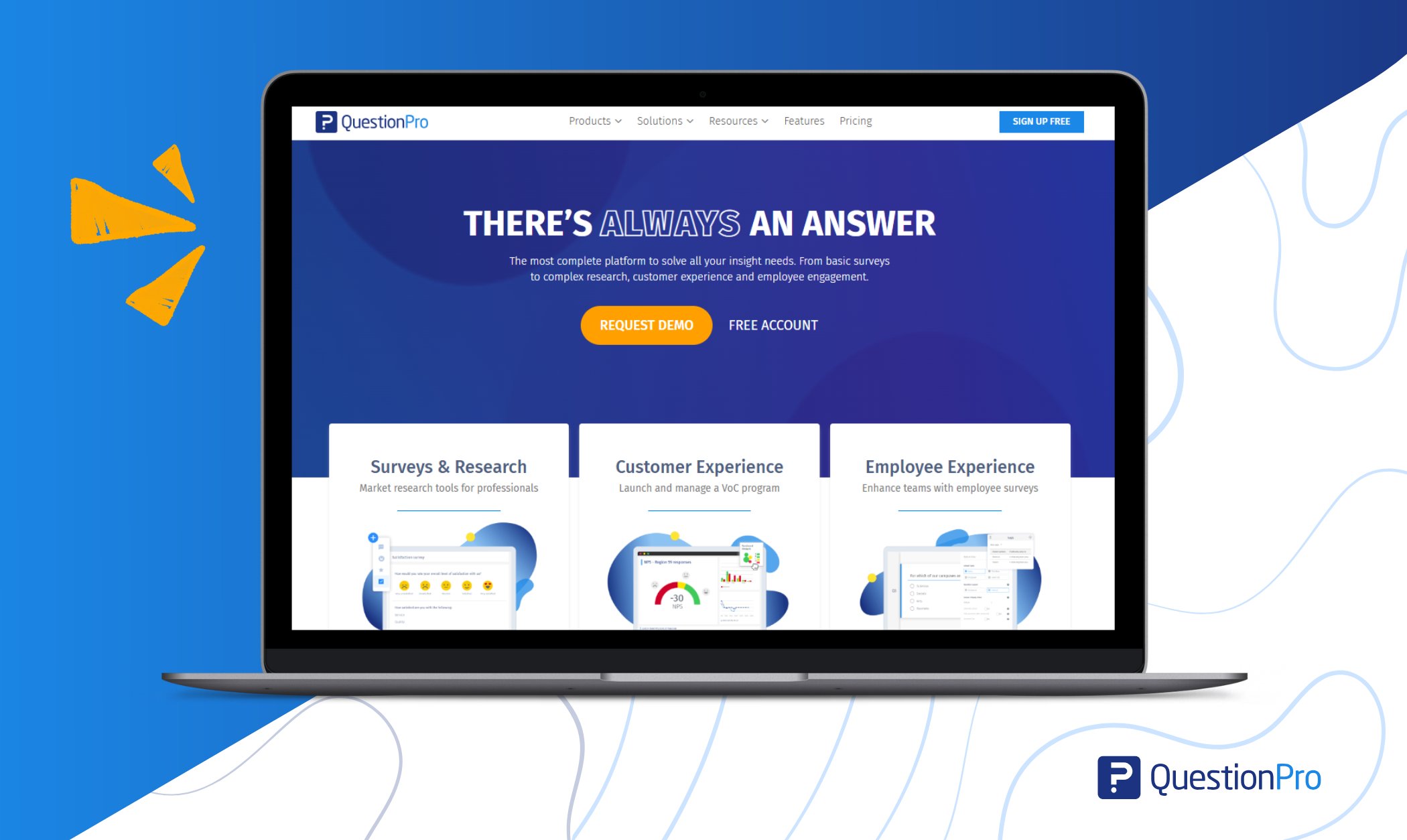
QuestionPro lets you gather high-quality data from real people through:
- Targeted surveys, micro-surveys, and on-site intercepts for real-time feedback
- Panel access and community engagement to reach defined customer segments quickly
- Follow-up waves and pulse checks to continuously refresh insights
You can ensure that the quality and usability of your data are critical for a functional digital twin. QuestionPro can help you:
- Run A/B tests on survey questions and messaging to ensure clarity and reliability
- Engineer advanced features like NPS, AskWhy, churn indicators, root cause analysis, sentiment analysis, and behavioral drivers
- Convert open-text responses into structured signals using text analytics for sentiment, topics, and actionable insights
A complete digital twin combines survey data with behavioral, transactional, and operational data. QuestionPro supports:
- APIs and data exports to connect surveys with CRM, web, app, and transactional systems
- Secure governance features, including role-based permissions, consent tracking, anonymization, and encryption
- Filtering by audience, region, or channel to generate segmented insights for better decision-making
QuestionPro can help you collect and analyze data and turn insights into action:
- Dashboards monitor KPIs, trends, driver signals, and segment differences
- Real-time insights allow you to anticipate challenges and adjust strategies quickly
- Closed-loop workflows capture outcomes from actions, feeding results back into the digital twin to continuously improve predictions
With QuestionPro, your digital twin for market research moves beyond theory into practice. You can collect clean signals, validate ideas, engineer predictive features, integrate multiple data sources, and activate insights in one platform.
Conclusion
A digital twin for market research transforms the way you understand, simulate, and predict customer behavior. By leveraging survey data, analytics, and AI, you can create a living model of your market, test strategies virtually, and make smarter, faster decisions.
Digital twins are moving market research from descriptive to predictive and prescriptive. This shift allows you to:
- Respond quickly to market changes
- Test strategies virtually without real-world risk
- Deliver personalized experiences based on real-time insights
As AI, automation, and advanced survey platforms evolve, digital twins will become essential for competitive, data-driven organizations.
With platforms like QuestionPro, integrating surveys into your digital twin is seamless, giving you the tools to turn insights into action and stay ahead in a competitive market.
Frequently Asked Questions (FAQs)
Answer: Start with surveys for sentiment and intent, then add behavioral signals such as clicks and purchases, CRM and sales data, and external trends or social listening.
Answer: AI models detect patterns across survey and behavioral data, then simulate how segments will react to changes in features, pricing, or messages.
Answer: Refresh it with new surveys and transaction events, monitor drift in predictions, and iterate on features and models as feedback comes in.
Answer: No. Think “companion,” not “replacement.” Use the twin to narrow options, then validate winners with experiments such as A/B, conjoint, or MaxDiff.
Answer: QuestionPro provides survey capture, intercepts, communities, data quality controls, text analytics, dashboards for monitoring, closed-loop workflows, and APIs to connect CRM and transactional systems so you can collect, validate, integrate, and act in one place.