• Skip to main content
  • Skip to primary sidebar
  • Skip to footer
QuestionPro

QuestionPro

questionpro logo
  • Products
    survey software iconSurvey softwareEasy to use and accessible for everyone. Design, send and analyze online surveys.research edition iconResearch SuiteA suite of enterprise-grade research tools for market research professionals.CX iconCustomer ExperienceExperiences change the world. Deliver the best with our CX management software.WF iconEmployee ExperienceCreate the best employee experience and act on real-time data from end to end.
  • Solutions
    IndustriesGamingAutomotiveSports and eventsEducationGovernment
    Travel & HospitalityFinancial ServicesHealthcareCannabisTechnology
    Use CaseAskWhyCommunitiesAudienceContactless surveysMobile
    LivePollsMember ExperienceGDPRPositive People Science360 Feedback Surveys
  • Resources
    BlogeBooksSurvey TemplatesCase StudiesTrainingHelp center
  • Features
  • Pricing
Language
  • English
  • Español (Spanish)
  • Português (Portuguese (Brazil))
  • Nederlands (Dutch)
  • العربية (Arabic)
  • Français (French)
  • Italiano (Italian)
  • 日本語 (Japanese)
  • Türkçe (Turkish)
  • Svenska (Swedish)
  • Hebrew IL (Hebrew)
  • ไทย (Thai)
  • Deutsch (German)
  • Portuguese de Portugal (Portuguese (Portugal))
  • Español / España (Spanish / Spain)
Call Us
+1 800 531 0228 +1 (647) 956-1242 +55 9448 6154 +49 030 9173 9255 +44 01344 921310 +81-3-6869-1954 +61 (02) 6190 6592 +971 529 852 540
Log In Log In
SIGN UP FREE

Home Market Research

Market Research for Students: Steps, Tools, and Examples

market-research-for-students

Market research for students is the process of collecting and analyzing information about customers, markets, products, services, or business ideas for an academic project. It helps students turn assumptions into evidence, whether they are studying marketing, business, entrepreneurship, product design, social sciences, or consumer behavior.

Students at universities often use market research for class assignments, capstone projects, business plans, startup ideas, and thesis work. The goal is not to create a perfect corporate research report. The goal is to ask a clear question, collect useful data, and explain what the findings mean.

QuestionPro can support this process with survey creation, distribution, offline data collection, and reporting tools. But the quality of the project still depends on the student’s research question, audience, survey design, and analysis.

What is market research for students?

Market research for students means studying a market, audience, product, service, or business problem using structured research methods.

A student market research project may study what people want, how they make decisions, what problems they face, which brands they prefer, or whether a new idea has demand.

For example, a student may research:

  • Whether college students would use a campus food delivery app.
  • How Gen Z shoppers choose skincare products.
  • Why students prefer one streaming platform over another.
  • Whether local customers would pay for eco-friendly packaging.
  • How students in India compare online learning platforms.
  • What makes US college students choose one bank or fintech app.

Good market research does not start with a conclusion. It starts with a question.

Why is market research important for students?

Market research is important for students because it teaches them how to make decisions based on evidence instead of guesswork.

The U.S. Small Business Administration explains that market research helps businesses find customers, while competitive analysis helps them understand how to stand out. This same idea applies to student projects. If students are testing a business idea, product concept, or marketing strategy, research helps them understand demand, competition, and customer needs.

Market research helps students learn how to:

  • Define a real problem.
  • Understand a target audience.
  • Collect feedback from the right people.
  • Compare customer needs and preferences.
  • Test business or product ideas.
  • Analyze survey results.
  • Present findings clearly.
  • Make recommendations based on data.

This skill is useful beyond the classroom. Employers, startups, nonprofits, and research teams all need people who can ask better questions and interpret feedback carefully.

What are the main types of market research students can use?

Students can use primary research, secondary research, qualitative research, and quantitative research. Most strong projects use more than one type.

Primary research

Primary research is data students collect directly from people.

Common primary research methods include surveys, interviews, focus groups, observations, and field research. For example, a student may survey 100 university students about food delivery habits or interview small business owners about payment tools.

Primary research is useful because it answers the student’s specific research question.

Secondary research

Secondary research uses information that already exists.

Sources may include academic papers, government reports, industry reports, company websites, news articles, public datasets, and library databases.

Secondary research is useful at the beginning of a project because it helps students understand the market before collecting their own data.

Qualitative research

Qualitative research collects non-numerical feedback, such as opinions, experiences, and explanations.

Students often collect qualitative data through interviews, open-ended survey questions, focus groups, or observation notes.

Qualitative research helps explain why people think or behave a certain way.

Quantitative research

Quantitative research collects numerical data that can be counted, compared, or measured.

Examples include multiple-choice questions, rating scales, ranking questions, and yes or no questions.

Quantitative research is useful when students want to measure patterns, compare groups, or summarize results in charts.

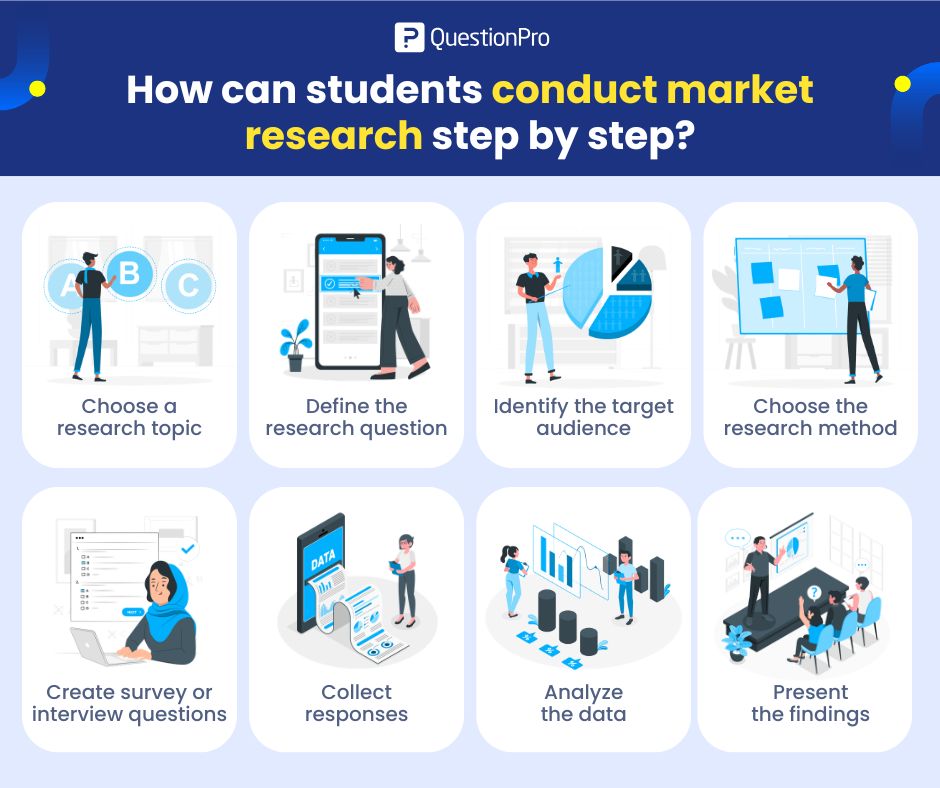
How can students conduct market research step by step?

Students can conduct market research by choosing a clear topic, defining a research question, selecting the right audience, collecting data, analyzing results, and presenting findings.

1. Choose a research topic

Start with a topic that is specific enough to study.

A broad topic like “social media” is too large. A better topic would be “how Instagram ads influence skincare purchases among college students.”

A focused topic makes the project easier to research and explain.

2. Define the research question

A research question is the main question the project is trying to answer.

Examples:

  • What factors influence students when choosing a food delivery app?
  • How do college students compare online learning platforms?
  • What price range would students accept for a monthly fitness app?
  • Which product features matter most to first-time buyers?
  • How do customers evaluate local coffee shops?

A strong research question should be clear, answerable, and connected to the assignment goal.

3. Identify the target audience

The target audience is the group of people the research is about.

Examples include college students, working professionals, parents, small business owners, first-year students, MBA students, shoppers in a city, or users of a specific app.

For a US project, the audience may be undergraduate students in one university. For an India-focused project, it may be students in a specific city or academic program. And for a global project, the audience may include respondents from multiple countries.

4. Choose the research method

Choose a method that fits the question.

Use surveys when you need feedback from many people. Use interviews when you need detailed explanations. And use secondary research when you need market background. Use observation when you need to study real behavior.

For many student projects, a simple survey plus a few interviews works well.

5. Create survey or interview questions

Write questions that are clear, neutral, and easy to answer.

Avoid leading questions like:

“Why do you love our new app idea?”

Use neutral questions like:

“How likely are you to use this app?”

Good survey questions should focus on one idea at a time. They should not push respondents toward a specific answer.

6. Collect responses

Students can collect responses through email, social media, QR codes, classroom groups, university communities, online panels, or in-person field research.

The method should match the audience. If the study is about campus dining, students should collect responses from people who actually eat on campus. If the study is about working professionals, a student-only sample will not be enough.

7. Analyze the data

Data analysis means reviewing responses to find patterns, differences, and useful insights.

Students can analyze:

  • Response counts.
  • Percentages.
  • Average ratings.
  • Common themes in open-ended answers.
  • Differences between groups.
  • Relationship between answers.
  • Unexpected findings.

Do not just report what the chart says. Explain what it means for the research question.

8. Present the findings

The final report should connect the research question, method, results, and recommendation.

A simple structure works well:

  • Research objective.
  • Method.
  • Audience.
  • Key findings.
  • Charts or tables.
  • Interpretation.
  • Limitations.
  • Recommendation.

Limitations are important. If the sample is small, or only includes students from one college, say that clearly.

What are examples of market research projects for students?

Good market research project ideas are specific, realistic, and connected to a real decision.

Examples include:

  • Measuring demand for a campus food delivery service.
  • Studying how students choose banking or fintech apps.
  • Testing interest in a new fitness or wellness app.
  • Understanding why students choose one university over another.
  • Comparing brand preferences for smartphones.
  • Studying buying behavior for sustainable fashion.
  • Testing awareness of eco-friendly packaging.
  • Measuring satisfaction with university facilities.
  • Researching customer needs for a local cafe.
  • Studying online learning preferences in the USA and India.
  • Testing pricing for a student subscription service.
  • Understanding why students abandon online shopping carts.

The best project topics usually have a clear audience and a decision attached to the findings.

What survey questions can students ask?

Students should ask survey questions that match the research objective and avoid unnecessary questions.

Useful question types include:

  • Screening questions.
  • Multiple-choice questions.
  • Rating scale questions.
  • Ranking questions.
  • Open-ended questions.
  • Demographic questions.
  • Purchase behavior questions.
  • Brand awareness questions.
  • Satisfaction questions.

Example questions:

  • How often do you use food delivery apps?
  • Which factor matters most when choosing a delivery app?
  • How satisfied are you with the current options available?
  • What price would you consider reasonable for this service?
  • Which brand comes to mind first in this category?
  • What problem do you face most often with this product?
  • How likely are you to recommend this idea to a friend?
  • What would make you more likely to use this service?

Keep surveys short. Students often collect better responses when the survey takes less time and feels easy to complete.

What mistakes should students avoid in market research?

Students should avoid vague topics, biased questions, weak samples, and conclusions that go beyond the data.

Common mistakes include:

  • Choosing a topic that is too broad.
  • Asking leading questions.
  • Surveying the wrong audience.
  • Collecting too few responses.
  • Asking too many open-ended questions.
  • Using confusing answer options.
  • Ignoring secondary research.
  • Forgetting to explain limitations.
  • Treating opinions as facts.
  • Making recommendations not supported by data.
  • Copying survey questions without adapting them.
  • Ignoring privacy and consent basics.

A practical rule: if the data does not support the conclusion, do not make the claim.

How can QuestionPro help students with market research?

QuestionPro can work as an online survey tool that helps students create surveys, distribute them, collect responses, and analyze results in one place. 

Students can use QuestionPro for market research surveys, academic research surveys, product idea testing, customer feedback, classroom projects, and field research.

Helpful features include:

  • Survey templates.
  • Multiple question types.
  • Survey logic.
  • Online distribution.
  • QR code sharing.
  • Mobile-friendly surveys.
  • Charts and reports.
  • Export options for further analysis.
  • Offline surveys for field research.

The offline survey option can be useful for students collecting responses in classrooms, events, rural areas, campuses, retail locations, or places with limited internet access.

QuestionPro is a useful tool, but it does not replace good research design. Students still need a clear question, the right audience, fair wording, and careful analysis.

Final thoughts on market research for students

Market research for students becomes easier when the project follows a clear process.

Start with one research question. Choose the right audience. Use simple survey or interview questions. Collect honest responses. Analyze the results carefully. Present findings with limits and recommendations.

Whether the project is for a US business class or an Indian university assignment, the core idea stays the same: good market research helps students replace assumptions with evidence.

Create memorable experiences based on real-time data, insights and advanced analysis. Request Demo

Frequently Asked Questions (FAQs)

What is market research for students?

Market research for students is the process of collecting and analyzing information about a market, audience, product, or business idea for an academic project. It helps students understand customer needs, preferences, behavior, and demand.

What is the easiest market research method for students?

Surveys are often the easiest method because students can collect structured responses quickly. A short online survey works well for class projects, while interviews can add deeper explanations behind the numbers.

How many survey responses does a student need?

There is no single perfect number. For small class projects, 50 to 100 responses may be enough to find basic patterns. Larger academic projects may need more responses based on the research goal and audience.

What are good market research topics for students?

Good topics include campus food delivery, online learning preferences, student banking habits, sustainable fashion, mobile app usage, local cafe demand, brand awareness, product pricing, and customer satisfaction with university services.

Can students use online surveys for academic research?

Yes, students can use online surveys for academic research if the questions are clear, the sample matches the topic, and privacy requirements are followed. Some universities may also require instructor or ethics approval.

Why is market research useful for students in the USA and India?

Market research is useful because students in both countries often work on business plans, startup ideas, consumer behavior projects, and academic surveys. It helps them understand real audiences instead of relying only on assumptions.

SHARE THIS ARTICLE:

About the author
Harshad Deshpande
Director, Sales at QuestionPro. Empowering Organizations and Higher Ed with Research Survey Software and CX Solutions.
View all posts by Harshad Deshpande

Primary Sidebar

Research what's on your mind. Find out what's on theirs!

A suite of tools to leverage research and transform insights.

Discover our insight platform

RELATED ARTICLES

HubSpot - QuestionPro Integration

Cross Elasticity: What it is + Importance + Calculation

Jul 06,2023

HubSpot - QuestionPro Integration

Build smarter, faster surveys with QuestionPro AI document import

Jul 21,2025

HubSpot - QuestionPro Integration

2024 Presidential Election Polls: Harris vs. Trump

Nov 05,2024

BROWSE BY CATEGORY

Footer

MORE LIKE THIS

carousel-layout-for-matrix-questions

Stop Losing Respondents to Your Matrix Questions: Introducing Carousel Layout

Jun 18, 2026

Beyond the Annual Survey: How Universities Build Always-On Student Listening

Jun 18, 2026

Are Micro-Credentials What Do Students Actually Want? Inside the Unbundling of the Degree

Jun 18, 2026

Journey Frameworks

Stop Starting from Scratch: How Journey Frameworks Help Teams Scale Customer Journey Mapping

Jun 18, 2026

Other categories

questionpro-logo-nw
Help center Live Chat SIGN UP FREE
  • Sample questions
  • Sample reports
  • Survey logic
  • Branding
  • Integrations
  • Professional services
  • Security
  • Survey Software
  • Customer Experience
  • Workforce
  • Communities
  • Audience
  • Polls Explore the QuestionPro Poll Software - The World's leading Online Poll Maker & Creator. Create online polls, distribute them using email and multiple other options and start analyzing poll results.
  • Research Edition
  • LivePolls
  • InsightsHub
  • Blog
  • Articles
  • eBooks
  • Survey Templates
  • Case Studies
  • Training
  • Webinars
  • All Plans
  • Nonprofit
  • Academic
  • Qualtrics Alternative Explore the list of features that QuestionPro has compared to Qualtrics and learn how you can get more, for less.
  • SurveyMonkey Alternative
  • VisionCritical Alternative
  • Medallia Alternative
  • Likert Scale Complete Likert Scale Questions, Examples and Surveys for 5, 7 and 9 point scales. Learn everything about Likert Scale with corresponding example for each question and survey demonstrations.
  • Conjoint Analysis
  • Net Promoter Score (NPS) Learn everything about Net Promoter Score (NPS) and the Net Promoter Question. Get a clear view on the universal Net Promoter Score Formula, how to undertake Net Promoter Score Calculation followed by a simple Net Promoter Score Example.
  • Offline Surveys
  • Customer Satisfaction Surveys
  • Employee Survey Software Employee survey software & tool to create, send and analyze employee surveys. Get real-time analysis for employee satisfaction, engagement, work culture and map your employee experience from onboarding to exit!
  • Market Research Survey Software Real-time, automated and advanced market research survey software & tool to create surveys, collect data and analyze results for actionable market insights.
  • GDPR & EU Compliance
  • Employee Experience
  • Customer Journey
  • Synthetic Data
  • About us
  • Executive Team
  • In the news
  • Testimonials
  • Advisory Board
  • Careers
  • Brand
  • Media Kit
  • Contact Us

QuestionPro in your language

  • English
  • Español (Spanish)
  • Português (Portuguese (Brazil))
  • Nederlands (Dutch)
  • العربية (Arabic)
  • Français (French)
  • Italiano (Italian)
  • 日本語 (Japanese)
  • Türkçe (Turkish)
  • Svenska (Swedish)
  • Hebrew IL (Hebrew)
  • ไทย (Thai)
  • Deutsch (German)
  • Portuguese de Portugal (Portuguese (Portugal))
  • Español / España (Spanish / Spain)

Awards & certificates

  • survey-leader-asia-leader-2023
  • survey-leader-asiapacific-leader-2023
  • survey-leader-enterprise-leader-2023
  • survey-leader-europe-leader-2023
  • survey-leader-latinamerica-leader-2023
  • survey-leader-leader-2023
  • survey-leader-middleeast-leader-2023
  • survey-leader-mid-market-leader-2023
  • survey-leader-small-business-leader-2023
  • survey-leader-unitedkingdom-leader-2023
  • survey-momentumleader-leader-2023
  • bbb-acredited
The Experience Journal

Find innovative ideas about Experience Management from the experts

  • © 2022 QuestionPro Survey Software | +1 (800) 531 0228
  • Sitemap
  • Privacy Statement
  • Terms of Use