Millennials in the workforce are no longer only early-career employees. Many are now managers, parents, homeowners, senior specialists, entrepreneurs, and decision-makers shaping how companies hire, retain, and support talent in the USA.
Pew Research Center defines millennials as people born between 1981 and 1996. That means this generation now includes workers in their late 20s through mid-40s.
The old idea that millennials are “young workers” is outdated. Employers need a more current view of what millennial employees want, what shaped their careers, and how their expectations affect workplace culture.
What does “millennials in the workforce” mean?
“Millennials in the workforce” refers to employees born between 1981 and 1996 who are active in the labor market.
This group entered work during a period shaped by the internet, student debt, the Great Recession, rapid digital adoption, and changing expectations around work-life balance.
A millennial worker today may be:
- A first-time manager.
- A senior individual contributor.
- A working parent.
- A remote or hybrid employee.
- A business owner.
- A department leader.
- A mid-career employee considering a career change.
This matters because companies cannot treat millennials as one early-career group anymore. Their needs often depend on career stage, income, family responsibilities, location, industry, and role.
How many millennials are in the US workforce?
Millennials are the largest generation in the US labor force.
The U.S. Department of Labor reported that millennials were the largest generation in the US labor force in Q2 2024, making up 36%. Gen X made up 31%, Gen Z made up 18%, Baby Boomers made up 15%, and the Silent Generation made up 1%.
That makes the millennial workforce a major focus for employers, HR teams, and workforce researchers. Their expectations influence hiring, employee engagement, leadership development, benefits, workplace flexibility, and retention strategy.
For US employers, understanding millennials is not a niche HR topic. It is part of understanding the largest current share of working adults.
Why did the Great Recession shape millennial workers?
The Great Recession shaped many millennial workers because they entered the labor market during or after a period of weak hiring, layoffs, wage pressure, and financial uncertainty.
Many millennials graduated into a difficult job market. Some took part-time jobs, unpaid internships, gig work, or roles outside their field just to get started. Others delayed major financial milestones, such as buying homes, starting families, or saving for retirement.
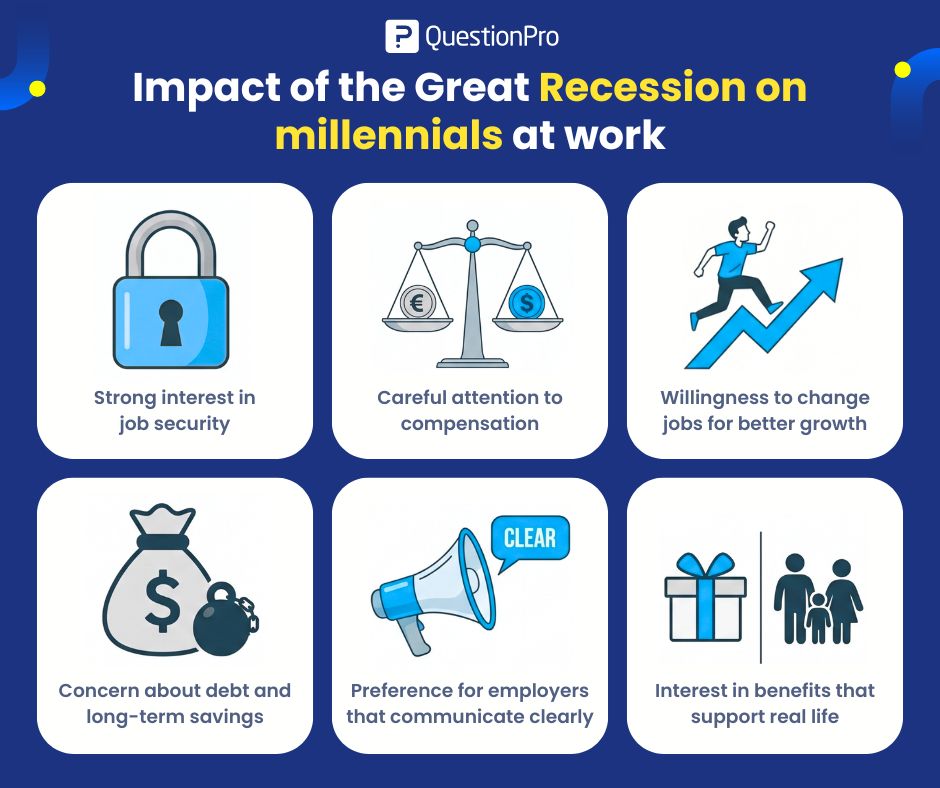
That experience still affects how many millennials think about work. It can show up in several ways:
- Strong interest in job security.
- Careful attention to compensation.
- Willingness to change jobs for better growth.
- Concern about debt and long-term savings.
- Preference for employers that communicate clearly.
- Interest in benefits that support real life, not only office perks.
This does not mean every millennial thinks the same way. But the economic context matters when employers study workplace expectations.
What do millennials value at work?
Millennials at work often value growth, flexibility, fair pay, meaningful work, and strong communication.
In practice, this usually means they want a workplace that offers both career progress and a reasonable way to manage life outside work.
Common workplace expectations include:
- Clear career paths.
- Competitive compensation.
- Flexible work options where possible.
- Regular feedback from managers.
- Learning and development.
- Inclusive workplace culture.
- Transparent communication.
- Purpose behind the work.
- Mental health and wellness support.
- Fair recognition.
- Practical benefits, such as healthcare, retirement plans, and paid time off.
Millennials are often described as purpose-driven, but purpose does not replace pay. Most employees still need fair compensation, stable benefits, and a clear path forward.
A better way to frame it: many millennial employees want work that feels worth the effort, both financially and personally.
This is where employee experience matters. It helps employers understand how people feel across the full work journey, from onboarding to growth, management, recognition, and retention.
What challenges do millennial employees face?
Millennial employees often face mid-career pressure, financial stress, caregiving responsibilities, burnout, and limited advancement opportunities.
Many are old enough to manage teams but young enough to still be building financial stability. Some are caring for children, aging parents, or both. Others are trying to catch up after early-career setbacks from the Great Recession or disruptions during the COVID-19 period.
Common challenges include:
- Wage growth not matching cost-of-living increases.
- Student debt or delayed savings.
- Career bottlenecks.
- Burnout from always-on communication.
- Lack of manager support.
- Limited leadership development.
- Unclear promotion criteria.
- Tension around remote, hybrid, or office work.
- Pressure to balance family, career, and personal health.
Employers that ignore these issues may lose experienced workers who are expensive to replace.
How are millennials different from Gen Z and Gen X at work?
Millennials often sit between Gen X and Gen Z in the workplace, which gives them a unique role in team culture and leadership.
Gen X employees are often more established in senior leadership or later-stage careers. Gen Z employees are newer to the workforce and more likely to be early-career. Millennials are commonly in the middle, managing teams, raising families, building expertise, and moving into leadership.
A simple comparison:
| Generation | Common workforce position | Workplace focus |
|---|---|---|
| Gen X | Senior roles, experienced managers, executives | Autonomy, stability, leadership influence |
| Millennials | Mid-career specialists, managers, senior contributors | Growth, flexibility, fair pay, meaningful work |
| Gen Z | Early-career employees, newer entrants | Learning, belonging, feedback, flexibility |
These are broad patterns, not fixed rules. Age, industry, income, education, location, and role can matter more than generation.
The best employers avoid stereotypes and use employee feedback to understand what different groups actually need.
How can employers engage and retain millennial employees?
Employers can engage and retain millennial employees by offering clear growth paths, practical flexibility, fair compensation, consistent manager communication, and a healthy workplace culture.
Retention does not depend on one perk. It depends on whether employees see a future with the company.
Useful actions include:
- Create clear promotion criteria.
- Train managers to give useful feedback.
- Offer flexible work when the role allows it.
- Review pay equity and compensation competitiveness.
- Build leadership development programs.
- Recognize strong work in specific, timely ways.
- Support mental health and workload balance.
- Ask for employee feedback and act on it.
- Explain business decisions clearly.
- Connect work to customer, team, or company outcomes.
One mistake is assuming millennials only want flexibility. Flexibility helps, but it does not fix poor management, unclear growth, or weak pay.
What should HR teams measure to understand millennial workers?
HR teams should measure engagement, satisfaction, retention risk, manager quality, career growth, workload, flexibility, benefits, and workplace culture.
Useful measurement areas include:
- Employee engagement.
- Employee satisfaction.
- Intent to stay.
- Manager trust.
- Career development.
- Workload and burnout.
- Flexibility preferences.
- Benefit satisfaction.
- Belonging and inclusion.
- Recognition.
- Internal mobility.
- Communication quality.
An employee engagement survey can help HR teams compare feedback across generations, departments, locations, and career stages.
An employee satisfaction survey can also help teams understand whether millennial employees feel supported, fairly treated, and likely to stay.
The key is to avoid treating millennials as one uniform group. A 29-year-old individual contributor and a 43-year-old manager may have very different priorities.
How can QuestionPro Employee Experience help research millennials in the workforce?
QuestionPro Employee Experience can help organizations study millennials in the workforce through employee feedback, workforce surveys, and audience research.
For internal HR teams, QuestionPro Employee Experience can support employee engagement surveys, pulse surveys, employee satisfaction surveys, onboarding feedback, exit surveys, and manager feedback programs.
For external research teams, QuestionPro Audience can help collect feedback from targeted respondent groups, including millennials, when businesses need to understand workforce attitudes, employment expectations, benefits preferences, or career behavior.
This is most useful when companies need evidence instead of assumptions. The goal is not to label a generation. The goal is to understand the real needs, frustrations, and motivations of the people in that group.
Final thoughts on millennials in the workforce
Millennials in the workforce are now a core part of the US labor market. They are not just new hires or entry-level employees. Many are experienced professionals shaping management, culture, customer experience, and business performance.
Employers should stop relying on old stereotypes or outdated job lists. The better approach is to study what millennial employees actually experience today: pay pressure, career growth, flexibility, management quality, burnout, and workplace trust.
Companies that listen carefully and respond with practical changes will be in a stronger position to retain millennial talent.
Frequently Asked Questions (FAQs)
Millennials are people born between 1981 and 1996. In the workforce, that means millennials now include employees in their late 20s through mid-40s.
Millennials are often motivated by fair pay, career growth, flexibility, meaningful work, good managers, and clear communication. These priorities can vary by role, income, life stage, and industry.
Millennials may change jobs for better pay, career growth, flexibility, manager quality, or stronger alignment with their goals. Job changes are often practical decisions, not simply a lack of loyalty.
Managers should communicate clearly, give regular feedback, explain expectations, and discuss growth paths. Many millennial employees value direct, practical communication that helps them understand how to improve and advance.
Companies can measure millennial engagement through employee surveys, pulse checks, retention analysis, manager feedback, exit surveys, and career development questions. Results should be segmented by role, department, location, and career stage.