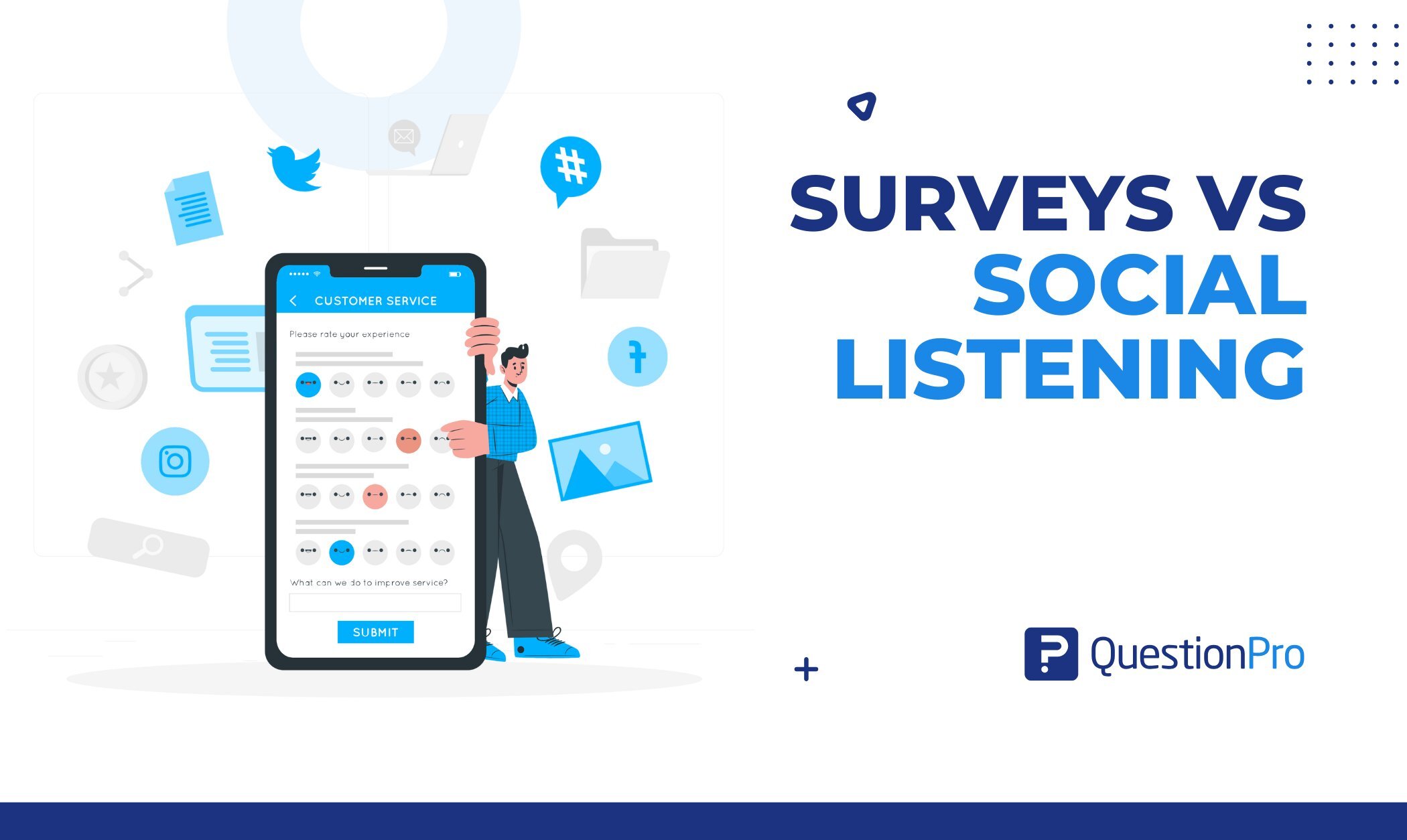
Marketers today have more ways than ever to understand their audience, and the surveys vs social listening question comes up often when teams decide where to put their research budget. Surveys ask people directly what they think. Social listening watches what people are already saying without asking anything at all.
Both approaches produce real customer insights, but they work in different ways and answer different kinds of questions. A team that only surveys misses the raw, unfiltered conversations happening on social media. A team that only listens misses the precise, structured answers a targeted question can produce.
In this blog, we’ll cover how surveys and social listening compare, where each one wins, and how pairing them gives marketers a fuller read on customer behavior.
What is a survey?
A survey is a structured research tool that asks a defined group of people the same set of questions to measure opinions, behaviors, or satisfaction in a way that can be counted and compared. Marketers design the questions, choose the audience, and control exactly what gets measured.
That structure is what makes surveys useful for tracking things like customer satisfaction, feature preferences, or reactions to a new campaign. Because every respondent answers the same question, the results are easy to quantify and compare over time.
Surveys carry real strengths and real limits:
- They let researchers ask about one specific issue and get a direct answer, instead of waiting for the topic to surface naturally online.
- Well-designed surveys produce comparable, quantifiable data that is easy to report to stakeholders and track wave over wave.
- Response quality depends on who answers. Low response rates or leading questions can introduce survey bias, where the wording or sampling skews the results, so it’s worth checking for before trusting the numbers.
Social listening is the practice of tracking and analyzing what people are already saying about a brand, product, or topic across social media, forums, and review sites, without sending anyone a single question. Instead of asking, marketers observe conversations as they happen.
People often use “social listening” and “social monitoring” interchangeably, but they aren’t the same thing. Social monitoring tracks direct mentions and replies in real time, mostly for customer service response. Social listening goes further, analyzing sentiment, themes, and trends across a wider set of conversations to spot patterns a marketing or product team can act on.
With the right social listening tools, marketers can spot emerging trends, track brand reputation, and catch issues customers never mention in a formal feedback request. The data is unfiltered, which is its biggest strength and its biggest challenge. Slang, sarcasm, and irrelevant mentions all need real analysis before the noise turns into an insight.
Once you know how each method works, the practical differences are easier to see. Here’s a side-by-side breakdown of how surveys and social listening compare across the factors that matter most to marketers.
| Factor | Surveys | Social listening |
|---|---|---|
| Data source | Answers to your predefined questions | Conversations happening naturally online |
| Control over questions | Full control over questions and audience | No control; people talk about what they choose |
| Type of feedback | Structured and easy to organize | Unstructured, raw, and often emotional |
| Speed | Slower, requires design and distribution | Real-time, as opinions happen |
| Depth of data | Focused on the topics you choose | Broad, covers topics you may not expect |
| Best use case | Measuring satisfaction, testing ideas, benchmarking | Tracking sentiment, spotting trends, monitoring reputation |
| Data quality | Consistent, but can suffer from fatigue or bias | Authentic, but often noisy and needs cleaning |
Which method gives better insights?
Neither method wins outright. The better question is which one fits the decision in front of you.
Surveys work best when you need a direct answer to a specific question, such as how customers rate a new feature or whether a campaign message landed. A software company, for example, can survey users right after they try a new feature and get a clear usability score to guide the next release.
Social listening works best when you want to catch something customers aren’t being asked about. A retail brand tracking mentions of shipping delays can spot a growing complaint days before it shows up in a satisfaction survey. That said, social feedback is only part of the picture. Forrester’s analysis of how US consumers report service problems found that the large majority still use traditional channels like surveys, phone, and email, while only a small share turn to social platforms, which is exactly why the visible complaints online rarely tell the whole story on their own.
A quick way to decide:
Use surveys when you need precise answers to a specific question, comparable data you can track over time, or feedback tied to a defined audience segment.
Use social listening when you need real-time sentiment, unprompted reactions, or an early warning on a reputation or service issue.
How to measure and evaluate each method
Comparing insights side by side only works if you track the right numbers for each method.
For surveys, the core metrics are response rate, completion rate, and margin of error, since a survey’s reliability depends on how many people answered and how well they represent your target audience. Rating scales such as CSAT (customer satisfaction score) and Net Promoter Score (a measure of customer loyalty) are common outputs. For social listening, the core metrics are mention volume, sentiment score, and share of voice, since these show how much people are talking, how they feel, and how visible you are compared to competitors.
| What you’re measuring | Surveys | Social listening |
|---|---|---|
| Reliability | Response rate and sample size | Volume and source diversity of mentions |
| Sentiment | Rating scales such as CSAT and NPS | Sentiment analysis of text and tone |
| Trend detection | Wave-over-wave comparison | Real-time spikes in mention volume |
| Reporting cadence | Periodic, weekly to quarterly | Continuous and always on |
The biggest mistake is treating this as an either/or decision instead of matching the method to the question.
Watch for these common missteps:
- Relying only on social listening and assuming it represents your whole customer base, when it usually skews toward people who are already vocal online.
- Sending long, generic surveys that trigger survey fatigue and low response rates, instead of short ones tied to a specific decision.
- Misreading sarcasm or a niche complaint in social conversations as a widespread trend, without checking whether it points to a real customer pain point first.
- Treating each data source in isolation instead of cross-checking a survey finding against what people are already saying online.
Marketers who want both structured and unstructured feedback in one place don’t have to stitch together two separate platforms.
QuestionPro pairs survey design and analysis with social listening tools that track mentions, sentiment, and conversations across social media, forums, and review sites, so a team can see a satisfaction score alongside the brand health signals coming from social conversations. That combined view makes it easier to catch a sentiment shift early and follow up with a targeted survey to understand why it’s happening.
Here’s a simple approach for pairing the two methods instead of picking one.
- Start with social listening to spot patterns, complaints, or questions customers are already raising without being asked.
- Build a short, targeted survey around the specific pattern you found, so you get structured, comparable data on it.
- Cross-check the survey results against ongoing social conversations to see whether sentiment shifts once you act on the feedback.
Your audience is already telling you, in two different ways
Customers who fill out a survey and customers who post about you online are often the same people, just responding through different channels. One channel waits for your question. The other doesn’t wait for anything.
Treat surveys vs social listening as complementary lenses rather than competing choices, and you get a picture of your audience that neither method could produce alone.
Frequently Asked Questions (FAQs)
No. Social listening captures conversations from a self-selected group of people who choose to post online, while surveys let you reach a defined audience with specific questions. Most research teams use both rather than replacing one with the other.
Pricing varies widely by scale and features, ranging from free manual tools to enterprise platforms costing several thousand dollars a month. Cost usually depends on the number of tracked keywords, data sources, and how much historical data and analytics you need.
Yes. Free tools like platform-native search or basic alert services can track brand mentions on a small scale. Many small teams start manually before investing in a dedicated platform once monitoring becomes too time-consuming to manage by hand.
Surveys work better for loyalty metrics like NPS, since loyalty needs a structured, comparable score tracked over time. Social listening can support that score by revealing the reasons behind loyalty shifts as they surface in real customer conversations.
Social listening benefits from near-daily or weekly review, since conversations move quickly, especially during a launch or a crisis. Survey data is typically reviewed on a set cadence, such as monthly or quarterly, tied to reporting cycles.