An NPS survey question is the single 0 to 10 rating question that asks how likely a customer is to recommend your company, product, or service. It sits at the center of the Net Promoter Score (NPS), one of the most widely tracked customer loyalty metrics in the United States.
The question looks simple. SaaS companies, retailers, and healthcare providers all rely on some version of it. Small differences in wording, timing, and follow-up decide whether the answer becomes useful insight or just another number on a dashboard.
In this guide, we will cover the standard question format, the main question types, example wording by use case, and how to calculate and act on your score.
What is an NPS Survey Question?
An NPS survey question asks customers to rate, on a scale from 0 to 10, how likely they are to recommend a business to a friend or colleague.
Standard format:
On a scale from 0 to 10, how likely are you to recommend [Company/Product/Service] to a friend or colleague?
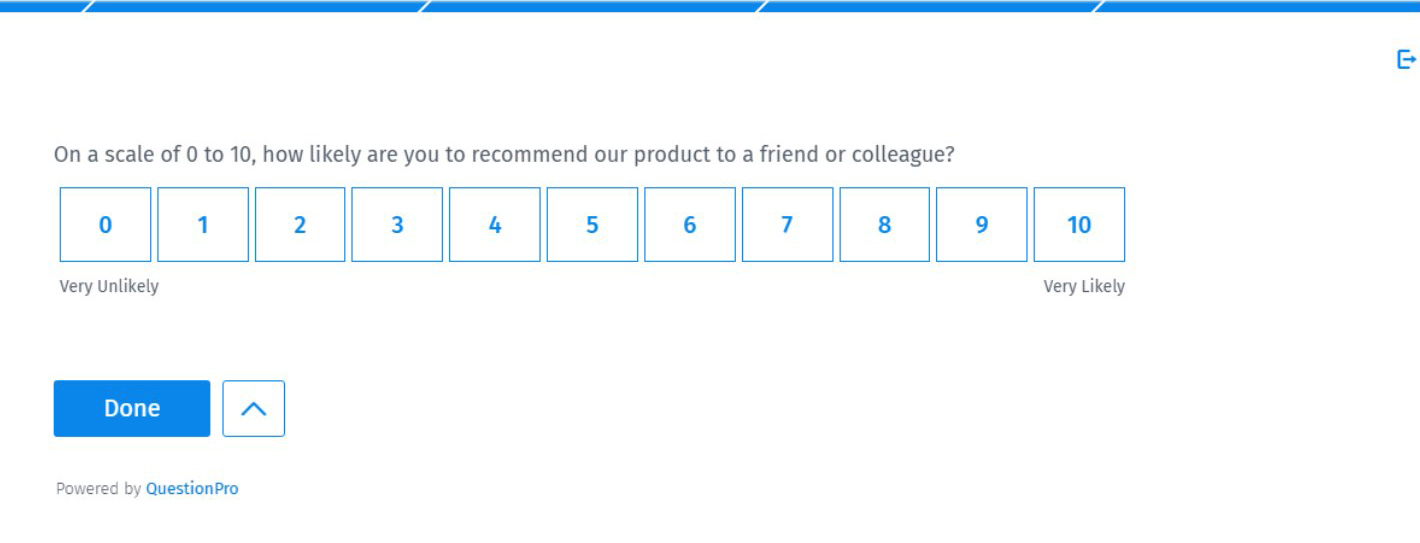
Responses fall into three segments:
- Promoters (score of 9 or 10): Loyal customers likely to keep buying and refer others
- Passives (score of 7 or 8): Satisfied but unenthusiastic customers who are open to switching
- Detractors (score of 0 to 6): Unhappy customers at risk of churn or negative word of mouth
The Net Promoter Score itself is the percentage of promoters minus the percentage of detractors, producing a result that ranges from -100 to 100.
Fred Reichheld introduced the metric with Bain & Company and Satmetrix in 2003. It remains one of Bain’s flagship frameworks today, detailed on the official Net Promoter System resource.
NPS survey question vs. NPS score vs. Net Promoter Score: What’s the difference?
These three terms get used interchangeably, but each describes a different piece of the same system.
| Term | What it is |
|---|---|
| NPS survey question | The single 0 to 10 question customers answer |
| NPS score | The calculated result: percentage of promoters minus percentage of detractors |
| Net Promoter Score (NPS) | The umbrella methodology, including the question, scoring, segmentation, and follow-up process |
The question produces raw responses. The score is the number you report. Net Promoter Score is the full system built around that number, including how you segment respondents and what you do next.
Types of NPS survey questions: Transactional, relationship, and eNPS
There are three primary types of NPS questions, and each fits a different moment in the customer relationship.
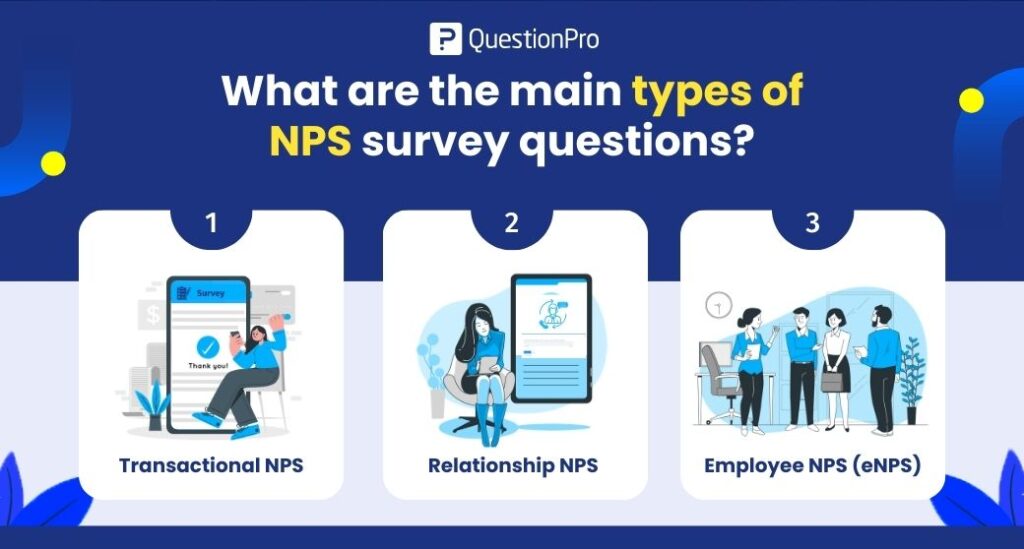
Transactional NPS
Transactional NPS measures sentiment right after a specific interaction, such as a support call, purchase, or onboarding step.
How likely are you to recommend us based on your recent support experience?
This type is tactical. If support wait times rise, transactional NPS surveys tend to reflect that within days.
Relationship NPS
Relationship NPS measures overall brand loyalty and is usually sent quarterly or annually rather than after a single interaction.
How likely are you to recommend our company to a friend or colleague?
US subscription businesses often rely on this version to track loyalty trends across renewal cycles.
Employee NPS (eNPS)
Employee Net Promoter Score (eNPS) measures internal loyalty by asking employees how likely they are to recommend the company as a place to work.
HR teams in competitive US labor markets often track eNPS alongside retention and engagement data rather than as a standalone number.
How to choose the right NPS question type for your goal
The right question type depends on the decision you are trying to make, not on what a competitor happens to use.
- If you want to catch operational problems fast, use transactional NPS right after the specific interaction.
- If you want to track long-term brand health, use relationship NPS on a fixed schedule.
- If you want to understand workforce sentiment, use eNPS on the same cadence as your engagement surveys.
- If your business has multiple products, run separate transactional NPS per product instead of one blended relationship score.
What is a good NPS score?
An NPS score ranges from -100 to 100, and there is no single “good” number that applies to every business. Context and industry matter more than the raw figure.
General interpretation:
| Score range | Interpretation |
|---|---|
| Below 0 | Needs improvement |
| 0 to 30 | Average |
| 30 to 50 | Good |
| 50 to 70 | Excellent |
| Above 70 | Exceptional and rare |
US benchmarks vary by sector. SaaS and technology companies often land between 30 and 50, while retail, financial services, and telecom typically sit lower because of heavier competition and easier switching. For current figures by sector, see NPS benchmarks by industry.
Tracking your trend over time matters more than comparing to a universal number. A score climbing from 15 to 25 over two quarters often reflects more real progress than a flat 35.
When should you send an NPS survey?
Timing affects data quality as much as wording does. Ask too early and customers have not formed a full opinion. Ask too late and the details fade.
Best moments to send:
- Right after a completed purchase
- Immediately following support resolution
- During renewal or contract cycles
- Inside a product or SaaS dashboard, post-activation
- By email, 7 to 14 days after delivery
In the US B2B environment, email still dominates NPS distribution. In SaaS and fintech, in-app prompts tend to get faster, higher-quality responses.
NPS survey question examples by use case
The core question rarely changes. What changes is the object of recommendation, and that object should match the exact experience you want feedback on.
A mid-size SaaS company, for example, might run relationship NPS quarterly for overall loyalty, then layer in a transactional NPS question right after onboarding to catch friction before it shows up in the bigger number. The wording below adapts to whichever moment you are measuring.
Product feedback
Use this when you want input on a specific product rather than the whole company.
How likely are you to recommend our payroll software to a colleague in your industry?
Service and support
Use this right after a customer interacts with your support team.
Based on your recent service experience, how likely are you to recommend our support team?
Post-purchase (retail and e-commerce)
US retailers typically trigger this 24 to 72 hours after delivery.
After completing your purchase, how likely are you to recommend our company?
B2B and professional services
Naming the professional context can increase relevance and response quality.
How likely are you to recommend our compliance platform to other finance professionals?
Healthcare
Wording needs to stay compliant and centered on the patient experience rather than clinical outcomes.
Based on your recent visit, how likely are you to recommend our clinic to friends or family?
SaaS and subscription
Trigger this after a user reaches a meaningful milestone, such as finishing onboarding or renewing a plan.
How likely are you to recommend [Product] to a colleague who does similar work?
Financial services
Trust and clarity matter more than enthusiasm in regulated financial products.
Based on your experience with our banking app, how likely are you to recommend it to a friend or family member?
Nonprofit and membership organizations
Recommendation intent here often signals willingness to volunteer or donate again, not just satisfaction.
How likely are you to recommend membership with us to someone who shares your interests?
Best NPS follow-up questions to ask after the rating
The rating gives you a number. The follow-up question explains the reason behind it, and the most useful approach tailors that follow-up to the respondent’s segment.
For promoters (score of 9 or 10)
- What do you value most about our product or service?
- What made you give us this score?
- Would you be open to sharing a review or testimonial?
For passives (score of 7 or 8)
- What would make you more likely to recommend us?
- What is one thing we could improve?
- What almost made you give a higher score?
For detractors (score of 0 to 6)
- What was missing or disappointing in your experience?
- How can we make this right?
- Would you be open to discussing this further?
In US service industries especially, a fast follow-up with detractors can prevent a negative public review before it gets posted.
How to calculate and analyze your NPS score step by step
NPS measures behavioral intent rather than satisfaction. Asking someone if they would recommend you, rather than if they are simply satisfied, correlates more strongly with retention and revenue growth.
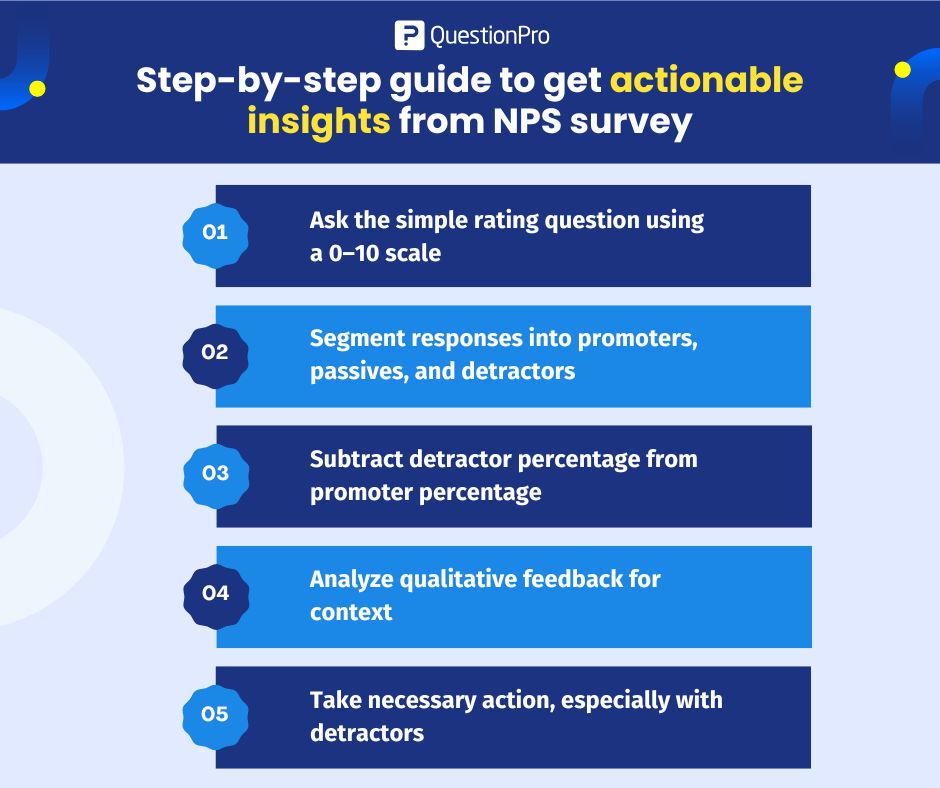
- Ask the standard 0 to 10 question.
Keep the wording and scale identical every time you send it so results stay comparable. - Segment responses.
Group every response into promoters, passives, or detractors based on the score. - Calculate the score.
Subtract the percentage of detractors from the percentage of promoters. - Read the qualitative feedback.
The open-ended follow-up explains what is driving the number. - Act on the result.
Close the loop with detractors, ask promoters for advocacy, and address the friction passives report.
A free NPS calculator can handle the math once you have your response counts.
NPS vs. CSAT vs. CES: What’s the difference?
NPS measures loyalty and recommendation intent. CSAT (Customer Satisfaction Score) and CES (Customer Effort Score) measure different moments and should not be used as substitutes for NPS.
| Metric | Measures | Typical scale | Best used for |
|---|---|---|---|
| NPS | Loyalty and likelihood to recommend | 0 to 10 | Long-term brand perception and growth potential |
| CSAT | Satisfaction with one interaction | 1 to 5 or 1 to 7 | Support, purchase, or service events |
| CES | Ease of completing a task | 1 to 5 or 1 to 7 | Friction in onboarding or support |
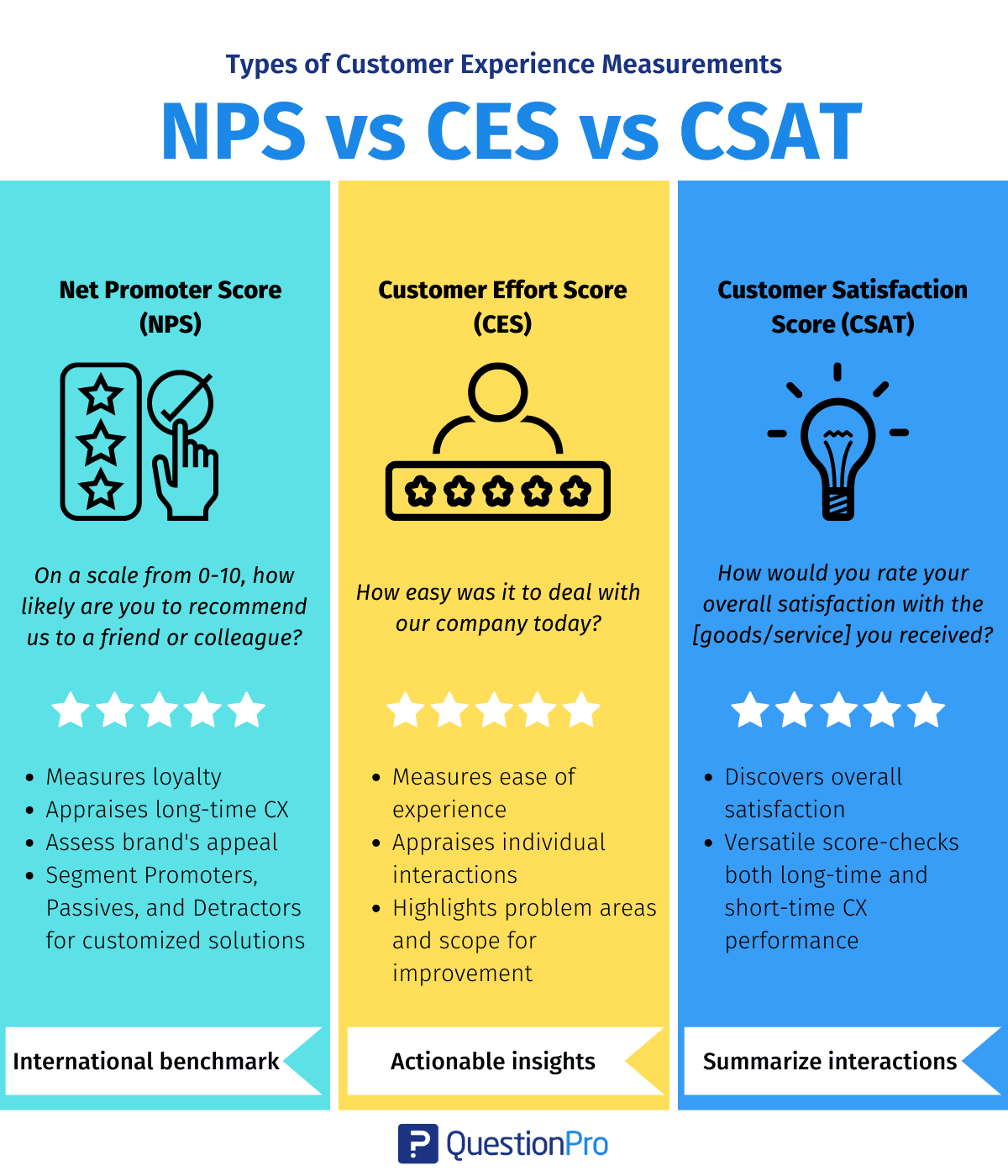
Many companies run all three side by side. NPS tracks the long-term trend, CSAT flags satisfaction gaps at specific touchpoints, and Customer Effort Score (CES) surfaces where a process is harder than it should be.
Common NPS survey question mistakes to avoid
Most scoring problems come from survey design, not from customers.
- Adding marketing language.
Words like “amazing” or “world-class” bias how people respond. - Combining satisfaction and recommendation in one question.
This confuses respondents and weakens the data. - Changing the scale.
The standard 0 to 10 format is what makes benchmarking possible. A 1 to 5 scale breaks that comparison. - Over-surveying customers.
Sending NPS too often causes survey fatigue and lower-quality responses. - Ignoring the written comments.
The score without context tells you what happened, not why. - Resurveying the same customer too soon.
Sending a relationship NPS survey a month after the last one rarely captures a meaningful change in sentiment.
Consistency in wording, scale, and timing is what turns NPS into a reliable long-term indicator rather than a number that jumps around for no clear reason.
How QuestionPro supports NPS survey questions
Running an NPS program well requires structure more than volume. The QuestionPro Customer Experience platform handles the parts that are easy to get wrong manually.
- AI-assisted question building that keeps the 0 to 10 scale and neutral wording intact
- Automatic promoter, passive, and detractor segmentation
- Follow-up questions triggered by the respondent’s score
- Real-time dashboards that surface recurring themes in written feedback
The value is consistency. When the question, scale, and follow-up logic stay the same survey after survey, the resulting trend line becomes something you can actually act on.
Why the NPS survey question still earns its place
Newer analytics tools have not replaced NPS, because the question still measures something specific: whether a customer will risk their own reputation to recommend you. That signal connects directly to word of mouth, and word of mouth still drives a large share of US purchase decisions.
The question works best paired with other signals rather than used alone. Combined with CSAT, CES, or journey-level tracking, it moves from a single number to a pattern you can act on quarter after quarter.
Frequently Asked Questions (FAQs)
Yes. Net Promoter Score, NPS, and the Net Promoter System are trademarks associated with Bain & Company, Fred Reichheld, and NICE Systems. Businesses can use the methodology freely, but marketing materials referencing “NPS” as a formal term should follow standard trademark attribution practices.
It depends on the goal. Anonymous surveys tend to get more honest scores from detractors, while named responses let support teams follow up directly on negative feedback. Many US companies make the name field optional instead of required.
There is no fixed minimum, but consistency matters more than volume. A stable base of 50 to 100 responses per period, collected the same way each time, is usually enough for a small business to spot a meaningful trend.
Yes, through a basic email or form tool, but you will calculate segments and scores manually. Dedicated survey software automates segmentation, follow-up logic, and trend tracking, which becomes worthwhile once NPS runs on a recurring basis.
NPS surveys, because they ask a single question, generally see higher completion rates than multi-question satisfaction surveys. Email-based NPS campaigns in the US often land in the single digits, while in-app prompts typically perform better.