Customer journey benefits are the improvements a business gains when it understands how customers move from first awareness to purchase, retention, and advocacy. A customer journey map helps teams see the customer’s path, touchpoints, emotions, pain points, and service gaps in one place.
For businesses in the USA, this matters because customers often move across many channels before making a decision. A person may find a brand on Google, compare reviews, visit a website, speak with sales, receive emails, and contact support. And then decide whether to buy again. If those moments feel disconnected, the customer journey suffers.
What is a customer journey?
A customer journey is the full path a customer follows when discovering, considering, buying, using, and staying connected with a product, service, or brand. It includes every direct and indirect interaction a customer has with the business.
A customer journey can include:
- Social media posts
- Search results
- Ads
- Website visits
- Product pages
- Sales calls
- Emails
- Live chat
- Phone support
- Product onboarding
- Billing
- Surveys
- Reviews
- Loyalty programs
For example, a customer may first hear about a company from a LinkedIn post, visit the website, compare pricing, book a demo, talk to sales, buy the product, contact support, answer a survey, and later renew. That entire path is the customer journey.
What are customer journey benefits?
Customer journey benefits are the practical gains companies get from understanding the full customer path. These benefits include better customer experience, clearer team alignment, stronger content strategy, fewer service gaps, improved retention, and smoother customer interactions.
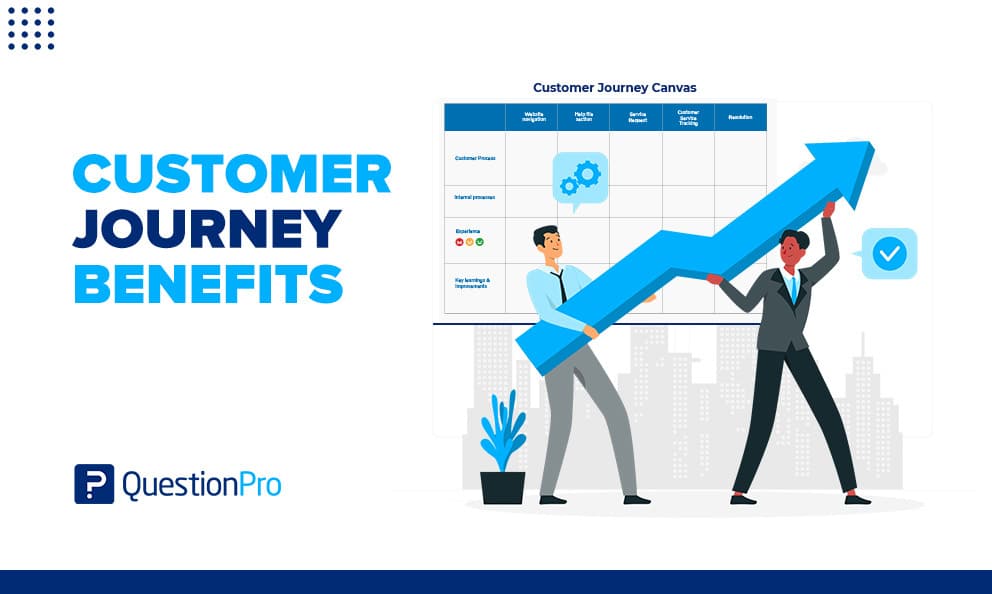
A customer journey map is a visual representation of the steps customers take when interacting with a business. It usually includes customer actions, emotions, questions, pain points, touchpoints, and business opportunities.
Nielsen Norman Group explains that journey maps combine storytelling and visualization to help teams understand and address customer needs.
The biggest value is simple: teams stop guessing what customers experience and start seeing the journey from the customer’s point of view.
What are the main customer journey stages?
Customer journey stages are the phases customers move through as they build a relationship with a business. The most common stages are awareness, consideration, purchase, retention, and advocacy.
- Awareness
Awareness is when a customer first discovers a brand, product, or service. This may happen through search, social media, ads, word of mouth, events, or content.
- Consideration
Consideration is when customers compare options and decide whether the offer fits their needs. They may read reviews, visit pricing pages, ask for recommendations, or compare competitors.
- Purchase
Purchase is when the customer decides to buy. This stage includes checkout, contracts, payment, delivery, onboarding, or any handoff needed to start using the product or service.
- Retention
Retention is when the business works to keep the customer satisfied after purchase. This includes product use, support, communication, renewals, and ongoing value.
- Advocacy
Advocacy happens when satisfied customers recommend the brand, leave positive reviews, refer others, or share their experience publicly.
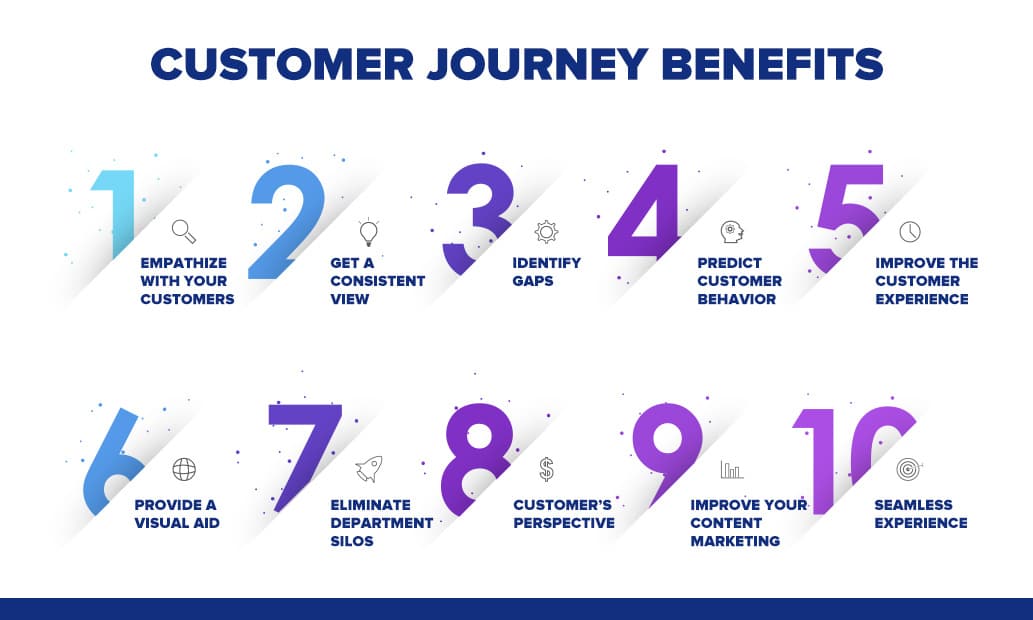
What are the top customer journey mapping benefits?
The top customer journey mapping benefits come from making the customer experience visible. A map helps teams understand what customers do, what they feel, where they struggle, and what the business should improve.
1. Empathize with your customers
Journey mapping helps teams understand what customers think, feel, and need at each stage. This makes it easier to see where customers feel confident, confused, ignored, or frustrated.
Empathy matters because business teams often see the process from inside the company. Customers see it from the outside. A journey map helps close that gap.
2. Create a consistent view of the customer journey
A customer journey map gives teams one shared view of the experience. Marketing, sales, support, product, and leadership can look at the same journey instead of working from separate assumptions.
This shared view makes customer journey strategy easier because everyone can see how their work affects the full experience.
3. Identify gaps in service and communication
Journey maps make service gaps and communication gaps easier to find. A gap may happen when customers do not receive updates, cannot find help, get conflicting information, or move between teams without context.
For example, sales may promise one onboarding timeline while support handles a different reality. Mapping the journey helps teams spot those disconnects.
4. Predict customer behavior more clearly
Customer journey mapping helps teams understand what customers are likely to do next. If many customers abandon a form, skip onboarding, or contact support after a specific email, the map can show where behavior changes.
This does not mean teams can predict every action. It means they can identify common patterns and prepare better responses.
5. Improve the customer experience journey
A customer journey map helps teams improve the customer experience by showing where friction occurs. Friction can include long wait times, confusing website pages, weak onboarding, unclear pricing, or repeated support requests.
Once teams identify these issues, they can redesign processes, clarify communication, and remove unnecessary steps.
6. Give stakeholders a visual view of the journey
Journey maps are useful because they make customer experience easier to explain. Instead of giving stakeholders a long report, teams can show the journey visually.
This helps leaders quickly see:
- Where customers interact with the brand
- Where pain points appear
- Which teams are involved
- Where customers drop off
- Which improvements should come first
A visual map is easier to discuss, share, and update.
7. Reduce department silos
Department silos happen when teams work separately and do not share enough customer context. A customer journey map helps break this pattern because it shows how marketing, sales, product, support, and operations affect one experience.
For example, a marketing message can create expectations that sales must explain, product must deliver, and support must defend. Mapping helps teams see those connections.
8. Understand the customer’s perspective
One of the most important customer journey benefits is seeing the experience as customers see it. This helps teams find friction that internal dashboards may miss.
Customers do not care which department owns a problem. They care whether the experience feels easy, clear, and useful. Journey mapping keeps that reality visible.
9. Improve your content marketing strategy
A customer journey map helps teams create content that matches customer needs at each stage. Awareness content should educate. Consideration content should compare options. Purchase content should reduce uncertainty. Retention content should support long-term use.
Useful content may include:
- Blog posts
- Comparison guides
- Case studies
- Demo pages
- Help articles
- Onboarding emails
- FAQs
- Customer stories
Content works better when it answers real questions at the right moment.
10. Create a more seamless experience
A seamless customer experience means customers can move from one stage or channel to another without unnecessary friction. The goal is not to make every touchpoint perfect. The goal is to make the full journey feel connected and easy to follow.
Journey mapping helps teams remove repeated steps, conflicting messages, unclear handoffs, and avoidable delays.
How do you get the most value from a customer journey strategy?
A customer journey strategy works best when teams use the map as a working tool, not a one-time workshop output. The map should guide priorities, reveal friction, and support ongoing customer experience improvement.
To get more value from journey mapping:
- Use real customer feedback.
- Include customer touchpoints across channels.
- Involve marketing, sales, product, support, and operations.
- Identify pain points by stage.
- Prioritize the highest-impact fixes.
- Track metrics such as NPS, CSAT, CES, churn, retention, and conversion.
- Update the map when products, channels, or customer behavior changes.
- Use a customer journey dashboard to monitor progress.
A journey map is only useful if teams act on what it shows.
How can QuestionPro Customer Experience help with customer journey benefits?
QuestionPro Customer Experience can help teams collect feedback across customer touchpoints, identify journey gaps, and understand where customers face friction. This helps businesses move from a static customer journey map to ongoing customer journey improvement.
QuestionPro Customer Experience can help teams:
- Create and send customer feedback surveys.
- Measure NPS, CSAT, and CES.
- Track feedback by touchpoint, channel, or segment.
- Analyze customer comments and sentiment.
- Identify service and communication gaps.
- Build customer journey dashboards.
- Set workflows for closed-loop follow-up.
- Monitor customer retention and advocacy signals.
This helps CX, marketing, sales, support, and product teams act on customer journey insights instead of leaving the map as a one-time exercise.
Final takeaway
Customer journey benefits are not limited to better diagrams or prettier workshops. The real value comes from helping teams see the customer’s path clearly, understand where friction happens, and decide what to fix first.
A strong customer journey map helps teams empathize with customers, identify gaps, reduce silos, improve content, predict behavior, and create a smoother experience. When teams keep the map connected to feedback and metrics, it becomes a practical tool for customer experience improvement.
Frequently Asked Questions (FAQs)
Customer journey benefits are the improvements a business gains from understanding how customers move across stages, touchpoints, and channels. These benefits include better customer experience, fewer service gaps, stronger alignment, clearer content strategy, and improved retention.
A customer journey map is useful because it shows the customer’s path from awareness to advocacy. It helps teams see touchpoints, pain points, emotions, service gaps, and opportunities to improve the customer experience.
The main customer journey stages are awareness, consideration, purchase, retention, and advocacy. Some businesses also add onboarding, support, renewal, or loyalty stages depending on the customer relationship.
Journey mapping improves customer experience by showing where customers struggle, where communication breaks down, and where teams need to act. It helps businesses fix friction points across sales, marketing, product, support, and service.
Customer journey maps are useful for CX, marketing, sales, support, product, customer success, and leadership teams. Any team that affects customer touchpoints can use the map to understand and improve the customer journey.