The awareness stage is the first step of the buyer’s journey, when a person notices a problem and starts searching for answers. They do not know your brand yet. They may not even know the right words for what they need.
That makes this stage easy to ignore and costly to skip. Buyers shape their shortlists long before they talk to sales, so the brands they meet first often win the later comparison.
In this blog, we’ll define the awareness stage, compare it with similar terms, and walk through strategies, content types, examples, and metrics.
What is the awareness stage?
The awareness stage is the phase of the buyer’s journey in which a potential customer realizes they have a problem or opportunity and begins researching it. The buyer wants information, not a product.
In the buyer’s journey, this stage comes before consideration and decision. It starts with symptoms, such as:
- Missed targets or flat growth
- Rising customer complaints
- A tool that no longer does the job
The buyer then tries to name the problem and learn how others handle it.
Your job here is simple. Be the clear, trustworthy answer when they search. Mentioning your product is optional at this point.
Why does the awareness stage matter?
The awareness stage matters because most of a buying decision forms before the buyer ever speaks to a seller. Recent research shows how early that happens in business-to-business (B2B) purchases.
- Buyers spend only 17% of their purchase time meeting with suppliers. The rest goes to independent research and internal discussion.
- In 6sense’s 2025 B2B Buyer Experience Study, buyers first contacted sellers about 61% of the way through their process.
- The same study reports that 94% of buyers ranked their shortlisted vendors by preference before contacting any of them.
The takeaway is plain. If buyers do not meet you during research, you start the comparison from behind. Considered consumer purchases, such as a car or a mortgage, follow a similar pattern.
How is the awareness stage different from similar terms?
The awareness stage is often confused with brand awareness, customer awareness levels, and top of funnel. Each term describes something different, and mixing them leads to muddled plans.
Customer awareness, for example, ranks how much a buyer knows about their problem and your solution. Our guide to the five levels of customer awareness covers that model in detail.
| Term | What it describes | Whose view | Example |
|---|---|---|---|
| Awareness stage | The point where a buyer recognizes a problem and starts researching | Buyer | Searching “why are survey response rates dropping” |
| Customer awareness levels | Five levels that rank how much a buyer knows about the problem and your solution | Buyer | Knows the solution category but not your brand |
| Brand awareness | How familiar a market is with your brand name | Market | Share of target buyers who can name you |
| Top of funnel | The marketing team’s label for activities that attract new audiences | Company | A blog post or a paid social ad |
| Customer journey | Five stages: awareness, consideration, decision, retention, and advocacy | Customer | A buyer who becomes a repeat customer |
A buyer can be in the awareness stage while your brand awareness is high or low. They are separate dials. The buyer’s journey covers only the first three stages, while the customer journey continues after the purchase.
What do buyers do and ask in the awareness stage?
In the awareness stage, buyers search for symptoms and explanations, not vendors. They ask broad questions, scan several sources, and compare very little.
Their questions usually fall into three groups:
- Symptom questions: “Why is employee turnover rising?” or “Why is my website traffic flat?”
- Definition questions: “What is customer effort score?”
- Approach questions: “How do companies reduce churn?”
Notice that none of these queries names a product. That is your opening. Write for the question, in the buyer’s own words, and answer it plainly. Many buyers also ask AI assistants first, so write answers that an assistant could quote correctly.
How does the awareness stage differ for B2B and B2C buyers?
B2B buyers research as a group over weeks or months, while most business-to-consumer (B2C) buyers decide alone and faster. The stage still starts with a problem in both cases, but the path looks different.
- B2B: Several people research on their own, so each one needs content that speaks to their role. A finance lead and an operations lead ask different early questions about the same project. Long guides, webinars, and LinkedIn posts tend to fit.
- B2C: One person usually decides, often within minutes for small purchases. Short video, social posts, creator reviews, and search listings carry more weight.
For higher-priced items, the stage stretches out and starts to look like the B2B pattern.
What are the best awareness stage strategies?
The best awareness stage strategies put useful answers where buyers already look. Most teams combine three or four of the tactics below instead of trying everything at once.
Owned channels: Content, search, and email
Owned channels are the ones you control. They build value over time, which makes them the base of most awareness plans.
- Content marketing: Publish educational posts, guides, and videos that answer the buyer’s early questions.
- SEO (search engine optimization) and AI search visibility: Structure pages with clear headings and direct answers so search engines and AI assistants can find and quote them.
- Email newsletters: Give new subscribers a steady, useful reason to remember you.
Start here if your budget is small and your timeline is long.
Social media, influencers, and community
Social platforms put your ideas in front of people who never searched for you. Short posts, clips, and carousels work well when each one teaches a single small thing. Influencer marketing borrows an existing audience’s trust, so pick creators whose followers match your buyer persona rather than chasing the biggest follower count. Communities, such as industry forums and professional groups, reward members who help without selling. Answer questions there for a few weeks before you mention your own work.
Paid ads and public relations
- Paid search and social ads: Buy reach quickly and target by interest, location, or job title.
- Display and video ads: Build recognition through repeated exposure to the same message.
- Public relations: Earn coverage through press releases, expert commentary, and media relationships.
- Traditional media: TV, radio, and print still reach broad consumer audiences.
Events and referrals
Face-to-face and word-of-mouth tactics build trust in a way that ads cannot.
- Trade shows and events: Attend or host industry events, and take part in local community programs.
- Referral marketing: Invite happy customers to recommend you, and make sharing easy with a simple link or reward.
Both work best when your current customers are already satisfied.
Which content types work best in the awareness stage?
The best awareness stage content teaches first and sells later. It answers a real question in a format the buyer can finish in one sitting.
| Content type | Why it works in the awareness stage | Example title (illustrative) |
|---|---|---|
| Blog posts | Capture search traffic for early questions and build a crawlable brand asset | Why do survey response rates drop? 7 common causes |
| Infographics | Summarize a process or data set in one shareable image | The buyer’s journey at a glance |
| Videos | Explain a concept visually, and short clips fit social feeds | What is churn? A 90-second answer |
| Podcasts | Reach listeners during commutes and build a recognizable voice | Interview with a customer experience leader |
| E-books and whitepapers | Offer depth for readers who want to learn more, with e-books shorter and more actionable | A beginner’s guide to customer feedback |
| Checklists and templates | Give an instant, practical win | Customer journey map template |
| Social posts | Teach one idea in a few lines and point to longer content | Three signs your onboarding is leaking users |
| Newsletters | Keep new subscribers learning on a regular schedule | The monthly feedback digest |
| Webinars | Teach live, answer questions, and leave a recording behind | How to read your first customer survey results |
| Original research and polls | Create fresh data that others cite and share | State of customer expectations survey |
What are examples of awareness stage content in action?
Concrete scenarios show how the same stage looks across different businesses. The three examples below are illustrative, not case studies.
- B2B software company.
A team that sells HR analytics publishes a guide titled “Why is employee turnover rising?” It includes a short self-assessment, a LinkedIn carousel version, and a 10-minute webinar. None of it pitches the product. - Local dental clinic.
A clinic in a US suburb posts short videos on “Why do my teeth hurt in cold weather?” and keeps its Google Business Profile current. Neighbors find helpful answers first, then the clinic. - Direct-to-consumer brand.
An eco-friendly bottle brand posts a short video on easy ways to cut single-use plastic at home. Viewers meet the brand while thinking about the problem, not the product.
How do you choose the right awareness stage tactics?
Choose tactics by matching your buyer, budget, and timeline, not by copying competitors. Start with the channels where your buyer already asks questions.
- Small budget and a long runway: Begin with SEO content and email. They cost little and keep working after you publish.
- Need reach within weeks: Use paid search and social ads. They buy visibility fast, but results stop when spending stops.
- Niche B2B audience: Pair webinars, LinkedIn posts, and industry events. They reach decision makers in their own role.
- Local or service business: Focus on your Google Business Profile, referrals, and short video. They meet nearby buyers who search for help.
- Complex or technical topic: Publish guides, whitepapers, and original research. Depth builds credibility.
Test two tactics for 90 days before you add a third.
How do you build an awareness stage plan step by step?
A good awareness plan fits on one page. Follow these steps to go from a blank page to a measurable plan.
- Define your buyer persona.
Use surveys and interviews to learn their role, goals, and early questions. Our guide to creating an ideal customer persona shows how. - List the problem in the buyer’s words.
Collect 20 to 30 real questions from sales calls, support tickets, and search suggestions. - Pick two or three channels.
Match them to where your buyer already looks. - Create one pillar asset.
Write or record an in-depth answer to the biggest question, such as a guide or video. - Cut it into smaller pieces.
Turn the pillar into posts, clips, an infographic, and newsletter issues. - Add a soft next step.
Offer a related guide, not a sales call. - Set a baseline and review monthly.
Record starting numbers for reach, traffic, and branded search, then check them every month.
How do you measure the awareness stage?
Measure the awareness stage by tracking reach, attention, and recall together, because no single number tells the whole story. Pair behavior data from analytics with a brand awareness survey built in online survey software.
| Metric | What it tells you | How to collect it |
|---|---|---|
| Reach and impressions | How many people saw your content | Ad platforms, social analytics |
| Organic traffic to top-of-funnel pages | Whether search demand finds you | Web analytics, search console |
| Branded search volume | Whether more people look for you by name | Search console, keyword tools |
| Engagement rate | Whether content holds attention | Social and email analytics |
| New email subscribers | Whether readers want more | Email platform |
| Unaided awareness | Share of your market that names you without a prompt | Survey |
| Aided awareness | Share that recognizes you from a list | Survey |
| Self-reported source | Where new leads say they first heard of you | “How did you hear about us?” field |
Track each metric monthly and judge trends over two or three quarters. One strong month proves little. Survey the same audience segments each quarter so results stay comparable.
Which survey questions measure awareness?
- Unaided recall: “When you think of [category], which brands come to mind?” Use an open text box.
- Aided recognition: “Which of these brands have you heard of?” List your brand and four to six competitors.
- First touch: “Where did you first hear about us?” Offer a single choice list with an “other” option.
- Familiarity: “How familiar are you with [brand]?” Use a five-point scale.
What mistakes should you avoid in the awareness stage?
The most common awareness stage mistakes come from treating early buyers like late-stage buyers. Fixing them usually costs little.
- Pitching too soon.
Early buyers want to understand the problem. A product pitch in the first paragraph sends them back to search. - Writing in your own jargon.
Buyers search in plain words, so use their phrasing in titles and headings. - Relying on one channel.
A single platform change can wipe out your reach. Spread your effort across at least two channels. - Judging success by clicks alone.
Clicks do not show recall. Add a survey question or branded search tracking. - Skipping the handoff.
Content with no related next step leaves interested readers stranded. - Assuming the path is a straight line.
Buyers loop back and jump ahead, so keep content live for every stage.
How does the awareness stage lead into the consideration stage?
A buyer leaves the awareness stage once they can name the problem and start comparing ways to solve it. That shift is the consideration stage, where they weigh options and vendors.
You can often see the change in behavior. Visitors return several times, read comparison pages, or subscribe to your newsletter. Their questions also change from “why is this happening?” to “which approach should we choose?”
Meet that shift with comparison guides, case studies, and demos. Short surveys at each stage help you spot where interest stalls, and marketing funnel surveys show how to ask the right question at every step. Remember that buyers do not always move forward in order. A new stakeholder can restart research late in a deal, so keep awareness content live.
How can QuestionPro help you find awareness stage gaps?
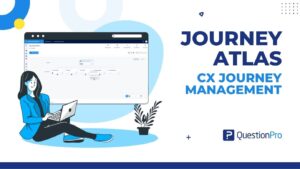
QuestionPro Customer Experience helps you see how buyers feel at the awareness stage by placing insight directly on a journey map. That makes early friction visible to every team, not only marketing.
QuestionPro Customer Experience includes journey management tools that let you map the awareness stage next to later stages. Journey Layers add context on top of the base map, such as customer emotions and friction at each stage or touchpoint, which is any moment a buyer meets your brand.
- Map awareness touchpoints, such as search, social, and events, as the first stage of the journey.
- Add an emotions layer to see whether first impressions feel clear or confusing.
- Add a friction layer to flag touchpoints where buyers drop out early.
With those layers in place, the awareness stage becomes something your team can improve, not just describe.
Why the awareness stage rewards helpful brands
The awareness stage rewards brands that help before they sell. Buyers rarely remember an ad, but they remember the page that finally explained their problem clearly. Treat every awareness asset as a first conversation with someone who may not buy for months. Do it well, and you join the shortlist before the comparison begins.
Before you publish your next asset, ask yourself:
- Does it answer a real question in the buyer’s own words?
- Would a stranger understand it without knowing who we are?
- Does it offer one useful next step?
Frequently Asked Questions (FAQs)
Usually not. Early buyers do not know you well enough to trade an email address for a download. Keep guides, videos, and posts open, and gate only deeper assets, such as original research or templates, once readers return.
Yes, in some cases. Returning customers, referrals, and people who already know the category may enter at consideration or decision. Even then, a new stakeholder or a changed need can send the buying group back to awareness research.
A growing number of buyers ask AI assistants their first questions and read a short, combined answer. Write pages with a direct answer under each heading, clear definitions, and cited facts, so assistants can quote your content accurately.
Yes, and it can stay simple. A US small business can claim and update its Google Business Profile, answer local questions in short posts or videos, and ask happy customers for reviews and referrals.
State laws such as the California Consumer Privacy Act give residents rights to know about and opt out of certain data sharing. Use clear cookie notices, honor opt-outs, and lean on first-party signals like surveys and email sign-ups.