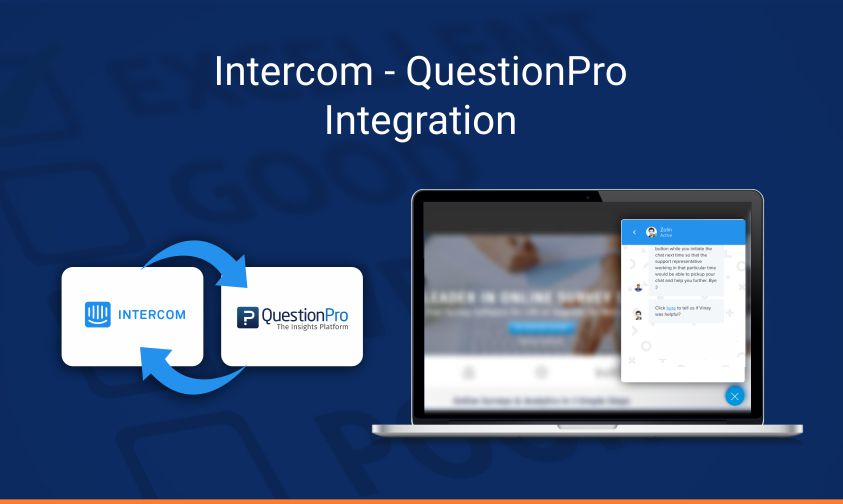
Live chat tools like Intercom make it easy to have real conversations with customers, but they do not automatically tell you how those conversations landed. An NPS Intercom integration closes that gap by sending a quick loyalty question the moment a chat ends.
Without it, most support teams fall back on manual review to judge agent performance, reading through transcripts one at a time to guess at quality. That approach does not scale past a handful of conversations a day.
This article covers what an NPS Intercom integration does, how it works, and what it changes for teams trying to evaluate support quality at scale, as part of a broader customer experience program.
What is an NPS Intercom integration?
An NPS Intercom integration connects a Net Promoter Score survey question to the end of an Intercom chat session, so customers receive a quick loyalty or satisfaction prompt right after their conversation closes.
Net Promoter Score, in this context, typically appears as a single question: are you satisfied with the customer service you received on this chat, rated on a defined scale. The response feeds into a dashboard that tracks results across every agent and conversation, rather than sitting isolated inside a single chat transcript.
Why do support teams need this kind of integration?
Support teams need this kind of integration because manually assessing chat quality does not scale, and it introduces inconsistency between reviewers judging different conversations.
Before automated post-chat surveys became common, many teams relied on spot-checking transcripts to evaluate agent performance, which is time-consuming and easy to apply unevenly across a large support team. A structured, automated survey applied consistently after every chat removes that guesswork and gives every agent the same measurement standard.
How does the NPS and Intercom integration work?
The NPS and Intercom integration works by triggering a short survey link automatically once a support chat concludes, then routing the response into a centralized dashboard.
- A customer finishes a chat conversation with a support agent in Intercom.
- The integration sends a link to a short satisfaction question, such as “Are you satisfied with the customer service you received on this chat?”
- The customer rates their experience on the defined scale.
- The response updates a dashboard automatically, broken down by agent, team, or overall organization performance.
QuestionPro’s Net Promoter Score question type supports this workflow when connected to Intercom, giving support leaders a single place to see performance trends instead of piecing them together manually.
What can a support performance dashboard show?
A support performance dashboard built on this integration can show individual agent scores, team-level trends, and organization-wide sentiment, all updating in near real time as new responses come in.
Useful views typically include:
- Performance by individual support agent, useful for coaching and recognition.
- Trends over time, visualized through CX dashboards, to spot whether a recent process change improved or hurt satisfaction.
- Segment-level breakdowns, such as by customer type or issue category, to find where quality gaps concentrate.
What are the benefits of connecting NPS to Intercom?
Connecting NPS to Intercom gives support organizations a consistent, scalable way to measure quality without adding manual review work for managers.
- Single source of truth.
One dashboard reflects real-time performance across the whole support team, rather than scattered manual notes.
- Faster coaching.
Managers can identify which agents need support sooner, instead of waiting for a quarterly review cycle.
- Recognition made easier.
Consistently high-performing agents become visible in the data, not just anecdotally known.
- Team-wide accountability.
Every agent is measured against the same standard, which reduces disputes about subjective evaluation.
How should you set up NPS tracking for live chat?
Setting up NPS tracking for live chat starts with defining exactly what question you want answered, since a generic satisfaction question and a specific post-resolution question measure slightly different things.
A few setup decisions matter most:
- Choose a rating scale that matches how granular you want agent-level comparisons to be.
- Decide whether the survey should be fully anonymous or tied to the customer’s account for follow-up.
- Set a reasonable delay before the survey link sends, so it arrives while the interaction is still fresh in the customer’s mind.
Common mistakes when measuring post-chat satisfaction
A few habits reduce how useful post-chat NPS data ends up being.
- Sending the survey too long after the chat ends, when the interaction is no longer fresh in the customer’s memory.
- Treating a single low score as conclusive without checking the transcript for context.
- Comparing agents handling very different issue types without accounting for complexity differences.
- Never sharing results with agents directly, which removes the coaching value of the data drawn from closed-loop feedback practices.
Turning every chat into a measurable data point
A live chat integration like this turns a stream of individual conversations into a measurable, trackable performance metric.
Instead of guessing which agents are excelling and which need support, a team gets a consistent answer updated in real time, without adding manual review work to anyone’s plate.
Frequently Asked Questions (FAQs)
No, when set up correctly. The survey link typically sends automatically after the chat closes, so it does not interrupt the live conversation itself, and completing it takes the customer only a few seconds.
The same underlying approach, triggering a satisfaction question after a support interaction, works with most live chat and helpdesk platforms that support outbound survey links or API-based triggers, not just Intercom specifically.
There is no fixed threshold, but most teams wait for at least 20 to 30 responses per agent before drawing firm conclusions, a sample size consistent with general guidance on review reliability from G2, since a handful of ratings can be skewed by one unusually difficult conversation.
Not automatically for every low score, but patterns matter. A single low score from one difficult customer is normal, while a consistent pattern of low scores for one agent or issue type is worth a closer manager review.
Response handling depends on how the survey is configured. Teams should decide upfront whether responses stay anonymous or link back to the customer record, and communicate that choice clearly if it affects how feedback gets used.