Customer intelligence is the practice of collecting customer data from every touchpoint and turning it into decisions about how to serve each customer. Done well, it shows you who is about to leave, who is ready to buy more, and why. Done poorly, it becomes a dashboard nobody opens.
Most teams already hold the raw material. Purchase records sit in one system, support tickets in another, and survey scores in a third. The gap is a connected view of that data and a habit of acting on it.
In this guide, we’ll cover the definition, the five data types, a working strategy, measurement, examples, and how to choose software.
What is customer intelligence?
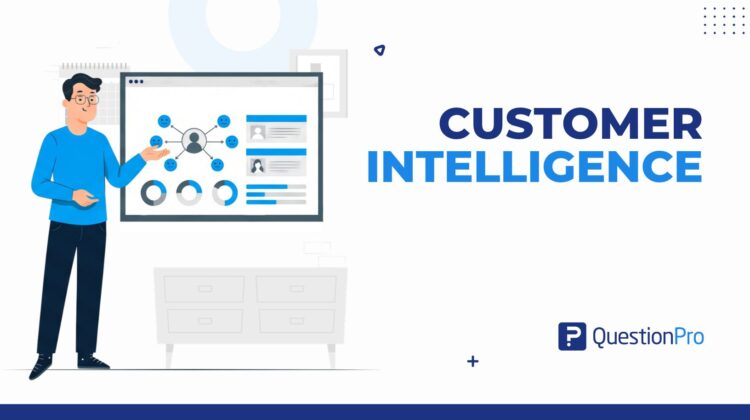
Customer intelligence is the ongoing process of collecting, connecting, and analyzing customer data to understand behavior and guide decisions about each customer. It combines what customers do, what they say, and who they are into one usable picture.
The word “ongoing” matters. A one-off survey produces a finding. Customer intelligence is the system that keeps producing findings, routes them to the right team, and checks whether acting on them worked.
Three parts make up that system:
- Data: Transactions, web activity, support logs, and surveys.
- Analysis: Raw records become segments, scores, and patterns.
- Action: Marketing, sales, product, and service teams change what they do.
Without the third part, you have reporting, not intelligence.
Customer intelligence vs customer insights, analytics, and business intelligence
Customer intelligence is the broadest of the four terms that people often swap. It is the system, while the other three are outputs, methods, or a different subject entirely.
| Term | What it is | Question it answers | Usual owner |
|---|---|---|---|
| Customer intelligence | An ongoing system that unifies customer data and turns it into action | What should we do for each customer next? | Cross-functional teams |
| Customer insights | One specific, non-obvious finding about customer behavior or motivation | Why did customers act this way? | Researchers and analysts |
| Customer analytics | The statistical methods and models applied to customer data | What happened, and what is likely to happen? | Data analysts |
| Business intelligence | Reporting on company operations such as sales, cost, and inventory | How is the business performing? | Finance and operations leaders |
An insight is an output. Customer intelligence is the machine that keeps producing outputs like it. If you want the single-finding side, read our guide to customer insights analysis. For the modeling side, see customer analytics.
Benefits of customer intelligence
Customer intelligence helps a business keep customers, grow their value, and stop guessing. The strongest case is personalization, because customers now expect it.
McKinsey found that 71% of consumers expect companies to deliver personalized interactions, and 76% get frustrated when this does not happen. The same research reports that faster-growing companies drive 40% more of their revenue from personalization than slower-growing peers.
Beyond personalization, teams see these gains:
- Lower churn: Usage drops, unresolved tickets, and low satisfaction scores flag at-risk accounts early. Our explainer on customer churn shows how to calculate and track it.
- Smarter marketing spend: You target segments that respond instead of blasting everyone.
- Better product decisions: Feedback themes tie directly to cancellations and feature requests.
- Stronger service: Agents see history and sentiment before they reply.
- Higher lifetime value: Timely, relevant offers raise repeat purchase and upgrade rates.
Types of customer intelligence
There are five main types of customer intelligence data: transactional, behavioral, psychographic, demographic, and attitudinal. Each answers a different question, and the strongest programs combine all five.
| Type | What it captures | Example | Common source |
|---|---|---|---|
| Transactional | What customers buy and how they pay | Order value, purchase frequency, discount use | Point of sale, billing, e-commerce platform |
| Behavioral | What customers do before and after buying | Pages viewed, features used, emails opened | Web and app analytics, product logs |
| Psychographic | Why customers choose, based on values and interests | Lifestyle, priorities, brand attitudes | Surveys, interviews, social listening |
| Demographic | Who customers are | Age, income, location, job title | CRM, registration forms, surveys |
| Attitudinal | How customers feel about you | Satisfaction, loyalty, pain points | Surveys, reviews, support conversations |
Where attitudinal data comes from
Attitudinal data is the type most teams under-collect, because no system records it automatically. You have to ask. These are the main sources:
- Rating surveys: Net Promoter Score (NPS) asks how likely someone is to recommend you on a 0 to 10 scale. Customer satisfaction score (CSAT) rates a single interaction. Customer effort score (CES) rates how hard a task felt.
- Open-ended questions: Free-text answers explain the “why” behind a score.
- Reviews and social comments: Public opinion you did not request.
- Interviews and focus groups: Deeper context for a small group.
- Customer communities: Ongoing discussion with members who opted in.
Why first-party data matters most
First-party data is information customers give you directly or generate on your own properties. You collect it with consent, so it is the most reliable and the easiest to keep compliant. Third-party data can fill gaps, but it is only as good as its source and its age.
Common first-party sources include:
- Purchase and billing history
- App and website activity
- Survey and poll responses
- Support chats and emails
Customer intelligence examples
These three scenarios are illustrative, not client results. They show how data from different sources combines into one decision.
Reducing churn at a subscription business
A software company wants to spot cancellations before they happen. It combines three signals into a risk score:
- Logins fell by half over 30 days.
- Two support tickets stayed unresolved for a week.
- The last NPS response was a detractor score of 4.
The risk score triggers a call from a customer success manager within 48 hours. The team then tags the reason for each save or loss, so the model improves.
Personalizing offers at a retailer
A retailer blends purchase history with a short preference survey. Transactional data shows what each shopper buys. The survey adds why, such as price sensitivity or interest in sustainable brands. Shoppers who value sustainability receive different product pages and emails than bargain hunters, even when their past purchases look alike.
Fixing a product problem at a software company
Cancellation surveys include one open-ended question: “What was the main reason you left?” Analysts group the answers into themes. One theme, a confusing onboarding flow, appears in a large share of lost accounts.
- The product team redesigns onboarding.
- Support publishes a setup guide.
- Success managers check whether new accounts finish setup in week one.
Step-by-step guide to building a customer intelligence strategy
A customer intelligence strategy starts with a business question and ends with a measured result. Follow these six steps in order, and keep the first version small.
- Set the questions and goals.
Pick one or two decisions to improve, such as reducing churn in year one. Write the goal as a number with a deadline.
- Inventory your data sources.
List every system holding customer data, who owns it, and how fresh it is.
- Build a single customer view.
Match records across systems with a shared identifier, such as an email address or account ID, and remove duplicates.
- Fill the attitudinal gap.
Add surveys, open-ended questions, or a community where behavior alone cannot explain a trend.
- Analyze and segment.
Group customers by value, risk, or need, and test which segments respond to different actions. Start with descriptive reporting (what happened), then add predictive models (what will happen) once data quality allows.
- Act, then close the loop.
Send each insight to a named owner, set a response time, and record the outcome.
How customer journey mapping adds customer intelligence
A customer journey map shows the stages a customer moves through and the feelings and friction at each one. It turns separate data points into a story, which makes gaps in your intelligence easy to see.
Place each data source on the map. Transactional data sits at purchase, behavioral data at research and onboarding, and attitudinal data at moments such as post-purchase and after a support call. Any stage with no data is a blind spot. Any stage with data but no owner is a wasted signal.
Dedicated customer journey mapping software helps by connecting feedback to each touchpoint. You can then see where satisfaction drops, rather than guessing from an average score.
How to measure customer intelligence
Measure customer intelligence by whether decisions improve, not by how much data you hold. Set a baseline for 90 days before launch, then compare customers who received an action against a similar group who did not.
Track these metrics:
- Customer churn rate: The share of customers lost in a period. Compare at-risk accounts you contacted against those you did not.
- NPS and CSAT: Movement after a fix shows whether customers noticed it.
- Customer lifetime value (CLV): The total revenue you expect from a customer over the relationship. Rising CLV in targeted segments signals better relevance.
- Insight-to-action time: The days between a warning signal and a team response. Aim for days, not quarters.
- Single-view coverage: The percentage of active customers with a unified profile. Low coverage means blind spots.
- Survey response rate: A falling rate warns of survey fatigue or poor timing.
How to choose customer intelligence software
No single tool covers every job, so choose by the gap you need to close. Most programs combine two or three categories.
| Tool category | Main job | What it holds | Typical gap |
|---|---|---|---|
| CRM | Manages contacts and sales activity | Account records, deal history | Little feedback or sentiment |
| Customer data platform (CDP) | Unifies data into one profile | Behavioral and transactional data | Weak on why customers feel as they do |
| Survey and voice of the customer platform | Collects and analyzes feedback | Attitudinal data | Needs other systems for behavior |
| Analytics and BI tools | Reports and models | Aggregated metrics | Depends on clean inputs |
| Social listening | Tracks public conversation | Reviews, mentions | Not tied to individual accounts |
Five questions to ask before buying
- Which decision will this tool improve, and who makes it?
- Does it connect to the systems we already use?
- Can it capture feedback at the moment it matters, not weeks later?
- Does it support consent and data deletion requests?
- Will the team that owns the decision actually open it?
Teams building the feedback layer often start with a survey platform such as QuestionPro Survey Software. If you are comparing wider options, our roundup of customer insight platforms covers pricing and features.
Building a customer panel with QuestionPro Communities
Most customer intelligence comes from observation, but you must ask for the most useful part. A research community gives you a standing group of customers who agree to answer, so you stop recruiting from scratch for every question.
QuestionPro Communities lets you recruit and manage members, target specific segments with surveys, and run discussions and polls in one portal. Members can earn rewards such as points, badges, cash, or donations, which supports steady participation. Dashboards and reports then show results, with methods such as weighting and gap analysis for deeper cuts.
The result is a first-party feedback source you own. Pair it with QuestionPro Customer Experience to trigger NPS and CSAT surveys after key moments, and match the answers to what the same customers did.
Common mistakes and privacy risks
The biggest risks are collecting without a purpose and acting without consent. Both waste money, and the second can create legal exposure.
- Starting with the tool, not the question.
Teams buy a platform, then hunt for a use.
- Leaving data in silos.
Each team sees one slice and reaches a different conclusion.
- Ignoring free-text feedback.
Comments hold the reasons that scores hide.
- Skipping consent.
Under the California Consumer Privacy Act, residents can ask what data a business holds, request its deletion, and opt out of its sale or sharing. Other US states have similar laws.
- Over-personalizing.
Using data customers never knowingly shared feels intrusive and costs trust.
- No owner for insights.
A finding with no named owner ends up in a slide deck.
Customer intelligence is a habit, not a project
You do not need a large data team to begin. Pick one decision, such as which customers are likely to leave, and connect the three or four data sources that bear on it. Ask customers directly where the numbers cannot explain the behavior.
Then repeat. Each cycle makes the profiles sharper, the segments cleaner, and the team faster at responding.
- This week: Name one decision and its owner.
- This month: Connect the sources behind it and run one survey.
- This quarter: Compare results against your baseline and expand.
The businesses that win with customer intelligence are rarely the ones with the most data. They are the ones that notice sooner and act sooner.
Frequently Asked Questions (FAQs)
A customer data platform is software that unifies customer records into profiles. Customer intelligence is the wider practice that uses those profiles, plus surveys and analysis, to decide what to do. A platform supplies the data, while intelligence supplies the decisions.
Less than most teams assume. One clear question, such as why customers cancel, and three or four sources are enough to begin. Start with transaction history, support tickets, and a short survey, then expand once your first decision improves.
Yes, when you collect data lawfully and honor consumer rights. The California Consumer Privacy Act and similar state laws require notice, deletion on request, and opt-out options. Check requirements with legal counsel, because rules differ by state and data type.
Assign one accountable lead, often in customer experience, marketing operations, or insights, but share the outputs widely. Ownership of the system is separate from ownership of each decision, which belongs to the team that can act on the finding.