Net Promoter Score tells you if customers are likely to recommend you. But it only answers that well when you send it at the right moment. In this blog, we’ll break down transactional vs relational NPS, when each one fits, and how to use them together without muddying your data.
Most teams pick one type of NPS survey by habit, not by design. That choice decides whether you get fast, actionable signals or a slow, accurate read on brand health. Getting it backward wastes survey budget and customer patience alike.
What is NPS (Net Promoter Score)?
Net Promoter Score is a single-question metric. It measures how likely a customer is to recommend your business, product, or service to someone else. It’s scored on an 11-point scale, from 0 to 10, and every response sorts into one of three groups.
- Promoters (score 9-10): Highly satisfied customers who actively recommend you and tend to buy again.
- Passives (score 7-8): Satisfied but unenthusiastic customers who won’t complain, but also won’t champion you and may switch if a competitor makes a better offer.
- Detractors (score 0-6): Unhappy customers who are unlikely to return and may actively discourage others from buying.
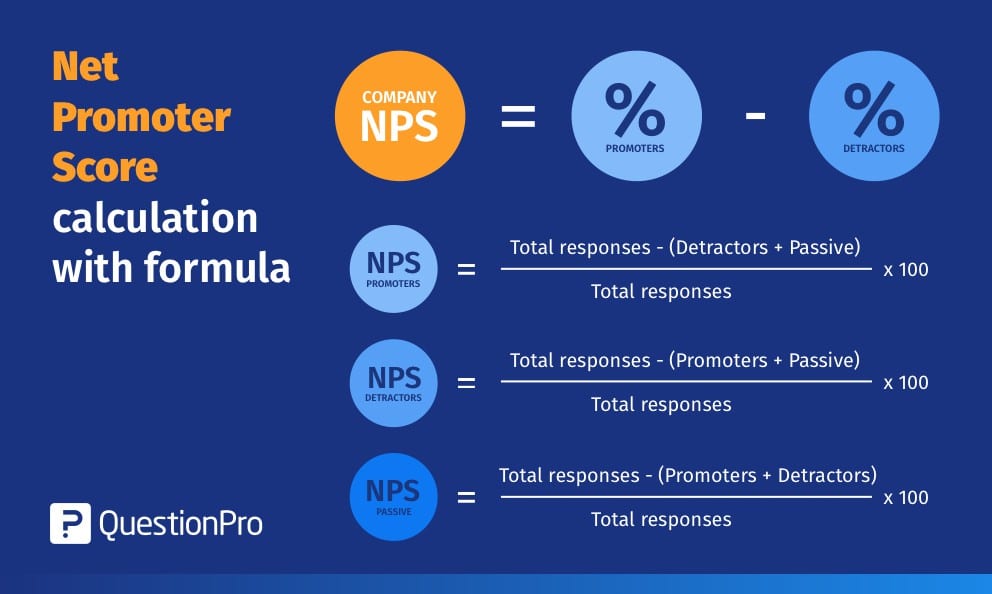
To calculate NPS, subtract the percentage of detractors from the percentage of promoters. Passives count toward the total respondent pool but don’t appear in the formula itself. The result lands between -100 and +100. That number only means something once you know where it came from: a single interaction, or a customer’s overall relationship with your brand. That’s the actual decision behind transactional vs relational NPS.
What is transactional NPS?
Transactional NPS, often shortened to tNPS, measures how a customer felt right after one specific interaction. Think of a support call, a checkout, or a delivery. It’s triggered automatically by an event, not sent on a calendar. That means the feedback captures a moment while it’s fresh, instead of an averaged, months-old impression.
A retailer might send a tNPS survey the day after an order ships. It asks how likely the customer is to recommend the company based on that delivery specifically. Any low score routes straight to the fulfillment team for follow-up. See more transactional and relational NPS survey question examples for different touchpoints.
What is relational NPS?
Relational NPS, or rNPS, measures a customer’s overall sentiment toward your brand, independent of any single transaction. It’s typically sent on a fixed schedule, such as quarterly or annually, rather than after a specific event. It reflects the accumulated experience of everything a customer has been through with you.
- Tracks brand health and loyalty trends over time, not a single touchpoint.
- Works well for subscription businesses, B2B accounts, and any relationship that spans multiple interactions.
- Gives leadership a comparable, trackable number for board reporting and year-over-year benchmarking.
- Answers a broader question, such as “How likely are you to recommend [company] to a friend or colleague?” with no reference to a specific order or ticket.
What’s the difference between transactional and relational NPS?
The two methods differ in nearly every practical dimension. That includes what they measure and who owns the resulting data.
| Aspect | Transactional NPS | Relational NPS |
|---|---|---|
| What it measures | Satisfaction with one interaction | Overall loyalty to the brand |
| Trigger | Event-based (after purchase, ticket, delivery) | Time-based (quarterly, annually) |
| Frequency | Continuous, high volume | Periodic, lower volume |
| Best owner | Frontline team or department head | CX or executive leadership |
| Typical use | Fixing a specific touchpoint | Tracking brand health over time |
| Sample question | “How likely are you to recommend us based on your recent purchase?” | “How likely are you to recommend [company] overall?” |
Neither version is objectively better. Transactional NPS gives you fast, granular signal at the cost of a narrow view. Relational NPS gives you a defensible, board-level number at the cost of speed and specificity.
How do you choose between transactional and relational NPS?
Base the decision on what you’re trying to influence, not on which survey is easier to set up.
- Map your interaction volume.
Frequent, distinct touchpoints, like support tickets or checkouts, favor transactional NPS since it gives you a score for each one. Infrequent or long-cycle relationships favor relational NPS.
- Match the survey to the decision it informs.
Fixing a specific step in the journey calls for transactional data, since it points to the exact place to intervene. Setting company-wide CX goals calls for relational NPS instead.
- Check your resourcing.
Transactional NPS needs a workflow to review and act on high-volume, continuous responses. Relational NPS needs less day-to-day handling but more planning around timing and sample size per wave.
- Default to both if you can support it.
Most mature CX programs run relational NPS as the strategic baseline. They layer transactional NPS on top at the highest-impact touchpoints, rather than treating the choice as either-or.
How do transactional and relational NPS differ from CSAT and CES?
NPS, CSAT, and CES get confused constantly. All three can be triggered after a single interaction, which makes transactional NPS look a lot like Customer Satisfaction Score (CSAT) on the surface. They aren’t interchangeable.
| Metric | What It Measures | When It’s Typically Sent | Key Distinction |
|---|---|---|---|
| Transactional NPS | Likelihood to recommend after one interaction | Immediately after the event | Forward-looking: predicts advocacy |
| Relational NPS | Likelihood to recommend based on the whole relationship | Quarterly or annually | Broadest lens: brand-level loyalty |
| CSAT (Customer Satisfaction Score) | Satisfaction with one interaction | Immediately after the event | Backward-looking: rates what already happened |
| CES (Customer Effort Score) | How much effort a task took | Immediately after the event | Diagnostic: flags friction, not sentiment |
The practical rule is simple. CSAT tells you if an interaction met expectations. CES tells you if it was hard. NPS, transactional or relational, tells you if the experience translates into advocacy. For a closer look at how these three fit together, see QuestionPro’s comparison of NPS, CSAT, and CES and how CES specifically stacks up against NPS.
What does transactional and relational NPS look like in practice?
The right mix depends heavily on business model. Three common patterns show how this plays out in practice.
SaaS and subscription businesses
- Automated transactional NPS fires at moments like activation or first renewal, since a product-led team can’t manually check in with every user.
- Transactional scores catch friction early, before it turns into churn.
- Relational NPS runs quarterly and answers a different question: are the users who stuck around actually satisfied, or just not yet motivated to cancel.
Ecommerce and retail
Post-purchase transactional NPS goes out a few days after delivery, tied to shipping speed and product condition. A separate post-return or post-support survey captures how a service recovery went. Relational NPS runs once or twice a year across the full customer base. It tracks whether loyalty is trending up or down, independent of any single order.
B2B professional services
- Relational NPS is often the primary metric here, since B2B relationships are longer and concentrated among fewer buyers.
- It’s gathered during quarterly business reviews or renewal conversations.
- Transactional NPS still matters after major milestones, such as project delivery or onboarding completion, to catch a problem before the next renewal cycle.
How do you measure and track NPS accurately?
Getting a usable score depends on more than picking transactional or relational. It depends on running the survey correctly.
- Keep the question wording identical across waves so scores stay comparable over time.
- Send relational NPS to a large enough, randomly selected slice of your customer base each wave, not just the accounts your team happens to talk to most.
- Track transactional NPS by touchpoint separately, rather than blending scores from support, checkout, and onboarding into one number.
- Never combine a transactional score and a relational score into a single blended NPS. They measure different things on different timelines, and merging them creates a number that maps to no real decision.
- Pair the number with a follow-up “why” question, so low scores come with enough context to act on.
- Run both survey types through one NPS software platform so touchpoint and brand-level data stay in the same system instead of scattered across tools.
What common mistakes hurt transactional and relational NPS programs?
CX quality is under real pressure industry-wide right now. Forrester’s 2025 Global Customer Experience Index found that 25% of US brands saw their CX ranking decline for the second year running, compared to just 7% that improved. That trend makes getting the measurement approach right more urgent than it used to be.
- Surveying too often.
Sending relational NPS more than a few times a year causes fatigue and depresses response rates without adding insight.
- Collecting feedback without closing the loop.
A low score that never gets a follow-up teaches customers the survey doesn’t matter, which quietly kills future response rates.
- Comparing scores across unrelated segments.
A B2B relational NPS of 40 and a retail transactional NPS of 40 aren’t the same signal. Benchmark within your own industry and survey type.
- Treating NPS as the only metric.
NPS explains sentiment, not the full picture of behavior. Pair it with retention, usage, and support data before making major decisions from the score alone.
How does QuestionPro support transactional and relational NPS?
QuestionPro’s Customer Experience platform runs both survey types from one system, instead of stitching together separate tools.
- Pre-built transactional and relational NPS templates, so surveys can be triggered by an event or scheduled on a recurring cadence without custom setup.
- A live NPS dashboard that plots score changes over time and breaks results down by touchpoint or customer segment.
- Closed-loop case management that automatically creates a ticket for each detractor response and routes it to the right team, so low scores turn into follow-up instead of sitting in a report.
- NPS key driver analysis that identifies which specific interactions pull the overall score up or down, useful once you’re running transactional surveys at more than one touchpoint.
Getting more value from transactional and relational NPS together
Transactional vs relational NPS isn’t really a competition. It’s two different lenses pointed at the same customer relationship. Relational NPS tells you whether the relationship is healthy overall. Transactional NPS tells you which specific moments are helping or hurting that number.
Programs that use only one tend to either drown in operational noise or miss the exact touchpoint causing churn.
Run relational NPS as your strategic baseline. Layer transactional NPS at the touchpoints that matter most to retention. Route both into the same customer journey analytics view, so the two scores inform each other instead of living in separate reports.
Frequently Asked Questions (FAQs)
No. They measure different things on different timelines, and blending them produces a number that doesn’t correspond to any real decision. Track and report the two separately, then look at both together when you review overall CX performance each quarter.
Most programs send relational NPS quarterly or annually, since it tracks a slower-moving signal than transactional surveys. Sending it more often causes survey fatigue and lowers response rates without adding meaningful new insight between one wave and the next.
No. Both trigger after a single interaction, but they measure different things. Transactional NPS predicts future advocacy, while CSAT rates whether that specific interaction met expectations. Treat them as complementary metrics, not interchangeable substitutes for the same question.
Start with relational NPS to establish a brand-level baseline before you add anything else. Once that baseline exists, layer in transactional NPS at the touchpoints most tied to retention, such as onboarding or support interactions.
Yes. The same transactional-versus-relational logic applies to employee feedback through Employee Net Promoter Score, or eNPS. The survey cadence and triggers differ from customer NPS, but the underlying distinction carries over.