How to avoid survey bias is a major concern for anyone who relies on survey data to make informed decisions. Survey bias happens when the design, wording, or distribution of a survey influences responses in a way that does not actually reflect what the target audience really thinks. When bias is present, survey results may appear reliable but ultimately lead to conclusions that just aren’t accurate.
Avoiding survey bias helps improve the accuracy, validity, and usefulness of research findings. By understanding where bias comes from and how it affects responses, researchers can design surveys that capture more honest and representative feedback.
In this blog, we’ll explain the most common types of survey bias and show you some practical ways to avoid bias, ensuring that your results really do reflect what people are thinking, rather than some unintended influence.
What is survey bias?
Survey bias is a systematic error that affects survey results and hampers honest responses. It happens when certain design choices or data-collection methods lead survey respondents to answer in a particular way, so their responses may not necessarily reflect their true opinions or behaviors.
For example, social desirability bias can cause people to give answers they think are more acceptable, which does not necessarily reflect their actual attitudes or actions.
Survey bias can occur at any stage of your research, including sampling, question wording, response options, and survey administration. The American Association for Public Opinion Research (AAPOR) and ESOMAR emphasize that survey bias reduces the ability to generalize findings. Because when it does, your results are basically worthless, no matter how big your sample size is.
Understanding survey bias can help you identify where things might go wrong and then make sure you’re doing your survey the right way.
Learn more: What is survey bias, and the types of survey bias
Why survey bias happens
Survey bias often occurs unintentionally. Researchers may introduce bias without realizing it, even when surveys are carefully planned. It appears because surveys rely on human judgment at every stage, from defining the audience to interpreting results. Small decisions can shape how people understand questions and how comfortable they feel answering honestly.
Some of the most common reasons why survey bias happens include:
- Selecting a sample that does not represent the target population
- Asking questions that suggest a preferred answer
- Using unclear or subjective language
- Designing surveys that fatigue or pressure respondents
Additionally, demand characteristics, such as cues or clues in the survey environment, can influence how respondents respond. This effect is especially strong in focus groups or interviews, where participants may try to confirm what they believe is the researcher’s hypothesis.
Recognizing these sources early makes it easier to reduce their impact before data collection begins.
Learn more: Why response bias happens and how to prevent it
Types of survey bias
Survey bias can appear in different ways depending on how a survey is designed and conducted. Each type affects results differently and can reduce accuracy if not addressed. Understanding these types helps researchers identify risks and apply the right controls.
- Sampling bias
Occurs when the survey sample does not represent the target population. Certain groups may be overrepresented or excluded, which limits how well results apply to a broader audience.
- Nonresponse bias
Happens when people who do not participate differ significantly from those who do. If these differences are systematic, survey findings may reflect only partial perspectives.
- Response bias
Appears when respondents provide inaccurate answers due to question wording, scale design, or perceived expectations, even when they participate fully.
- Social desirability bias
Occurs when respondents give answers they believe are socially acceptable rather than truthful, especially in surveys covering sensitive topics.
- Acquiescence bias
Refers to a tendency to agree with statements regardless of content. This is common in surveys that rely heavily on yes or no or agreement-based questions.
- Order bias
Arises when the order of questions or answer options influences responses, causing earlier items to shape later answers.
Also check: Identifying and reducing reference bias in surveys and research
How to avoid survey bias
How to avoid survey bias requires intentional design choices across the entire survey research process. Survey bias is often introduced through question wording, structure, or context rather than intent. Applying clear and consistent rules helps ensure responses reflect genuine opinions and behaviors rather than influenced answers.
1. Avoid yes or no questions
Yes or no questions increase the risk of acquiescence bias, where respondents are more likely to select “yes” because it feels agreeable. These questions limit detail and reduce the accuracy of insights.
Why this happens:
Binary choices do not allow respondents to express priorities or degrees of opinion.
Example:
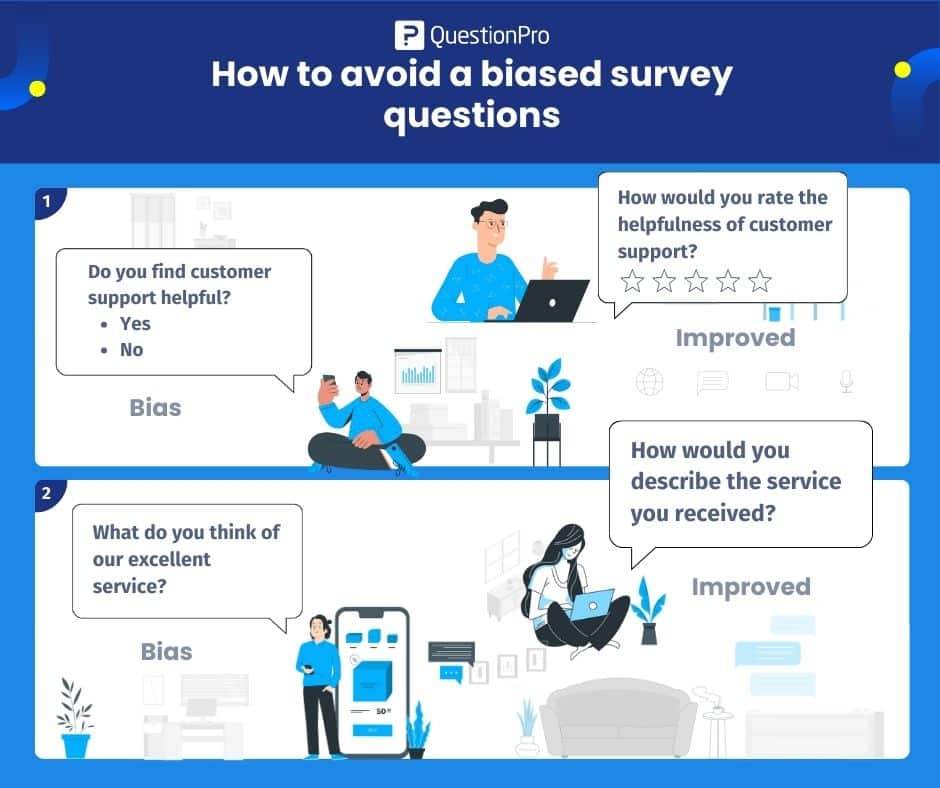
- Biased: Do you find customer support helpful?
- Improved: How would you rate the helpfulness of customer support?
Good practice:
- Use multiple-choice, rating, or ranking questions
- Allow more than one valid response
2. Avoid leading questions
Leading questions guide respondents toward a particular answer through wording or framing. This reduces neutrality and increases confirmation bias.
Why this happens:
Positive or negative adjectives influence how respondents interpret the question.
Example:
- Biased: What do you think of our excellent service?
- Improved: How would you describe the service you received?
Good practice:
- Remove value-based language
- Keep question wording factual and neutral
- Apply neutral labels to rating scales
3. Order questions and answers carefully
The sequence of questions and answers affects how respondents think about later items. This influence is known as order bias.
Order Bias in Questions
Earlier questions can shape how respondents interpret later ones.
Good practice:
- Start with general questions
- Move to specific or evaluative questions later
- Avoid revealing information that could influence responses
Order Bias in Answer Options
Respondents are more likely to select options listed first.
Good practice:
- Randomize answer options where possible
- Use fixed order only when the sequence is meaningful
Learn more: Eliminate order bias in surveys
4. Be anonymous where possible
When respondents know who is sponsoring a survey, they may provide more favorable responses. This is known as sponsor bias.
Why this matters:
Brand awareness can influence honesty, especially in feedback or concept testing.
Good practice:
- Collect anonymous responses when possible
- Remove brand identifiers in early-stage research
- Clearly communicate anonymity to respondents
5. Do not feed answers to respondents
Survey questions should not introduce ideas or emotions that influence later responses. Emotionally loaded language can shape perceptions and skew results.
Why this matters:
Priming affects how respondents evaluate later questions.
Good practice:
- Use neutral wording throughout the survey
- Separate descriptive questions from evaluative ones
- Avoid emotional framing
6. Clarify language and timeframes
Vague terms allow for different interpretations, which reduces consistency across responses.
Example:
- Vague: How often do you use this product?
- Clear: How often have you used this product in the past 30 days?
Good practice:
- Use specific timeframes
- Avoid jargon and internal terminology
- Match language to the target audience
Some survey questions assume respondents share the same experience or behavior. This can force inaccurate answers.
Example:
- Biased: Which subscription plan do you use?
- Improved: Which of the following best describes your situation?
Good practice:
- Include “None,” “Not applicable,” or “Other” options
- Allow respondents to answer honestly
- Avoid assuming usage, ownership, or experience
8. Keep the survey length appropriate
Long surveys increase fatigue bias, which leads to rushed or careless responses toward the end of the survey.
Why this matters:
Survey fatigue affects attention and response accuracy, even among motivated respondents.
Good practice:
- Ask only questions that support the research goal
- Remove redundant or low-impact questions
- Place the most important questions earlier in the survey
9. Design for accessibility and device use
Surveys that are difficult to read or use on certain devices can exclude participants and introduce bias.
Why this matters:
Accessibility issues can disproportionately affect certain groups, skewing results.
Good practice:
- Ensure online surveys work on mobile and desktop devices
- Use clear fonts and readable layouts
- Avoid complex grids or long text blocks
10. Review results with bias in mind
Bias can still affect results even after careful design. Reviewing data with awareness of limitations improves interpretation.
Why this matters:
Understanding remaining bias helps prevent overgeneralization.
Good practice:
- Compare respondent demographics to the target population
- Note who did not respond and possible reasons
- Document known limitations when reporting findings
Comparison table of common survey biases
Survey bias can affect results in different ways depending on where it appears in the research process. A clear comparison helps researchers quickly identify which type of bias may be influencing their data and what steps can be taken to reduce its impact.
The table below outlines the most common survey biases, explains how they occur, and summarizes practical methods for prevention.
Survey bias type | What it means | How it affects results | How to reduce it |
| Sampling Bias | The sample does not represent the target population | Results reflect only certain groups, not the full audience | Use random or stratified sampling and clear screening criteria |
| Nonresponse Bias | Certain groups are less likely to respond | Missing viewpoints lead to skewed conclusions | Use reminders, multiple channels, and a reasonable survey length |
| Question Wording Bias | Questions influence how people answer | Responses shift toward implied or expected answers | Write neutral, simple, and assumption-free questions |
| Response Bias | Respondents give socially acceptable or inaccurate answers | Reported behavior differs from real behavior | Ensure anonymity and use neutral wording |
| Order Bias | Question or option order affects responses | Earlier items influence later answers | Randomize question and answer order |
| Scale Bias | Rating scale questions are unbalanced or unclear | Responses cluster toward one side of the scale | Use symmetric scales with clear labels |
| Acquiescence Bias | Respondents tend to agree with statements | Agreement rates appear higher than reality | Mix positive and negative statements |
| Fatigue Bias | Respondents lose focus in long surveys | Later answers become rushed or careless | Keep surveys short and focused |
| Interviewer Bias | Interviewer behavior influences responses | Responses reflect interviewer influence | Use standardized scripts and training |
How to design surveys to avoid bias: Dos and don’ts
Understanding how different survey biases work makes it easier to diagnose data quality issues and select appropriate corrective actions. By matching each bias type with the right prevention method, researchers can improve survey accuracy and produce insights that better reflect real opinions and behaviors.
Dos: Survey design best practices
Follow these practices to support clear understanding and unbiased responses:
- Write clearly and simply
Use basic words and short sentences. Avoid double negatives, jargon, or confusing phrasing.
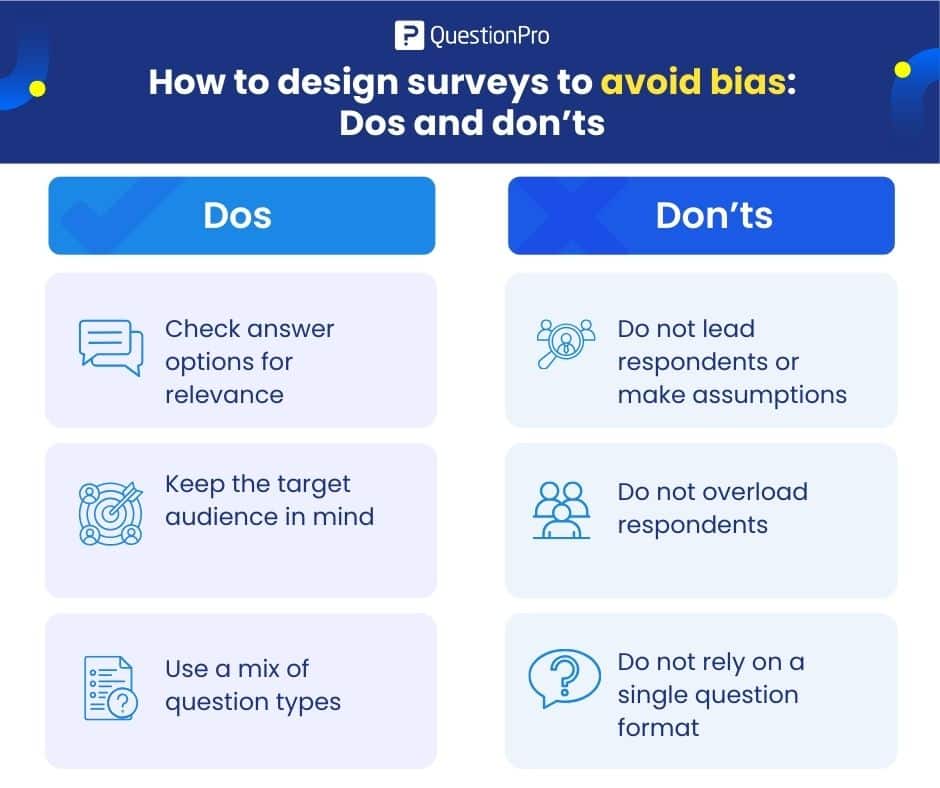
- Check answer options for relevance
Ensure that all response options directly relate to the question and cover realistic possibilities.
- Keep the target audience in mind
Match language, tone, and examples to the knowledge level of respondents. Surveys for beginners should avoid references that only experts would understand.
- Use a mix of question types
Combine closed-ended and open-ended survey questions to maintain engagement and capture both structured and detailed feedback.
- Format surveys for all devices
Design surveys that are easy to read and complete on mobile and desktop. Responsive layouts help prevent exclusion and usability-related bias.
Don’ts: Common biases to avoid
Avoid these practices, as they commonly introduce bias into survey responses:
- Do not lead respondents or make assumptions
Avoid wording that suggests a preferred answer or assumes a specific behavior or experience. Allow respondents to answer in their own way, even if the results differ from expectations.
- Do not overload respondents
Keep questions focused and avoid double-barreled questions. Organize questions into clear categories to reduce cognitive effort.
- Do not rely on a single question format
Repeating only yes or no questions can bore respondents and limit insight. A lack of variety increases disengagement and leads to superficial answers.
Also check: What wording bias is with examples
How to avoid survey bias with QuestionPro
How QuestionPro helps avoid survey bias is by supporting survey design and data collection practices that limit common sources of error. The platform provides features that help researchers apply bias-reduction rules consistently.
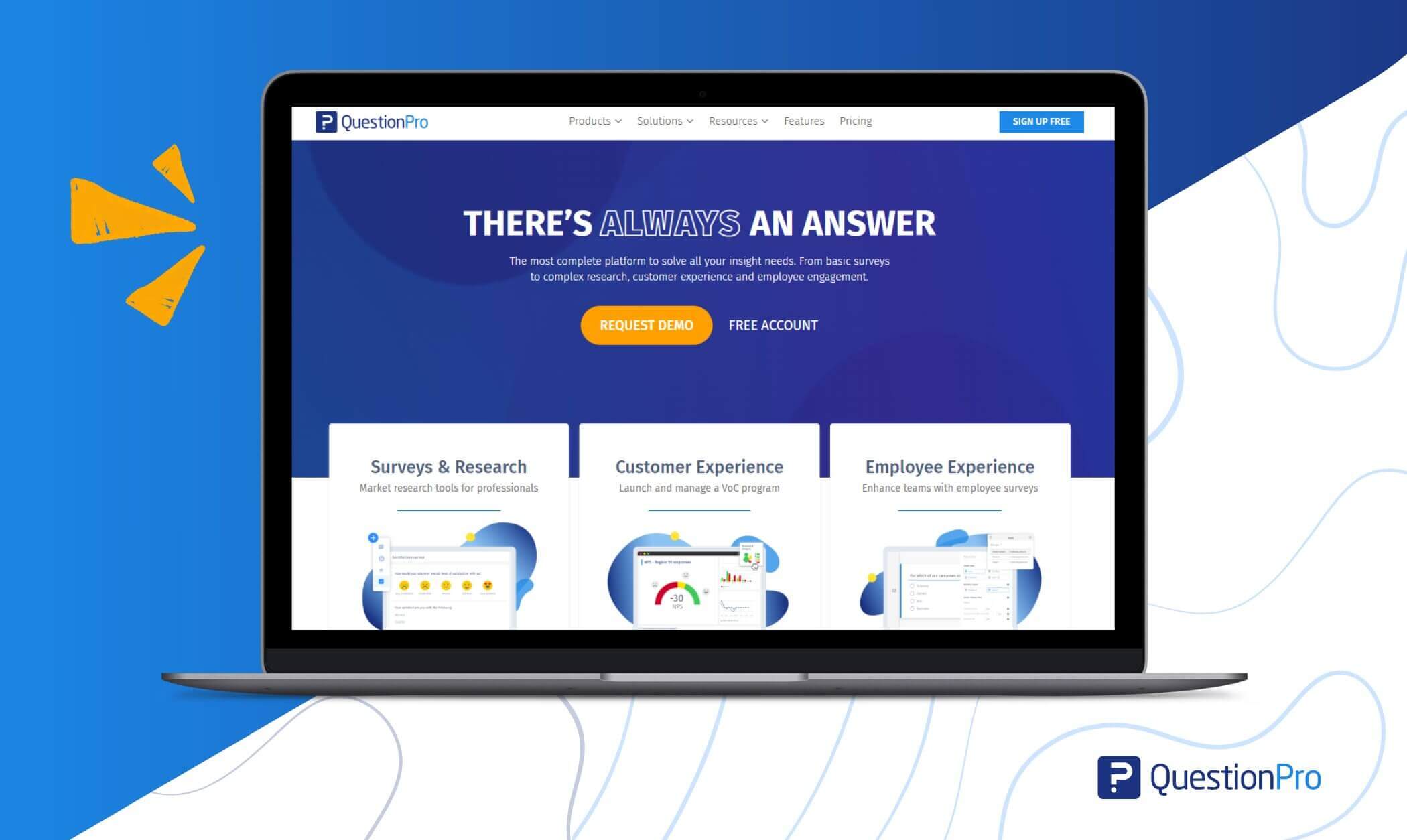
- Helps control sampling and audience selection
QuestionPro allows researchers to define screening questions, quotas, and logic rules to help ensure the right audience participates in a survey. This helps reduce sampling bias by aligning respondents more closely with the intended target population.
- Supports neutral and flexible question design
The platform supports a wide range of question types, including multiple-choice, rating scales, ranking, and open-ended questions. This flexibility makes it easier to avoid yes or no questions, reduce acquiescence bias, and design balanced response options.
- Reduces order bias through randomization
QuestionPro includes options for randomizing questions and answer choices. Randomization helps reduce order bias by preventing earlier questions or top-listed options from influencing responses.
- Encourages honest and anonymous responses
Researchers can configure surveys to collect responses anonymously. Anonymity reduces social desirability and sponsor bias, especially in feedback surveys and studies involving sensitive topics.
- Improves data quality during collection
QuestionPro provides tools to monitor response behavior, such as completion time checks and pattern detection. These features help identify low-quality responses that may introduce bias during data collection.
By supporting careful survey design and ongoing quality checks, QuestionPro helps researchers reduce common sources of survey bias and collect more accurate, reliable insights.
Conclusion
Avoiding survey bias is essential for producing accurate insights that reflect real opinions and behaviors. While bias cannot be eliminated entirely, careful survey design, neutral wording, thoughtful structure, and ongoing review can significantly reduce its impact.
By understanding common bias types and applying practical prevention steps, researchers can improve the quality, credibility, and usefulness of their survey data.
Frequently Asked Questions (FAQs)
Answer: Survey bias cannot be fully avoided, but it can be reduced. Careful survey design, neutral wording, and representative sampling help limit its impact.
Answer: Sampling bias is one of the most common types. It occurs when the survey sample does not represent the target population.
Answer: Survey bias can be detected by checking response patterns, completion speed, and demographic gaps compared to the target audience.
Answer: Yes or no questions increase acquiescence bias, where respondents tend to agree by default. They also limit nuance in responses.
Answer: Yes, long surveys increase fatigue bias. Fatigued respondents are more likely to rush or provide low-quality answers.
Answer: Anonymity reduces social desirability and sponsor bias by encouraging more honest responses.