Innovation and employee engagement are more connected than most organizations realize. When employees are invited to contribute ideas, solve real problems, and see their thinking shape business decisions, their connection to their work deepens in ways that benefits packages and recognition programs rarely achieve on their own.
The numbers make the problem hard to ignore. According to Gallup’s 2023 State of the Global Workplace report, only 23% of employees worldwide are actively engaged at work. In the US, that figure is 32%, meaning roughly two in three American workers are going through the motions rather than bringing their full effort to the job. Gallup estimates the cost of that disengagement at $8.8 trillion in lost productivity globally each year.
Innovation programs offer a practical, often underused path to closing that gap. The employee engagement strategies guide covers why the connection works, how to build it into your organization, and how to measure whether it is actually moving the needle.
What is the connection between innovation and employee engagement?
Employee engagement is the degree to which employees are emotionally invested in their work and committed to the organization’s goals. Innovation, in this context, means creating structured opportunities for employees at all levels to contribute ideas, improve processes, and solve real problems.
The connection between the two comes down to what actually drives intrinsic motivation: autonomy, mastery, and purpose. When employees are asked to innovate, they get all three at once.
| What innovation provides | Why it drives engagement |
|---|---|
| Autonomy | Employees have agency over what they work on and how they approach it |
| Mastery | They develop new skills through the process of developing and pitching ideas |
| Purpose | They see a direct line between their effort and the organization’s direction |
High engagement drives what researchers call discretionary effort, the extra work people do beyond what is required. That discretionary effort is where most organizational innovation actually comes from. The two reinforce each other.
Why disengaged employees are an innovation problem
Disengagement and innovation are fundamentally incompatible.
An employee who does not feel connected to their work has little incentive to take the risk of proposing something new, challenging a broken process, or investing extra effort in developing an idea that might not go anywhere. Taking creative risks requires a baseline of psychological safety and organizational trust that disengaged employees simply do not have.
Most traditional organizations treat innovation as the responsibility of a specific team: R&D, product, or a dedicated innovation unit. That leaves the majority of the workforce on the sidelines. It also means the organization is drawing from a fraction of its available intellectual capacity.
The employees closest to the customer, the front line, the support teams, the account managers, are often the first to see where processes fail, where customer needs go unmet, and where competitors are gaining ground. When those employees are disengaged, that insight never surfaces. The organization loses twice: it loses the engagement, and it loses the ideas.
Why innovation programs improve employee engagement
Research by Deloitte found that organizations with strong innovation cultures have 2.5 times higher employee engagement scores than those without. The causal direction runs both ways: engaged employees innovate more, and innovation programs drive engagement higher.
Here is why it works in practice:
- Ownership drives commitment.
When an employee’s idea gets developed and implemented, they have contributed something real to the organization. That sense of ownership is one of the most powerful engagement drivers available, and it costs far less than most benefits programs. - Visibility creates retention incentive.
Innovation programs give employees a platform to demonstrate capabilities beyond their job description. For younger workers especially, being seen as someone who contributes at a higher level than their role requires is a significant factor in employee retention. - Skills development reduces attrition.
Teaching employees to identify opportunities, develop ideas, and communicate value propositions builds professional capabilities that benefit both the individual and the organization. Employees who feel they are growing are significantly less likely to leave. - Culture signal matters for recruiting.
An organization that actively invites its workforce to innovate sends a clear message about how it views its people. That signal shapes how employees talk about the company to peers and potential candidates.
Five ways to embed innovation into your employee engagement strategy
These five approaches are used by organizations across the US to make innovation a genuine part of how everyone works, not just what a specific team does.
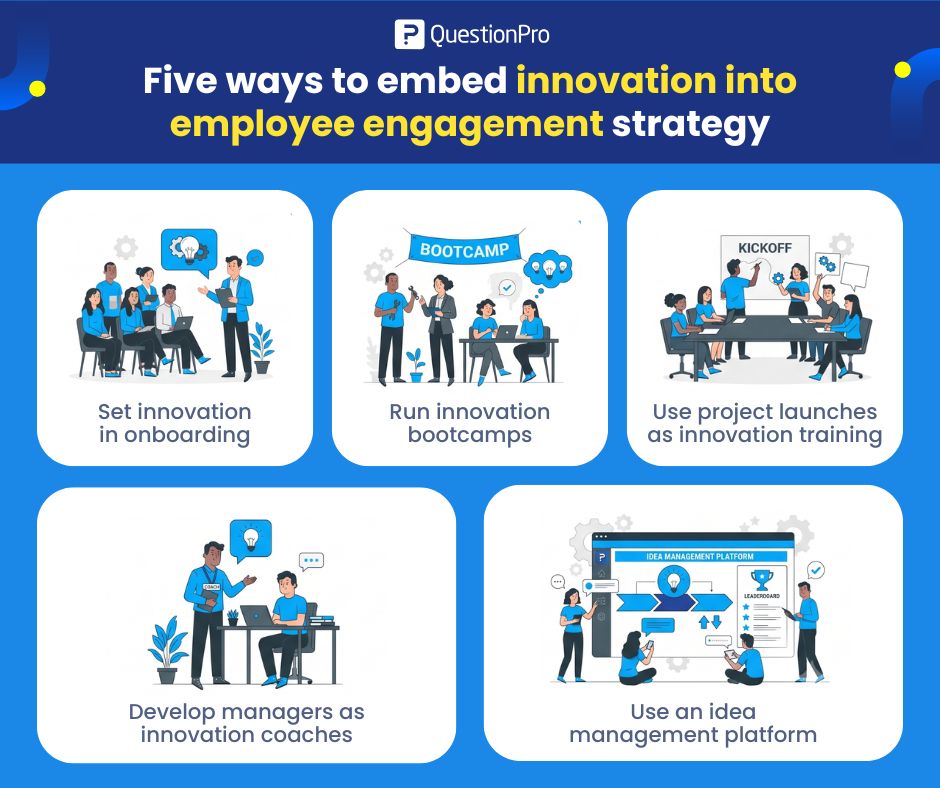
1. Set innovation expectations during onboarding
Most onboarding programs focus on compliance, tools, and role-specific information. That is a missed opportunity.
Adding an innovation component during onboarding sets a clear expectation from day one: everyone here has two jobs, deliver on their current assignment and participate in building a better future for the organization.
At minimum, cover:
- How your organization runs innovation (process, not just concept)
- Where to submit ideas and how they are evaluated
- Examples of ideas that have been implemented and who was behind them
- What participation looks like at different career stages
Some organizations go further and turn the onboarding process itself into an innovation exercise. New hires are given a real business challenge, taught the innovation methodology, and invited to generate and present ideas to leadership. People seeing the organization with fresh eyes often surface the most useful perspectives.
2. Run innovation bootcamps across the workforce
An innovation bootcamp is a focused one to two day training program that teaches employees the core skills needed to identify opportunities, generate ideas, and develop strong value propositions.
The goal is not to produce finished innovations. The goal is to build a common language and skill set that every employee can apply in their daily work.
Effective bootcamps bring together employees from different departments and levels. Cross-functional diversity produces better ideas and expands networks across the organization, which has secondary benefits for collaboration that show up in engagement scores long after the bootcamp is over.
Skills typically covered:
- Opportunity identification
- Creative problem-solving techniques
- Idea development and iteration
- Communicating a business case clearly
When these skills are spread across an entire workforce, the organization’s capacity to spot and act on opportunities increases substantially, and employees feel more capable and confident in their roles.
3. Use project launches as innovation training moments
Every new project is an opportunity to reinforce innovation practices rather than treating them as a separate program that runs in parallel to real work.
- Without innovation integration: Project brief is handed down. Team executes. Problems surface during delivery.
- With innovation integration: Project kickoff includes a structured ideation phase. Team surfaces risks, alternatives, and improvement opportunities upfront. Fewer surprises emerge mid-project because the hard questions were asked at the start.
Over time, this approach embeds innovation as a standard operating practice rather than something employees are asked to do on top of their existing responsibilities. It stops being an event and starts being how work gets done.
4. Develop managers as innovation coaches
No innovation program succeeds without active support from managers. Even well-designed programs stall when managers do not understand their role or feel threatened by employee initiative.
According to McKinsey, 94% of senior leaders say innovation is a strategic priority, yet only 6% say they are satisfied with their organization’s innovation performance. That gap almost always runs through middle management.
Developing managers as innovation coaches means:
- Training them in the organization’s innovation methodology
- Giving them tools to facilitate idea generation within their teams
- Holding them accountable for creating psychological safety, the conditions where employees feel comfortable taking the risk of proposing something new
- Recognizing and rewarding managers whose teams participate actively
Fixing the manager capability gap is one of the highest-impact investments an organization can make in both innovation and engagement.
5. Use an idea management platform to crowdsource innovation
Idea management software gives employees a structured digital environment to submit ideas, comment on others’ submissions, vote for the most promising concepts, and track the progress of ideas through a development pipeline.
These platforms make innovation scalable across large or geographically dispersed workforces. Rather than relying on a small group to generate ideas in a workshop, organizations can run targeted innovation campaigns with a clear challenge, a two to three week submission window, and a visible evaluation process.
What keeps people coming back: Gamification features such as voting, leaderboards, and recognition for top contributors keep the program visible between campaigns. When employees can see their ideas being tracked and potentially implemented, participation rates in future campaigns consistently increase.
QuestionPro’s idea management software gives HR and insights teams a practical tool for running structured innovation campaigns and tracking employee participation alongside other engagement metrics.
How to measure the impact of innovation on employee engagement
Measuring the connection between innovation programs and engagement requires tracking both program participation and engagement outcomes over time.
| Metric | What it tells you | Warning sign |
|---|---|---|
| Participation rate | Percentage of employees submitting ideas, voting, or commenting | Flat or declining rate after launch signals the program is losing relevance |
| Idea implementation rate | Percentage of ideas that reach testing or implementation | High submissions with low implementation means employees do not trust the process |
| Engagement score by participation | Difference in scores between active participants and non-participants | No difference suggests the program is not connecting to what employees value |
| Retention among innovators | Turnover rate of active participants vs non-participants | High turnover among innovators signals contributions are not being recognized |
| Manager-reported culture change | Whether managers observe more initiative and collaboration | No change after six months points to a manager capability or buy-in gap |
Run your regular employee engagement survey and segment results by innovation program participation. That comparison is the clearest signal of whether the program is generating genuine engagement or just activity.
Common mistakes when launching innovation programs
Most innovation programs that fail do so for reasons that are entirely predictable:
- Making it exclusive.
Programs limited to senior staff or designated innovators miss the point entirely. Engagement improves most when every employee has a genuine opportunity to contribute. - No visible follow-through.
Collecting ideas and never communicating what happened to them is the fastest way to kill a program. Every submission needs a visible outcome: advanced, in review, or declined with a reason. - Treating it as a one-time event.
A single hackathon generates enthusiasm but not cultural change. Sustained impact requires embedding innovation into onboarding, project launches, and management practices over time. - Disconnecting it from business strategy.
Generic campaigns produce generic ideas. Innovation challenges tied directly to a current strategic priority produce higher-quality submissions and more immediate executive interest. - Skipping manager training.
Programs that underinvest in manager capability consistently underperform. Managers who feel threatened by employee initiative will quietly suppress the behavior the program is trying to build.
Innovation is one of the strongest engagement levers available
Most organizations looking to improve engagement default to familiar fixes: better benefits, more recognition, flexible working policies. These things matter, but they address the surface of what drives engagement rather than the root.
What employees in the US and globally consistently say they want is meaningful work, a sense of growth, and the feeling that their contribution matters beyond their immediate job description. Innovation programs, done well, address all three simultaneously.
The organizations that recognize the link between innovation and employee engagement and act on it deliberately tend to outperform on both dimensions. Their employees stay longer, contribute more, and generate a consistent pipeline of ideas that gives the business a real advantage over competitors who are still trying to solve the engagement problem with another benefits package.
Frequently Asked Questions (FAQs)
Innovation programs improve engagement by giving employees a meaningful way to contribute beyond their job description. Developing ideas, building new skills, and seeing their thinking influence organizational decisions addresses the intrinsic motivation drivers that sustain long-term engagement more effectively than extrinsic rewards alone.
According to Gallup’s 2023 State of the Global Workplace report, 32% of US employees are actively engaged at work. Globally, that figure is 23%. Disengaged employees cost the global economy an estimated $8.8 trillion in lost productivity annually.
Define the business challenge you want employees to address, choose a platform or process for collecting and evaluating ideas, train managers to support participation, launch an initial campaign with a clear timeline, and communicate what happened to every submission. Visibility and follow-through are what sustain participation over time.
Organizations of all sizes across industries in the US use these programs. Technology companies, healthcare systems, financial services firms, and consumer brands all run structured idea management programs. The approach works best when it is inclusive and open to all employees, not just senior staff.
Track participation rates, compare engagement survey scores between active participants and non-participants, monitor idea implementation rates, and measure retention among employees who participate most actively. These metrics together show whether the program is generating genuine engagement or just surface-level activity.