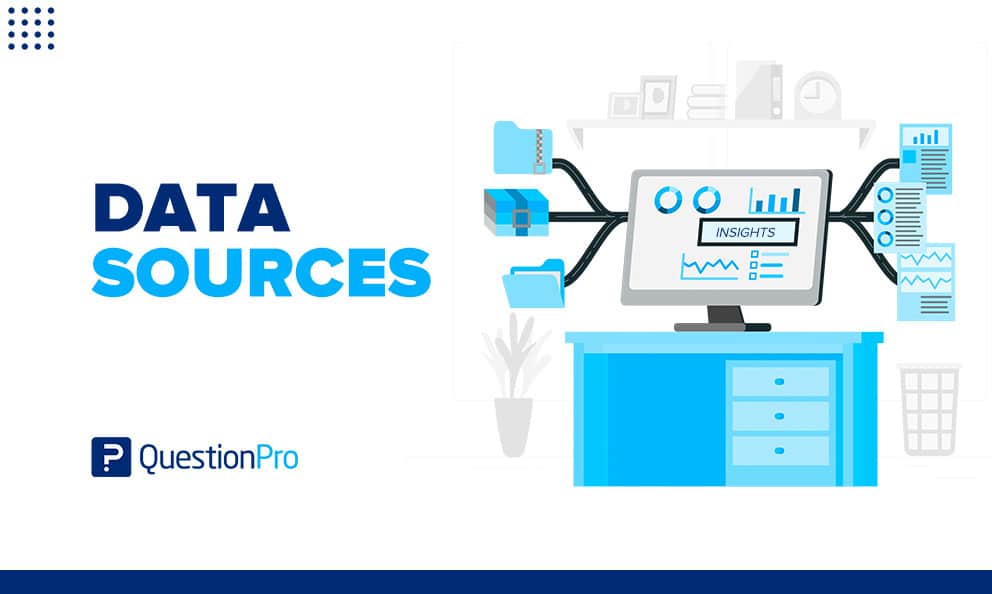
A data source is the place where information comes from before it is stored, analyzed, reported, or used in a business process. It can be a database, spreadsheet, survey, CRM system, API, website, customer feedback platform, government dataset, or research repository.
In simple terms, a data source answers one question: Where did this information come from?
That question matters more than it sounds. If the source is reliable, current, and collected in the right way, the analysis has a better chance of being useful. If the source is unclear or low quality, even the best dashboard or report can lead teams in the wrong direction.
For businesses in the USA, common data sources include customer surveys, sales records, web analytics, support tickets, product usage data, public datasets, and market research panels. Public platforms like Data.gov also provide access to US government datasets for research, analysis, and application development.
What does data source mean?
A data source means any original location, system, file, or method that provides data for use. The data may be collected directly from people, generated by software, stored in a database, or accessed from an external platform.
For example, a customer satisfaction survey is a data source because it collects feedback directly from customers. A CRM is also a data source because it stores customer names, contact details, purchase history, and sales activity. A website analytics tool is another data source because it records user behavior such as visits, clicks, and conversions.
A data source can be:
- A system: CRM, ERP, survey platform, analytics tool
- A file: spreadsheet, CSV, PDF, text file
- A database: SQL database, data warehouse, research database
- A person or group: survey respondents, interview participants, focus group members
- A public dataset: Census data, labor statistics, open government data
- An API: a connection that lets software retrieve data from another system
The U.S. Census Bureau, for example, provides public datasets through APIs, which allow developers and analysts to access Census data programmatically.
Why are data sources important?
Data sources are important because they affect the accuracy, trustworthiness, and usefulness of every report, model, dashboard, or research finding. A weak data source can create misleading insights, even when the analysis looks polished.
A reliable data source helps teams:
- Understand where the information came from
- Check whether the data is current
- Confirm whether the data was collected ethically
- Compare results across different systems
- Reduce errors in reporting and analysis
- Support stronger decisions with evidence
For example, a retail company may use sales records to see what customers bought, website analytics to see how they browsed, and surveys to understand why they made certain choices. Each source explains a different part of the customer story.
Data quality also depends on how the source was created. Harvard Business School Online notes that data should be complete and collected legally and ethically, because poor collection practices can damage the accuracy of analysis.
What are the different data sources?
Different data sources can be grouped by where the data comes from and how it is created. The most useful categories are primary, secondary, internal, external, qualitative, and quantitative data sources.
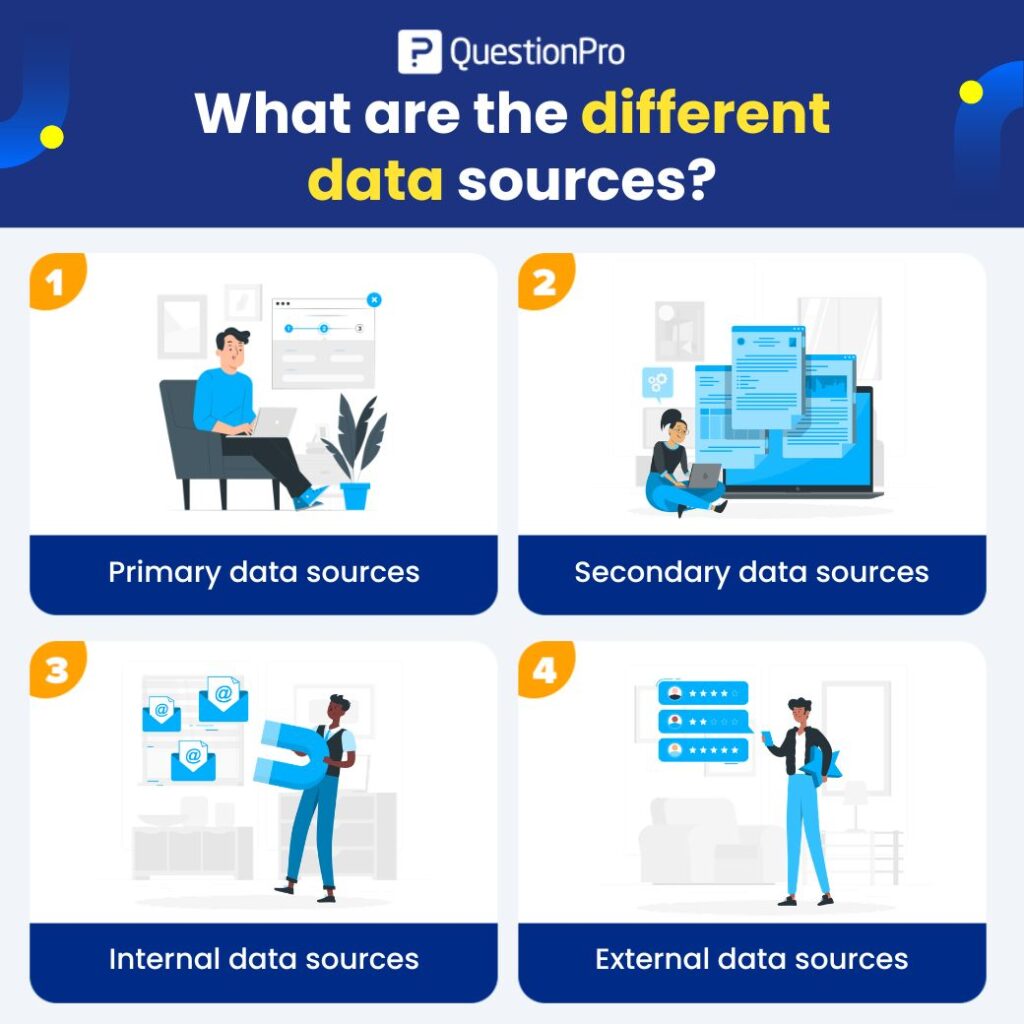
Primary data sources
Primary data sources provide information collected directly for a specific purpose. These sources are common in research because they answer a question that existing data cannot fully explain.
Examples include:
- Online surveys
- Interviews
- Focus groups
- Product testing
- Customer feedback forms
- Employee engagement surveys
- Observational research
A company launching a new product in the USA may run a survey with target customers to understand pricing expectations, feature preferences, and purchase intent. That survey becomes a primary data source.
Secondary data sources
Secondary data sources provide information that already exists. The data was originally collected for another purpose, but it can still support analysis.
Examples include:
- Government reports
- Academic studies
- Industry benchmarks
- Public datasets
- Published market reports
- Existing company records
For example, a business may use Census data to understand population trends in a US market before planning regional research.
Learn about: What’s the real difference between primary and secondary research
Internal data sources
Internal data sources come from inside the organization. They are often easier to access and can reflect real customer or business activity.
Examples include:
- CRM records
- Sales data
- Customer support tickets
- Survey results
- Product usage logs
- Website behavior
- Email campaign data
- Employee feedback
Internal sources are useful because they show what is already happening in the business. The main risk is that internal data can be incomplete, outdated, or spread across too many tools.
External data sources
External data sources come from outside the organization. They are useful when internal data does not provide enough context.
Examples include:
- Public government datasets
- Third-party market research
- Social media data
- Review sites
- Partner data
- Industry databases
- Competitive research
External data can help teams understand market size, customer trends, regional behavior, and industry shifts. It should always be checked for credibility, freshness, and collection method.
What are the main types of data sources?
The main types of data sources include databases, files, applications, APIs, surveys, web analytics tools, and public datasets. In technical settings, data sources may also be described as machine data sources or file data sources.
Database data sources
A database data source stores organized data that software can query. Examples include customer records, inventory tables, ticketing systems, and transaction histories.
For example, an e-commerce website may check an inventory database before showing whether a product is available. In this case, the inventory database is the data source.
File data sources
A file data source stores connection or data information in a file. In database connectivity, Microsoft explains that file data sources are not registered to one user or machine and can streamline connections by storing the connection string in a file.
Common file-based sources include:
- CSV files
- Excel spreadsheets
- JSON files
- XML files
- Text files
- Shared research files
Files are simple and portable, but they can create version control problems when multiple people edit or copy them.
Machine data sources
A machine data source is stored on a specific system with a user-defined name. Microsoft explains that machine data sources include the information the driver manager and driver need to connect to the data source.
This term is often used in ODBC settings, where a data source name helps applications connect to databases.
Application data sources
Application data sources come from software tools used by a business. Examples include CRM platforms, survey tools, accounting systems, HR software, and help desk platforms.
These sources are useful because they capture business activity in real time or near real time.
API data sources
An API data source allows one system to request data from another system. API stands for application programming interface, which is a set of rules that lets software systems communicate.
For example, a dashboard may pull updated demographic data from a public API or pull survey results from a research platform.
What are qualitative data sources?
Qualitative data sources provide non-numerical information that explains opinions, motivations, feelings, experiences, and behavior. These sources help researchers understand the “why” behind numbers.
Common qualitative data sources include:
- Open-ended survey responses
- Customer interviews
- Focus group discussions
- Online community posts
- Product reviews
- Support chat transcripts
- Social media comments
- User testing notes
- Field observations
For example, a customer satisfaction score may show that satisfaction dropped. Open-ended survey responses can explain why customers are frustrated. That makes qualitative data sources especially valuable for customer experience, product research, employee experience, and market research.
Qualitative data sources are not always easy to analyze because the responses can be long, emotional, or inconsistent. Still, they often reveal issues that structured metrics miss.
How do data sources and collection methods work together?
Data sources and collection methods work together because the source tells you where the data comes from, while the collection method explains how the data was gathered.
For example, survey responses are a data source. The collection method may be an email survey, website intercept survey, mobile survey, or panel survey.
| Data source | Collection method |
| Survey responses | Online surveys, email surveys, mobile surveys |
| Interview feedback | One-on-one interviews, video calls, phone interviews |
| Focus group comments | Moderated group discussions |
| Website behavior | Web analytics tracking |
| CRM records | Customer profile and interaction logging |
| Support tickets | Help desk forms and service conversations |
| Public government data | Open datasets and APIs |
| Product usage data | In-app tracking and event logs |
This distinction matters because two teams can use the same data source but collect the data in different ways. That can affect response quality, bias, completeness, and cost.
QuestionPro’s guide on data collection methods explains how organizations collect data from different audiences at different times for decision-making and research.
Also check: Data collection tips from customer feedback surveys
How do you choose a reliable data source?
Choose a reliable data source by checking accuracy, relevance, freshness, collection method, ownership, privacy rules, and whether the data matches the question you need to answer.
Use this checklist before using a data source:
- Relevance: Does this source answer the research or business question?
- Accuracy: Is the data complete, correct, and consistent?
- Freshness: When was it collected or last updated?
- Method: How was the data collected?
- Bias risk: Could the source overrepresent or underrepresent a group?
- Access: Can the team use the data legally and ethically?
- Format: Is the data structured enough for analysis?
- Traceability: Can you explain where the data came from?
For example, a company researching US customer preferences should not rely only on old purchase records. It may need current survey data, customer interviews, and market-level context to get a fuller picture.
A reliable data source does not have to be perfect. It needs to be clear, relevant, and fit for the decision being made.
How QuestionPro helps turn feedback into a useful data source
QuestionPro helps organizations collect first-party data directly from customers, employees, research participants, and online communities. That feedback can become a reliable data source when it is collected with clear questions, clean sampling, and organized reporting.
For example, a business can use QuestionPro to collect:
- Customer satisfaction survey responses
- Product feedback
- Employee engagement data
- Market research survey data
- Community discussion feedback
- Panel responses
- Qualitative open-text answers
This is useful because many teams already have operational data, such as sales or web analytics, but still lack direct feedback from people. Survey and feedback data can explain why customers behave a certain way, why employees feel engaged or disengaged, and what buyers expect next.
QuestionPro’s Insights Hub can also help teams organize research knowledge so findings do not stay trapped in scattered files or one-off reports. That makes research outputs easier to reuse as a trusted data source across teams.
Final thoughts on using data sources well
A data source is only useful when people understand where the data came from, how it was collected, and whether it fits the question being asked. Strong analysis starts before a chart, report, or dashboard is created. It starts with choosing the right source.
For research, customer experience, and business analytics, the best results often come from combining different data sources. CRM records can show who the customer is. Web analytics can show what they did. Surveys and interviews can explain what they think and why they acted.
The goal is not to collect every possible source. The goal is to choose the sources that are accurate, relevant, ethical, and clear enough to support a real decision.
Frequently Asked Questions (FAQs)
Data sources are the places where information comes from. They can include surveys, databases, spreadsheets, CRM systems, APIs, websites, interviews, public datasets, and customer feedback tools.
A customer survey is a data source because it collects answers directly from people. Other examples include sales databases, website analytics tools, support tickets, Census datasets, and CRM records.
Qualitative data sources collect non-numerical information, such as opinions, experiences, comments, and explanations. Examples include interviews, focus groups, open-ended survey responses, product reviews, and support conversations.
A data source is where the information comes from. A collection method is how the information is gathered. For example, survey responses are a data source, while an online survey is the collection method.
Useful data sources for US market research include customer surveys, Census datasets, CRM records, online panels, interviews, focus groups, website analytics, product reviews, and social media feedback.
A reliable data source should be accurate, current, relevant, traceable, and collected through a clear method. Businesses should also check privacy rules, sample quality, and potential bias before using it.