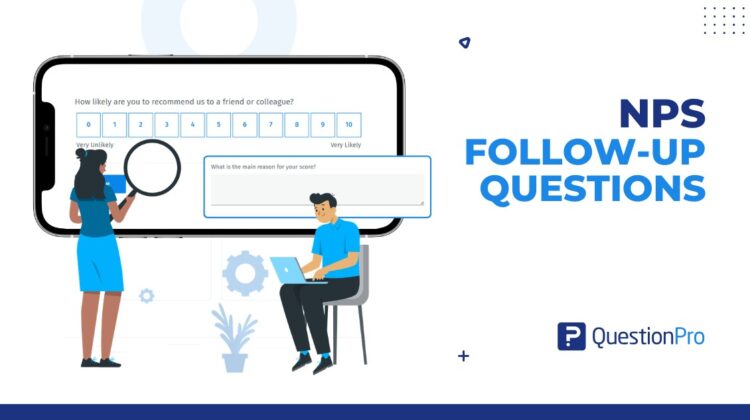
A Net Promoter Score (NPS) tells a company how many customers are promoters, passives, or detractors on a 0 to 10 recommendation scale. It does not explain why. NPS follow-up questions are the open-ended prompts that turn that number into something a team can actually act on.
A score that drops from 42 to 35 is an alert with no address. The right follow-up question turns that alert into a support wait time, a confusing onboarding step, or a pricing change customers felt blindsided by. That is the difference between a metric a team reports and one it can fix.
In this guide, we’ll learn which NPS follow-up questions to ask promoters, passives, and detractors, when to send them, and what to do with the answers once they arrive.
What is an NPS follow-up question?
An NPS follow-up question is the open-ended prompt that appears right after a respondent gives their 0 to 10 Net Promoter Score. Its job is to capture the reasoning behind the number, not to collect another score.
The standard Net Promoter Score question asks how likely someone is to recommend a company to a friend or colleague. The follow-up asks why, and the why is where the actionable insight lives. Without it, NPS is a single data point with no diagnosis attached.
This is different from a root cause question, which asks a respondent to pick a reason from a preset list, and from a general comment box, which is not tied to a specific rating. An NPS follow-up question is always anchored to the score the person just gave.
Why does the follow-up question matter more than the score?
The NPS score is a sentiment indicator. The follow-up question is the diagnostic layer, and most of the practical value in an NPS program lives there.
A good follow-up answer typically reveals:
- The specific moment or interaction that shaped the rating
- Whether the issue is a one-off or a pattern across customers
- What would need to change for the score to move
Consider a support team that watches its NPS drop from 42 to 35 in a quarter. The score alone says something went wrong. A follow-up response that says support took four days to reply during a renewal window says exactly what to fix and by when.
In a widely cited survey, Forrester found that 61% of companies have no formal process for closing the customer feedback loop, which means most of that diagnostic detail never reaches the team that could act on it.
How many NPS follow-up questions should you ask?
Keep it to one or two follow-up questions at most. A single open-ended question asking for the reason behind the score is enough for most NPS programs, and every extra question raises the chance a customer abandons the survey before finishing.
The right count depends on how the survey is triggered.
| Survey type | Recommended follow-up count |
|---|---|
| Transactional NPS, sent after one interaction | 1 question |
| Relational NPS, sent quarterly or biannually | 1 to 2 questions |
| Programs using survey software with skip logic | 1 question per segment, shown automatically |
Adding a third or fourth question rarely improves the data. Customers who feel a survey is dragging on give shorter, less specific answers toward the end, or they leave before submitting.
What is the best NPS follow-up question to ask?
The single most effective NPS follow-up question is: “What is the main reason for your score?” It is open, neutral, and works for any respondent regardless of their rating, without steering them toward a particular answer.
Other strong universal follow-up questions include:
- What could we do to improve your experience?
- What one thing would make you more likely to recommend us?
- Is there anything specific that influenced your rating today?
These work as a single question sent to an entire NPS list. The stronger approach, and the one most CX teams lean on by 2026, is showing a different follow-up question depending on whether the respondent is a promoter, a passive, or a detractor.
What are the best NPS follow-up questions by segment?
Conditional logic lets a survey display a different follow-up question based on the score someone just gave. An NPS detractor asked “what did you love most?” wastes the moment. A promoter asked “what went wrong?” feels tone deaf. Segmenting the question makes the answers far more usable.
Follow-up questions for promoters (score 9 to 10)
Promoters are already loyal. The goal of their follow-up is learning what is driving that loyalty so the business can protect and repeat it.
- What is the main reason you would recommend us to others?
- Which feature or moment has been most valuable to you?
- What is the one thing you would tell a colleague about us?
- Can you describe a time we genuinely impressed you?
Responses from promoters often become a company’s best marketing language, written by an actual customer instead of a copywriter.
Follow-up questions for passives (score 7 to 8)
Passives are satisfied but not committed, and a small friction point or a better offer from a competitor can tip them either way. Their follow-up should surface what stands between them and a higher score.
- What would make you more likely to recommend us?
- Is there anything keeping you from giving us a higher score?
- What feature or improvement would make the biggest difference for you?
- What is one thing we could do better?
A SaaS company that runs this question consistently might find passives keep mentioning a missing integration or a confusing pricing tier, a fixable gap rather than a fundamental problem.
Follow-up questions for detractors (score 0 to 6)
Detractors are unhappy and at risk of leaving, so the follow-up should surface the specific pain point without sounding defensive.
- What was missing or disappointing about your experience?
- What is the main reason for your score today?
- What would it take for us to earn a higher rating from you?
- Can you tell us more about what happened so we can make it right?
Avoid baking an apology into the question itself, such as “We’re sorry you had a bad experience, what went wrong?” That framing assumes the problem and can make the survey feel performative rather than genuine.
How does conditional logic work in NPS follow-up surveys?
Conditional logic, also called skip logic or branching, automatically shows a different follow-up question depending on the score a respondent just gave. Setting it up follows a simple structure.
- Set a score range rule for promoters.
If the score is 9 or 10, show the promoter follow-up question.
- Set a score range rule for passives.
If the score is 7 or 8, show the passive follow-up question.
- Set a score range rule for detractors.
If the score is 0 to 6, show the detractor follow-up question.
- Test each branch.
Submit a test response in every score range to confirm the right question appears before launch.
If a survey tool does not support conditional logic, a single universal question still works. It just means segmenting the responses manually after the data comes in, which takes longer but still produces usable insight.
When should you send the NPS follow-up question?
Timing depends on whether the survey is transactional or relational. Transactional NPS is triggered by one specific interaction, such as a support call or an onboarding session. Relational NPS is sent on a fixed schedule to measure overall brand loyalty over time. The transactional and relational NPS approaches call for different timing.
| NPS type | When to send |
|---|---|
| Transactional | Within 24 to 48 hours of the interaction |
| Relational | Same interval every cycle, quarterly or biannually |
Avoid sending either type during a known friction point, such as right after an outage, a price increase announcement, or a major product change. The score will reflect that moment instead of the relationship, and the follow-up answers will be harder to act on systematically.
What NPS follow-up mistakes should you avoid?
A few mistakes quietly break most Net Promoter Score follow-up programs, even when the question itself is well written.
- Asking a generic question to everyone: A single undifferentiated comment box gets far less specific answers than a question tailored to the respondent’s score.
- Adding a third or fourth question: Every extra question after the first follow-up increases abandonment and shortens the answers people do give.
- Using a leading or apologetic question: Phrasing that assumes the outcome, positive or negative, biases the response before the customer starts typing.
- Letting verbatims sit unread: A follow-up answer that never reaches a human on the product, support, or pricing team was collected for nothing.
What should you do with NPS follow-up responses?
Collecting the responses is the easy part. What most programs get wrong is what happens after.
- Route detractor responses immediately.
Send them to a support or customer success team within 24 hours, not into a monthly report.
- Tag and categorize the open text.
Use NPS analysis tools or text analytics to group verbatims into themes like support, pricing, or missing features.
- Close the loop with the customer.
Meaning, reply once you have acted on their feedback. A message from a real person, not an automated email, rebuilds trust and improves response rates in future cycles.
- Share the themes across teams.
Product needs recurring feature gaps, marketing needs promoter language, and sales needs detractor trends before renewal conversations.
How do you know if your NPS follow-up questions are working?
A follow-up question is working if it changes what the team does next, not just what it reports. Track completion rate on the open-text field separately from the rating question. A wide gap between the two usually means the question is too long, too vague, or poorly timed.
Track how many verbatims get tagged with a clear theme within a set window, such as 48 hours, and how many detractor responses receive a personal reply. A rising NPS score with no matching rise in closed-loop replies is a warning sign, not a win. It usually means the score moved for reasons unrelated to anything the team actually fixed.
How does QuestionPro Customer Experience support NPS follow-up programs?
QuestionPro Customer Experience supports conditional logic, so segment-specific follow-up questions appear automatically based on each respondent’s score, without manual routing. Post-interaction surveys can trigger within hours of a support call, onboarding session, or transaction.
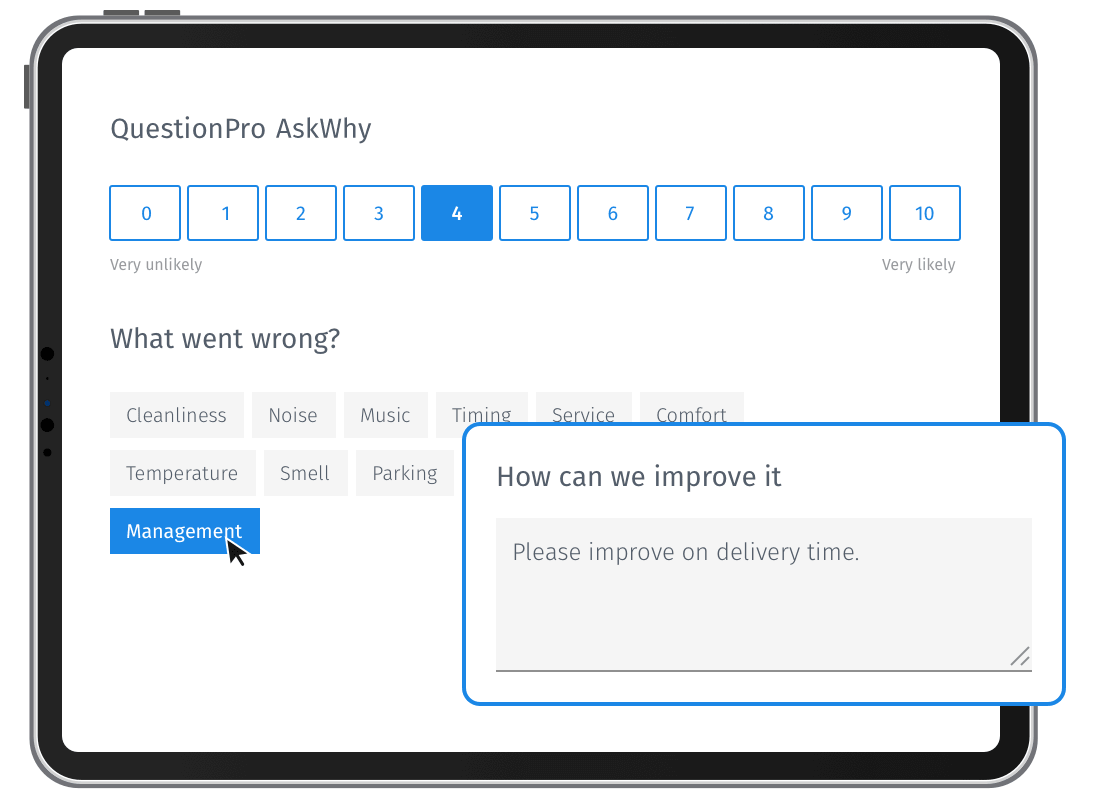
The AskWhy question type lets customers explain their score and vote on themes other respondents raised, which surfaces what matters most without manual text analysis at scale. A few things it adds on top of a standard follow-up:
- Root cause selection paired with the open-ended reason, in one step
- Dashboards segmented by score range, team, and channel
- Faster routing of detractor responses to whoever owns the fix
What your NPS follow-up questions are actually measuring
An NPS score gives a number to track over time. The follow-up gives the reasons behind that number, the specific moments, friction points, and small wins shaping how customers feel about a brand.
Businesses that improve their score are rarely the ones staring hardest at the number itself. They are the ones reading the verbatims, routing feedback to the right person, and closing the loop before a detractor churns or a passive drifts to a competitor. The follow-up question is not an optional add-on to NPS. It is the part that makes the score worth measuring in the first place.
Frequently asked questions
No. Making it required increases abandonment, especially among detractors who may skip a survey entirely rather than type a required explanation. Keep it optional but make the field prominent, since most customers who rate a score do want to explain it if asked well.
NPS follow-up questions ask customers why they rated a brand a certain way. Employee Net Promoter Score (eNPS) follow-up questions ask the same of employees rating their workplace, and usually probe management, workload, or culture instead of product or support.
Yes. Text analytics and sentiment analysis tools can group thousands of verbatim responses into themes like pricing, support, or onboarding within minutes, flagging which ones need a human reply first. This does not replace closing the loop personally, but it removes the manual sorting step.
There is no ideal length. A single specific sentence, such as naming a four-day support delay during renewal, is more useful than three vague sentences about being generally unhappy. Prompt for specifics with the question wording rather than requiring a minimum character count.
Only if it is a single, optional probe, such as which product area prompted the score. A second required question meaningfully lowers completion. If a program needs more detail, use conditional logic to route a sharper first question instead of stacking a second one.