An online brand audit is a review of how a brand appears, performs, and is perceived across digital channels such as search, social media, review sites, forums, websites, and online communities. For market research firms, it can support qualitative research by showing what customers say publicly before a focus group, interview, or survey begins.
The old concern was simple: would online brand audit reports replace traditional research? The better question is more useful: how can they improve it?
Market research firms should not see an online brand audit as a replacement for qualitative research. It is a way to add digital context, spot early themes, and build stronger research questions.
What is an online brand audit?
An online brand audit is a structured review of a brand’s digital presence, public visibility, and online perception.
It looks at what people can find, read, say, and compare about a brand online. That may include search results, website messaging, social media content, online reviews, competitor mentions, customer complaints, and brand sentiment.
A brand audit is the broader process of evaluating how a brand is performing and where it may need improvement. Smartsheet’s resource includes digital brand audit templates that help teams review brand assets, messaging, and performance across digital channels.
For research teams, the online part matters because customers often leave public signals before they ever answer a survey. Those signals can help researchers understand the market conversation before designing formal research.
What does an online brand audit report include?
An online brand audit report usually includes findings about brand visibility, customer sentiment, digital consistency, competitor presence, and reputation risks.
A useful report may review:
- Search visibility.
- Website messaging.
- Social media presence.
- Online reviews.
- Customer complaints.
- Brand mentions.
- Competitor comparisons.
- Customer sentiment.
- Content gaps.
- Message consistency.
- Reputation risks.
- Common customer language.
- Recurring pain points.
- Questions customers ask online.
- Strengths and weaknesses in digital channels.
The best online brand audit reports do not only list screenshots or metrics. They explain what the findings mean for the brand, the customer, and the next research decision.
Why should market research firms care about online brand audits?
Market research firms should care about online brand audits because digital signals can sharpen the research process before fieldwork starts.
A focus group or interview guide is only as good as the questions behind it. If the research team does not know what customers are already saying online, it may miss important topics.
An online brand audit can help firms:
- Check whether focus group themes appear in wider online conversations.
- Identify pain points before writing discussion guides.
- Discover how customers describe a brand in their own words.
- Find competitor comparisons clients may not be tracking.
- Spot emerging reputation issues.
- Build stronger surveys and interview questions.
- Offer a lower-cost starting point for smaller clients.
- Create a clearer bridge between social listening and primary research.
For US research agencies serving brands across crowded digital categories, this matters because public perception can change quickly across reviews, social platforms, search results, and online communities.
How does an online brand audit support qualitative research?
An online brand audit supports qualitative research by helping researchers find themes, questions, and assumptions to test with real participants.
Qualitative research is used to understand people’s thoughts, motivations, experiences, and reasons behind behavior. Focus groups, interviews, and open-ended survey responses can explain why people feel a certain way.
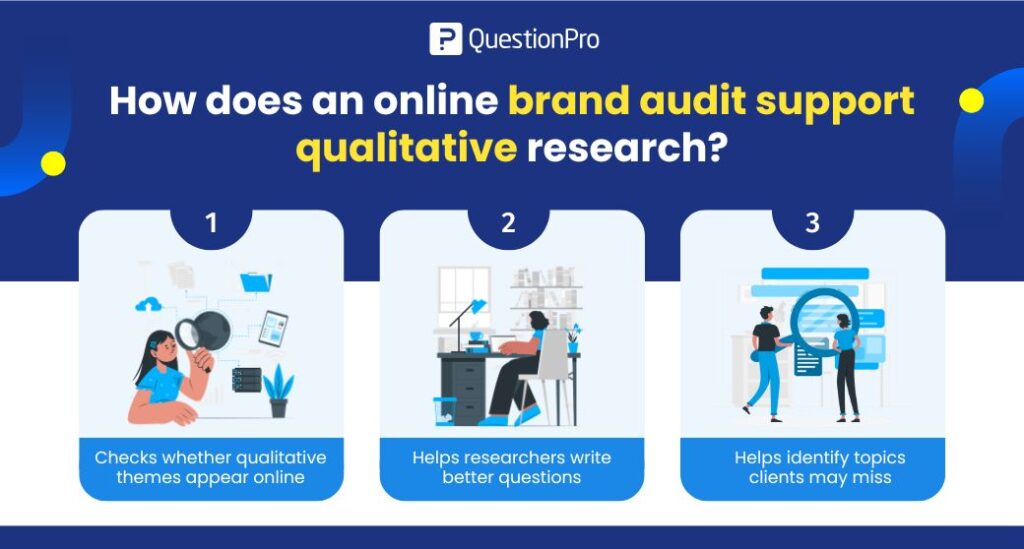
An online brand audit can support this work in three practical ways.
It checks whether qualitative themes appear online
If a focus group says a brand feels “trustworthy but expensive,” an online brand audit can check whether that same theme appears in reviews, forums, social comments, and competitor discussions.
This does not prove the theme is universal, but it helps researchers see whether the finding exists beyond one room.
It helps researchers write better questions
Online conversations can reveal customer language that clients do not use internally.
For example, a client may talk about “account enablement,” while customers talk about “getting started” or “setup help.” That difference matters when writing survey questions or interview prompts.
It helps identify topics clients may miss
Clients often know their products well, but they may not know every question customers ask online.
An audit can reveal concerns about pricing, onboarding, trust, support, product claims, shipping, usability, or comparison with competitors. Those findings can shape stronger research topics.
Online brand audit vs qualitative research: What is the difference?
An online brand audit reviews public digital signals, while qualitative research collects direct feedback from selected participants.
| Area | Online brand audit | Qualitative research |
|---|---|---|
| Main source | Public online data | Direct participant feedback |
| Main goal | Understand digital presence and online perception | Understand motivations, feelings, and reasons |
| Common inputs | Reviews, search results, social posts, forums, websites | Interviews, focus groups, open-ended survey responses |
| Strength | Shows public conversation and digital context | Explains why people think or behave a certain way |
| Limitation | Online comments may not represent the full market | Small samples may not reflect broader opinion |
| Best use | Research planning and brand perception checks | Deeper understanding and message exploration |
The two methods answer different questions. An online brand audit asks, “What signals are visible online?” Qualitative research asks, “Why do people think, feel, or behave this way?”
Used together, they give research firms a stronger foundation.
How can market research firms use online brand audits with clients?
Market research firms can use online brand audits as a planning tool, a standalone diagnostic, or a first step before deeper research.
Common use cases include:
- Preparing for focus groups.
- Building interview guides.
- Writing survey topics.
- Checking public sentiment before a brand tracker.
- Finding competitor positioning themes.
- Identifying gaps between brand messaging and customer language.
- Offering a lower-cost entry product for smaller clients.
- Creating a research roadmap for larger studies.
- Monitoring brand perception before and after a campaign.
- Helping clients understand reputation risks.
A practical example:
A small business wants qualitative research but cannot afford a large study. A market research firm can start with an online brand audit to review reviews, social comments, search results, and competitor messaging. Then the firm can recommend a focused survey or a smaller interview study based on the strongest themes.
This gives the client useful evidence without pretending that online data tells the whole story.
What are the limitations of online brand audits?
Online brand audits are useful, but they do not replace primary research.
Primary research is data collected directly from participants for a specific research question. Surveys, interviews, focus groups, and observations are common examples.
Online brand audits have clear limitations:
- Online comments are not always representative.
- Loud voices can distort perception.
- Sentiment tools may misread sarcasm, humor, or context.
- Some audiences do not share much online.
- Private customer experiences may never appear in public channels.
- Review platforms can attract extreme opinions.
- Digital visibility varies by industry.
- Competitor data may be incomplete.
- A brand audit cannot explain every motivation behind behavior.
This is why market research firms should treat an online brand audit as input, not final truth.
The audit can show what to investigate next. It should not be the only source used for major brand, product, or customer experience decisions.
How can QuestionPro help validate online brand audit findings?
QuestionPro can help research teams validate online brand audit findings with surveys, customer feedback, and audience research.
For example, if an audit shows that customers often mention pricing confusion, a research team can use QuestionPro to test whether that issue is common across a broader target audience. If online reviews suggest support delays are damaging brand perception, a team can survey customers after support interactions to measure how widespread the problem is.
Useful validation methods include:
- Brand awareness surveys.
- Customer feedback surveys.
- Concept testing surveys.
- Message testing.
- Customer satisfaction surveys.
- Open-ended feedback.
- Audience research.
- Post-purchase surveys.
QuestionPro’s brand awareness survey template can help teams measure recognition, recall, and perception. Its online survey software can also help research teams move from audit findings to structured data collection.
The goal is simple: use online brand audit findings to ask better questions, then use research to measure how much those findings matter.
Final thoughts on online brand audit reports and qualitative research
Online brand audit reports should not replace qualitative research. They should help market research firms ask better questions, test stronger assumptions, and give clients a broader view of brand perception.
A good audit can show what customers say in public. Qualitative research can explain why they say it. Surveys can measure how common the issue is across the target audience.
The strongest research approach uses each method for what it does well.
Frequently Asked Questions (FAQs)
The purpose of an online brand audit is to understand how a brand appears and is perceived across digital channels. It helps teams review search visibility, customer sentiment, reviews, social conversations, competitor comparisons, and reputation risks.
Yes. Online brand audit reports can help market research firms plan better focus groups, interviews, and surveys. They reveal public customer language, recurring complaints, competitor themes, and topics that may need deeper validation.
No. An online brand audit can show visible digital signals, but qualitative research explains motivations, emotions, and context through direct participant feedback. The two methods work better together than separately.
A digital brand audit may use website content, search results, social media posts, review sites, forums, customer comments, competitor pages, and public brand mentions. The exact sources depend on the industry and audience.
Many companies can benefit from an online brand audit once or twice a year. Fast-moving brands, competitive categories, or companies facing reputation issues may need more frequent reviews.
Surveys can test whether themes found online are common among a broader target audience. For example, if reviews mention pricing confusion, a survey can measure how many customers share that concern and why it matters.