Surveys are one of the most popular ways to collect feedback and understand people’s opinions. Businesses, researchers, and organizations rely on survey data to make important decisions. But what if the results don’t truly reflect what people think? Survey bias can quietly influence your results. It is a systematic error introduced into sampling or testing by selecting or encouraging one outcome or answer over others.
It happens when the survey design, questions, or audience affects how people respond. Often, this bias is unintentional, but it can still change the outcome and lead to incorrect conclusions. The biases present in survey design and responses can never be entirely eliminated, but awareness of them is crucial for minimizing their impact on data collection and analysis.
In this blog, we’ll explain survey bias, how it affects research, and ways to reduce bias so you can collect more honest and reliable insights.
What is Survey Bias?
Survey bias happens when a survey does not show people’s real opinions or experiences. Instead of honest answers, the results are influenced by how the survey is created or shared.
This can lead you to completely misinterpret the bigger picture. This can appear in many ways:
- It may come from confusing or leading questions.
- It can also happen when only a specific group of people is surveyed.
- Sometimes, respondents change their answers to look polite or socially acceptable.
Most of the bias is unintentional. Even small mistakes can affect the final results. That’s why understanding bias in your surveys is important for collecting accurate and trustworthy data.
Also Read: Identifying and Reducing Reference Bias in Surveys and Research
How Survey Bias Affects Research Results
Bias can significantly impact research by affecting results and leading to wrong conclusions. When surveys favor certain responses, the data fail to reflect the true opinions of the audience, making it less reliable.
Here’s how survey bias can affect research:
- Inaccurate Decisions: Businesses or organizations may make strategies or changes based on misleading data, which can harm growth or effectiveness.
- Missed Opportunities: Valuable feedback and insights may be overlooked, preventing improvements or innovations.
- Reduced Credibility: Research findings that don’t reflect reality can damage trust with customers, stakeholders, or the public.
- Wasted Time and Resources: Conducting surveys that produce biased results wastes effort, money, and time without delivering actionable outcomes.
- Biased Understanding: Bias can create a false impression of audience preferences, satisfaction, or behavior, affecting long-term planning.
- Flawed Data and Low ROI: Survey bias can give inaccurate data, leading to poor insights and weak results for your product or business.
Reducing bias in surveys ensures that research data is accurate, trustworthy, and useful for making informed decisions.
Learn More: Research bias: What it is, Types & Examples
3 Types of Survey Bias
When you’re conducting a survey, keep in mind that the results might not necessarily reflect people’s genuine opinions. Survey bias can seriously mess up your research and give you a pretty misleading idea of what people are really thinking.
Below are the key types of survey bias and how they happen:
- Sampling bias
- Response bias
- Interviewer bias
1. Sampling bias
Sampling bias happens when the selected participants do not represent the entire target audience. This leads to results that reflect only a specific group instead of the whole population.
Common examples of sampling bias include:
- Non-response bias
Non-response bias occurs when certain groups are left out of the survey altogether. For instance, conducting an online survey may exclude people who have limited internet access, resulting in incomplete insights.
- Self-selection bias
Self-selection bias happens when participation is voluntary, and only people with strong opinions choose to respond. For example, customers who are either very satisfied or very dissatisfied are more likely to complete feedback surveys, while neutral users may remain silent.
- Survivorship bias
Survivorship bias happens when the survey data includes only those who have completed a process and ignores non-respondents, which can affect the results by focusing on only those who remain or succeed.
2. Response bias
Response bias occurs when respondents do not answer questions truthfully or accurately due to question wording, survey design, or external pressure.
Common forms of response bias include:
- Extreme response bias
This type of survey bias is a type of bias where respondents consistently choose only the highest or lowest options on a scale. This bias appears when questions push respondents toward a particular answer.
For example, asking “How helpful was our excellent customer service?” encourages positive responses instead of honest feedback. - Neutral response bias
Neutral response bias happens when respondents struggle to remember past events accurately. In long-term experience surveys, participants may unintentionally provide incorrect information based on memory gaps.
Then survey questions are unclear, respondents may select neutral options, which can lead to biased insights and affect the reliability of research outcomes.
- Acquiescence bias
Acquiescence bias occurs when respondents agree with statements regardless of their genuine opinions, often to please the researcher, and this can be reduced by using balanced or opposite statements. This bias occurs when respondents give polite or positive answers to avoid offending the researcher or organization. This is common in employee or customer satisfaction surveys.
- Question order bias
If you ask people questions in the wrong order, you can influence them by the answers they gave earlier. A previous response can influence subsequent answers, affecting the consistency and reliability of the survey response.
So, for example, if you ask about overall satisfaction before you ask about specific features, people may adjust their answer to match the first one.
- Social desirability or conformity bias
Social desirability bias happens when respondents answer questions in a way they believe is socially acceptable rather than truthful. The importance of gathering truthful responses is critical, as social desirability bias can lead to biased responses and compromise the validity of the data.
For example, in health or workplace surveys, participants may underreport negative behaviors or opinions to present themselves positively.
Also check: How to identify and reduce convenience bias from surveys
3. Interviewer bias
Interviewer bias occurs when the presence or behavior of the interviewer influences how respondents answer questions. This survey bias is a specific form of survey and interview bias that happens when an interviewer’s behavior, stereotypes, or preconceptions affect the responses given. This bias is more common in face-to-face or phone surveys.
Examples of interviewer bias include:
- Tone and body language bias
An interviewer’s tone, gestures, or facial expressions can subtly guide respondents toward certain answers, even without direct intent.
- Reporting bias
It happens when interviewers misinterpret or inaccurately record responses, leading to errors during data analysis. Reporting bias occurs when data analysis selectively emphasizes or ignores specific responses.
Which Surveys are Most Affected by Bias
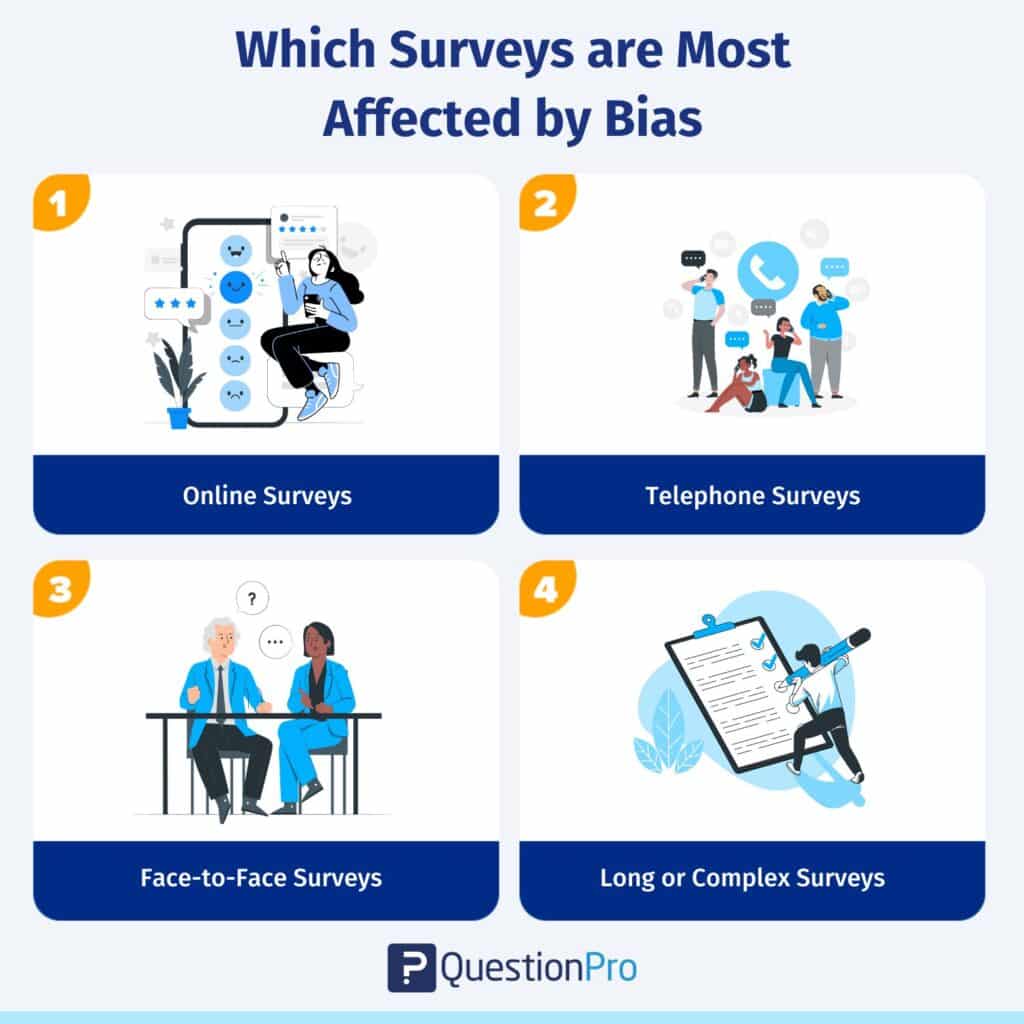
Not all surveys are affected by bias in the same way. Some surveys are more likely to have bias because of how they are designed, shared, or conducted. Knowing which surveys are most affected can help researchers plan better and get more accurate results.
- Online Surveys
Online surveys are easy to use, but can have sampling bias and non-response bias. People without internet or those not comfortable with technology may not take part. This survey bias can cause some groups to be overrepresented, which skews the results.
- Telephone Surveys
Telephone surveys can be affected by response bias and interviewer bias. Participants may give socially desirable answers to please the interviewer, and the interviewer’s tone or reactions can unintentionally influence responses.
- Face-to-Face Surveys
Face-to-face surveys often have interviewer and social desirability bias. People may give answers that seem acceptable. The interviewer’s presence can make them nervous.
- Long or Complex Surveys
Long questionnaires or complex surveys are particularly affected by non-response bias and acquiescence bias. Participants may drop out before completing the survey. Survey fatigue can cause respondents to become tired or disengaged, leading to less reliable data and potential biases.
Leaving some groups underrepresented, or they may answer quickly without thinking, just to finish the survey.
Using the right survey tools can help researchers gather data more effectively, reduce bias, and ensure the collection of valuable data for decision-making.
You May Also Like: What is Proximity Bias & How to Prevent It + Examples
How to Avoid Survey Bias
It’s important to avoid bias in surveys if you want to get some genuine, reliable, and actually useful data. The key is using proper sampling methods, designing clear questions that don’t have a bias to them, keeping things anonymous, and making sure your interviewers know what they’re doing.
The research team plays a crucial role in designing, conducting, and reviewing surveys to prevent bias in your surveys and minimize bias throughout the process. Additionally, using automated survey templates can help minimize survey bias by reducing biased questions.
Here, we will discuss some more ways of avoiding bias in your survey with examples for your better understanding:
1. Avoiding Selection Bias
You send a customer feedback survey only to your long-term customers. The results will likely be positive and miss the opinions of new or unhappy customers.
How to avoid it:
- Pick participants randomly: Don’t just survey the easiest-to-reach customers.
- Include more people: A larger sample gives a more balanced view.
- Balance your groups: Make sure different ages, locations, or customer types are included.
- Use multiple survey channels: Online, phone, or in-person surveys help reach everyone.
2. Avoiding Response Bias
You ask employees about workplace satisfaction face-to-face. Some may give positive answers just to avoid conflict, even if they are unhappy.
How to avoid it:
- Keep language simple: Everyone should understand the questions the same way.
- Randomize question order: Earlier questions shouldn’t influence later ones.
- Allow anonymity: Respondents are more honest if their identity is protected.
- Use balanced rating options: Prevent extreme responses by offering fair choices.
- Encourage thoughtful responses: Design your survey to prompt respondents to reflect and provide genuine, considered answers, which helps improve data quality and reduce response bias.
3. Avoiding Interviewer Bias
During a phone survey, the interviewer sounds excited about a product. Respondents may feel pressured to give positive answers.
How to avoid it:
- Train interviewers: Make sure they stay neutral in tone and wording.
- Test the survey first: Try it with a small group to spot issues before sending it out widely.
Survey Design and Characteristic Bias
How you design a survey plays a big role in whether the answers are reliable. Characteristic bias can creep in when questions are worded poorly or arranged in a way that subtly influences how people respond. When that happens, results can be misleading. People may react more to the tone, wording, or order of questions than to what they actually think.
To avoid this survey bias, survey questions should be simple, clear, and neutral. It’s best to stay away from emotional or leading language and make sure response options are balanced, so respondents don’t feel pushed toward a specific answer. This helps people answer honestly and comfortably.
It’s also important for survey creators to watch out for their own biases. These can unintentionally shape questions or survey structure. Getting feedback from others or running a small pilot survey can help spot and fix issues early. With careful design and regular review, surveys can reduce characteristic bias and produce more trustworthy results.
You May Also Like: Wording Bias: What it is with Examples
Biased Question Examples to Avoid in Your Survey
Survey questions can easily influence answers if they are not worded carefully. Confirmation bias can influence both how questions are phrased and how respondents answer, leading to skewed or biased data. Here are some common types of biased questions and better ways to ask them:
1. Leading questions
Some questions make it obvious what answer you want, which can affect honesty.
- Example: “Isn’t our customer support amazing?”
- Why it’s biased: People may feel they should agree even if they had a poor experience.
- Better version: “How satisfied are you with our customer support?”
Using balanced or opposite statements in your questions can help avoid acquiescence bias and encourage more genuine responses.
2. Double-barreled questions
When a question combines two ideas, it’s hard for respondents to answer clearly.
- Example: “Do you think our product is affordable and high quality?”
- Why it’s biased: Respondents might think it’s affordable but not high quality, leading to confusing answers.
- Better version: Ask separate questions:
- “How affordable do you find our product?”
- “How would you rate the quality of our product?”
3. Loaded questions
These questions assume something is true, which can push answers in one direction.
- Example: “How much do you dislike waiting times at our store?”
- Why it’s biased: It assumes people dislike waiting, which may bias responses.
- Better version: “What do you think about the waiting times at our store?”
4. Extreme wording questions
Words like “always” or “never” can influence responses.
- Example: “Do you always shop with us instead of competitors?”
- Why it’s biased: Most people don’t “always” do anything, so answers may be inaccurate.
- Better version: “How often do you shop with us compared to other stores?”
5. Yes/No Questions
Simple yes/no questions can oversimplify opinions.
- Example: “Are you happy with our services?”
- Why it’s biased: It doesn’t capture varying levels of satisfaction.
- Better version: “How would you rate your satisfaction with our services?” (Use a scale like 1–5)
Recommended Read: Stupid Questions To Avoid When Writing A Survey!
How QuestionPro Helps Reduce Survey Bias
Survey bias can quietly affect your results and lead to wrong decisions. Effective data collection is essential for accurate feedback and reliable market research, as it ensures that the information gathered truly represents your target audience.
If your survey doesn’t reach the right people or the questions influence answers, the data won’t reflect real opinions. QuestionPro helps you avoid these issues by making surveys fair, clear, and easy for people to respond to.
Using tools like QuestionPro can help ensure data collection processes yield accurate feedback and support valid market research outcomes.
1. Avoid selection bias by reaching the right people
Share surveys through:
- Web links
- QR codes and
- Mobile to reach more people
Use random distribution to avoid surveying only a specific group. Apply demographic filters to ensure balanced responses. QuestionPro allows you to manage diverse audiences with panel and sample tools. This ensures your survey includes different types of respondents, not just a select few.
2. Reduce response bias with clear and neutral questions
Create simple, neutral questions with QuestionPro that don’t push respondents toward an answer. Shuffle questions and answer options to prevent order bias. You can also turn on anonymous response settings so people feel comfortable being honest.
Use balanced rating scales to avoid extreme responses. These steps help respondents answer based on their true experience.
3. Prevent interviewer bias with a consistent survey experience
You can use self-guided online surveys to remove interviewer influence with QuestionPro. Keep the same question format for all respondents. Test surveys to catch confusing or biased questions before launch. This keeps the survey experience fair for everyone.
Data Analysis Strategies for Identifying and Avoiding Bias
After collecting survey data, the real work begins. Careful analysis is key to spotting bias that may have slipped in during the survey. A good first step is to look for response patterns that don’t seem natural, such as many people always picking the most positive or most negative option.
This can be a sign of extreme responding or people answering in a socially acceptable way rather than honestly.
Missing responses also matter. If certain questions are skipped or some groups drop out before finishing the survey, it can point to non-response survey bias. That usually means parts of your audience aren’t fully represented.
Using methods like regression analysis can help uncover these gaps and adjust the results so they better reflect the full population.
Visual tools like charts and graphs are also useful. They make it easier to spot odd patterns, outliers, or trends that may signal bias. By reviewing the data step by step and from different angles, researchers can catch issues early, avoid wrong conclusions, and turn survey results into insights they can actually trust and use.
Conclusion
Survey bias is a common challenge in research, but it can be reduced with the right approach. From how questions are written to who takes the survey, every step matters. Even small mistakes can affect results and lead to misleading conclusions.
By understanding the different types of survey bias and knowing which surveys are most affected, researchers can design better studies. Simple steps like using clear questions, reaching a diverse audience, and allowing anonymous responses can make a big difference.
Tools like QuestionPro can also help reduce bias in surveys by offering features such as randomized question order, survey logic, audience targeting, and multiple distribution channels. These tools make it easier to design unbiased surveys, reach the right respondents, and collect reliable data.
Reducing survey bias ensures that insights reflect real opinions and experiences. This leads to more accurate research, better decision-making, and results you can trust.
Frequently Asked Questions (FAQs)
Answer: Survey bias happens when survey results do not reflect the true opinions or behaviors of respondents. It is usually caused by poor survey design, unbalanced samples, or leading questions.
Answer: The main types of survey bias include sampling bias, response bias, and interviewer bias. Each type affects survey results in different ways.
Answer: No, survey bias cannot be completely eliminated. However, it can be reduced by using clear questions, representative samples, and neutral survey design.
Answer: An example of survey bias is asking only satisfied customers to complete a feedback survey. This excludes unhappy customers and creates overly positive results.
Answer: Online surveys, telephone surveys, face-to-face surveys, and long surveys are more likely to be affected by bias due to sampling issues and respondent behavior.
Answer: Reducing survey bias helps ensure survey results are accurate, trustworthy, and useful for making informed decisions.