Brand trust measurement is the process of evaluating how confident customers feel about a brand’s reliability, honesty, and ability to deliver on its promises. In the United States, where consumers have many alternatives, trust often determines which brand they choose.
Companies often monitor signals like reviews, repeat purchases, or social media mentions. But the most accurate way to measure trust is through a brand trust survey. Surveys capture customer perceptions directly instead of inferring them from behavioral data.
A well-designed survey allows organizations to measure trust, identify the factors that influence it, and track how trust changes over time.
In this guide, we’ll explore how to measure brand trust, the most important brand trust metrics, and how surveys reveal what customers truly think about a brand.
What is brand trust measurement?
Brand trust measurement evaluates consumer confidence in a brand’s ability to deliver consistent value and act in the customer’s interest.
In research, trust is usually built from three core perceptions:
- Reliability: The brand consistently delivers what it promises
- Credibility: The brand communicates honestly and transparently
- Customer orientation: The brand prioritizes customer needs and fairness
Brand trust measurement goes beyond satisfaction. It evaluates whether customers believe the brand will behave responsibly in the future.
In competitive markets like the United States, trust strongly influences loyalty, repeat purchases, and brand advocacy. According to the Edelman Trust Barometer, trust is a major factor shaping whether consumers recommend brands or remain loyal during market uncertainty.
Why do companies measure brand trust?
Organizations track brand trust metrics because trust often predicts long-term customer behavior.
Tracking brand trust metrics helps organizations:
- Understand how customers perceive brand credibility
- Detect early warning signs of declining reputation
- Identify the drivers of customer loyalty and advocacy
- Track brand health over time
- Compare trust levels with competitors
A decline in trust often appears before drops in retention or revenue. For this reason, many companies treat brand trust measurement as an early warning signal for brand health.
What are the most important brand trust metrics?
Brand trust can be measured through several indicators. These metrics help researchers understand how customers evaluate a brand’s credibility, customer experience, and long-term reliability.
- Net Promoter Score (NPS)
Net Promoter Score measures how likely customers are to recommend a brand to others on a scale from 0 to 10. A higher NPS often signals stronger trust because customers are confident enough to associate their reputation with the brand.
- Customer Satisfaction Score (CSAT)
Customer Satisfaction Score measures how satisfied customers are with a product, service, or interaction. Consistently high CSAT scores indicate that customers feel confident about the brand’s ability to deliver positive experiences.
- Customer Effort Score (CES)
Customer Effort Score evaluates how easy it is for customers to resolve issues or complete interactions with a brand. Lower effort levels often increase trust because customers perceive the brand as competent and customer-focused.
- Brand Credibility Score
Brand credibility measures whether customers believe a brand’s claims and messaging. When credibility scores are high, customers tend to view the brand as honest, knowledgeable, and dependable.
- Customer Retention Rate
Customer retention rate measures how many customers continue buying from a brand over time. High retention often signals strong trust because customers feel confident continuing the relationship rather than switching to competitors.
Learn more: What is reputation management and how to protect your brand reputation
How does a survey work to measure brand trust?
A brand trust survey is a structured questionnaire used to measure how customers perceive a brand’s reliability, transparency, and customer orientation.
Most surveys use a Likert scale, a rating scale that measures agreement with a statement.
Typical scale example:
- 1 = Strongly disagree
- 5 or 7 = Strongly agree
Researchers usually include 8 to 15 statements covering different trust dimensions. Multiple questions improve reliability and reduce measurement error.
How does brand trust influence customer loyalty?
Trust shapes customer behavior in ways traditional brand metrics cannot fully explain.
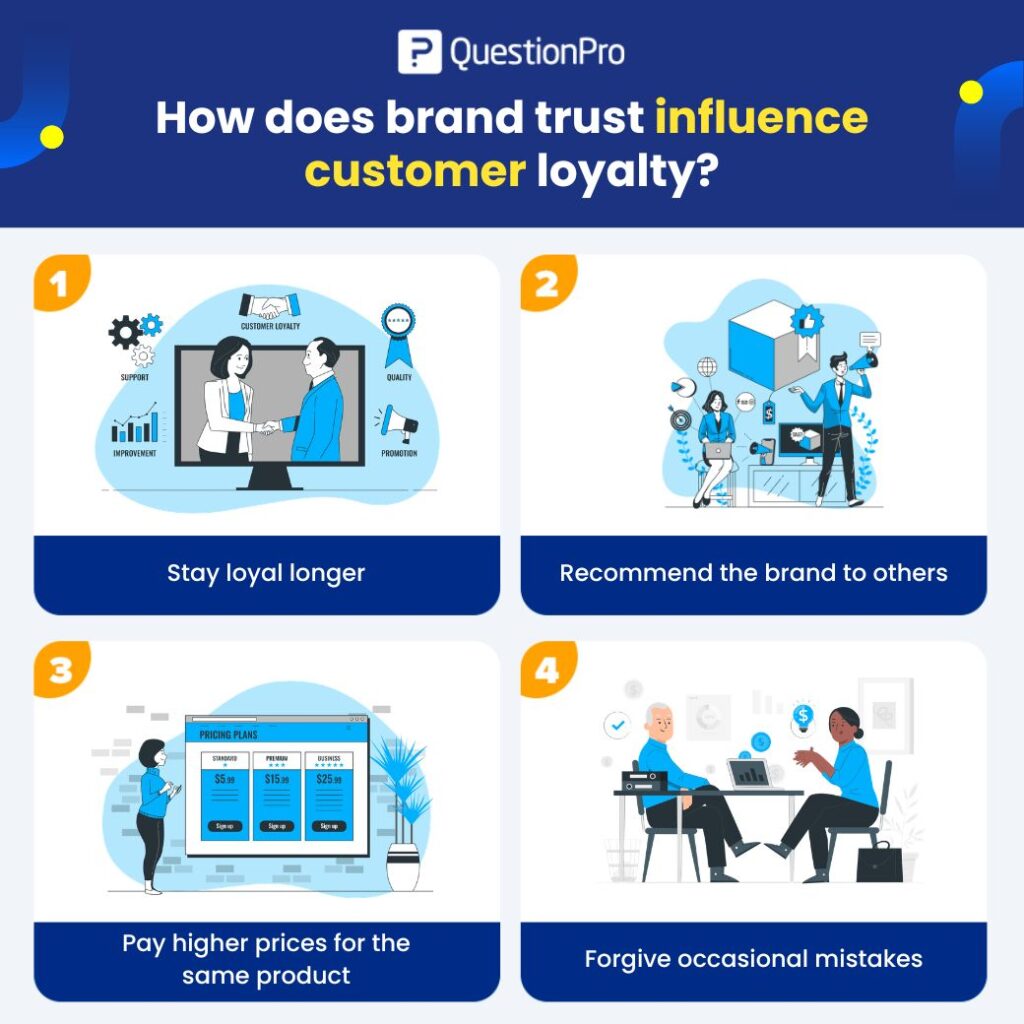
When customers trust a brand, they are more likely to:
- Stay loyal longer
- Recommend the brand to others
- Pay higher prices for the same product
- Forgive occasional mistakes
In the US market, where consumers compare multiple brands before purchasing, trust often becomes the deciding factor.
For example, when two brands offer similar products and prices, consumers usually choose the one they trust more.
What questions should you include in a brand trust survey?
A well-designed customer trust survey measures multiple dimensions of trust rather than relying on a single question. Each dimension captures a different perception customers have about a brand, which helps researchers understand what drives or weakens trust over time.
Core Trust Questions
Core trust questions measure the overall level of confidence customers have in a brand.
Example questions:
- How much do you trust our brand overall?
- How confident are you when purchasing products from our brand?
Reliability
Reliability measures whether the brand consistently delivers on its promises.
Example questions:
- How strongly do you agree that our brand keeps its promises?
- How consistent is the quality of our products or services?
- How reliable do you consider this brand compared with competitors?
Transparency
Transparency evaluates whether customers believe the brand communicates honestly.
Example questions:
- How honest is our brand in its communication with customers?
- How transparent is our brand about pricing and policies?
Customer Care
Customer care measures whether customers feel valued and treated fairly by the brand.
Example questions:
- How fairly does our brand treat its customers?
- How effectively does our brand resolve customer problems?
Ethics and Responsibility
Ethical behavior often plays an important role in brand trust. It assesses whether customers believe the brand behaves responsibly toward society and its customers.
Example questions:
- How strongly do you believe our brand operates ethically?
- How confident are you that our brand protects customer data?
Together, these survey questions help researchers identify trust drivers, the brand perceptions that influence how customers evaluate and trust a brand.
How do you measure brand trust with surveys?
Organizations typically follow a structured process to conduct brand trust measurement. A clear methodology helps ensure the results are reliable and useful for decision-making.
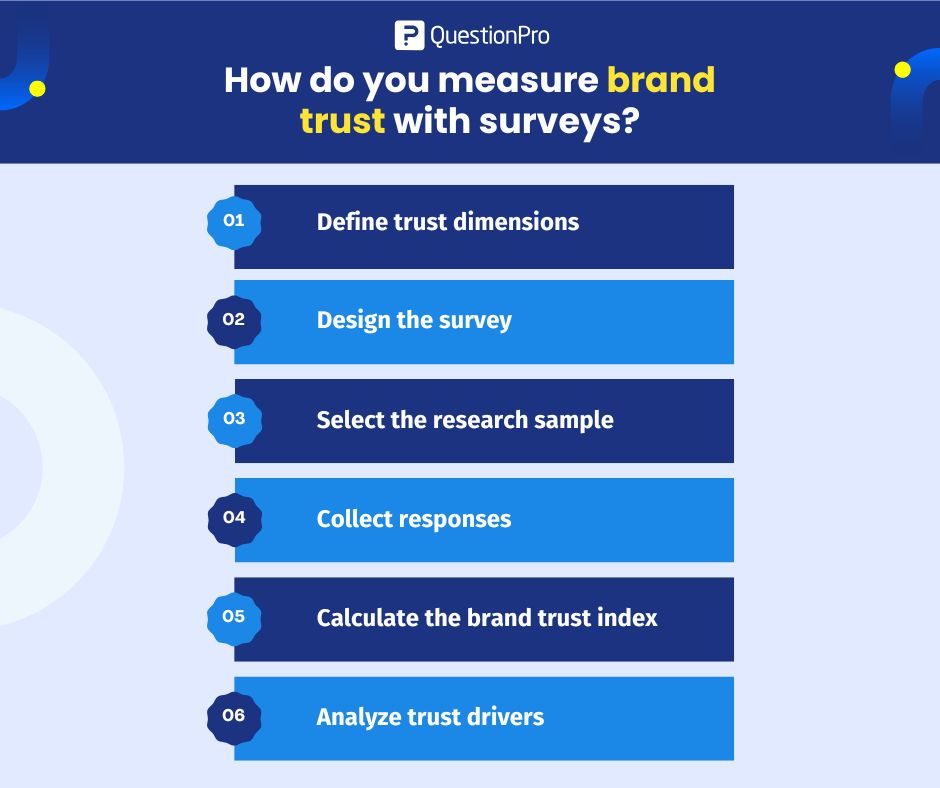
Step 1: Define trust dimensions
Start by identifying the aspects of trust your research should measure. Most brand trust surveys evaluate perceptions such as:
- Whether the brand consistently delivers on its promises
- How openly the brand communicates with customers
- Whether customers believe the brand maintains high standards
- How fairly and effectively the brand treats customers
- Whether the brand acts responsibly toward customers and society
Defining these dimensions helps ensure the survey captures the full picture of customer trust.
Step 2: Design the survey
Create multiple trust statements using a Likert scale. Including metrics such as Net Promoter Score (NPS) or Customer Satisfaction Score (CSAT) can help connect customer experience with trust perceptions.
Step 3: Select the research sample
Choose respondents who represent your target audience. This may include:
- Current customers
- Recent buyers
- Potential customers in the market
A well-balanced sample ensures the results reflect real market perceptions rather than feedback from a limited group.
Step 4: Collect responses
Distribute the survey through channels that make participation easy. Common options include:
- Email survey invitations
- Website or in-app surveys
- Research panels
- Mobile survey apps
Short, easy-to-complete surveys typically produce higher response rates and more accurate feedback.
Step 5: Calculate the brand trust index
Combine responses from trust-related questions to calculate an overall score. Many organizations convert the result into a brand trust index, often ranging from 0 to 100.
Step 6: Analyze trust drivers
The final step is identifying which perceptions most influence trust. Researchers often analyze the data to answer questions such as:
- Which trust dimensions score highest or lowest?
- Which factors correlate with loyalty or recommendation?
- Are trust levels changing across customer segments?
Understanding these drivers helps companies prioritize improvements that strengthen long-term customer relationships.
Learn about: How brand perception surveys help understand and improve brand image
What tools can help measure brand trust through surveys?
Organizations often use specialized survey platforms to conduct brand trust measurement at scale. These tools help researchers design questionnaires, collect responses, and analyze trust metrics in a structured way.
Survey platforms typically provide features such as:
- Customizable survey templates
- Likert scale question types
- Automated data collection
- Real-time dashboards for survey results
- Segmentation and reporting tools
One example is QuestionPro Survey Software, which allows researchers to create brand trust surveys, distribute them across multiple channels, and analyze responses in a centralized dashboard.
Platforms like QuestionPro can help teams:
- Build surveys that measure trust drivers such as reliability, transparency, and credibility
- Track trust scores over time through brand tracking studies
- Segment results by customer groups or demographics
- Identify which experiences most influence trust and loyalty
Using dedicated survey software helps organizations conduct consistent brand trust research, especially when tracking trust trends across multiple markets or time periods.
How often you should measure brand trust?
Brand trust measurement is usually tracked as part of a brand tracking study.
Typical measurement cycles include:
- Quarterly surveys for large brands
- Biannual surveys for mid-sized companies
- Annual brand health studies
Many US companies also monitor trust continuously using social listening tools. These tools analyze online conversations and reviews to detect shifts in public sentiment.
Trust levels can change quickly after product failures, data breaches, or negative media coverage. Continuous monitoring helps organizations respond faster to reputation risks.
Why does brand trust matter in the US market?
The United States is one of the most competitive consumer markets in the world. Customers regularly compare brands, read reviews, and share experiences online before making decisions.
Trust influences many industries, including:
- ecommerce
- financial services
- technology
- healthcare
- subscription services
Brands that maintain high trust levels are more likely to retain customers and introduce new products successfully. For many American companies, brand trust measurement is considered a core indicator of brand health alongside awareness and satisfaction.
Frequently asked questions (FAQs)
Brand trust measurement evaluates how confident customers are that a brand will deliver on its promises and treat customers fairly. It is typically measured through surveys that assess perceptions such as reliability, transparency, and credibility.
Net Promoter Score (NPS) does not measure trust directly. It measures willingness to recommend a brand, which is often influenced by customer trust and satisfaction.
Yes. Customer Satisfaction Score (CSAT) and Customer Effort Score (CES) provide insight into the quality of customer experiences, which strongly influence trust.
A brand trust index is a standardized score, usually ranging from 0 to 100, calculated from survey responses that measure customer trust across multiple dimensions.
Most organizations measure brand trust once or twice per year as part of a brand tracking study. Companies in sensitive industries such as finance or technology often measure trust quarterly.
Yes. Trust is one of the strongest predictors of customer loyalty. When trust scores decline, companies often see future drops in retention, recommendation, and repeat purchases.