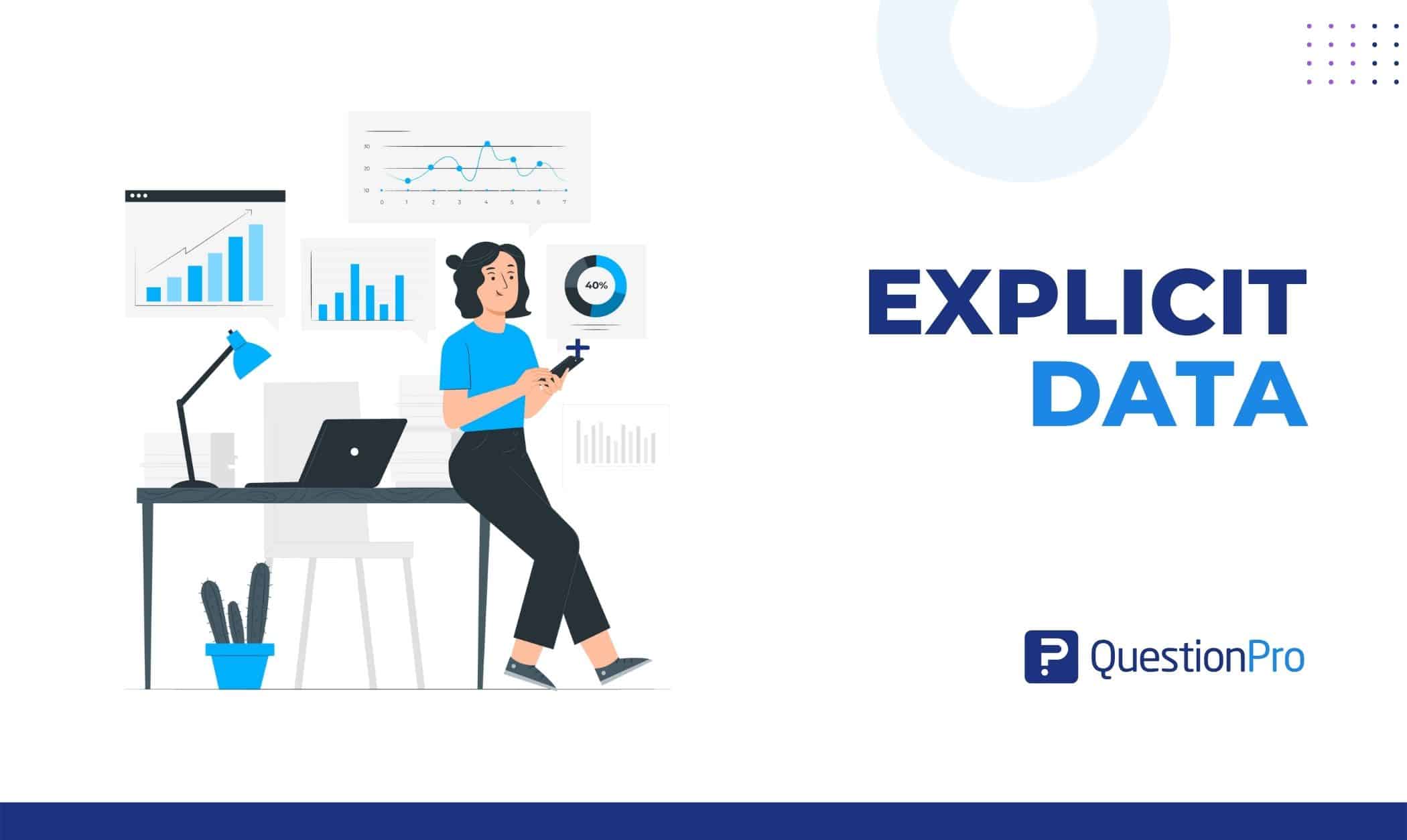
Explicit data is any information a customer or user hands over on purpose, like their name, an email address, or an answer to a survey question. It is the most direct signal you can get about what someone wants, because they told you themselves instead of you having to guess.
Most companies already collect explicit data every day through sign-up forms, satisfaction surveys, and product reviews. The problem is that a lot of it sits unused, gets duplicated across different tools, or never gets compared against how customers actually behave.
In this guide, we’ll cover what explicit data means, how it compares to implicit data, real examples, and how to collect and use it well.
What is explicit data?
Explicit data is information a person shares with you knowingly and voluntarily, without you needing to infer or interpret anything.
If a shopper selects a size and style preference while setting up an account, that is explicit data. If a customer rates a support call one to five stars, that is explicit data too. In both cases, the person made a conscious choice to tell you something, rather than you having to piece it together from what they clicked or how long they stayed on a page.
Explicit data is not the same as explicit knowledge, a knowledge management term for documented processes, manuals, and SOPs a company keeps for its staff. That’s a separate discipline built around internal documentation, not customer or user data, and the two terms get mixed up often enough that it’s worth stating plainly here.
Explicit data is also frequently discussed alongside implicit data, which is inferred from behavior such as clicks, time on page, or purchase history rather than stated directly. The next section breaks down that difference in more detail.
Explicit data vs. implicit data: What’s the difference?
The core difference comes down to intent. Explicit data is declared on purpose. Implicit data is observed, not declared, and has to be interpreted before it means anything.
| Factor | Explicit data | Implicit data |
|---|---|---|
| Source | Directly stated by the person | Inferred from behavior |
| Example | Survey answer, profile field, star rating | Pages visited, time on site, cart abandonment |
| Accuracy | Reliable but can go stale over time | Reflects real behavior but needs interpretation |
| Collection effort | Requires the person to act (fill a form, answer a question) | Collected passively in the background |
| Best use | Understanding stated needs and preferences | Understanding actual behavior patterns |
Neither type replaces the other. A customer might declare interest in a product category on a form and then never click on anything in that category again. Comparing what someone says against what they do is usually more useful than relying on just one side.
Types and examples of explicit data
Explicit data shows up in more places than most teams realize. Common examples include:
- Survey and questionnaire responses, including satisfaction scores and open-ended feedback
- Registration and sign-up form fields, such as name, email, job title, or company size
- Star ratings and reviews left on a product or service
- Net Promoter Score responses, where a customer rates how likely they are to recommend a brand
- Preference center selections, like choosing email topics or communication frequency
- Membership or account application details, such as stated interests or intended use
Each of these examples has one thing in common: the person made an active choice to share it. This is also what separates explicit customer data from data that gets collected passively as a byproduct of browsing or using a product.
Why explicit data matters for customer experience and research
Explicit data matters because it tells you what people actually want, in their own words, instead of leaving you to guess from behavior alone. That makes it a foundation for personalization, product decisions, and research that holds up when someone asks how you arrived at a conclusion.
Personalization built on clear, stated preferences performs measurably better than guesswork. McKinsey research found that 71 percent of consumers expect companies to deliver personalized interactions, and 76 percent get frustrated when this doesn’t happen, which is difficult to deliver without knowing what customers have actually said they want. Explicit data is often the fastest way to close that gap, because it comes with a stated preference attached rather than a pattern you have to interpret.
It also supports better customer data management overall, since explicit records tend to be structured and easier to organize than behavioral logs pulled from multiple systems.
For research teams specifically, explicit data gives you something behavioral tracking can’t: a reason. A drop in usage tells you something changed. A survey response can tell you what changed and why, which is usually the piece a team actually needs before deciding what to fix.
How to collect explicit data
Collecting explicit data well comes down to asking clearly, asking at the right moment, and checking that what you collect stays accurate.
- Ask direct questions at natural touchpoints.
Add a short survey after a purchase, a support ticket, or a key product milestone, rather than a single long form at sign-up.
- Keep forms short and specific.
Every extra field lowers completion rates. Ask only for what you will actually use.
- Use structured data collection methods.
Surveys, rating scales, and preference centers produce cleaner, more comparable data than open text fields alone.
- Give people a reason to respond.
Explain briefly why you’re asking and what it changes for them, such as more relevant recommendations or faster support.
- Check data quality regularly.
Track response rates and completion rates, and refresh stale fields like job titles or interests on a set schedule instead of assuming they still hold.
Tools built for structured surveys, such as online survey software, make steps one through four easier to run consistently across a large customer base, since the format and logic stay the same for every respondent.
When to rely on explicit data vs. implicit data
The right choice depends on whether you need a stated preference or a behavior pattern. Here’s a simple way to decide:
Reach for explicit data when you need to:
- Confirm a stated preference, like a communication channel or product interest
- Understand the reason behind a change, not just that it happened
- Build a profile field you can act on immediately, such as a size or plan tier
Reach for implicit data when you need to:
- Understand behavior at scale, where asking everyone directly isn’t practical
- Track what people actually do rather than what they say they’ll do, as with behavioral targeting
- Spot patterns without adding another question to the customer’s plate
In practice, most mature data strategies use both together. A stated preference tells you intent. Observed behavior tells you whether that intent held up. When the two disagree, that gap is often worth investigating rather than ignoring.
Common mistakes with explicit data
The most common mistake is collecting explicit data and never acting on it. If a customer states a preference and nothing changes afterward, they notice, and they’re less likely to answer the next survey.
A second mistake is treating old explicit data as permanent. Job titles change, interests shift, and a preference collected two years ago may no longer be accurate. Data that never gets refreshed becomes a liability rather than an asset.
A third mistake is asking for more than you need. Long forms and frequent surveys create fatigue, which lowers both response rates and the accuracy of the answers you do get. Shorter, well-timed requests consistently outperform long ones.
A fourth mistake is trusting explicit data on its own, without ever checking it against behavior. If most customers say they prefer a feature but usage data shows nobody opens it, that gap deserves a follow-up question rather than a decision based on the survey alone.
How QuestionPro helps with explicit data collection
QuestionPro’s survey tools are built around collecting explicit data cleanly and consistently, so responses stay comparable over time instead of scattered across disconnected forms. That includes:
- Structured question types and rating scales that keep responses consistent across every respondent
- Built-in Net Promoter Score tracking for ongoing sentiment data
- Reporting that makes it easier to spot when a stated preference and actual behavior start to diverge
None of this requires stitching together data from several unrelated tools by hand.
Getting more value from what customers already tell you
Most companies already have more explicit data than they use well. The bigger opportunity usually isn’t collecting more of it, it’s asking better questions, keeping what you collect current, and actually acting on what people tell you. That’s what turns a form field or a survey answer into a decision worth making.
Frequently Asked Questions (FAQs)
Not exactly. First-party data includes anything a company collects directly, including behavioral data from its own website or app. Explicit data is a subset of first-party data limited to information someone consciously chose to share, like a form answer or survey response.
Survey data is explicit data. A respondent is consciously choosing their answer to a specific question, which is the defining trait of explicit data regardless of the survey format or length.
Less than most forms ask for. Under privacy laws like the California Consumer Privacy Act, companies should only collect data tied to a clear, disclosed purpose, which also tends to improve completion rates on forms and surveys.
Yes. People sometimes misstate preferences, skip questions, or provide outdated details that were accurate when submitted but no longer are. This is why refreshing explicit records periodically matters as much as collecting them in the first place.
Zero-party data is a term for explicit data shared specifically to shape a company’s future experience or offer, such as a stated product preference. It overlaps heavily with explicit data but emphasizes the customer’s intent to personalize what comes next.