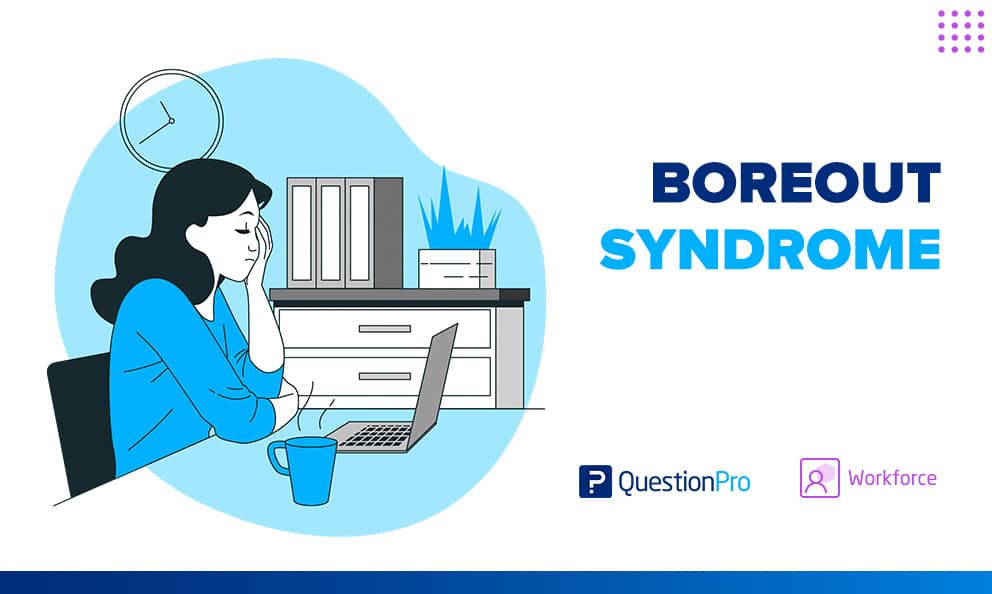
Boreout syndrome is a state of chronic boredom, low interest, and lack of challenge at work. It comes from having too little meaningful work, not too much. Employees feel stuck, drained, and quietly checked out.
Many managers miss it because the person still looks busy. Boreout hides behind slow email replies, long meetings, and polite smiles.
In this guide, we break down what boreout is, how it differs from burnout, how to measure it, and what managers and employees can do about it.
What is boreout syndrome?
Boreout syndrome is a work-related condition caused by long-term mental underload: too little work, work that is too easy, or work that feels pointless. The person stays bored, uninterested, and unchallenged for months at a time.
Swiss consultants Philippe Rothlin and Peter Werder coined the term in their 2007 book Diagnose Boreout. According to Wikipedia’s summary of the research, they described three parts: boredom, lack of challenge, and lack of interest. Earlier, in 1991, researcher Barry Farber had described a similar pattern as “underchallenged burnout” in teachers.
Boreout is not an official medical diagnosis. Researchers treat it as an occupational stress pattern, and it often overlaps with depression, anxiety, and disengagement.
Boreout vs burnout vs brownout vs quiet quitting
Boreout and burnout feel similar but start from opposite causes. Burnout follows too much stress, as this guide on how to identify and prevent employee burnout explains. Boreout follows too little stimulation.
The World Health Organization defines burnout as a syndrome from chronic workplace stress that has not been successfully managed. Boreout has no matching entry because its root is underload, not stress.
| Term | Main cause | Typical signal | Common fix |
|---|---|---|---|
| Boreout | Too little meaningful work | Boredom, pretending to be busy | More challenge, variety, growth |
| Burnout | Chronic overwork and stress | Exhaustion, cynicism | Less load, more recovery |
| Brownout | Loss of meaning or purpose | Detachment, going through the motions | Reconnect work to purpose |
| Quiet quitting | Doing only the minimum | Strict limits on effort | Fix the cause, which may be any of the above |
Quiet quitting is a behavior, not a cause. Boreout is one of several reasons an employee may start doing the bare minimum.
What causes boreout syndrome?
Boreout usually has a mix of job design, management, and culture causes. No single one explains every case.
- Too few tasks: The workload is light, so the day has long stretches with nothing to do.
- Repetitive work: The same low-skill tasks repeat daily, with no variety or new learning.
- Overqualification: Skills and experience far exceed what the role asks for.
- No growth path: The employee sees no promotion, new project, or skill-building ahead.
- Unclear or meaningless work: The person cannot see why the tasks matter to customers or the business.
- A culture of presence: Being seen at a desk counts more than results, so people stretch simple tasks to look busy.
Researchers Misun and Hudakova argue that this last cause is central. In their overview, they tie boreout to employees who pretend to be overworked in cultures that reward visible busyness.
What are the symptoms of boreout?
Boreout symptoms show up in mood, behavior, and body. Most look like ordinary tiredness at first, which is why they go unnoticed.
Emotional symptoms
- Low motivation and frequent boredom
- Irritability and anxiety about the work week
- Lower self-esteem and a sense of wasted potential
Behavioral symptoms
- Stretching small tasks to fill the day
- Looking busy while doing little
- Withdrawing from colleagues and meetings
- Surfing the web or handling personal tasks at work
Physical symptoms
- Headaches and stomach upset
- Poor sleep
- Frequent minor illnesses
Frankfurt psychotherapist Wolfgang Merkle, quoted in Wikipedia’s overview, notes that the physical picture can resemble burnout. Persistent symptoms deserve attention from a doctor or mental health professional, not a workplace fix alone.
Real-world examples of boreout
These are illustrative scenarios, not case studies. They show how boreout looks in different roles.
- The overqualified analyst.
A data analyst with a master’s degree spends most days reformatting the same weekly report. The task takes two hours. She stretches it to a full day and stops proposing new ideas. - The remote employee with no feedback.
A support agent in a quiet queue finishes tickets by noon. No one asks about the rest of the day. He fills it with low-value busywork and starts job hunting. - The long-tenured specialist.
A ten-year employee has mastered every part of the role. Nothing new arrives. He avoids team meetings, answers questions curtly, and counts the days to retirement.
Each person is productive on paper. Each is also a retention risk.
How common is boreout?
No one has reliable, current US prevalence data for boreout itself. Most figures track related ideas such as boredom or disengagement, so treat them as signals, not exact rates.
| Measure | Figure | Source |
|---|---|---|
| European employees who said they had nothing to do | 32% | 2008 StepStone study of 11,238 people, reported by Welcome to the Jungle |
| Employees who feel constantly bored at work | 15% | Persometrics, reported by Talkspirit |
| Employees engaged at work worldwide, 2025 | 20% | Gallup State of the Global Workplace |
| Employees engaged in the US and Canada, 2025 | 31% | Gallup State of the Global Workplace |
Gallup also reports that 64% of employees worldwide are not engaged. Boreout is one likely contributor, though the data cannot say how much.
What does boreout cost an organization?
Boreout costs organizations through quality, retention, and customer experience. The damage is quiet, so it rarely appears on a dashboard until people leave.
Researcher Ruth Stock studied frontline staff in 2015 and 2016. Her work, listed in Wikipedia’s reference list, examined whether boreout limits innovative behavior and customer orientation at work.
Wellbeing data helps here, and these employee wellbeing survey questions are a useful starting point. The practical risks are easy to name:
- Fewer new ideas from capable people
- Lower service quality in customer-facing roles
- Higher voluntary turnover among top performers
- Negative moods that spread to nearby teammates
- Higher absence from stress-related symptoms
How do you measure boreout in your team?
You measure boreout by asking about workload, challenge, and meaning, then looking for patterns by team, tenure, and role. One low score is not proof. A cluster of them is.
A short survey works well. Use a 5-point agreement scale and include items such as:
- “My work challenges me to use my skills.”
- “I have enough meaningful work to fill my day.”
- “I often look for ways to appear busy.”
- “I can see how my work affects customers or the business.”
- “I have learned something new at work in the last 90 days.”
Set your own flag rules before you collect data. For example, treat any team where more than 25% of people disagree with the first two items as a priority group. Compare those results with absence, turnover, and manager notes.
A pulse survey repeated every few weeks shows whether scores move after you act. A broader employee engagement survey gives the baseline.
Step-by-step guide to preventing boreout
Prevention starts with matching work to skill and giving people reasons to grow. These steps suit most managers.
- Audit workload.
Ask each person to log their tasks for two weeks. Look for gaps and repetition. - Rotate tasks.
Move routine work among team members so no one carries it alone. - Add stretch projects.
Give capable people a project slightly above their comfort level. - Connect work to impact.
Share customer feedback and business results with the people who did the work. - Offer learning time.
Set aside a few hours a month for courses, mentoring, or cross-team shadowing. - Hold regular one-on-ones.
Ask what feels too easy, not just what feels hard. - Reward results, not presence.
Judge output and quality, and drop expectations to look busy. This is a workplace culture shift, not just a task change.
Flexible schedules help too, as long as the freed time goes to growth and not to more empty hours.
How do you decide which fix to use?
Pick the fix that matches the cause. A task-rotation plan does not help someone whose role sits well below their skill level.
| If the cause is… | Start with… | Watch for… |
|---|---|---|
| Too little work | Rebalance workload across the team | Resentment from busier colleagues |
| Repetitive work | Rotate tasks or automate them | Skills gaps on rotation |
| Overqualification | Stretch projects or a role change | Impatience if no path opens |
| No growth path | Career conversation and learning plan | Promises that are not kept |
| Unclear purpose | Share customer and business impact | Generic messages that feel hollow |
| Presence culture | Change how performance is judged | Managers who still reward long hours |
When several causes overlap, fix the one the employee names first. Their view is the best signal you have.
What to do if you are experiencing boreout
If you think you have boreout, name the problem and act on it early. It rarely resolves by waiting.
- Write down what is missing: Is it variety, challenge, growth, or purpose?
- Ask for more: Tell your manager which skills you want to use and propose a specific project.
- Reshape your role: Researchers call this job crafting: adjusting your tasks and relationships to fit your strengths.
- Build skills outside work hours if the role cannot change right away.
- Talk to someone: A mentor, HR partner, or therapist can help.
- Consider a move: An internal transfer or new job may be the right answer if the role will not change.
Fear of losing income often keeps people in boring jobs. A clear plan makes staying or leaving a choice, not a trap.
Common mistakes when addressing boreout
Most fixes fail because they treat boreout like burnout. Giving a bored employee a day off does not give them a reason to care.
- Assuming laziness: Quiet, low-effort behavior is often a symptom, not a trait.
- Adding random tasks: More busywork makes boredom worse. The work must be meaningful.
- Skipping the conversation: Do not guess. Ask the employee what would help.
- Using only engagement scores: A single average can hide a bored group inside a healthy team.
- Ignoring top performers: Strong employees are the most likely to leave when understimulated.
- Making one-time fixes: Boreout returns if the role stays the same.
How QuestionPro Employee Experience helps surface boreout
Boreout is hard to see because it is quiet. QuestionPro Employee Experience gives HR teams a way to ask the right questions on a regular schedule and see where challenge and meaning run low.
HR teams can use it to:
- Run recurring pulse checks with the workload and growth items above
- Break results down by department, tenure, or role to find clusters instead of averages
- Read open-text comments that explain the scores in employees’ own words
- Track whether scores improve after a manager changes someone’s role
Boreout is a design problem, not a character flaw
Most bored employees are not unmotivated. They are working in roles that stopped asking enough of them. When the job fits the person, motivation tends to follow.
The best defense is simple. Ask people regularly whether their work challenges them, listen to the answer, and change the work. Organizations that do this keep their strongest people and spot trouble early.
Frequently Asked Questions (FAQs)
No. Boreout is not listed as a diagnosis in the DSM-5 or ICD-11. Researchers describe it as an occupational stress pattern, and its symptoms can overlap with depression or anxiety, so a doctor should assess persistent symptoms.
Recovery varies by person and by how fast the work changes. Some people feel better within weeks of gaining new responsibilities. Others need months, especially if low self-esteem or poor sleep developed. Treat lasting symptoms with professional support.
Remote work can raise the risk when feedback is rare and tasks are unclear. It can also lower it, since people gain flexibility. The deciding factor is whether remote employees get meaningful work, clear goals, and regular check-ins from managers.
Overqualified workers, long-tenured specialists, early-career employees in routine roles, and people in jobs with fixed, repetitive duties face higher risk. Weak management feedback and few growth paths raise the risk further, regardless of seniority.
Boreout itself is not a legal category in the US. If symptoms become a diagnosed condition such as depression or anxiety, employees may have rights under laws like the Americans with Disabilities Act. Employees should check with HR or an employment attorney.