Product development is the process of creating, testing, launching, and improving a product. It starts with an idea, but it only works when that idea is validated with customer needs, business goals, technical feasibility, and market demand.
A strong product development process helps teams avoid building products based only on assumptions. It gives product, research, design, engineering, marketing, and leadership teams a shared way to move from concept to launch.
For companies in the USA, especially in software, healthcare, ecommerce, education, and financial services, product development often needs to balance speed with compliance, accessibility, customer trust, and competitive pressure.
What is product development?
Product development is the full lifecycle of turning a product idea into something customers can use, buy, adopt, and return to over time.
It includes idea generation, validation, business planning, design, development, testing, launch, and ongoing improvement. Product development can apply to a new product, a new feature, a redesigned experience, or an improvement to an existing product.
A product can be physical, digital, or service-based. For example:
- A SaaS company building a new analytics dashboard.
- A food brand testing a new product flavor.
- A healthcare company improving a patient portal.
- An e-commerce business redesigning its checkout flow.
- A financial services company launching a new mobile feature.
Product development does not end at launch. The best teams keep learning from usage data, customer feedback, support tickets, and market changes after the product goes live.
Why is product development important?
Product development is important because it reduces the risk of building something customers do not need, cannot use, or will not pay for.
A clear process helps teams make better decisions before investing too much time and budget. It also creates alignment between the product vision, customer problem, technical work, and go-to-market plan.
Product development helps businesses:
- Validate product ideas before full investment.
- Understand customer needs and pain points.
- Prioritize features that support business goals.
- Reduce costly rework after launch.
- Improve collaboration between teams.
- Test usability before customers experience friction.
- Launch with clearer positioning and stronger evidence.
- Improve the product after release.
Without a clear process, businesses can mistake internal excitement for customer demand. That is one of the fastest ways to waste development resources.
What is the difference between product development and product management?
Product development is the process of building and improving a product. Product management is the function that guides product strategy, prioritizes what to build, and aligns teams around customer and business goals.
The two are connected, but they are not the same.
Product development focuses on how the product moves from idea to launch. Product management focuses on why the product should exist, who it serves, what problems it solves, and which work should come first.
A product manager often supports product development by:
- Defining the customer problem.
- Setting product goals.
- Prioritizing the roadmap.
- Aligning stakeholders.
- Working with design and engineering.
- Reviewing customer feedback.
- Measuring post-launch performance.
A product roadmap often connects product management and product development. It shows what the team plans to build, why it matters, and how the work supports the larger product strategy.
What are the main product development stages?
The main product development stages are idea generation, validation, planning, prototyping, development, testing, launch, and post-launch improvement.
Different businesses may use different names for these stages, but the logic is usually the same: find the right problem, test the idea, build carefully, launch clearly, and improve based on evidence.
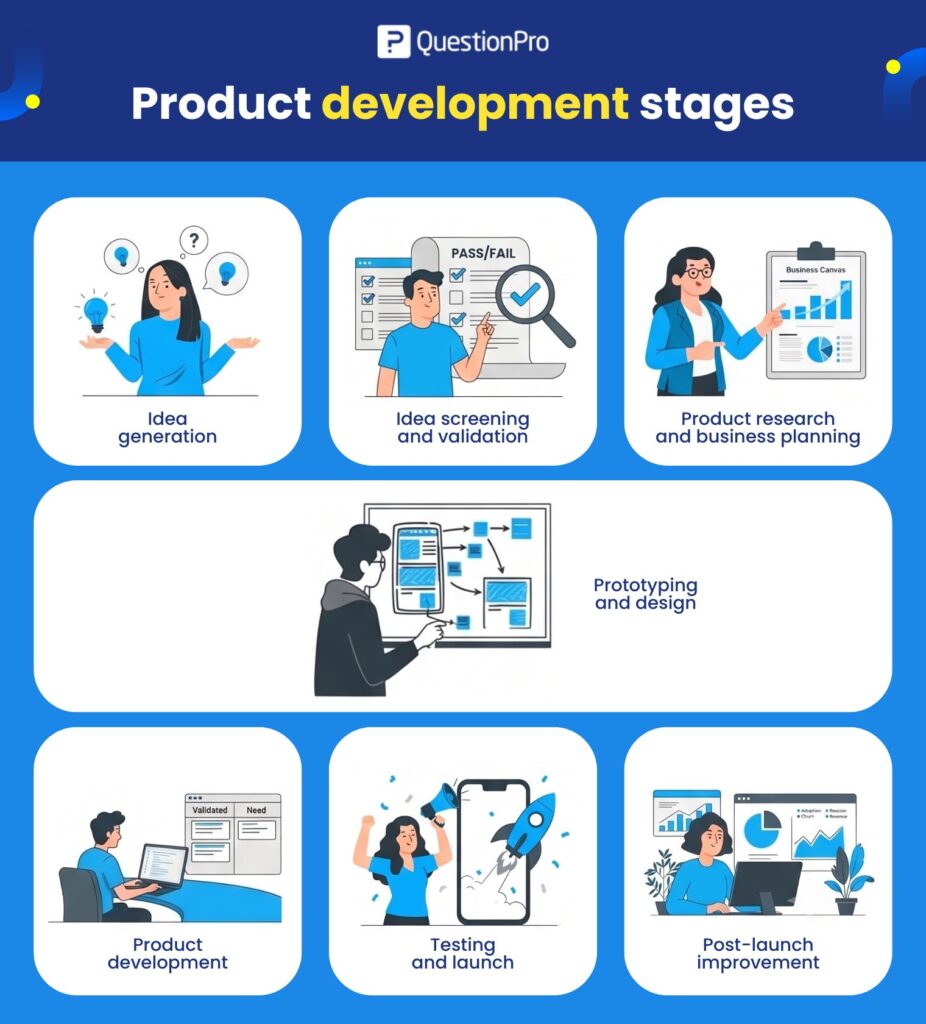
1. Idea generation
Idea generation is the stage where teams collect possible product ideas, feature requests, customer problems, and market opportunities.
Good ideas can come from:
- Customer feedback.
- Product research.
- Support tickets.
- Sales conversations.
- Competitor analysis.
- Usage data.
- Market research.
- Internal team observations.
- Customer interviews.
The goal is not to approve every idea. The goal is to collect enough signals to understand which problems may be worth solving.
2. Idea screening and validation
Idea screening is the process of filtering product ideas based on customer need, business value, feasibility, and risk.
Validation means testing whether the idea has real demand before the team invests heavily in development.
Teams can validate ideas through:
- Concept testing.
- Customer interviews.
- Surveys.
- Landing page tests.
- Prototype feedback.
- Usability testing.
- Competitive analysis.
- Pricing research.
Concept testing is useful at this stage because it helps teams ask potential customers what they think about a product idea before launch. It can reveal whether the idea is clear, valuable, believable, and worth pursuing.
3. Product research and business planning
Product research helps teams understand the customer, market, problem, and demand behind a product idea.
Business planning connects that research to the practical side of development. This includes the target audience, pricing, budget, revenue model, launch plan, risks, and success metrics.
At this stage, teams should answer:
- Who is this product for?
- What problem does it solve?
- How painful is that problem?
- What alternatives do customers use today?
- What makes this product different?
- What will it cost to build and support?
- How will the team measure success?
A product can be technically strong and still fail if the market, positioning, or business model is weak.
4. Prototyping and design
A prototype is an early version or model of a product used to test ideas before full development.
Prototypes can be simple or advanced. They may include sketches, wireframes, clickable mockups, sample packaging, demo flows, or early product versions.
Prototyping helps teams spot problems before engineering work becomes expensive. It also gives customers, stakeholders, and internal teams something concrete to react to.
This stage is especially useful for testing:
- User flows.
- Navigation.
- Feature clarity.
- Messaging.
- Visual design.
- Purchase intent.
- Usability.
- Customer expectations.
A prototype does not need to be perfect. It needs to be clear enough to learn from.
5. Product development
Product development is the stage where the team builds the product or feature.
For digital products, this usually involves engineering, design systems, data, QA, security, accessibility, and integrations. For physical products, it may include manufacturing, sourcing, packaging, compliance, and supply chain planning.
The team should keep checking the original customer problem during development. It is easy to add extra features, but extra work can slow the launch and blur the product’s purpose.
The best development work stays connected to the validated need, not just the internal wishlist.
6. Testing and launch
Testing checks whether the product works, is usable, and is ready for customers.
Common testing activities include:
- Quality assurance testing.
- Usability testing.
- Security testing.
- Performance testing.
- Accessibility review.
- Beta testing.
- Customer acceptance testing.
- Launch readiness checks.
After testing, the launch plan brings the product to market. This may include messaging, pricing, documentation, training, sales enablement, customer communication, and support preparation.
A launch should not be treated as the finish line. It is the start of real-world learning.
7. Post-launch improvement
Post-launch improvement is the process of using customer behavior, feedback, and performance metrics to improve the product after release.
Teams should track signals like:
- Product adoption.
- Activation rate.
- Retention.
- Churn.
- Support volume.
- Customer satisfaction.
- Feature usage.
- Conversion.
- Revenue impact.
- Qualitative feedback.
If customers are not using a feature, the team needs to understand why. The issue may be product fit, usability, awareness, pricing, onboarding, or the original assumption.
What product development strategies help businesses build better products?
A product development strategy is a plan for how a team will create, validate, launch, and improve products in a way that supports customer needs and business goals.
Strong strategies keep teams from building too quickly without evidence.
Useful product development strategies include:
- Start with the customer problem: Define the problem before proposing the product.
- Validate demand early: Test ideas before committing major resources.
- Use prototypes before full builds: Reduce risk by testing early versions.
- Prioritize features carefully: Choose work based on value, effort, and strategy.
- Build in smaller releases: Ship usable improvements instead of waiting for one large release.
- Test with real users: Use feedback from the target audience, not only internal opinions.
- Connect launch to positioning: Make sure customers understand why the product matters.
- Improve after launch: Use real behavior and feedback to guide updates.
The strongest strategy is usually not the fastest one. It is the one that helps the team learn early, avoid avoidable risk, and build something customers actually value.
What product development methodologies can businesses use?
Product development methodologies are structured ways to organize product work, team collaboration, delivery, and improvement.
No single methodology fits every company. The right choice depends on product type, team size, risk level, market speed, customer expectations, and regulatory needs.
Agile
Agile is a flexible approach to product development that focuses on collaboration, working solutions, customer feedback, and responding to change.
The original Agile Manifesto values individuals and interactions, working software, customer collaboration, and responding to change.
Agile is common in software product development because it supports shorter feedback cycles and incremental delivery. It works well when requirements may change as teams learn more from users.
Scrum
Scrum is an Agile framework that organizes work into short cycles called sprints.
A sprint is a fixed period, often one to four weeks, where the team completes a planned set of work. Scrum typically includes roles such as product owner, Scrum master, and development team.
Scrum is useful when teams need structure, regular planning, and frequent reviews. It can become too rigid if teams focus more on ceremonies than learning and delivery.
Kanban
Kanban is a workflow method that visualizes work as it moves through stages such as backlog, in progress, review, and done.
A Kanban board helps teams see what is being worked on, what is blocked, and where work is piling up.
Kanban works well for teams that need flexibility, continuous delivery, and visibility across tasks. It is often useful for product teams handling ongoing improvements, support-driven fixes, and iterative product updates.
Lean product development
Lean product development focuses on reducing waste, learning quickly, and building only what creates value.
In practice, lean teams try to avoid overbuilding. They test assumptions early, gather evidence, and keep improving the product based on what they learn.
Lean is useful for startups and innovation teams because it helps them test demand before investing too much in a full product build.
Design thinking
Design thinking is a human-centered approach that helps teams understand user needs, define problems, generate ideas, prototype solutions, and test them.
It is especially useful when the problem is unclear, or the team needs to understand customer behavior more deeply.
Design thinking works well with customer interviews, journey maps, usability testing, and prototype feedback.
How does customer research support product development?
Customer research supports product development by helping teams understand what customers need, what they struggle with, and how they respond to product ideas before and after launch.
Research reduces guesswork. It gives teams evidence for decisions that otherwise depend on internal opinions.
Useful research methods include:
- Surveys.
- Customer interviews.
- Focus groups.
- Concept testing.
- Usability testing.
- Feedback forms.
- Product usage analysis.
- Win-loss interviews.
- Support ticket analysis.
QuestionPro fits naturally into this process when teams need to collect feedback, test concepts, and understand customer expectations. The tool does not replace product judgment, but structured feedback can help teams make clearer product decisions.
For example, a company can use surveys to compare early product concepts, test feature demand, measure post-launch satisfaction, or understand why users do not adopt a new feature.
What mistakes should teams avoid in product development?
The biggest mistake in product development is building before the team has clearly validated the problem.
Common mistakes include:
- Starting with a feature idea instead of a customer problem.
- Skipping research because the team feels confident.
- Treating launch as the end of the process.
- Building too many features in the first version.
- Ignoring technical feasibility.
- Not involving design, engineering, support, and go-to-market teams early.
- Testing only with internal stakeholders.
- Failing to define success metrics.
- Ignoring customer feedback after launch.
- Copying competitors without understanding user need.
A practical rule: if the team cannot explain who the product is for, what problem it solves, and how success will be measured, the idea is not ready for development.
Final thoughts on product development
Product development works best when teams combine customer research, clear planning, strong execution, testing, and continuous improvement.
The goal is not just to launch something new. The goal is to build a product that solves a real problem, fits the market, and keeps improving after customers start using it.
A good process helps teams move faster with fewer bad bets. It gives structure to creativity and makes product decisions easier to explain.
Frequently Asked Questions (FAQs)
The main steps are idea generation, validation, research, business planning, prototyping, development, testing, launch, and post-launch improvement. Some teams use fewer or more stages, but the goal is always to reduce risk and build something customers need.
A SaaS company adding a new reporting dashboard is an example of product development. The team may research user needs, validate demand, design a prototype, build the feature, test usability, launch it, and improve it after release.
Product development can take weeks, months, or years depending on product complexity, team size, compliance needs, and market risk. A small digital feature may move quickly, while healthcare, financial, or hardware products often take longer.
New product development focuses on creating a product from scratch. Product development is broader. It includes new products, new features, redesigns, improvements, testing, launches, and ongoing updates to existing products.
There is no single best methodology. Agile works well for flexible software teams, Scrum adds structure, Kanban improves workflow visibility, Lean reduces waste, and design thinking helps teams understand customer problems before building.
Customer feedback helps teams test assumptions, understand pain points, and improve products after launch. It can reveal whether customers understand the product, value the features, and experience friction during real use.