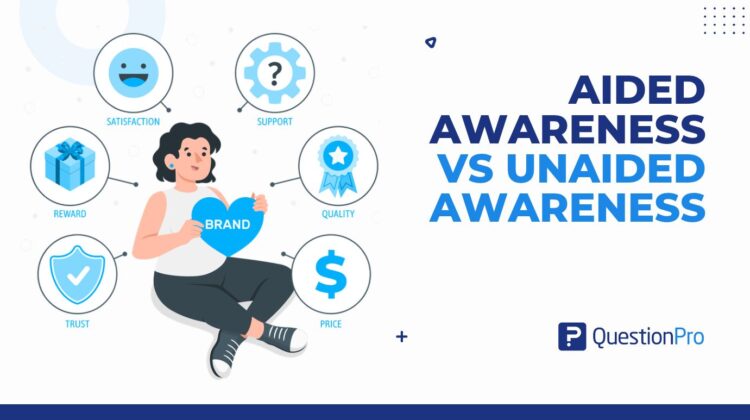
Aided awareness vs unaided awareness is the core split in brand awareness measurement. Unaided awareness shows whether people name your brand from memory. Aided awareness shows whether they recognize it when you show a list.
You need both numbers, because they test different kinds of memory. One shows how deeply your brand sits in memory. The other shows how far your name has spread. The gap between them tells you what to fix next.
In this guide, we’ll define each term, show sample questions, walk through the math, and explain when to use which.
What is the difference between aided awareness and unaided awareness?
Unaided awareness measures whether respondents name your brand from memory with no prompt. Aided awareness measures whether they recognize your brand when you show its name, logo, or a list of brands. Unaided is a recall test. Aided is a recognition test.
| Feature | Unaided awareness | Aided awareness |
|---|---|---|
| Also known as | Brand recall, spontaneous awareness | Brand recognition, prompted awareness |
| Prompt | None | Brand name, logo, or list |
| Question type | Open-ended text box | Multiple response list |
| What it shows | How strongly the brand sits in memory | How far the brand name has spread |
| Typical score | Lower | Higher |
| Best for | Judging brand strength and category leadership | Judging reach and early-stage visibility |
What is unaided awareness?
Unaided awareness is the share of people who name your brand without any prompt. Many researchers call it brand recall. Respondents see a category cue, such as a product type, and write every brand they can think of.
Here is an example: Which brands of canned vegetables can you name? Nothing in the question mentions your brand. If a respondent types it, the brand earned that spot in memory. The first brand a respondent names is the top-of-mind brand.
What is aided awareness?
Aided awareness is the share of people who recognize your brand when it appears in a prompt. Many researchers call it brand recognition. The prompt can be a list of names, a grid of logos, or product images.
Build the question with care:
- Use a multiple-response format, which lets people select more than one answer, so they can pick every brand they know.
- Randomize the list order for each respondent.
- Include your direct competitors, not only your own brand.
- Add one fictional decoy brand to catch guessing and over-claiming.
- Add a clear “None of these” option.
Expect aided scores to exceed unaided scores for nearly every brand. Anyone who can recall a brand can also recognize it.
How do awareness, familiarity, top-of-mind, and salience differ?
Awareness tells you whether people know a brand exists. The neighboring measures tell you how well they know it, how fast it comes to mind, and how easily it surfaces in a buying moment.
| Term | What it measures | Example question |
|---|---|---|
| Unaided awareness | Recall with no prompt | “Which running shoe brands can you name?” |
| Aided awareness | Recognition with a prompt | “Which of these brands have you heard of?” |
| Top-of-mind awareness | The first brand named in an unaided question | “Which brand comes to mind first?” |
| Brand familiarity | Depth of knowledge about a brand | “How familiar are you with Brand X?” (five-point scale) |
| Brand salience | How easily a brand comes to mind across buying situations | “You need running shoes on a tight budget. Which brands come to mind?” |
Awareness and familiarity are not interchangeable. A voter can know a candidate exists without knowing a single policy position. Familiarity implies deeper knowledge, so ask about it only after a respondent confirms awareness.
Salience goes a step further. Research from the Ehrenberg-Bass Institute links mental availability, meaning how easily a brand comes to mind in buying situations, to the likelihood of purchase. For a wider view of these metrics, see QuestionPro’s guide to brand measurement.
How do you write aided and unaided awareness questions?
Write unaided questions as open text boxes with a category cue. Write aided questions as randomized multiple-response lists. Always ask the unaided question first, because a brand list teaches respondents the names and ruins the recall test. Our brand awareness survey guide covers the full survey build.
Unaided awareness question examples
Keep the cue broad enough that the category stays open. Never mention your brand or your company in the wording. These open-ended questions work well:
- Category cue: “When you think of accounting software for small businesses, which brands come to mind?”
- Top-of-mind: “Which brand comes to mind first when you need to rent a car?”
- Occasion cue: “Which brands would you consider for a weeknight family dinner delivery?”
- Spokesperson cue: “Which public figures come to mind when you think of heart health?”
- Probe: “Are there any other brands you can think of?”
Aided awareness question examples
Repeat the same category cue, then show the list. Include your brand, four to six competitors, and one decoy.
Which of the following accounting software brands have you heard of? Select all that apply.
You can swap names for logo grids, packaging photos, or ad stills. Use images when you want to test visual recognition instead of name recognition. A brand awareness survey template saves setup time.
Step-by-step guide to running an aided and unaided awareness survey
Run the questions in one fixed order: unaided first, aided second, familiarity third. This sequence keeps each answer clean and makes waves comparable.
- Define the category and audience. Name the product category and the buyers you want, such as US adults who bought coffee in the last 90 days.
- Ask the unaided question. Use an open text box and a category cue.
- Ask the aided question. Show a randomized list with competitors and a decoy.
- Pipe-aided picks into familiarity. Piping carries an earlier answer into a later question, so add logic to your online survey and let people rate only the brands they said they know.
- Validate claimed awareness. Ask follow-up questions, such as “What can you tell me about Brand X?” and compare answers with known facts.
- Segment the results. Break scores down by age, region, product usage, and customer status.
How do you calculate aided and unaided awareness?
Divide the number of respondents who named or recognized your brand by the total qualified respondents, then multiply by 100. Add a third ratio, awareness conversion, to see how much recognition turns into recall.
Unaided awareness % = (respondents who named your brand ÷ total respondents) × 100
Aided awareness % = (respondents who selected your brand ÷ total respondents) × 100
Awareness conversion % = (unaided % ÷ aided %) × 100
Here is a hypothetical study with 500 qualified respondents.
| Brand | Unaided mentions | Unaided % | Aided selections | Aided % | Conversion |
|---|---|---|---|---|---|
| Brand A | 140 | 28% | 410 | 82% | 34% |
| Your brand | 90 | 18% | 310 | 62% | 29% |
| Brand C | 35 | 7% | 250 | 50% | 14% |
| Brand D | 10 | 2% | 150 | 30% | 7% |
Sample size sets how far you can trust these numbers. The margin of error is the range a score could shift by chance. At 400 completes, it is about ±4.9 points at 95% confidence, using the standard margin of error formula. Pew Research Center notes that subgroups of about 100 interviews can carry margins of error of 10 points or more. Plan for at least 400 total completes and 100 per segment you want to compare.
What does the gap between the two scores tell you?
Read the gap as a pattern, not as a raw number. Each pattern points to a different next step.
- High aided, low unaided: People know the name but do not think of you first. Build distinctive cues and repeat them where buyers shop.
- Low aided, low unaided: Few people know you exist. Invest in reach before you test messages.
- High aided, high unaided: You hold a strong position. Defend it and track salience by buying situation.
- Unaided higher than aided: This signals a data problem. Check for a missing brand in the list or a coding error.
How do you choose between aided and unaided awareness?
Track both in every wave, then choose which one to lead with based on your brand’s stage and the decision in front of you. The right lead metric changes as a brand grows.
| Your situation | Lead with | Why |
|---|---|---|
| New or small brand | Aided awareness | Few people recall you yet, so unaided scores stay near zero. |
| Established brand in a crowded category | Unaided awareness | Recall shapes who gets considered first. |
| Campaign launch | Both, before and after | Aided shows reach. Unaided shows memory lift. |
| Entry into a new US region | Aided, then unaided | Reach comes before recall. |
| Competitor comparison | Unaided with top-of-mind | It shows which brand owns the category. |
What are real-world examples of aided and unaided awareness?
Three scenarios show how the two scores steer different decisions. The numbers below are illustrative, not from a published study.
- Consumer goods launch.
A regional snack brand moves onto national shelves. Aided awareness among US adults reaches 35%, but unaided stays at 4%. Shoppers recognize the bag without thinking of it first, so the team repeats its packaging cues across more stores and media.
- B2B software.
An accounting platform surveys US small business owners. Unaided recall is low, yet aided recognition is strong among firms with 10 to 50 employees. The team shifts spend toward content that ties the brand to a trigger moment, such as tax season.
- Cause or spokesperson.
A health nonprofit tests awareness of a public campaign and its ambassador. Aided recognition of the ambassador is high, but few people link that person to the cause unprompted. The next wave of messaging pairs the two directly.
What mistakes skew aided and unaided awareness results?
Most errors come from question order, list design, and coding. Each one can inflate or shrink a score without anyone noticing.
- Asking aided before unaided. The list teaches respondents brand names. Ask unaided first, every time.
- Keeping a fixed list order. Top positions get more clicks. Randomize for each respondent.
- Naming the sponsor. Respondents guess the study owner and over-report it. Keep the sponsor hidden.
- Skipping the decoy. Without a fake brand, you cannot see over-claiming.
- Coding loosely. Group spelling variants, treat sub-brands consistently, and count first mentions and total mentions separately.
- Using tiny samples. Segment scores swing widely below about 100 interviews.
- Changing wording between waves. Trend lines break when the cue changes.
How do you improve aided and unaided awareness over time?
Aided awareness grows with reach and consistent branding. Unaided awareness grows when your brand links to specific buying moments and those links get repeated.
- Keep your name, logo, and colors consistent so recognition builds.
- Expand reach through the channels your buyers actually use.
- Tie the brand to a buying moment, such as meal prep on a busy weeknight, so recall has a trigger.
- Repeat distinctive cues, because memory fades without repetition.
- Fold both scores into brand health tracking so each wave builds on the last.
How does QuestionPro help measure aided and unaided awareness?
QuestionPro Market Research Software speeds up the two hardest parts of awareness research: coding open-ended unaided answers and keeping the data clean.
Unaided answers arrive as free text. Every response needs coding, which means tagging it with the brand it names, before you can calculate a score. QuestionPro’s Text AI detects topics, sub-topics, and sentiment across open-ended responses. That speeds up the first pass. A researcher should still review the brand list for spelling variants and sub-brands.
Recall questions also attract junk entries. Data Quality AI flags bot submissions, AI-generated answers, and gibberish before they reach analysis. That protects your unaided count from false mentions.
For sample, QuestionPro Audience offers pre-screened respondents, including US consumers and B2B decision-makers, so you can match the audience to your category.
The gap between recognition and recall is your roadmap
Aided awareness tells you how many people have met your brand. Unaided awareness tells you how many remember it when it matters. The distance between the two is the work left to do.
Before your next wave, ask three questions:
- Which scores moved, and by how much?
- Which segments sit furthest apart on the two measures?
- Which single cue or buying moment will we strengthen next?
Measure the same way each time, and let the gap guide where you invest.
Frequently Asked Questions (FAQs)
There is no universal benchmark. Scores depend on category size, brand age, and how broad your category cue is. Compare your score to direct competitors in the same wave, then track your own trend. A steady rise matters more than any single number.
Run it quarterly for most brands, or before and after each major campaign. Keep question wording, audience criteria, and answer lists identical across waves. Fast-moving consumer categories may justify monthly pulses, while smaller B2B brands can often run twice a year.
Yes, but define the buyer first. Survey decision-makers by role, industry, and company size, since a user, a procurement lead, and an executive may know different brands. Expect smaller samples and wider margins, and allow a longer fieldwork window to reach busy US professionals.
No. Ad awareness asks whether people remember seeing your advertising, while brand awareness asks whether they know the brand. Measure both unaided, such as “Which ads have you seen for this category recently?”, and aided, using ad stills, to see which creative registers.
Set quotas, meaning target counts for each group, on age, gender, region, race and ethnicity, and income to mirror US Census Bureau data. Then screen for category buyers. Awareness can vary by region and age, so an unbalanced sample can skew every score.