Brand measurement helps you understand how people recognize, remember, trust, and choose your brand. It gives marketing, research, and leadership teams a clear way to track brand performance instead of relying on opinions, campaign vanity metrics, or sales numbers alone.
A strong brand can make people search for you by name, recommend you without being asked, pay attention to your content, and pick you over similar options. But none of that should be guessed. Brand measurement gives you the evidence to see what is working, what is unclear, and where your brand needs attention.
For US businesses, this matters even more in crowded categories like software, retail, financial services, healthcare, consumer goods, and professional services. Buyers often compare several brands before making a decision, and small perception gaps can affect trust, preference, and growth.
What is brand measurement?
Brand measurement is the process of tracking how your target audience knows, perceives, remembers, and prefers your brand over time.
It combines survey feedback, customer behavior, social listening, search data, sales signals, and competitive benchmarks to show how your brand is performing in the market. The goal is not just to see whether people have heard of you. The goal is to understand what they associate with you, how strongly they trust you, and whether they are likely to choose you.
A simple brand measurement definition is:
Brand measurement is the structured evaluation of brand awareness, perception, preference, loyalty, and value using clear metrics and repeatable research methods.
This makes brand measurement different from one-time campaign reporting. A campaign report may show clicks, impressions, or conversions. Brand measurement shows whether those efforts are changing how people think and feel about the brand.
Why is brand measurement important?
Brand measurement is important because it connects brand activity to real market signals. It helps teams see whether their messaging, campaigns, customer experience, and positioning are improving how people view the brand.
Without brand measurement, teams often make decisions based on incomplete signals. Sales may be up because of discounts, not because the brand is stronger. Social mentions may increase because of a controversy, not because people trust the brand more. Website traffic may grow while purchase intent stays flat.
Brand measurement helps answer questions such as:
- Do people recognize our brand in the category?
- Are we top of mind when buyers think about this product or service?
- Do customers understand what makes us different?
- Are people more likely to choose us than competitors?
- Is our brand trusted, liked, and recommended?
- Did our campaign improve perception or only generate reach?
- Are we building long-term brand equity?
For market research teams, brand measurement also creates a shared language across marketing, product, sales, customer experience, and leadership. Everyone can look at the same metrics and understand where the brand stands.
What is the difference between brand measurement and brand tracking?
Brand measurement is the broader process of evaluating brand performance. Brand tracking is the ongoing version of that process.
A one-time brand measurement study might be used before a rebrand, after a campaign, or during market expansion. Brand tracking measures the same core brand metrics on a recurring schedule so teams can see movement over time.
Here is the simple difference:
| Term | What it means | When to use it |
| Brand measurement | A structured way to measure brand awareness, perception, preference, and loyalty | Before strategy updates, after campaigns, during market research |
| Brand tracking | Repeated brand measurement over time | Monthly, quarterly, or twice a year |
| Brand health | The overall condition of your brand based on key signals | When leadership needs a clear view of brand strength |
| Brand audit | A deeper review of messaging, visuals, positioning, competitors, and customer perception | Before a rebrand or major repositioning |
Brand tracking works best when the questions, audience, sample source, and reporting cadence stay consistent. If you change the method every time, you may create noise instead of clear trends.
What are the most important brand measurement metrics?
The most useful brand measurement metrics show how people move from awareness to preference, loyalty, and advocacy. No single metric tells the whole story, so it is better to use a balanced set.
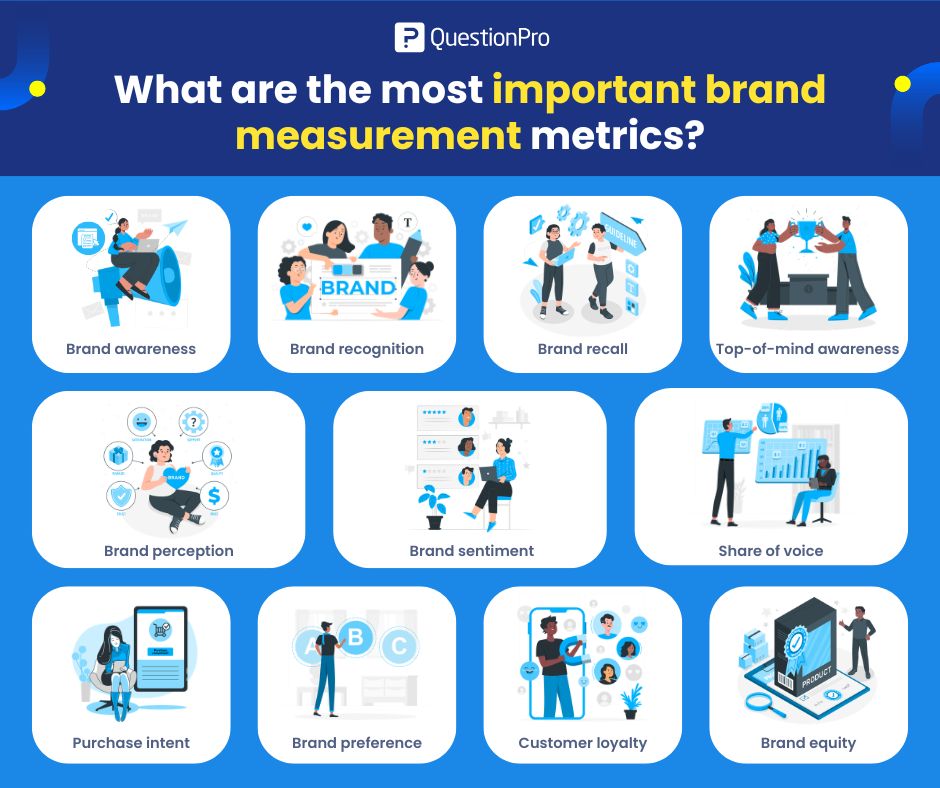
1. Brand awareness
Brand awareness measures how familiar people are with your brand.
It usually includes two types:
- Unaided awareness: People name your brand without seeing a list.
- Aided awareness: People recognize your brand when shown a list, logo, product, or message.
Example survey question:
“When you think of online survey software, which brands come to mind first?”
Brand awareness matters because people rarely buy from a brand they do not know. It is often the first signal to track in a new market, new category, or new audience segment.
2. Brand recognition
Brand recognition measures whether people can identify your brand when they see its name, logo, colors, tagline, packaging, product page, or ad.
Recognition is different from recall. A person may not name your brand from memory, but they may still recognize it when prompted.
Example survey question:
“Which of the following brands have you heard of?”
Brand recognition is useful when measuring the impact of visual identity, advertising, event sponsorships, product packaging, and display campaigns.
3. Brand recall
Brand recall measures whether people can remember your brand without help.
Strong recall means your brand is mentally available when someone thinks about a category or problem. For example, if a buyer in the USA thinks about “customer feedback software” and remembers your brand before searching Google, your brand has stronger recall.
Example survey question:
“What brand would you consider first for customer feedback software?”
Brand recall is especially helpful for competitive categories where many brands offer similar features.
4. Top-of-mind awareness
Top-of-mind awareness measures whether your brand is the first brand people mention in your category.
This is a stronger signal than general awareness because it shows priority in memory. If people name your brand first, you have a better chance of being considered early in the buying process.
Example survey question:
“What is the first brand that comes to mind when you think of market research software?”
Top-of-mind awareness is useful for mature categories where most buyers already know several options.
5. Brand perception
Brand perception measures what people believe, feel, and assume about your brand.
It answers a simple question: Do people see your brand the way you want to be seen?
Example survey questions:
- “Which words best describe this brand?”
- “How trustworthy does this brand feel?”
- “How innovative does this brand seem?”
- “What do you think this brand does better than others?”
Brand perception is important because awareness without the right meaning can create weak demand. People may know your brand but still see it as too expensive, too basic, too complex, outdated, or not relevant to them.
6. Brand sentiment
Brand sentiment measures whether mentions, reviews, survey comments, and social conversations are positive, negative, or neutral.
Sentiment analysis is the process of classifying the emotional tone of text. It can be done manually for smaller studies or with brand measurement software and social listening tools for larger datasets.
Example sources for sentiment:
- Open-ended survey responses
- Online reviews
- Social media comments
- Support tickets
- Community posts
- News coverage
- Reddit and forum discussions
Sentiment is useful because volume alone can be misleading. A spike in mentions can be good, bad, or mixed. Sentiment explains the tone behind the attention.
Share of voice measures how much of the category conversation belongs to your brand compared with competitors.
A simple formula is:
Share of voice = (Your brand mentions / Total category brand mentions) x 100
For example, if your brand receives 2,000 mentions and the total tracked mentions across your category are 10,000, your share of voice is 20%.
Share of voice can be measured across:
- Social media
- Search visibility
- Press mentions
- Review sites
- AI search visibility
- Industry reports
- Paid media impression share
Share of voice is most useful when paired with sentiment. A large share of negative conversation is not a healthy brand signal.
8. Purchase intent
Purchase intent measures how likely people are to buy from your brand in the future.
Example survey question:
“How likely are you to consider buying from this brand in the next 3 months?”
Purchase intent helps connect brand perception to commercial outcomes. If awareness is high but purchase intent is low, people may know your brand but not see enough value, trust, or relevance.
9. Brand preference
Brand preference measures whether people would choose your brand over competitors.
Example survey question:
“If you were choosing a provider today, which brand would you be most likely to select?”
Brand preference is a strong metric because it reflects competitive choice. It is especially useful in US markets where buyers often compare multiple vendors, read reviews, ask peers, and evaluate price before taking action.
10. Customer loyalty
Customer loyalty measures whether customers stay, buy again, and recommend your brand.
Common loyalty metrics include:
- Repeat purchase rate
- Customer retention rate
- Churn rate
- Net Promoter Score, also known as NPS
- Customer satisfaction, also known as CSAT
- Customer lifetime value
NPS is a loyalty metric that asks how likely someone is to recommend your brand to others. It does not explain everything by itself, but it is useful when tracked with open-ended feedback and customer segments.
11. Brand equity
Brand equity is the extra value your brand adds beyond the product or service itself.
A brand with strong equity can often earn more trust, stronger preference, better retention, and higher willingness to pay. Brand equity is shaped by awareness, perceived quality, emotional connection, reputation, and customer experience.
Example survey question:
“Compared with similar brands, how valuable does this brand feel to you?”
Brand equity is harder to measure than awareness, but it is one of the most important long-term indicators of brand strength.
Which brand measurement methods should you use?
The best brand measurement methods combine what people say, what people do, and how the market responds. Surveys are usually the core method, but they should not be the only source.
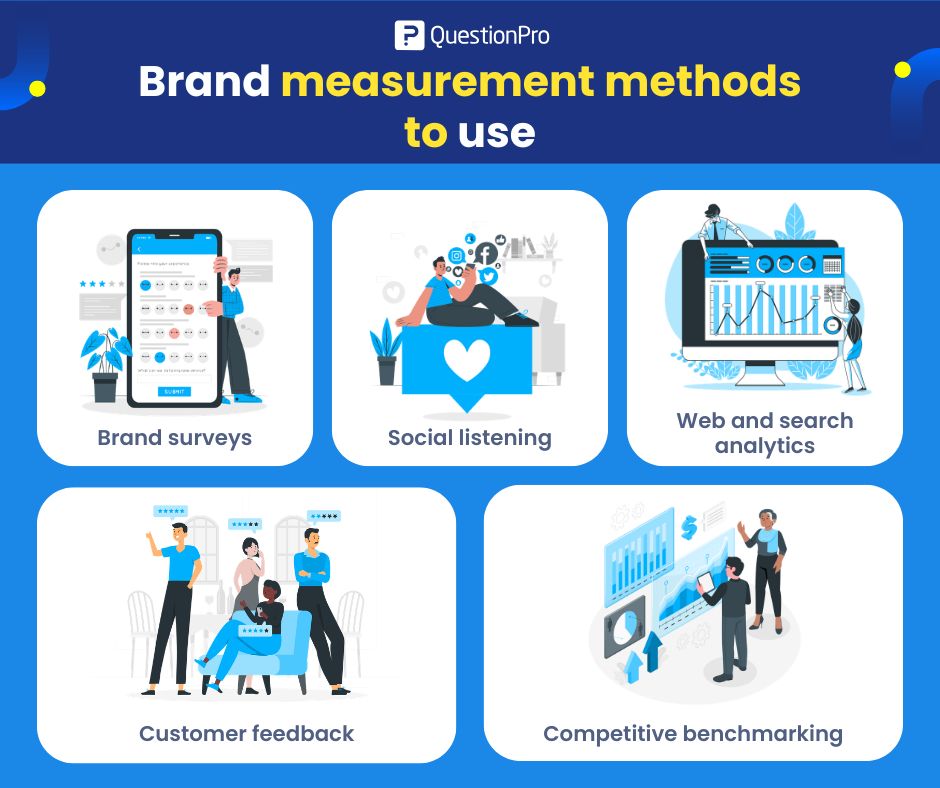
Brand surveys
Brand surveys ask your target audience direct questions about awareness, recall, perception, preference, and loyalty.
Use surveys when you need to understand:
- What people remember
- What people believe
- How your brand compares with competitors
- Which audience segments know or trust you
- Whether a campaign changed perception
A good brand survey should include both closed-ended questions for measurement and open-ended questions for context.
For example, QuestionPro’s guide to a brand awareness survey explains how surveys can measure recognition, recall, perception, and competitive position.
Social listening
Social listening tracks what people say about your brand across social media, forums, blogs, news, and review platforms.
Use social listening when you need to monitor:
- Brand mentions
- Sentiment trends
- Competitor mentions
- Customer complaints
- Emerging topics
- Campaign reactions
Social listening is strong for real-time feedback, but it can overrepresent people who are vocal online. It should be balanced with surveys and customer data.
Web and search analytics
Web and search analytics show how people find and interact with your brand online.
Useful signals include:
- Branded search volume
- Direct website traffic
- Returning visitors
- Organic traffic to branded pages
- Search click-through rate
- Landing page engagement
- Conversions from branded keywords
These signals show behavior, not just opinions. If branded search volume grows after a campaign, it may suggest more people are actively looking for the brand.
Customer feedback
Customer feedback shows how people experience your brand after they interact with it.
Useful sources include:
- NPS surveys
- CSAT surveys
- Customer interviews
- Support tickets
- Product reviews
- Sales call notes
- Community feedback
This method is useful because brand perception is not created only by advertising. It is shaped by product quality, support, onboarding, pricing, billing, delivery, and every customer touchpoint.
Competitive benchmarking
Competitive benchmarking compares your brand metrics against other brands in the same category.
Benchmarking helps answer:
- Are we more recognized than competitors?
- Are we more trusted?
- Are we easier to understand?
- Are we preferred by high-value segments?
- Are competitors gaining share of voice?
- Are we losing consideration in key markets?
For US brands, benchmarking should be specific by region, category, and audience. A national benchmark may hide differences between states, industries, or buyer groups.
What is a simple brand measurement framework?
A practical brand measurement framework should move from awareness to action. It should show whether people know your brand, understand it, prefer it, and act on it.
Use this simple framework:
Step 1: Define the brand goal
Start with one clear goal. Do not measure everything just because you can.
Examples:
- Increase awareness in the US mid-market segment
- Improve trust after a rebrand
- Measure campaign lift after a product launch
- Compare brand preference against competitors
- Track perception among existing customers
- Understand why purchase intent is low
A clear goal keeps your study focused and makes the results easier to use.
Step 2: Choose the audience
Brand measurement depends on the right audience. Current customers, lost customers, prospects, category buyers, and the general public will give different answers.
Common audience groups include:
- Current customers
- Prospective buyers
- Former customers
- Category users
- Competitor customers
- Regional audiences in the USA
- Decision-makers by job role or company size
For B2B studies, define the buyer role clearly. A software user, procurement lead, and executive sponsor may all view the same brand differently.
Step 3: Select the right metrics
Match the metric to the goal.
| Goal | Metrics to use |
| Measure visibility | Awareness, recall, recognition, reach, branded search |
| Measure meaning | Perception, associations, sentiment, message clarity |
| Measure preference | Consideration, purchase intent, brand preference |
| Measure loyalty | NPS, retention, repeat purchase, advocacy |
| Measure market position | Share of voice, competitor benchmarks, top-of-mind awareness |
| Measure campaign impact | Brand lift, ad recall, message recall, purchase intent change |
Avoid tracking too many metrics at once. A smaller set of useful metrics is better than a dashboard nobody uses.
Step 4: Collect data consistently
Use the same question wording, audience criteria, sample source, and reporting cadence whenever possible.
Changing too many variables makes results hard to compare. If awareness moves from 38% to 45%, you need to know whether the brand improved or whether the sample changed.
Step 5: Compare results by segment
Averages can hide the real story.
Segment your results by:
- Age group
- Region
- Customer type
- Industry
- Company size
- Buyer role
- Product usage
- Awareness level
- Customer tenure
For example, a US SaaS company might have strong awareness among enterprise buyers but weak awareness among small business owners. Those segments need different actions.
Step 6: Turn findings into actions
Brand measurement is only useful when teams act on it.
Examples:
- Low awareness: increase category visibility and branded search demand.
- Low recall: simplify messaging and repeat core brand cues.
- Weak perception: adjust positioning or fix customer experience gaps.
- Low preference: clarify differentiation and proof points.
- Negative sentiment: identify root causes and respond quickly.
- Low loyalty: improve onboarding, product experience, or support.
A brand measurement framework should not end with a report. It should lead to decisions.
What brand measurement techniques work best?
The best brand measurement techniques depend on what you need to learn. Some techniques are better for awareness, while others are better for perception, loyalty, or brand value.
Aided and unaided awareness testing
Use this technique to measure whether people know your brand with or without prompts.
Unaided question:
“Which brands come to mind when you think of customer experience software?”
Aided question:
“Which of the following customer experience software brands have you heard of?”
Use unaided awareness to measure memory strength. Use aided awareness to measure recognition.
Brand association mapping
Brand association mapping shows which ideas, emotions, and attributes people connect with your brand.
Example question:
“Which words do you associate with this brand?”
This technique is useful after a rebrand, product launch, or positioning update. It shows whether your intended message is actually landing.
Brand lift studies
Brand lift measures how exposure to a campaign changes awareness, recall, perception, or purchase intent.
A basic brand lift study compares two groups:
- People who were exposed to a campaign
- People who were not exposed to the campaign
Then you compare the difference in awareness, recall, preference, or intent.
Conjoint or trade-off research
Conjoint research measures how people make choices when they compare different product, brand, price, or feature combinations.
Use this when you need to understand how much your brand name influences choice compared with price, features, or benefits.
Customer journey measurement
Customer journey measurement tracks how brand perception changes across stages such as awareness, consideration, purchase, onboarding, support, and renewal.
This technique is useful because brand problems often appear at specific moments. A brand may look strong before purchase, but lose trust during onboarding or customer support.
What brand measurement tools should you use?
Brand measurement tools help collect, organize, and analyze brand signals. The right tool depends on whether you need surveys, social listening, web analytics, reporting, or a full research workflow.
Common types of brand measurement tools include:
| Tool type | What it measures |
| Survey platforms | Awareness, recall, perception, preference, loyalty |
| Social listening tools | Mentions, sentiment, share of voice, emerging topics |
| Web analytics tools | Direct traffic, branded search, returning visitors, conversions |
| SEO tools | Branded search visibility, keyword demand, AI visibility |
| Review platforms | Customer sentiment, ratings, complaints, advocacy |
| CRM and customer data tools | Retention, churn, customer lifetime value, repeat purchases |
| Research dashboards | Trends, segments, benchmarks, executive reporting |
Brand measurement software is most useful when it helps teams compare results over time, filter by audience segment, and combine quantitative scores with open-ended feedback.
How does brand measurement work step by step?
Brand measurement works best when it follows a repeatable process.
Step 1: Write the research question
Start with the decision you need to make.
Examples:
- Should we change our positioning?
- Did our campaign improve brand awareness?
- Why are buyers choosing competitors?
- Which audience segment trusts us most?
- Are we known for the right value proposition?
Step 2: Pick your metrics
Choose metrics that answer the research question.
If the question is about campaign performance, use brand lift, ad recall, message recall, and purchase intent. If the question is about market position, use awareness, top-of-mind awareness, share of voice, and competitor preference.
Step 3: Build the survey or tracking system
Create questions that are short, neutral, and easy to answer. Avoid leading wording.
Weak question:
“How much do you love our trusted and innovative brand?”
Better question:
“How would you describe your overall impression of this brand?”
Step 4: Collect responses from the right sample
Your sample should match the audience you care about. A US consumer brand may need a nationally representative sample. A B2B software company may need decision-makers in specific industries or company sizes.
Step 5: Analyze the results
Look for patterns by audience segment, not just the total score.
Useful analysis views include:
- Customers vs non-customers
- Aware vs unaware respondents
- Brand users vs competitor users
- Region or state
- Buyer role
- Age group
- Campaign exposure
- Product category usage
Step 6: Build a clear report
A useful brand measurement report should include:
- The goal of the study
- The audience and sample size
- The method used
- The key metrics
- The strongest findings
- The weakest signals
- Competitive comparison
- Recommended actions
- What to measure next
Step 7: Repeat the study
Brand measurement becomes more valuable over time. A single study gives you a snapshot. Repeated studies show whether your brand is getting stronger, weaker, or staying the same.
How much does brand measurement cost?
Brand measurement costs depend on sample size, audience difficulty, research method, survey length, reporting needs, and whether you use internal lists or paid research panels.
A simple brand measurement survey sent to your own customer list may cost very little beyond your survey software. A larger US study with a nationally representative sample, competitor benchmarking, segmentation, and advanced analysis will cost more.
The biggest cost drivers are:
- Number of completed responses
- Whether the audience is general consumers or niche B2B buyers
- Number of competitors included
- Survey length
- Need for US national or regional quotas
- Frequency of tracking
- Reporting and dashboard complexity
- Need for expert research support
A practical approach is to start with a focused study, then expand once you know which metrics matter most. Many teams waste budget by building an oversized tracker before they know what decisions it needs to support.
What are the pros and cons of brand measurement?
Brand measurement is valuable, but it has limits. Teams should understand both.
| Pros | Cons |
| Shows how people actually perceive the brand | Poor question design can create misleading results |
| Helps compare your brand against competitors | One-time studies can become outdated quickly |
| Tracks awareness, trust, preference, and loyalty | Social listening can overrepresent vocal audiences |
| Connects brand activity to business signals | Too many metrics can create confusion |
| Helps teams find weak spots before they grow | Results need action, not just reporting |
| Supports campaign, positioning, and CX decisions | Benchmarks can vary by category and sample quality |
The main risk is treating brand measurement as a reporting exercise. The real value comes from using the findings to improve messaging, customer experience, product clarity, and market positioning.
What brand measurement survey questions should you ask?
A good brand measurement survey includes questions for awareness, recall, perception, preference, and loyalty. Keep the survey short enough that people can complete it without rushing.
Use questions like these:
- Unaided awareness:
“Which brands come to mind when you think about our products?”
- Aided awareness:
“Which of the following brands have you heard of?”
- Top-of-mind awareness:
“Which brand comes to mind first in this category?”
- Brand recognition:
“Have you seen this logo, name, or product before?”
- Brand familiarity:
“How familiar are you with our brand?”
- Brand perception:
“Which words best describe your brand?”
- Trust:
“How much do you trust our brand?”
- Differentiation:
“How different does our brand feel from other brands in this category?”
- Consideration:
“How likely would you be to consider our brand?”
- Purchase intent:
“How likely are you to buy from our brand in the next 3 months?”
- Preference:
“Which brand would you choose if you were buying today?”
- Loyalty:
“How likely are you to recommend our brand to a friend or colleague?”
- Open-ended feedback:
“What is the first thing that comes to mind when you think about our brand?”
- Competitor comparison:
“Compared with other brands in this category, how would you rate our brand?”
- Reason for choice:
“What is the main reason you would or would not choose our brand?”
For US audiences, add demographic, regional, or firmographic questions only when they help explain the result. Do not add personal questions just because they are available.
How often should you measure brand performance?
Most brands should measure brand performance quarterly, twice a year, or after major campaigns. The right cadence depends on how fast your market changes and how often you can act on the findings.
Use this guide:
| Situation | Suggested cadence |
| Fast-moving consumer category | Monthly or quarterly |
| B2B software or services | Quarterly or twice a year |
| Major campaign launch | Before and after campaign |
| Rebrand or repositioning | Before launch, after launch, then quarterly |
| Early-stage brand | Every 6 months |
| Established brand | Quarterly or annually, depending on goals |
Always-on listening can help between formal studies, but it should not replace structured brand surveys. Surveys give you cleaner benchmarks. Listening gives you faster signals.
What should US brands watch when measuring brand perception?
US brands should pay attention to trust, privacy expectations, advertising claims, regional differences, and customer reviews.
Brand perception in the USA can shift quickly because buyers have many public feedback channels, including review sites, social platforms, media outlets, communities, and AI search tools. A claim that feels unclear, exaggerated, or unsupported can weaken trust.
If your brand uses testimonials, influencers, endorsements, or customer claims in campaigns, check that your marketing follows current FTC guidance. The FTC’s endorsement and testimonial guides explain how US advertisers and endorsers should approach truthful claims and disclosure of material connections. You can review the official source here: FTC Guides Concerning Use of Endorsements and Testimonials in Advertising.
This matters for brand measurement because trust is not only about messaging. It is also about whether your claims match the customer experience.
How can QuestionPro help with brand measurement?
QuestionPro can help teams create brand measurement surveys, collect responses from the right audience, and analyze brand metrics in one place.
With QuestionPro, you can measure:
- Brand awareness
- Brand recall
- Brand recognition
- Brand perception
- Customer loyalty
- NPS
- Purchase intent
- Competitive preference
- Campaign feedback
- Open-ended customer sentiment
Teams can start with a survey template, build custom questions, distribute surveys by email, website, social channels, or research sample, and review results with dashboards, filters, charts, and exports.
For brand research, the most useful setup is often a recurring survey with the same core questions. That gives you a clean way to compare brand health over time and see whether campaigns, product updates, or market changes are affecting perception.
What are the biggest mistakes in brand measurement?
The biggest mistake is measuring brand activity instead of brand impact.
Activity metrics show what your team did. Impact metrics show whether the market changed.
Common mistakes include:
- Tracking impressions without measuring recall
- Measuring awareness without measuring perception
- Asking leading survey questions
- Changing questions every wave
- Ignoring competitor benchmarks
- Treating social mentions as positive by default
- Looking only at averages
- Using a sample that does not match the target audience
- Reporting results without recommending action
- Tracking too many metrics at once
A good brand measurement program stays focused. It measures the signals that explain whether people know, trust, prefer, and recommend your brand.
What is the best way to start brand measurement?
The best way to start brand measurement is to run a focused baseline study.
A baseline study gives you your starting point. From there, you can track improvement.
Start with these five steps:
- Define the category you want to measure.
- Choose your target audience.
- Select 5 to 7 core metrics.
- Ask neutral survey questions.
- Compare results by audience segment and competitor.
A simple first study might measure awareness, recall, recognition, perception, consideration, purchase intent, and preference. Once you know your baseline, you can build a stronger brand measurement framework with recurring tracking.
Frequently Asked Questions (FAQs)
Brand measurement is the process of checking how well people know, understand, trust, and choose your brand. It uses metrics like awareness, recall, perception, preference, sentiment, and loyalty to show how strong your brand is in the market.
The best brand measurement metrics are brand awareness, brand recall, brand recognition, brand perception, sentiment, share of voice, purchase intent, brand preference, customer loyalty, NPS, and brand equity. The right mix depends on your goal.
To measure brand awareness in the USA, survey a relevant US audience and ask both unaided and aided awareness questions. You can also track branded search volume, direct traffic, social mentions, press mentions, and share of voice by US market or region.
Brand measurement tools can include surveys, social listening platforms, analytics tools, review monitoring tools, and dashboards. Brand measurement software usually combines several of these functions to help teams collect, analyze, and track brand metrics over time.
Most companies should run a brand measurement study quarterly or twice a year. Fast-moving consumer brands may need monthly tracking, while B2B brands may only need quarterly, semiannual, or campaign-based measurement.
Brand measurement matters for AI search visibility because AI tools often summarize brands based on clear, consistent, and trustworthy signals across the web. If your brand has strong awareness, clear messaging, positive sentiment, and credible third-party mentions, it is easier for AI systems to understand and reference your brand accurately.