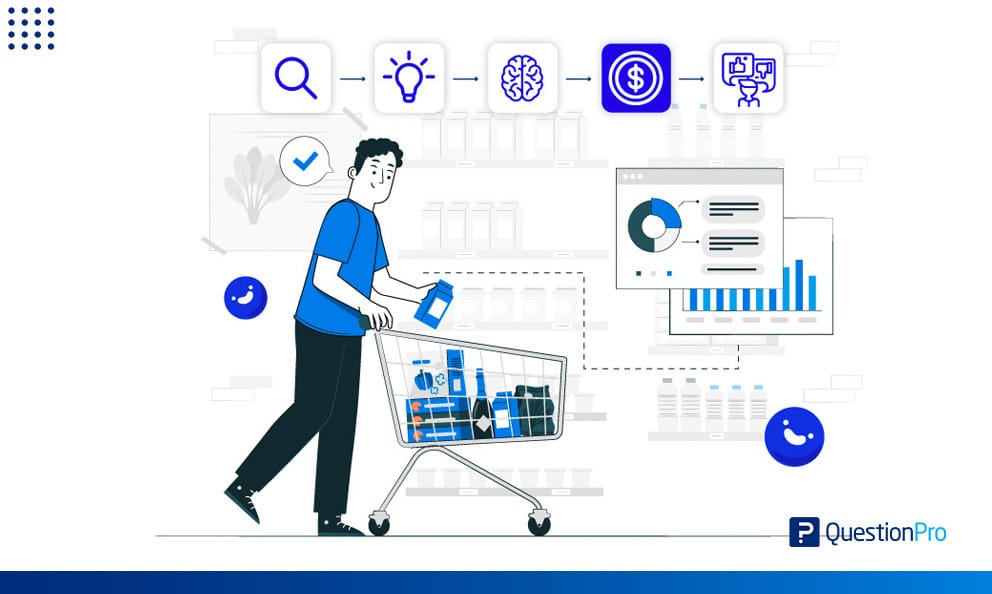
The consumer decision journey is the path a shopper takes from noticing a need to buying, and then deciding whether to buy again. Unlike a straight funnel, it loops. What a customer experiences after the purchase shapes the next decision.
McKinsey introduced the model in 2009, and marketers still use it to plan content, ads, and service. Most buyers do not move in a neat line. Brands that map the loop see exactly where they win or lose sales.
In this blog, we’ll break down the four stages, the loyalty loop, real examples, and how to map and measure each stage with survey data.
What is the consumer decision journey?
The consumer decision journey is a model of how shoppers move from recognizing a need to purchase and then to repeat buying, drawn as a loop instead of a funnel. Researchers David Court, Dave Elzinga, Susan Mulder, and Ole Jørgen Vetvik published it in a study of almost 20,000 consumers across five industries and three continents.
The model has four phases: initial consideration, active evaluation, closure, and post-purchase experience. The last phase feeds back into the first, which is why the shape is a circle.
A touchpoint is any moment where a shopper meets your brand, such as an ad, a review, a store visit, or a support chat. The journey is the sum of those touchpoints over time.
The model matters because it shows where brands win or lose. A brand in the initial-consideration set can be up to three times more likely to be bought than a brand outside it.
How is the consumer decision journey different from the purchase funnel?
The consumer decision journey differs from the purchase funnel because it loops back and includes the post-purchase experience. Three nearby terms often get mixed up with it, so this table separates them.
| Term | Shape | Focus | Best used for |
|---|---|---|---|
| Purchase funnel | Linear, narrowing | Awareness to purchase | Forecasting conversions by channel |
| Consumer decision journey | Loop | Consideration through repeat purchase | Planning touchpoints and loyalty |
| Customer journey | Timeline | Every interaction with one brand, including onboarding and support | Fixing service gaps |
| Customer buying process | Linear, five steps | The thinking behind one purchase | Understanding a single decision |
For the psychology behind one purchase, read our guide to the consumer decision-making process. For the linear sequence from problem recognition to post-purchase evaluation, see the customer buying process.
What are the stages of the consumer decision journey?
The consumer decision journey has four stages: initial consideration, active evaluation, closure, and post-purchase experience. Each stage gives the shopper a different job and gives your brand a different opening.
- Initial consideration: the shopper recalls a few brands from memory.
- Active evaluation: the shopper researches, adds brands, and drops others.
- Closure: the shopper picks a brand and buys.
- Post-purchase experience: the shopper uses the product and judges it.
Stage 1: Initial consideration
In initial consideration, a trigger starts the search and the shopper names the brands that come to mind first. The trigger might be a cracked phone screen, a new job, or an ad. Only brands the shopper already knows can enter this set.
McKinsey found that PC shoppers began with an average of 1.7 brands in mind. Car shoppers began with 3.8. Every earlier customer touchpoint builds the memory that earns your brand a place on that short list.
Stage 2: Active evaluation
In active evaluation, the shopper researches and the set of brands grows and shrinks. PC shoppers added an average of one brand to their starting set, and car shoppers added 2.2.
About two-thirds of touchpoints in this stage are consumer-driven, and about a third are company-driven. Shoppers pull information from sources such as:
- Online reviews and ratings
- Friends, family, and social posts
- Search engines and comparison sites
- Brand websites and retailer pages
Stage 3: Closure
Closure is the moment of purchase, when the shopper chooses one brand and buys it. Price, stock, delivery time, return policy, and checkout ease all decide the outcome.
The decision can still change late. McKinsey reports that up to 40% of consumers change their minds based on something they see, learn, or do in the store. A slow checkout or a surprise fee can do the same online.
Stage 4: Post-purchase experience
In the post-purchase stage, the shopper uses the product and compares it with what they expected. That verdict sets up the next purchase in the category. The shopper may:
- Confirm the choice and feel confident
- Contact support with a problem
- Leave a review or recommend the brand
- Keep researching after buying
The last behavior is common. McKinsey found that more than 60% of facial skin care consumers research online after they buy.
How does the loyalty loop work?
The loyalty loop is the shortcut a shopper takes when the post-purchase experience is good. They skip initial consideration and active evaluation next time and go straight to repurchase.
McKinsey separates loyal customers into two types. Active loyalists stay with a brand and recommend it to others. Passive loyalists stay out of inertia or confusion, and a competitor can lure them away.
Both types can look the same in repeat-purchase data. The difference shows up in how they talk about you and how they respond to a rival’s offer. McKinsey found up to a sixfold difference in the ratio of active to passive loyalists among major auto insurance brands.
Track that ratio as a health check for repeat revenue. Our guide to brand loyalty covers how to measure and build it.
How do shoppers behave in the messy middle?
The messy middle is Google’s name for the space between a trigger and a purchase, where shoppers loop between exploring and evaluating. It adds detail to the active-evaluation stage. Google’s research calls it a place “where customers are won and lost.”
Shoppers switch between two mental modes. Exploration widens the options. Evaluation narrows them. They repeat the cycle across search engines, social media, and review sites until one option wins.
Google tested 310,000 simulated purchase scenarios and found that six cognitive biases move choices:
- Category heuristics: Short spec summaries make comparison easier.
- Social proof: Reviews and recommendations persuade.
- Authority bias: Experts and trusted sources carry weight.
- Scarcity bias: Low stock raises desire.
- Power of now: A long wait weakens an offer.
- Power of free: A free gift can tip a choice.
In that test, even the weakest fictional challenger cereal brand won 28% of shopper preference from the established favorite once it used these levers well.
What are real examples of the consumer decision journey?
Examples show how the same four stages play out in different categories. The three below are illustrative scenarios built on the McKinsey model, not company case studies.
Example 1: Buying a laptop
| Stage | What the shopper does | What a brand can do |
|---|---|---|
| Initial consideration | Thinks of two brands after a laptop breaks | Stay visible in search and in retail displays |
| Active evaluation | Reads reviews, watches a teardown video, adds a third brand | Publish clear specs and encourage verified reviews |
| Closure | Buys from a retailer with free returns | Offer simple returns and fast delivery |
| Post-purchase | Joins a support forum to fix a setup issue | Send setup guides and check in after one week |
Example 2: Choosing a skincare product
A shopper sees a friend’s post and buys a serum. They keep reading ingredient reviews after the purchase to confirm the choice. A brand that answers those questions with clear usage guides turns doubt into a repeat order.
Example 3: Renewing a US auto insurance policy
- A passive loyalist renews because switching feels like work.
- A competitor’s quote arrives through a comparison site.
- The shopper re-enters active evaluation and compares prices.
- An insurer that proves its value before renewal keeps the customer in the loyalty loop.
Step-by-step guide to mapping the consumer decision journey
To map the consumer decision journey, list the four stages, find every touchpoint in each one, and attach customer feedback to each touchpoint. A journey map is a visualization of the process that a person goes through in order to accomplish a goal.
- Pick one segment and one product: A single map for all customers blurs the picture.
- Ask recent buyers to retrace their path: Ask which brands they thought of first, which they added later, and why they chose yours. As a practical starting point, aim for 30 to 50 recent buyers per segment.
- List the touchpoints at each stage: Include ones you do not control, such as reviews and friends. Our customer journey map guide includes a template.
- Rate each touchpoint: Score effort, emotion, and influence on the decision.
- Mark the drop-offs: Note where shoppers removed your brand from their list.
- Assign an owner and a metric: Review the map every quarter.
How do you measure the consumer decision journey?
You measure the consumer decision journey by pairing one behavior metric and one survey metric with each stage. Behavior data shows what shoppers did. Survey data shows why.
Three survey scores come up often. Net Promoter Score (NPS) asks how likely a customer is to recommend you on a 0 to 10 scale. Customer satisfaction score (CSAT) rates satisfaction with one interaction. Customer effort score (CES) rates how easy an interaction was.
| Stage | Behavior metric | Survey question or score |
|---|---|---|
| Initial consideration | Branded search volume | “Which brands come to mind first in this category?” |
| Active evaluation | Review-site visits, comparison-page views | “Which brands did you compare, and which did you drop?” |
| Closure | Conversion rate, cart abandonment | CES: “How easy was it to complete your purchase?” |
| Post-purchase | Repeat purchase rate, return rate | CSAT after delivery |
| Loyalty loop | Share of repeat buyers | NPS, split into promoters (9 to 10), passives (7 to 8), and detractors (0 to 6) |
Send the CES survey within 24 hours of checkout, while the experience is fresh. Send NPS after the customer has used the product long enough to judge it. You can run these questions through survey software and compare scores stage by stage.
How do you decide which stage to fix first?
Fix the stage where the biggest drop-off meets the most revenue. A simple scoring pass makes that call easier. Rate each stage from 1 to 5 on drop-off size, gap against your closest competitor, and revenue at stake. Then match the weakest stage to a fix:
- Rarely named at the start: Invest in awareness before conversion pages. Brands outside the initial set face steep odds.
- Added, then dropped: Improve proof, such as reviews, comparison content, and clear pricing.
- Abandoned at checkout: Remove friction in payment, shipping costs, and form fields.
- Low repeat purchase: Strengthen onboarding, support, and follow-up.
Fix one stage at a time. Then re-measure before you move to the next.
What are the most common consumer decision journey mistakes?
The most common mistakes come from treating the journey as a straight line owned by one team. Six patterns show up again and again.
- Treating it as a funnel.
A funnel ends at the sale. This model keeps going and feeds back into consideration. - Mapping only owned touchpoints.
Two-thirds of evaluation touchpoints are consumer-driven, so a map that lists only your ads misses most of the story. - Skipping the post-purchase stage.
Brands that stop listening at checkout lose the loyalty loop. - Using one map for every segment.
A first-time buyer and a returning customer take different paths. - Measuring clicks without asking why.
Analytics show a drop-off but not the reason behind it. - Treating the map as a one-time project.
Channels and shopper habits change, so review the map every quarter.
How QuestionPro captures feedback at each stage
QuestionPro Customer Experience ties survey feedback to journey stages, so teams can see which stage is weak and which touchpoint causes it. The journey management tool maps touchpoints and emotions, then tracks NPS and CSAT at each stage on the same map.
Three capabilities matter most for this model:
- Stage-level scores sit beside the touchpoint behind them.
- Negative feedback routes to an owner for follow-up.
- AI-supported analysis sorts open-ended comments by theme.
The loop rewards the brands that keep listening
A shopper’s decision never fully ends. Each purchase teaches them something about your brand, and they carry that lesson into the next choice. That makes the quiet moments after checkout just as important as the loud ones before it.
Brands that treat the journey as a conversation tend to hear problems early. They fix the weak stage, keep their place on the short list, and turn buyers into advocates. The stages give you a map, but listening gives you the direction.
Frequently Asked Questions (FAQs)
It depends on the category and the price. Low-cost items can move through all four stages in minutes, while cars, mortgages, and large appliances can take weeks or months. Ask recent buyers when they first thought of the category to find your median.
Partly. Business buyers also build a short list, evaluate, and buy, but several people usually decide together and cycles run longer. Map one journey per role, such as user and approver, and add a renewal loop for contracts.
Yes. AI answers and social feeds are new touchpoints inside active evaluation, not a replacement for the model. Audit where your brand appears; two-thirds of evaluation touchpoints were consumer-driven.
Interview ten recent customers, ask which brands they compared, and plot their answers on the four stages in a spreadsheet. Add a two-question survey after purchase. Repeat each quarter before you invest in dedicated tools.
No single team owns every stage. Marketing usually covers consideration, sales or e-commerce covers closure, and support covers the post-purchase stage. Name one owner per stage and one executive sponsor who reviews the combined map each quarter.