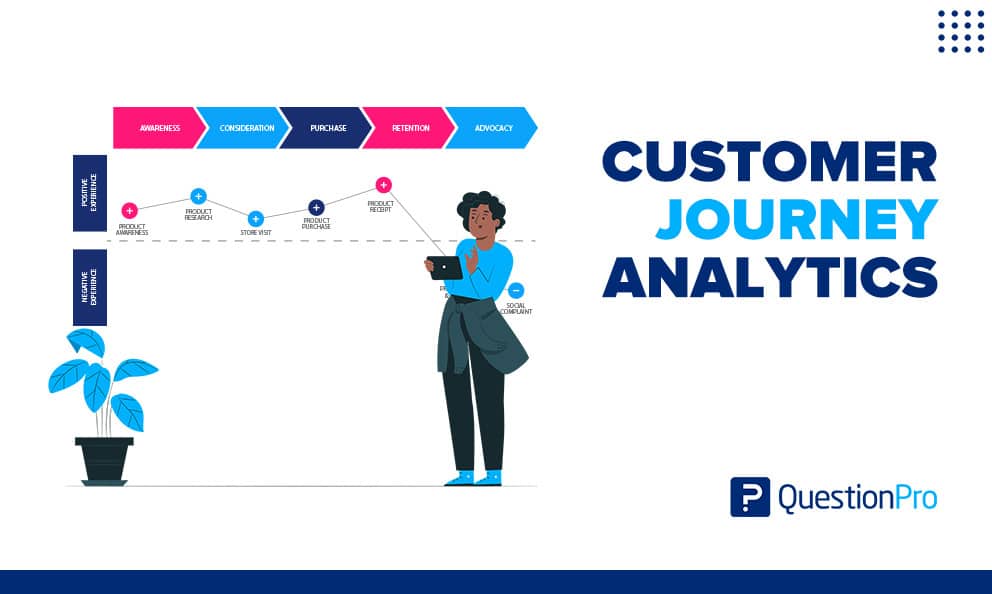
Customer journey analytics helps businesses understand how customers actually move across channels, touchpoints, and time. Instead of reviewing isolated metrics, it connects actions into real paths that explain why customers convert, struggle, or leave.
Rather than treating data as disconnected reports, customer journey analytics focuses on how interactions link together to shape real customer outcomes. By identifying pain points in the customer journey, reducing unnecessary effort, and understanding behavior patterns, you can improve retention, operational efficiency, and customer lifetime value.
For businesses in the USA dealing with complex digital journeys, journey analytics often reveals issues that traditional dashboards miss.
This article explains what customer journey analytics is, why it matters for CX, and how you can use it to improve real customer journeys.
What is customer journey analytics?
Customer journey analytics is the process of tracking and analyzing how customers interact with an organization across multiple touchpoints over time. These touchpoints can include website visits, product usage, purchases, support interactions, emails, surveys, and in-store activity.
Customer journey analytics focuses on sequences, not snapshots. Instead of asking what happened at one moment, it asks what happened before and after, and how those steps connect.
It also helps businesses understand behavior patterns, friction points, and outcomes like conversion, retention, and churn. It turns scattered interaction data into a coherent view of the real customer experience.
What is journey analytics?
Journey analytics is the broader concept behind customer journey analytics. It refers to analyzing any experience that unfolds as a sequence of events over time.
This can apply to customer journeys, employee onboarding journeys, patient care journeys, or user adoption flows. The core idea is that events matter more when their order, timing, and repetition are understood together.
Customer journey analytics is simply journey analytics applied to customer behavior.
What is customer journey analysis?
Customer journey analysis is the analytical work performed on journey data. It includes identifying common paths, drop-off points, loops, delays, and moments that influence results like retention or revenue.
Customer journey analysis answers questions like:
- What usually happens before a customer churns?
- Which paths lead to higher lifetime value?
- Where do people get stuck or repeat steps?
Customer journey analytics provides the data and structure and turns that data into insight.
What is customer experience analytics?
Customer experience analytics is a broader category that includes survey data, behavioral data, operational metrics, and feedback analysis. It measures how customers feel and how they behave.
Journey analytics fits inside CX analytics by adding sequence and context. Customer Satisfaction Score (CSAT) and Net Promoter Score (NPS) measure sentiment at a point in time. Journey analytics explains what happened before that score and what tends to happen after.
Why is customer journey analytics important for your CX?
Customer journey analytics is important because customers do not experience brands in isolated moments. They experience flows that stretch across time, devices, and teams.
CX programs often struggle when businesses focus on single metrics or channels. Journey analytics connects those pieces and shows how decisions in one area affect the overall experience. This is why customer journey analytics is important for CX programs that want to address root causes rather than isolated symptoms.
In the USA, where customers expect fast, consistent experiences across channels, journey-level insights are often essential for identifying hidden friction points.
Is data analytics worth it for customer journeys?
Data analytics is worth it when it supports a clear decision. In customer journey analytics, value comes from using data to change how journeys work.
Analytics delivers value when:
- Customer interactions can be tied to the same person
- Journeys are clearly defined with a specific start and end point
- Insights lead to specific actions that can be measured over time
When these conditions are missing, analytics becomes noise. Journey analytics works best when it supports a specific CX goal, such as reducing early churn or improving onboarding.
Learn more about is data analytics worth it for customer experience initiatives and the conditions that influence its true impact.
What is the value of the customer journey?
The customer journey shows how customers actually experience a product or service, rather than how businesses assume they behave.
Understanding the journey helps companies:
- See where expectations break down
- Identify moments that influence trust
- Understand why customers switch channels, pause, or abandon tasks
This perspective is especially useful in complex, multi-step journeys common in US industries such as SaaS, healthcare, and financial services, where customer actions rarely follow a straight line.
Learn how to create your customer journey canvas and download our template.
What are the main benefits of customer journey analytics?
Journey analytics helps organizations move from assumptions to evidence by showing how customer actions connect across the full journey.
Key benefits of customer journey analytics include:
- Tracking customer behavior across channels and time
- Identifying friction points that cause drop-offs
- Improving coordination between teams
- Reducing costs caused by repeated contacts, delays, or rework
- Identifying paths that lead to higher retention and long-term revenue
The biggest benefit is clarity. Businesses work from shared facts instead of opinions, which shortens decision cycles and reduces internal debate.
How to use customer journey analytics?
Using customer journey analytics starts with focus, not tools. It works best when you follow a clear, repeatable workflow.
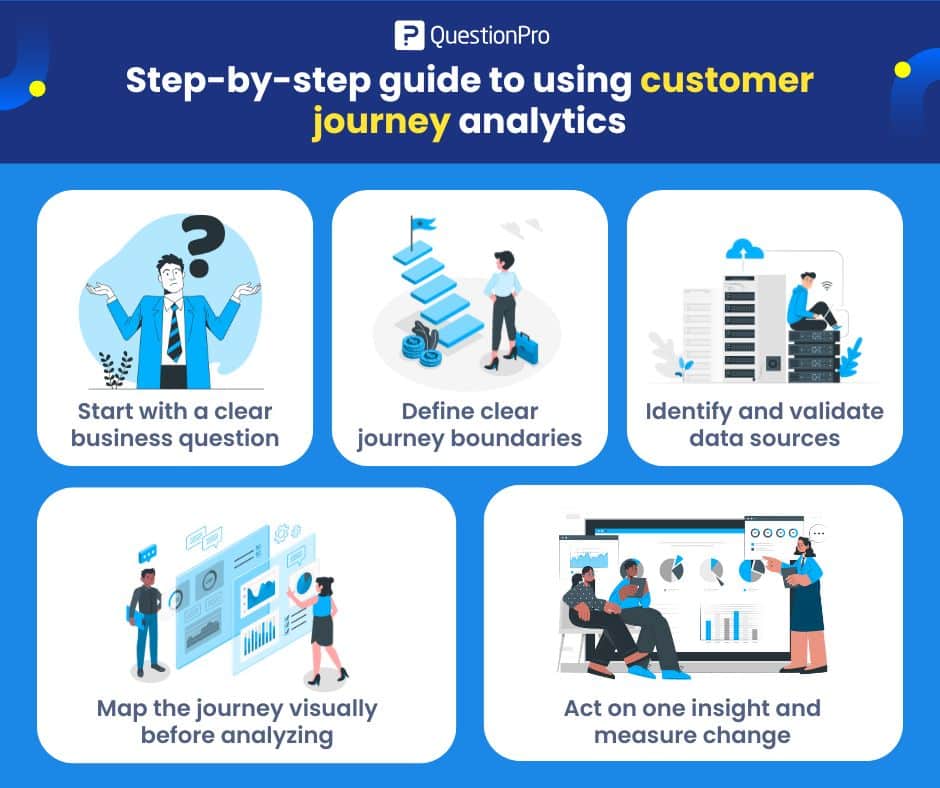
- Start by defining the business question.
Decide what outcome you want to improve, such as reducing churn in the first 90 days.
- Define the journey boundaries.
Be specific about where the journey starts and ends to avoid vague or misleading insights.
- Connect the data sources involved and confirm that events can be reliably tied to the same customer.
Without reliable identity matching, journey analysis breaks down.
- Map the journey visually.
Use this step to identify common paths, loops, delays, and drop-offs.
- Act on one insight at a time and measure the impact.
This step is what turns analysis into results and prevents teams from trying to fix everything at once.
Read the complete guide on how to use customer journey analytics, from defining journey boundaries to acting on insights and measuring impact.
How many customer journeys should you track?
Most teams should start with two to five high-impact journeys. Trying to track everything at once creates noise and slows action.
Good starting points include:
- Onboarding or first-use journeys
- Purchase or subscription journeys
- Support or issue-resolution journeys
As businesses gain confidence, they can expand coverage to additional journeys based on impact and complexity.
Customer journey analytics tools and platforms
Customer journey analytics tools help CX experts collect, connect, and analyze journey data across channels and time. The goal is to understand how customers move across touchpoints, not just to store events.
A strong analytics platform focuses on capabilities that support sequence analysis and decision-making, rather than isolated reporting.
Common capabilities include:
- Identity resolution across channels to connect actions to the same customer
- Event-level data ingestion to capture journeys step by step
- Journey mapping through an analytics journey map that visualizes paths, loops, and delays
- Segmentation based on customer attributes and behavior patterns
- Metrics tied directly to journey steps and business outcomes
Many businesses rely on a customer journey analytics dashboard to explore these paths, compare journeys, and track changes over time. Dashboards work best when they reflect real journeys rather than static KPIs.
Some businesses evaluate enterprise tools, such as Adobe Customer Journey Analytics, when comparing journey analytics platforms. The right choice depends on factors such as data complexity, analytics maturity, and how tightly journey analysis needs to integrate with broader CX programs.
This is where dedicated journey analytics software becomes useful for CX teams that need speed, clarity, and a shared view of how customer journeys actually unfold.
Which customer journey analytics metrics matter most?
Customer journey analytics metrics focus on how customers move through journeys and what outcomes those paths produce, not just scores.
Common metrics include:
- Journey completion rate
- Time required to complete a journey
- Drop-off points at each step
- Repeated steps, loops, or rework
- Conversion or retention tied to specific paths
These metrics help businesses identify which journeys create value, where friction occurs, and which steps have the greatest impact on results.
Customer journey analytics examples
Journey analytics examples help businesses see how journeys unfold in real life and why sequence often explains outcomes better than isolated metrics.
For example, consider tracing the ideal driving route from Austin to Houston. A planner might consult multiple sources, such as Google Maps, Waze, or Apple Maps, and also talk to friends who have already made the trip. At the end of this process, the result is a set of directions that show how to get from one point to another.
Now imagine having access to data on how people actually made the trip, including their routes, average speed, traffic conditions, and where delays occurred. Using that information, you could not only plan a more reliable route but also understand where journeys tend to break down, why certain paths cause problems, and which routes consistently lead to better outcomes.
As another example, a SaaS company might analyze onboarding journeys to see which paths lead to activation within the first 14 days. Journey analytics often reveals that customers who complete a specific setup step early are more likely to renew.
An e-commerce brand in the USA might track browse-to-purchase journeys across mobile and desktop to identify where customers switch devices or abandon carts due to delays or missing information.
Understand more about SaaS customer journey stages and how building a clear roadmap helps teams manage onboarding, adoption, and long-term customer success.
Customer journey analytics vs customer journey mapping: What is the difference?
Customer journey analytics and customer journey mapping address the same goal from different angles. They help organizations understand both how journeys are designed and how they actually unfold in real life.
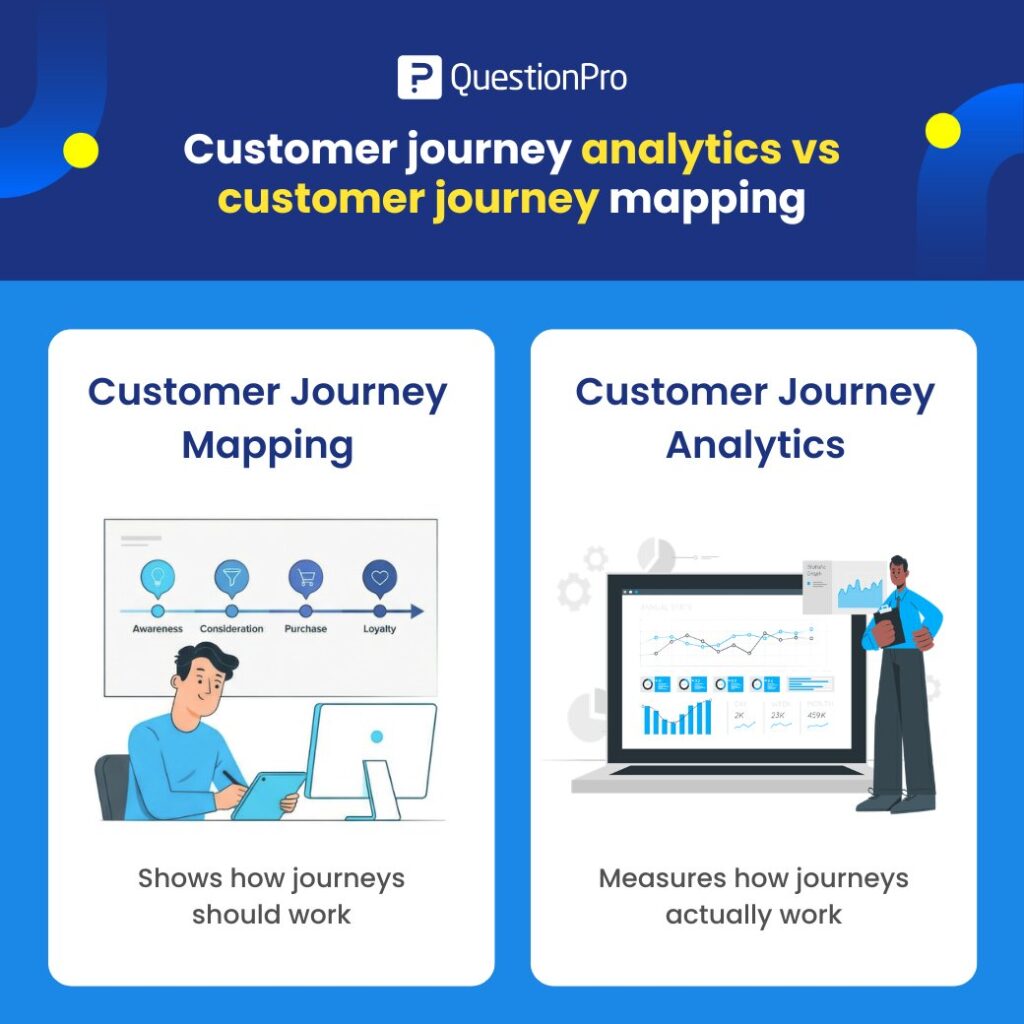
- Customer journey mapping is a qualitative practice used to document expected customer flows. It focuses on how customers are intended to move through common activities, and highlights desired experiences at key touchpoints.
- Customer journey analytics is a quantitative approach that connects data across channels and moments. It measures how customers actually move through journeys, including delays, loops, drop-offs, and negative experiences.
The two approaches are complementary, not interchangeable. Customer journey mapping provides context and intent, while customer journey analytics validates those assumptions with real behavior data.
| Aspect | Customer Journey Mapping | Customer Journey Analytics |
| Purpose | Design and document intended journeys | Measure and analyze actual journeys |
| Type of data | Qualitative | Quantitative |
| Focus | Expectations and ideal flows | Real behavior over time |
| Typical inputs | Interviews, workshops, research | Event data, interaction logs, metrics |
| What it shows | How journeys should work | How journeys actually work |
| Best use | Journey design and alignment | Journey validation and optimization |
Without analytics, journey maps remain assumptions. Without mapping, analytics lacks direction. When used together, mapping guides design decisions, and analytics confirms where journeys succeed or break down.
This combination allows teams to move from intention to evidence and improve customer journeys based on what customers actually experience, not what teams expect.
Explore customer journey mapping tools that help teams visualize journeys, align stakeholders, and support experience design across touchpoints.
Things to keep in mind
Customer journey analytics requires discipline. There are common areas where teams go wrong if the process is not handled carefully.
- Skipping the review phase
Acting on journey data without validating patterns leads to weak conclusions and ineffective actions. Journey insights should be reviewed and tested before changes are made.
- Working with insufficient data
Small or incomplete datasets produce misleading patterns. Without enough data across the full journey, conclusions are unreliable and can hide real opportunities.
- Focusing only on averages
Averages mask meaningful variation. Important signals often appear in edge cases, emerging paths, or minority behaviors that later become common.
- Underestimating the skills required
Journey analytics is not self-executing. Even with the right tools, teams need analytical skills to interpret paths, question assumptions, and translate insight into action.
Don’t let your team decide on hunches: Democratize customer data
Customer journey analytics only delivers value when insights are shared, not siloed. When journey data is accessible across teams, decisions are based on evidence rather than assumptions.
Democratizing customer data helps teams align around the same view of the customer journey. Product, CX, marketing, and operations teams can see how actions connect over time, where friction appears, and which changes actually improve outcomes.
This shared understanding reduces internal debate, speeds decision-making, and keeps teams focused on measurable improvements. Instead of reacting to isolated metrics or opinions, organizations can act with confidence based on how customers truly move across journeys.
Explore customer experience management platform software and practices, and how teams use them to combine journey data, feedback, and operational insights to support better CX decisions.
Want to apply customer journey analytics in practice?
Platforms like QuestionPro Journey Management Tool help support teams combine journey data with customer feedback in one place. By connecting behavioral paths with survey insights, teams can identify where journeys break down and track the impact of changes over time.
If you want to explore how customer journey analytics can be implemented within a CX program, you can learn more about QuestionPro Customer Experience here.
Frequently Asked Questions (FAQs)
Answer: It refers to methods and tools used to analyze how customers move through a series of interactions over time. Instead of looking at isolated events, it examines complete paths across channels to understand behavior, friction, and outcomes.
Answer: A simple definition is the analysis of connected customer actions across touchpoints to understand how experiences unfold and what drives results such as conversion, retention, or churn.
Answer: Journey analysis is the analytical work performed on journey data, such as identifying drop-offs, loops, or high-performing paths. Journey analytics refers to the broader system or approach that collects, connects, and structures journey data so that analysis is possible.
Answer: Traditional dashboards focus on static metrics at a single point in time. Customer journey analytics dashboards focus on paths and sequences, showing how customers move step by step and how earlier actions influence later outcomes.
Answer: A journey analytics platform is commonly used by CX, product, marketing, and operations teams. It helps these teams share a common view of customer behavior and align on how journeys actually work, not on assumptions.
Answer: No. It is useful for any organization with multi-step customer interactions. Smaller teams often benefit by focusing on a few high-impact journeys, such as onboarding, support, or renewal, rather than trying to analyze everything at once.
Answer: It is working when insights lead to measurable changes. Signs include reduced friction in key journeys, faster decision-making across teams, and clear links between journey improvements and outcomes like retention or conversion.