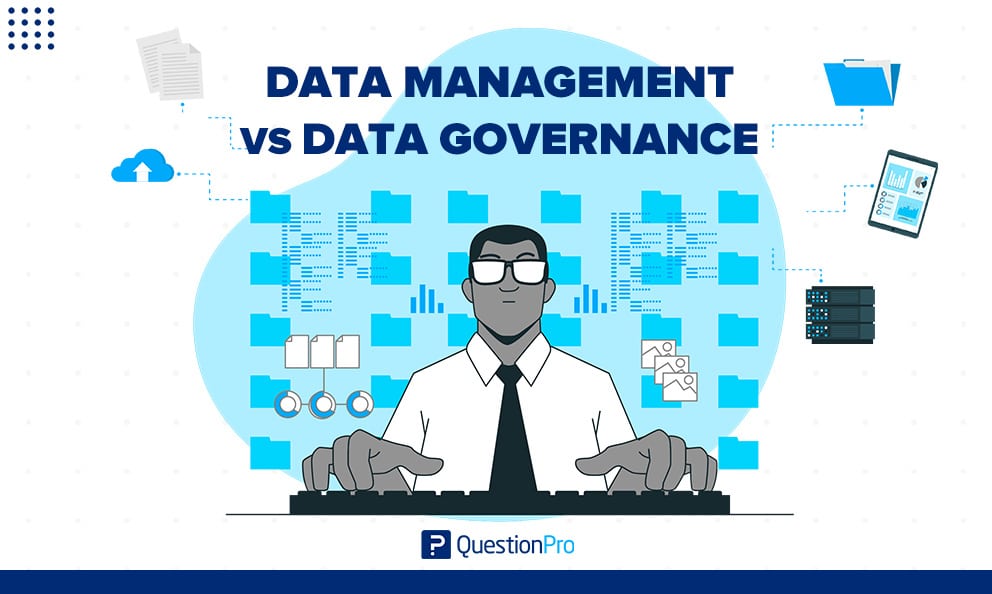
Data management vs data governance is a common comparison because both deal with how organizations handle data, but they do not mean the same thing. The difference matters because companies in the USA often manage customer data, employee data, financial records, research data, and operational data across many systems.
Without clear governance, teams may not know who owns the data, who can access it, or which version is correct. Without strong management, even good policies stay on paper and never reach daily workflows.
In this article, we will explain what data management and data governance mean, how they differ, how they work together, examples of each, and when businesses should focus on one or both.
What does data management vs data governance mean?
Data management vs data governance means comparing the operational side of data with the rule-setting side of data. Data management handles the systems and processes that make data usable. On the other side, data governance sets the standards that make data trustworthy, secure, and accountable.
A simple way to understand it:
- Data governance decides what should happen.
- Data management makes it happen.
For example, data governance may define who can access customer feedback data, how long survey responses should be retained, and what “active customer” means. Data management applies those rules through storage systems, permissions, data cleaning, dashboards, catalogs, and workflows.
Both are needed. Governance without management creates rules that are not enforced. Management without governance creates data systems that may be inconsistent, risky, or hard to trust.
What is data governance?
Data governance is the framework of roles, policies, rules, and standards that guides how data is collected, used, protected, shared, and maintained. It helps organizations create accountability around data.
A data governance framework usually includes:
- People: Data owners, data stewards, business leaders, IT teams, compliance teams, and security teams.
- Policies: Rules for access, privacy, retention, consent, usage, and sharing.
- Standards: Common definitions, naming rules, quality expectations, and documentation requirements.
- Metrics: Ways to monitor data quality, compliance, access issues, and policy adoption.
- Controls: Processes that protect sensitive data and reduce misuse.
Data governance is especially important when organizations handle sensitive customer, employee, health, financial, or research data. In the United States, privacy and compliance requirements can vary by industry and state, so businesses need clear rules for how data is handled.
The National Institute of Standards and Technology offers the NIST Privacy Framework, a useful reference for organizations that want to improve privacy risk management through structured policies, roles, and controls.
What is data management?
Data management is the process of collecting, storing, organizing, preparing, securing, and maintaining data so you can use it effectively. It covers the daily systems and workflows that keep data available and useful.
A data management strategy may have:
- Data storage in databases, warehouses, repositories, or cloud systems.
- Data preparation and cleaning.
- Data pipelines that move data between systems.
- Data collection from internal and external sources.
- ETL, which means extract, transform, load. It is the process of pulling data from sources, preparing it, and loading it into a destination system.
- Data catalogs and metadata, which help users find and understand datasets.
- Data security and access controls.
- Dashboards, reports, and analytics tools.
- Backup, archiving, and retention processes.
Good data management helps teams find the right data, trust what they are using, and avoid wasting time fixing repeated data problems.
For research teams, this can include organizing survey data, market research reports, customer feedback, qualitative data, and past studies in a searchable repository.
Data management vs data governance: What is the difference?
Data management vs data governance differ in purpose. Governance defines the rules for data. Management handles the practical work of storing, cleaning, moving, securing, and delivering data.
| Area | Data governance | Data management |
|---|---|---|
| Main focus | Rules, ownership, standards, and accountability | Systems, processes, storage, quality, and access |
| Main question | How should data be used, protected, and controlled? | How is data collected, stored, prepared, and delivered? |
| Primary users | Data leaders, compliance, legal, security, and business owners | Data engineers, analysts, IT, and data operations teams |
| Main output | Policies, roles, definitions, quality rules, and controls | Pipelines, catalogs, warehouses, dashboards, and integrations |
| Goal | Trusted, secure, compliant data | Usable, accessible, well-maintained data |
| Example | Define who can access customer data | Set permissions in the platform |
The easiest way to separate them is to ask whether the work is about rules or execution. If the task defines how data should be handled, it is governance. If the task handles the data directly, it is management.
What are examples of data governance and data management?
Examples make the difference between data governance and data management easier to see. Governance sets the policy. Management carries it out.
Common examples include:
- Access control
Governance decides which roles can access customer data. Management sets up permissions in the system.
- Data definitions
Governance defines what “active customer” means. Management applies that definition in dashboards and reports.
- Retention policy
Governance says certain records must be kept for seven years. Management archives or deletes records based on that rule.
- Data quality
Governance sets the required accuracy or completeness standards. Management runs validation, deduplication, and cleansing.
- Privacy controls
Governance defines how sensitive data should be protected. Management applies masking, encryption, or restricted access.
- Data cataloging
Governance requires documentation for important datasets. Management maintains the catalog and metadata.
These examples show why the two functions need each other. A policy is only useful when it changes how data is handled in real systems.
How do data governance and data management work together?
Data governance and data management work together by connecting business rules with technical execution. Governance gives data teams direction. Management turns that direction into usable systems and processes.
For example, a governance team may decide that customer survey data must include clear ownership, consent rules, retention limits, and quality checks. A data management team then organizes that survey data, applies access controls, documents the dataset, prepares it for reporting, and makes it available through approved dashboards or repositories.
This relationship also supports continuous improvement. If a dashboard shows inconsistent results, governance can review definitions and ownership. Management can then fix the data pipeline, clean records, or update documentation.
Strong data programs do not treat governance and management as separate silos. They connect policies, systems, people, and feedback loops.
Why do data governance and data management matter?
Data governance and data management matter because organizations need data that is accurate, secure, easy to find, and safe to use. When either side is weak, teams lose trust in the data.
Together, they help businesses:
- Improve data quality.
- Reduce compliance risk.
- Protect sensitive information.
- Create shared definitions.
- Improve reporting accuracy.
- Make analytics more reliable.
- Support AI readiness.
- Reduce duplicated work.
- Improve collaboration across teams.
- Give decision-makers more confidence.
Data quality management is one of the clearest shared areas. Governance defines what quality means, while management applies checks, fixes errors, and monitors ongoing quality.
When should businesses focus on data governance or data management?
Businesses should focus on data governance when the main problem is unclear ownership, inconsistent definitions, compliance risk, privacy concerns, or weak accountability. They should focus on data management when the main problem is scattered data, poor storage, duplicated records, manual preparation, or limited access.
Focus on data governance when:
- No one knows who owns key data.
- Teams use different definitions for the same metric.
- Sensitive data access is unclear.
- Compliance requirements are growing.
- Data quality rules are missing.
- Reports are not trusted.
Focus on data management when:
- Data is scattered across too many tools.
- Teams spend too much time preparing data.
- Data pipelines break often.
- Reports are slow or hard to build.
- Duplicate records are common.
- Data is hard to find or reuse.
A business focuses on both when the organization wants to scale analytics, customer experience programs, research operations, or AI initiatives. Useful data needs both trust and usability.
How can QuestionPro InsightsHub support data governance and data management?
QuestionPro InsightsHub fits into the research and insights side of data management. It gives teams a central place to organize survey findings, market research reports, customer studies, and insight documents, making them easier to find, understand, and reuse.
From a data management perspective, an insights hub can support:
- Centralized research assets: Store survey findings, reports, and insight documents in one searchable place.
- Less duplicate work: Help teams find existing research before starting a new study.
- Better documentation: Keep context around sources, study details, findings, and limitations.
- Easier knowledge reuse: Make past insights easier to apply to new business questions.
From a data governance perspective, an insights hub can support:
- Clearer ownership: Help teams understand who created, manages, or owns each research asset.
- Approved access: Keep research materials available to the right users.
- Consistent use of trusted insights: Reduce confusion caused by scattered files or outdated versions.
- Responsible research reuse: Help teams understand where insights came from before using them in decisions.
It does not replace a full enterprise governance program. But for research and insights teams, QuestionPro InsightsHub can support better habits around organization, access, documentation, and reuse.
Final takeaway
Data management vs data governance is not a choice between two competing ideas. Data governance sets the rules for trusted, secure, and responsible data use. On the other hand, data management puts those rules into daily practice through systems, workflows, storage, documentation, and access.
Businesses need both if they want data that people can find, understand, trust, and use. Governance without management becomes paperwork. Management without governance becomes risky and inconsistent. The strongest data programs connect rules with real execution.
Frequently Asked Questions (FAQs)
Data management handles the practical work of collecting, storing, organizing, securing, and maintaining data. Data governance sets the rules, roles, policies, and standards that guide how data should be used, protected, and trusted.
Data governance and data management are closely connected, but they are not the same. Governance sets the framework and rules. Data management applies those rules through systems, processes, tools, and daily data operations.
Data governance and data management help businesses improve data quality, reduce risk, protect sensitive information, support compliance, and make analytics more reliable. Without both, data can become scattered, inconsistent, unsafe, or hard to trust.
An example of data governance is a policy that defines who can access customer data, how long records must be retained, what consent is required, and who owns data quality for each business function.
An example of data management is cleaning duplicate customer records, building data pipelines, organizing datasets in a catalog, storing data in a warehouse, and making trusted data available through dashboards or reports.