A 180 degree evaluation is a performance review method where an employee is assessed by their manager and peers, alongside their own self-assessment. It sits between a traditional manager-only review and a full 360 degree feedback process, giving HR teams a faster way to compare self-perception against how a manager sees the same performance.
Many organizations use it as a starting point before moving to more complex, multi-rater systems. In this guide, we’ll explore what a 180 degree evaluation includes, how it compares to 360 degree feedback, sample questions, and a step-by-step process for running one.
What is a 180 degree evaluation?
A 180 degree evaluation combines a manager’s assessment of an employee with the employee’s own self-assessment, and in some structures, input from close peers.
Here’s how the two sides come together:
- Self-assessment: The employee rates their own performance before the review meeting, reflecting on strengths and gaps.
- Manager assessment: The manager rates the same competencies separately, using the same scale.
- Comparison: The two sets of scores are lined up side by side, and any gaps between them become the starting point for the review conversation instead of a surprise sprung on the employee mid-meeting.
Evaluators need direct working experience with the person under review, or the ratings hold little weight. A manager who rarely interacts with an employee’s day-to-day work, or a peer pulled in from an unrelated team, produces feedback that’s closer to guesswork than assessment. Most 180 degree evaluation programs limit raters to people who’ve worked closely with the employee for at least one full review cycle.
What sets this method apart from 360 degree feedback is simple: subordinates are left out. Some organizations stretch a 180 degree evaluation to include limited client input for client-facing roles, but the standard version stays focused on the manager and the employee.
Fewer raters means less coordination. That’s the trade-off worth remembering. A 180 degree evaluation is quicker to run and easier to interpret than a full multi-rater process, which makes it a practical fit for teams that want structured, comparative feedback without the scheduling overhead 360 degree feedback demands.
How does a 180 degree evaluation differ from a 360 degree evaluation?
A 180 degree evaluation and a 360 degree evaluation both measure performance, but they differ in scope, speed, and who provides feedback. The table below breaks down the main differences.
| Factor | 180 degree evaluation | 360 degree evaluation |
|---|---|---|
| Raters | Manager and employee self-assessment | Manager, peers, subordinates, self-assessment |
| Speed | Fast, usually completed in days | Slower, requires coordinating multiple raters |
| Depth | Focused, two-perspective comparison | Comprehensive, multi-perspective view |
| Anonymity | Usually not anonymous | Typically anonymous |
| Best for | Quick development check-ins | Leadership development and succession planning |
Choosing between the two depends on how much detail you need and how much time you can invest. A 180 vs 360 degree feedback decision usually comes down to organization size and how mature the feedback culture already is. For a deeper breakdown, see our 180 vs 360 feedback comparison.
What are the main uses of a 180 degree evaluation?
A 180 degree evaluation is most often used for individual development and as a lighter-weight complement to formal performance reviews.
- Development feedback: Useful for employees and new leaders looking to identify specific skill gaps without the overhead of a full multi-rater process.
- Performance review support: Works alongside a standard performance review process by adding a self-assessment layer that opens up dialogue between employee and manager.
Both uses share the same core value: comparing self-perception against a manager’s view surfaces blind spots that a one-sided review would miss.
A manager-only review closes off dialogue since the employee has no structured way to weigh in on their own performance before the conversation starts. Adding a self-assessment component changes that dynamic. It gives the employee a voice in the process, which tends to make the resulting conversation feel more like a discussion and less like a verdict handed down from above.
What are the pros and cons of a 180 degree evaluation?
A 180 degree evaluation offers faster, more focused feedback than a full multi-rater review, but it also has real limitations worth weighing before you adopt it.
Benefits
- Faster to administer than 360 degree feedback, since it involves fewer raters
- Opens direct dialogue between employee and manager instead of a one-way assessment
- Surfaces gaps between self-perception and manager perception early
- Supports clearer goal-setting and a more focused employee development plan
- Signals to employees that the organization invests in their growth
Challenges
- Leaves out peer and subordinate perspectives, so blind spots involving coworkers can go unnoticed
- Feedback usually is not anonymous, which can make managers soften their ratings
- Provides a narrower view than 360 degree feedback, so it is not a full substitute for comprehensive reviews
- Depends heavily on the manager’s ability to give balanced, specific feedback
What questions should a 180 degree evaluation include?
Strong 180 degree feedback questions focus on specific behaviors and job responsibilities rather than personality traits, and they’re phrased slightly differently for the self-assessment than for the manager assessment.
Common areas to cover:
- How well does the employee meet their core job responsibilities?
- How effectively does the employee communicate with the team?
- How does the employee respond to feedback and adjust their approach?
- What specific goals did the employee meet or miss this period?
- Where does the employee see their biggest opportunity for growth?
- How well does the employee collaborate with others on shared projects?
Framing questions around concrete situations, rather than general impressions, produces 180 degree feedback examples that are far easier to act on in the follow-up conversation.
The self-assessment version of each question should ask the employee to rate themselves first, before seeing the manager’s ratings. This keeps the self-assessment honest instead of anchored to what the employee expects the manager already thinks. Many teams also add one or two open-ended questions, such as asking what support the employee needs to hit their next goal, since a purely numeric scale can miss context that only a written answer captures.
How do you conduct a 180 degree evaluation?
Running a 180 degree evaluation involves four main steps, from mapping reporting lines to building a development plan from the results.
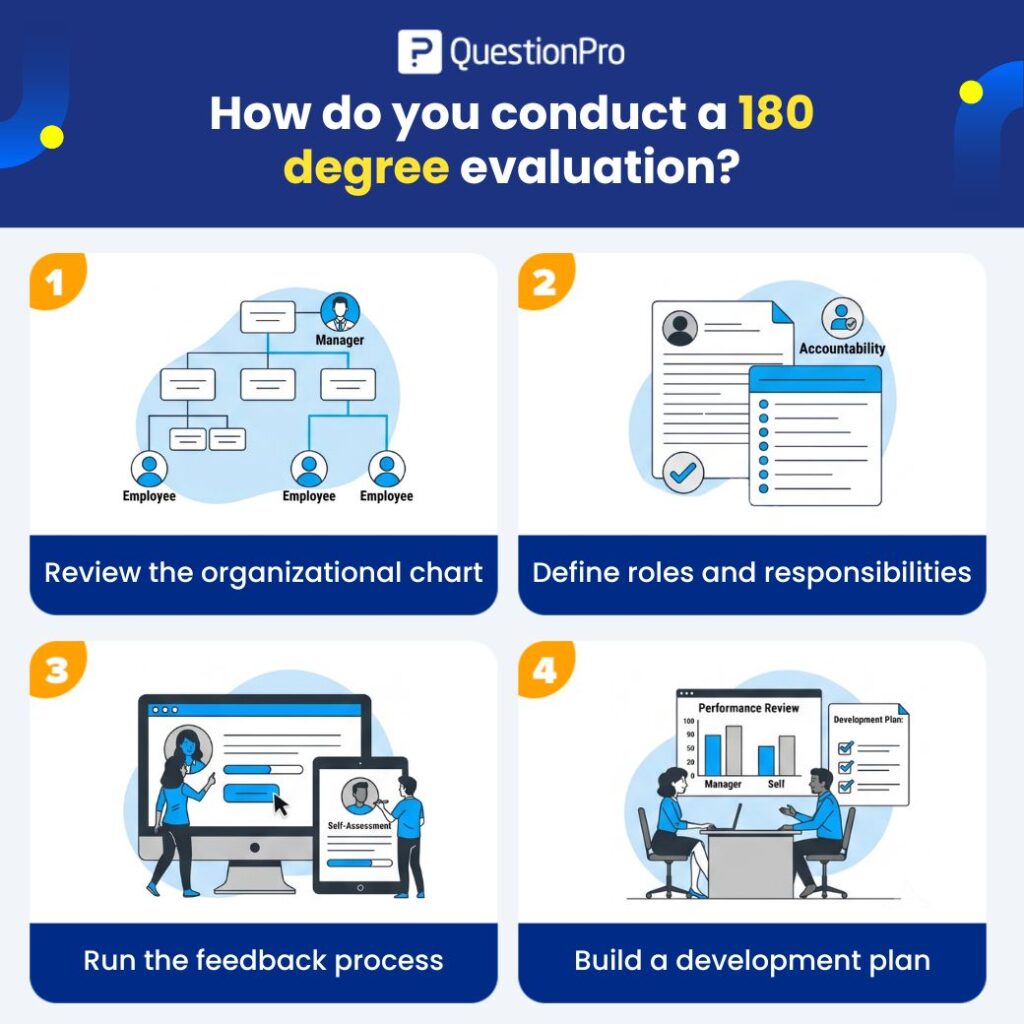
- Review the organizational chart. Confirm who reports to whom so you know which manager pairs with which employee for the review.
- Define roles and responsibilities. Document what each role is accountable for, since this determines which competencies belong in the assessment.
- Run the feedback process. Send the self-assessment and manager assessment, ideally through employee performance evaluation software so responses are collected and compared automatically.
- Build a development plan. Use the comparison between self-assessment and manager assessment to set specific goals, then schedule a follow-up review in three to six months.
Repeating this cycle on a consistent schedule, rather than as a one-off exercise, is what makes the results useful for tracking real improvement over time.
Organization size affects how much of this you can automate. A small team can run the whole process through a shared form and a manual comparison. A larger organization usually needs dedicated software to send forms, collect responses, and flag rating gaps automatically, since manually cross-referencing dozens or hundreds of self-assessments against manager assessments quickly becomes unmanageable for HR.
Getting more value from your evaluation process
A 180 degree evaluation works best when it feeds into an ongoing conversation, not a once-a-year event. Gallup has found that only 14% of employees strongly agree their performance reviews inspire them to improve, which points to a real gap between how most reviews are run and what actually drives change. Building in regular check-ins between formal review cycles helps close that gap.
Whether you run a 180 or move toward full 360 degree feedback later, the goal stays the same: give people specific, comparable feedback often enough that it actually shapes behavior.
Platforms like QuestionPro Employee Experience can help structure that feedback collection, but the real driver of results is how consistently the follow-up conversations happen. Pairing evaluations with a broader feedback survey program, and reviewing tips for effective performance reviews, gives most HR teams a solid foundation to build on. An employee pulse survey between formal cycles can also help catch issues before the next review.
Frequently Asked Questions (FAQs)
A manager and the employee both take part. The employee completes a self-assessment, the manager completes a separate assessment of the same competencies, and the two are compared during a review conversation.
Most organizations run it every six months, which allows enough time to see real change while keeping feedback recent enough to be accurate and specific.
Usually not. Because only the manager and employee are involved, both parties typically know who provided which rating, which supports direct follow-up conversation.
Standard versions do not, but some organizations add limited client feedback for client-facing roles. This variation should be defined clearly before the review starts.
A 180 degree evaluation uses only manager and self-assessment input. A 360 degree evaluation adds peers, subordinates, and sometimes external stakeholders for a broader view.