
Manager evaluation is the process of assessing how well a manager leads people, communicates expectations, supports employees, meets goals, and improves team performance. For US organizations, it is also a practical way to understand how managers affect employee experience, engagement, trust, and retention.
A manager may deliver strong business results and still create confusion, stress, or low morale. That is why a useful manager evaluation looks at both outcomes and behaviors.
The goal is not to punish managers. The goal is to help them lead better.
What is manager evaluation?
Manager evaluation is a structured review of a manager’s leadership performance, team impact, communication, and ability to support employee success.
It can include feedback from direct reports, peers, senior leaders, customers, and the manager’s own self-assessment. Many HR teams use employee surveys, 360 feedback, performance reviews, and goal tracking to collect this feedback.
A good evaluation answers three questions:
- Is the manager meeting role expectations?
- How does the manager’s behavior affect the team?
- What support does the manager need to improve?
Manager evaluation is part of performance management. Performance management is the ongoing process of setting expectations, giving feedback, coaching employees, and tracking progress. SHRM explains performance management as a process that includes goal planning, real-time feedback, coaching, and progress tracking.
Why is manager evaluation important?
Manager evaluation is important because managers shape the everyday employee experience. They influence how people receive feedback, understand priorities, handle workload, solve problems, and feel about work.
A weak manager can hurt morale, productivity, and retention. A strong manager can improve trust, clarity, engagement, and team performance.
Manager evaluations help organizations:
- Identify leadership strengths.
- Spot communication gaps.
- Improve manager coaching.
- Find team-level friction.
- Support fair promotion decisions.
- Build better development plans.
- Improve employee engagement.
- Reduce avoidable turnover risks.
- Create a stronger workplace culture.
The value is not only in collecting feedback. The real value comes from using that feedback to improve how managers lead.
What makes a good manager?
A good manager helps employees understand what matters, removes blockers, gives useful feedback, and creates a team environment where people can do strong work.
Good managers are not only task owners. They are coaches, communicators, decision-makers, and trust builders.
A strong manager usually:
- Sets clear expectations.
- Communicates regularly.
- Listens to employee concerns.
- Supports employee growth.
- Treats people fairly.
- Gives credit when it is due.
- Handles conflict early.
- Helps the team stay focused.
- Connects team goals to company goals.
- Builds trust instead of using fear.
- Gives employees enough autonomy to do their work.
The best manager evaluation process measures these behaviors directly. It does not rely only on whether the manager is liked or whether the team hit a target.
What skills should manager evaluations assess?
Manager evaluations should assess the skills that affect team performance, employee experience, and leadership quality.
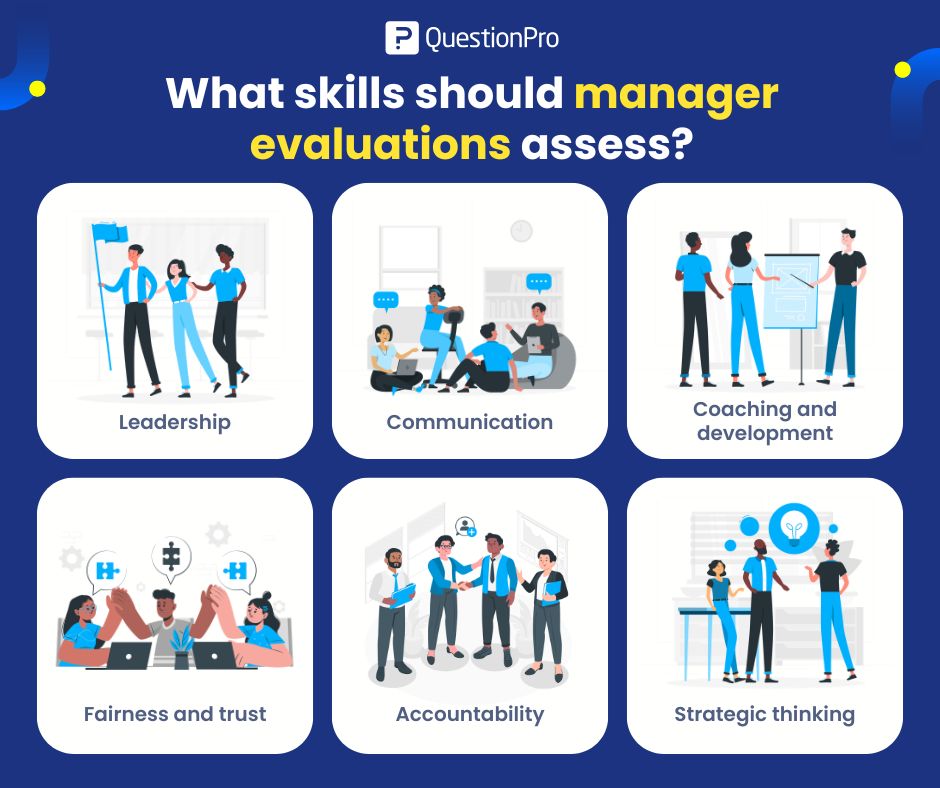
Leadership
Leadership skills show how well a manager guides the team toward shared goals.
A good manager sets direction, makes decisions, supports employees during pressure, and helps the team stay focused. A weak manager may avoid decisions, shift blame, or leave employees unsure about priorities.
Communication
Communication skills measure how clearly and consistently a manager shares information.
Managers should explain expectations, provide updates, listen carefully, and give constructive feedback. Good communication is simple, timely, and respectful.
Coaching and development
Coaching measures how well a manager helps employees grow.
This includes giving feedback, supporting career goals, identifying training needs, and helping employees improve skills. A manager who only assigns work but never develops people is missing a core part of the role.
Fairness and trust
Fairness measures whether employees feel respected, included, and treated consistently.
A manager evaluation survey should ask whether the manager avoids favoritism, applies standards fairly, and creates a safe environment for honest communication.
Accountability
Accountability measures whether a manager follows through on commitments and holds the team to clear standards.
This includes tracking progress, addressing issues early, and taking responsibility for team outcomes.
Strategic thinking
Strategic thinking measures how well a manager connects daily work to larger goals.
Managers should know how to prioritize, plan, adapt, and make decisions with limited resources. This matters in US workplaces where teams often work across changing budgets, hybrid schedules, and customer demands.
What methods can you use for manager evaluation?
Organizations can use several methods for manager evaluation. The best approach usually combines more than one source of feedback.
Employee surveys
Employee surveys collect feedback from direct reports about the manager’s communication, support, fairness, and leadership style.
This method works well because employees experience the manager’s behavior every day. Responses should be confidential when possible so employees can answer honestly.
360 feedback for managers
360 feedback for managers collects input from direct reports, peers, senior leaders, and sometimes customers.
This method gives a broader view of manager effectiveness. A manager may communicate well with executives but poorly with direct reports. Multi-source feedback helps reveal those gaps.
Manager self-assessments
A manager self-assessment asks managers to reflect on their own performance, strengths, and improvement areas.
This works best when compared with employee feedback. Large differences between self-ratings and team feedback can reveal blind spots.
Performance reviews
A manager performance evaluation reviews goals, outcomes, leadership behavior, and development progress.
It should not be limited to one annual meeting. Better performance reviews include regular check-ins, feedback, coaching, and progress updates throughout the year.
Goal tracking
Goal tracking measures whether the manager and team are meeting agreed objectives.
This should be paired with behavior feedback. A manager who hits goals by burning out the team still needs support and development.
How do you evaluate manager performance step by step?
To evaluate manager performance fairly, start with clear criteria, collect feedback from multiple sources, analyze patterns, and create a development plan.
1. Define what good management looks like
Start by defining the behaviors your organization expects from managers.
Examples include clear communication, fair decision-making, employee support, trust-building, coaching, accountability, and goal achievement.
2. Choose evaluation criteria
Select the skills and behaviors you want to measure.
Common criteria include leadership, communication, coaching, fairness, accountability, conflict resolution, decision-making, and strategic thinking.
3. Collect feedback from multiple sources
Use more than one feedback source when possible.
Direct reports are essential because they work with the manager every day. Peers, senior leaders, customers, and self-assessments can add useful context.
4. Keep feedback confidential
Employees are more likely to give honest feedback when they trust the process.
For small teams, avoid sharing raw comments that could reveal who wrote them. HR should explain how feedback will be used before the survey starts.
5. Analyze patterns and trends
Look for repeated themes across ratings and comments.
Do not overreact to one isolated comment. Focus on patterns that appear across multiple responses or feedback sources.
Managers should receive feedback in a clear, respectful, and useful way.
The conversation should focus on behaviors, impact, and next steps. Avoid personal criticism. The point is development.
7. Create an action plan
Turn the findings into a short improvement plan.
Choose two or three priority areas, define specific actions, set timelines, and decide how progress will be measured.
8. Follow up on progress
A manager evaluation should not end with a report.
HR or leadership should follow up after 60 to 90 days to check progress, remove blockers, and see whether employees notice improvement.
What manager evaluation questions should you ask?
Manager evaluation questions should focus on behaviors employees can observe.
Good questions are clear, specific, and tied to the manager’s role. Avoid vague questions like “Is your manager good?” That type of question does not tell HR what needs to improve.
Use questions like:
- Does your manager communicate expectations clearly?
- Does your manager provide useful feedback?
- Does your manager listen to employee concerns?
- Does your manager support your professional growth?
- Does your manager treat team members fairly?
- Does your manager recognize good work?
- Does your manager remove blockers when needed?
- Does your manager handle conflict respectfully?
- Does your manager explain decisions that affect the team?
- Does your manager create a respectful team environment?
- Does your manager help the team stay focused on priorities?
- How could your manager better support the team?
Use a mix of rating-scale and open-ended questions. Rating questions help HR compare patterns. Open-ended questions explain why employees feel that way.
What question types work best in a manager evaluation survey?
A manager evaluation survey should use question types that make feedback easy to answer and easy to analyze.
Likert scale questions
Likert scale questions ask respondents how much they agree or disagree with a statement.
Example:
My manager communicates expectations clearly.
Answer options may include:
- Strongly disagree
- Disagree
- Neutral
- Agree
- Strongly agree
Likert scale questions work well for measuring behaviors across leadership, communication, coaching, and fairness.
Rating scale questions
Rating scale questions ask employees to score a manager’s performance on a numeric scale.
Example:
On a scale of 1 to 5, how would you rate your manager’s ability to provide useful feedback?
These questions are simple to analyze and useful for tracking changes over time.
Open-ended questions
Open-ended questions let employees explain their experience in their own words.
Example:
What is one thing your manager could do to better support the team?
These responses are useful because they reveal context behind the ratings.
Multiple-choice questions
Multiple-choice questions help classify feedback into clear categories.
Example:
Which area should your manager improve most?
Options may include communication, coaching, delegation, fairness, decision-making, or workload planning.
Yes or no questions
Yes or no questions work best for simple checks.
Example:
Does your manager hold regular one-on-one meetings with you?
Use them sparingly. They are easy to answer but often lack detail.
How do you analyze manager evaluation results?
To analyze manager evaluation results, compare scores, review comments, and identify repeated themes.
Start with the main competency areas, such as communication, leadership, coaching, fairness, and accountability. Then read open-ended responses to understand the reasons behind high or low scores.
Useful analysis steps include:
- Compare scores across leadership competencies.
- Look for repeated themes in comments.
- Compare self-assessment results with employee feedback.
- Separate isolated complaints from common patterns.
- Review changes over time.
- Segment results only when sample size protects privacy.
- Choose two or three priority development areas.
- Connect each priority to an action plan.
Avoid using the results as a simple ranking system. Manager evaluation is more useful when it explains what needs to change and how to support that change.
How do you make manager evaluations fair?
Manager evaluations are fairer when they use consistent criteria, multiple feedback sources, and behavior-based questions.
A fair process protects both employees and managers. Employees need to feel safe giving honest feedback. Managers need to trust that results are not based on personal attacks or one-sided comments.
Best practices include:
- Use the same criteria for managers in similar roles.
- Keep employee feedback confidential when possible.
- Ask about behaviors, not personality.
- Use both ratings and written feedback.
- Avoid making decisions based on one comment.
- Train reviewers to recognize bias.
- Consider team context and workload.
- Review results with HR or a trained facilitator.
- Give managers a chance to respond and improve.
Fairness does not mean ignoring negative feedback. It means reading feedback responsibly and turning it into useful action.
What mistakes should HR teams avoid?
HR teams should avoid treating manager evaluation as a one-time form or a punishment tool.
Common mistakes include:
- Asking vague questions.
- Ignoring confidentiality.
- Collecting feedback but taking no action.
- Using only one feedback source.
- Sharing raw comments without context.
- Evaluating managers only on business results.
- Ignoring employee experience signals.
- Using the same questions for every management level.
- Failing to follow up after the evaluation.
- Allowing bias to shape interpretation.
The biggest mistake is asking employees for feedback and then doing nothing with it. That damages trust and makes future surveys less useful.
How can QuestionPro Employee Experience support manager evaluation?
QuestionPro Employee Experience can help HR teams collect, analyze, and act on manager feedback through surveys, 360 feedback, employee evaluation surveys, and pulse surveys.
For example, an HR team can use a 360-degree review survey template to collect feedback from different people who work with a manager. A team can also use employee feedback surveys to understand how managers affect communication, trust, motivation, and support.
QuestionPro also offers employee evaluation surveys that can help HR teams structure feedback around performance, development, and workplace experience.
The goal is not to collect more feedback for the sake of it. The goal is to turn feedback into manager development and track whether employees experience improvement over time.
Final thoughts on manager evaluation
Manager evaluation works best when it is used for development, not fear.
A strong process helps managers understand how their behavior affects employees, team performance, and employee experience. It also gives HR teams a clearer way to identify coaching needs, leadership gaps, and team-level risks.
The best approach is simple: define what good management looks like, collect honest feedback, analyze patterns fairly, and turn the results into action.
Frequently Asked Questions (FAQs)
Most organizations should evaluate managers at least once a year, with lighter pulse checks between formal reviews. In fast-moving US teams, quarterly feedback can help HR spot issues earlier and track whether managers are improving.
Direct reports should always be included because they experience the manager’s leadership daily. Peer feedback, senior leader feedback, customer input, and manager self-assessments can add context, especially for 360 feedback programs.
Manager evaluation results can inform promotion decisions, but they should not be the only factor. HR teams should combine feedback with business results, leadership behavior, team outcomes, and evidence of development progress.
Anonymous or confidential surveys usually produce more honest feedback, especially when employees worry about retaliation. For small teams, HR should protect identities by grouping results carefully and limiting raw comment sharing.
A five-point agreement scale works well for most manager evaluation surveys. It is simple for employees and easy for HR teams to analyze. Open-ended questions should be added to explain the reasons behind ratings.
HR should review the feedback carefully, identify repeated themes, and create a focused development plan. The manager should receive coaching, clear expectations, and a follow-up timeline. Serious behavior issues may need stronger intervention.