Getting honest feedback from your clients shouldn’t feel like pulling teeth. Yet many professional services firms struggle with low response rates, vague insights, and surveys that collect dust rather than drive change. Effective customer satisfaction surveys are essential for gathering valuable insights that inform meaningful improvements and business growth. A well-executed client satisfaction survey transforms scattered opinions into a strategic roadmap for retention and growth.
This guide breaks down everything you need to design, distribute, and act on client feedback in 2026. Before you begin the survey creation process, it’s crucial to define clear objectives to ensure your questions are relevant and your data is actionable. You’ll find practical frameworks, concrete examples, and a step-by-step checklist you can implement over the next 4–6 weeks.
Gathering consistent, actionable feedback from your clients is key to driving continuous improvement and maintaining high levels of satisfaction over time.
Key Takeaways
- A client satisfaction survey is a structured feedback mechanism designed to measure relationship health, service quality, and overall satisfaction in B2B and professional services contexts — fundamentally different from transactional customer surveys in retail settings. Important customer satisfaction surveys utilize survey measures to assess satisfaction levels, providing essential insights into client needs and expectations.
- Well-designed surveys in 2026 combine CSAT, NPS, and open-ended questions to capture both quantitative data and the reasons behind the numbers.
- Timing and channel selection dramatically influence response rates — sending surveys within 48–72 hours of a project milestone via personalized email can achieve 25–35% response rates compared to 10% for generic sends.
- Acting on survey results and communicating changes back to clients through “You said, we did” messaging is as important as data collection itself, building trust and improving future participation. Leveraging survey data supports continuous improvement and enables data driven decisions that enhance service quality and client loyalty.
- Research indicates that 91% of customers are likely to recommend a company after a positive experience, while 89% of CX professionals believe that poor experiences lead to customer churn.
What Is a Client Satisfaction Survey?
A client satisfaction survey differs fundamentally from typical customer surveys you’d encounter after buying a product online. While customer satisfaction surveys often target one-time transactions, client surveys focus on ongoing relationships in B2B and professional services settings — think law firms, consulting agencies, wealth management firms, and SaaS enterprises serving businesses. Client satisfaction surveys help businesses understand customer expectations and customer needs, enabling them to tailor services and build stronger relationships.
A client satisfaction survey is a structured set of questions sent to existing clients to measure how satisfied they are with services, communication, outcomes, and overall relationship health. These surveys typically mix quantitative and qualitative data: numeric scales for quick benchmarking alongside multiple choice and open-text prompts that capture how customers feel and gather detailed feedback.
Consider a law firm sending a satisfaction survey after closing a major case, asking not just about legal resolution but ongoing advisory trust, and including questions related to a recent purchase or recent interactions to improve the relevance of feedback. Or a SaaS provider surveying enterprise clients at Q2 2026 renewal time to gauge stickiness amid hybrid service delivery models. Both examples target long-term relationships rather than isolated purchases.
With QuestionPro’s CX platform, surveys can be delivered via email links, secure client portals, in-app widgets, or phone interviews — adapting to client preferences and regulatory constraints in sectors like financial services or healthcare. Capturing feedback at different stages of the customer experience helps improve service quality and ensures continuous improvement.
Why Client Satisfaction Surveys Matter in 2026
The landscape has shifted dramatically since 2020. Clients now benchmark their B2B vendors against consumer-grade experiences — they expect the seamlessness of Amazon or fintech apps from their consulting firm or IT services provider. B2B switching rates have surged 15–25% since 2022 due to budget scrutiny and vendor consolidation. Tracking customer satisfaction score and customer loyalty helps organizations identify dissatisfied customers early, enabling proactive retention strategies and fostering long-term relationships.
The importance of customer satisfaction cannot be overstated. Without structured feedback, firms operate on assumptions rather than evidence. Providing opportunities for clients to provide feedback through surveys is essential, as it enables organizations to use that input to make targeted improvements. Client satisfaction surveys help detect churn risk earlier, prioritize high-value accounts showing declining scores, and validate which service improvements actually matter to clients. They transform scattered opinions into actionable insights that drive business operations forward.
The Impact of Client Satisfaction on Growth and Reputation
High client satisfaction directly correlates with revenue outcomes, boosting client satisfaction and strengthening customer relationships. Firms with CSAT scores above 80% see 20–30% higher client retention and 1.5x cross-sell success in consulting and IT services. Satisfied customers become promoters who sign multi-year agreements, participate in case studies, and speak at industry events.
The benefits extend across multiple dimensions:
- Referral pipeline: Promoters refer through tight professional networks, boosting win rates in RFPs by 12–18% when armed with strong satisfaction scores
- Expansion revenue: High overall customer satisfaction creates openings for cross-selling additional services
- Proof points: Consistently strong 2026 survey scores become ammunition in proposals and pitch decks
- Price resilience: When client expectations are consistently met, clients push back less on fee increases
Collecting valuable data from post purchase interactions is essential for assessing product quality and identifying areas for improvement. This feedback helps organizations refine their offerings and further enhance the overall customer experience.
Conversely, dissatisfied clients amplify reputational damage through LinkedIn-era word-of-mouth, reducing new opportunity pipelines by up to 40%.
Common Challenges in Measuring Client Satisfaction
Despite acknowledging their importance, many firms struggle to run effective programs. Senior decision-makers yield response rates as low as 10–20% due to inbox overload. Feedback often comes from a single contact, ignoring multi-stakeholder views that paint a complete picture. Additionally, it can be challenging to identify dissatisfied customers and capture their feedback in their own words, which is crucial for understanding the root causes of dissatisfaction and improving retention.
Common obstacles include:
- Poorly timed surveys sent during intense deal work, dropping completion rates by 40%
- Vague questions like “How’s our service?” that fail to pinpoint specific issues
- Survey fatigue from over-surveying without visible follow-through
- Privacy and compliance concerns in regulated sectors requiring encrypted, anonymized handling
- Difficulty gathering consistent feedback and identifying patterns in survey data, making it harder to track evolving expectations and tailor improvements
The rest of this guide addresses how to overcome these challenges through better design, strategic timing, and closed-loop communication.
Core Components of an Effective Client Satisfaction Survey
Survey Design and Question Strategy
Keeping surveys short and focused — ideally 5 minutes or less with three to five clear customer satisfaction survey questions — improves completion rates significantly. Response rates drop after 5–7 questions, so discipline in question selection is essential. Crafting concise, well-designed questions ensures you capture feedback that is reliable and actionable.
Structure your survey around four question types to evaluate different aspects of the customer experience:
| Question Type | Example | Purpose |
| Core CSAT | “Overall, how satisfied are you with our firm?” (1–5 scale) | Headline metric |
| NPS | “How likely are you to recommend us?” (0–10 scale) | Loyalty indicator |
| Diagnostic (Multiple choice) | “How satisfied are you with our response times?” (1–5) | Specific driver |
| Open-ended | “What one change would improve our collaboration?” | Qualitative depth |
Use multiple choice questions to efficiently categorize respondents and analyze satisfaction across different aspects such as service quality, product offerings, and interactions. Open-ended questions are valuable for gathering detailed feedback and inviting improvement suggestions, helping you understand how to enhance your offerings.
With QuestionPro’s customer survey software, you can combine all four types in a single, mobile-responsive survey — complete with logic branching that shows follow-up questions only when relevant. For a head start, explore QuestionPro’s ready-made CSAT survey templates designed by research professionals.
Understanding which customer satisfaction metrics to prioritize — CSAT, NPS, or CES — is one of the most important design decisions you’ll make. For a side-by-side breakdown, see NPS vs CSAT vs CES: Key Differences and When to Use Each.
A significant portion of responses come from mobile devices, so test your survey on smartphones before launch. Also, remember to capture feedback at various touchpoints, such as immediately after key interactions, to ensure timely and accurate insights.
Distribution Channels and Timing
Match channels to client preferences:
- Personalized email from relationship partner: 25–35% response rate
- Generic email invitation: ~10% response rate
- In-app or portal surveys: Effective for tech-savvy clients
- Online surveys: Highly effective for gathering feedback on website experiences, usability, and digital touchpoints
- Phone interviews: Rich qualitative feedback but 50% no-show risk
Online surveys are particularly effective for gathering feedback quickly and efficiently, allowing you to evaluate digital experiences and identify usability issues.
Recommended timing patterns:
- Post-project surveys: Within 48–72 hours of delivery
- Post purchase interactions: Capture feedback immediately after a purchase to understand and improve the overall customer experience
- Quarterly relationship pulses: March, June, September, December
- Annual strategic surveys: November (before fiscal year-end crunch)
- Lifecycle checkpoints: 30 days after onboarding, 90 days before renewal
Gathering feedback at these key touchpoints supports continuous improvement by providing actionable insights to enhance service quality and client satisfaction.
Data Collection, Privacy, and Analysis
Secure, compliant handling of client responses is non-negotiable, especially for firms operating under GDPR, CCPA, or sector-specific regulations. Collecting accurate survey data is crucial, as it provides valuable data for analysis and helps generate actionable insights. Essential requirements include encrypted survey links with role-based access, clear data retention policies (12–24 months), and pre-defined segmentation by industry, region, revenue tier, or account manager.
QuestionPro’s text analysis software surfaces patterns in open-ended responses up to 30% faster than manual review — automatically tagging recurring themes like “response time” or “reporting clarity.” By identifying patterns in survey data, organizations can make targeted improvements and streamline processes to enhance the customer experience. Set internal thresholds for follow-up: any satisfaction score of 3 or below on a 5-point scale should trigger personal outreach within 5 business days. Using the data collected enables businesses to make informed decisions that drive continuous improvement.
Step-by-Step Guide to Creating a Client Satisfaction Survey Program
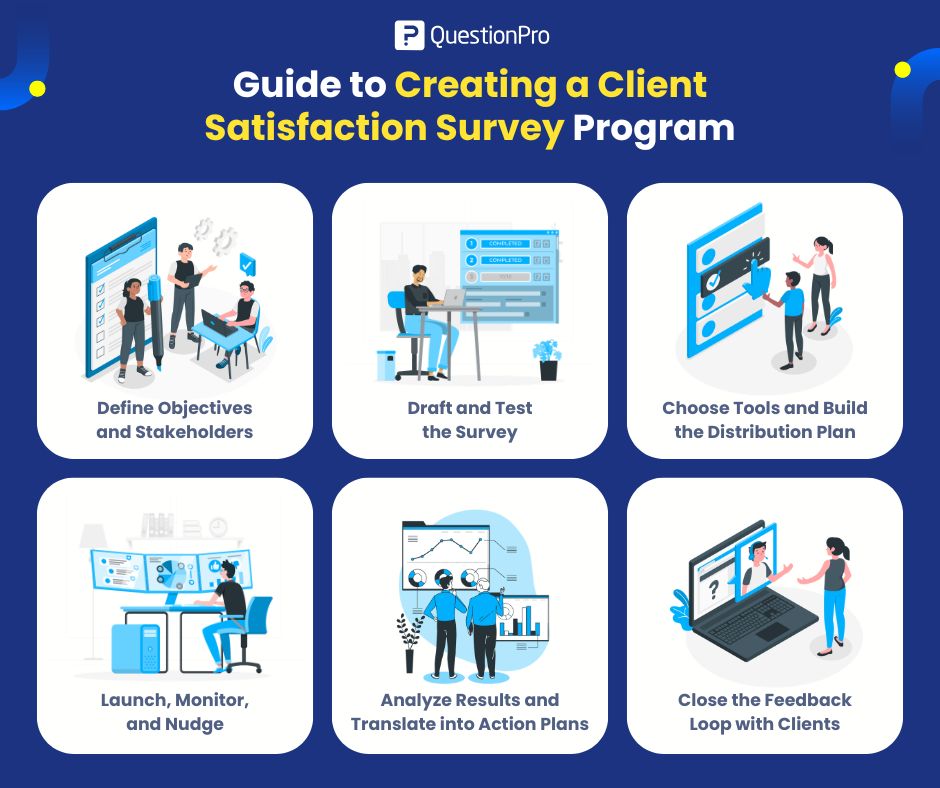
1. Define Objectives and Stakeholders
Start with specific objectives. Vague goals like “understand satisfaction” won’t drive action. Instead, aim for: “Reduce churn in top-tier clients by 15% in FY 2026” or “Benchmark relationship health across APAC vs. EMEA regions.” When defining survey objectives, it’s important to focus on understanding customer expectations, as well as identifying and addressing customer needs to ensure your offerings align with what clients truly want. Include questions that explore initial awareness—how clients first learned about your brand or product—and directly address customer needs to gain actionable insights.
Identify internal owners: an executive sponsor, a project manager in client success or marketing, and key account leads who own client relationships. Capture 3–5 priority questions the business needs answered — for example: “Are 2026 fee increases perceived as fair relative to value?” or “How do clients rate our digital reporting tools?”
2. Draft and Test the Survey
Draft an initial question set that includes a mix of customer satisfaction survey questions, such as multiple choice and open-ended questions, to gather actionable feedback. Focus on designing questions that yield meaningful insights for your business. Review the draft with a cross-functional team — sales, account management, compliance, and operations. Run a short internal pilot with friendly clients. Track estimated completion time and trim questions ruthlessly if it exceeds 5 minutes.
For guidance on what to ask, see Client Satisfaction Survey Questions with Examples — QuestionPro’s deep-dive on question design for B2B contexts.
3. Choose Tools and Build the Distribution Plan
Select a survey platform that integrates with your existing CRM and supports online surveys, making it easy to capture feedback from clients at key touchpoints. QuestionPro integrates natively with Salesforce, HubSpot, MS Dynamics, and more, ensuring each response ties to the right account automatically for segmented analysis and providing valuable data for further analysis.
Decide whether surveys will be anonymous or named. Named surveys enable targeted follow-up — often crucial in B2B contexts — while partial anonymity can balance candor with traceability.
Build a concrete send schedule:
- Wave 1: 10 June 2026
- Reminder 1: 17 June 2026
- Reminder 2: 24 June 2026
- Close fieldwork: 30 June 2026
4. Launch, Monitor, and Nudge
Monitor daily response rates during the first week and segment by client group to identify where extra nudging is needed. Ensure clients have regular opportunities to provide feedback, and monitor for consistent feedback to track evolving expectations and maintain service quality. Use value-oriented messaging: “Feedback from 2023–2025 led to upgraded reporting dashboards and faster support SLAs.” Collecting actionable feedback through your client satisfaction survey is crucial for driving meaningful improvements and business growth.
Senior partners or account directors should personally follow up with strategic accounts. A personal touch from someone the client knows dramatically increases participation. QuestionPro’s automated scheduling handles reminder sends so your team can focus on the high-value personal follow-ups.
5. Analyze Results and Translate into Action Plans
Translate raw responses into 3–5 clear priorities for the next 6–12 months. Calculate average CSAT, customer satisfaction score, NPS distribution, and year-over-year trends. Analyze satisfaction levels and customer sentiment to understand the reasons behind the scores. Segment results by client type — clients onboarded after a specific date may score differently, which is valuable for evaluating service changes.
Use these insights to make data driven decisions and informed decisions, ensuring that actions are prioritized based on accurate feedback and analysis.
Turn insights into concrete actions with owners and deadlines:
- Revise communication cadences — Owner: Account Team, Due: 31 July 2026
- Redesign onboarding materials — Owner: Client Success, Due: 31 August 2026
- Implement faster report turnaround — Owner: Operations, Due: 15 September 2026
QuestionPro InsightsHub allows teams to store, tag, and surface these insights across the organization — so findings from one survey wave inform decisions long after fieldwork closes, functioning as a CRM for your research.
6. Close the Feedback Loop with Clients
Within 30–60 days of closing the survey, go back to clients with a “You said, we did” message. This step transforms surveys from a one-off exercise into a trust-building routine, fostering continuous improvement and strengthening customer relationships by acting on feedback. Soliciting improvement suggestions through open-ended survey questions encourages clients to provide feedback on how your company can better meet their needs, while also allowing you to communicate the actions taken in response.
Follow-up formats include email summaries, short slide overviews shared in quarterly review meetings, and blog posts outlining high-level improvements for all clients.
Visibly acting on feedback drives 20% higher NPS in subsequent surveys.
Types of Client Satisfaction Surveys and When to Use Them
Relationship (Periodic) Surveys
Broad annual or semi-annual assessments covering overall satisfaction, strategic alignment, and perceived value. Relationship surveys are valuable for gathering consistent feedback, measuring satisfaction levels, and understanding customer preferences and customer loyalty over time. Likert scale questions work well for consistent benchmarking across periods. These surveys identify cross-sell opportunities with high scorers and long-term risk signals with declining accounts.
Post-Project or Transactional Surveys
3–5 questions sent within 24–72 hours of a specific interaction: project completion, workshop delivery, implementation go-live, or dispute resolution. Including questions related to a recent purchase or post purchase interactions helps capture feedback at the right moment and encourages customers to provide detailed feedback about their experience. QuestionPro’s CSAT survey templates are built precisely for this use case — quick to deploy and easy to analyze.
Net Promoter Score (NPS) Surveys
The Net Promoter Score — “How likely are you to recommend us to a colleague or peer?” — uses a 0–10 scale. NPS surveys provide a comprehensive view of customer sentiment, preferences, and loyalty, helping businesses understand not only overall satisfaction but also what drives advocacy and long-term relationships. Respondents are classified as:
- Detractors (0–6): At risk of churning, may spread negative word-of-mouth
- Passives (7–8): Satisfied but unenthusiastic
- Promoters (9–10): Loyal advocates likely to refer
Always add a follow-up open question to surface qualitative drivers. QuestionPro CX’s AskWhy feature automates this follow-up for every NPS response, capturing the reason behind every score without adding friction.
Customer Effort Score (CES) Surveys
CES surveys focus on ease of experience: “Overall, how easy was it to complete this process?” These surveys are valuable for evaluating service experiences, as they help identify friction points in the customer journey. By analyzing CES results, organizations can streamline processes and improve overall customer experience. Use around first login to new portals, post-onboarding, or KYC documentation. For a detailed comparison of when to deploy each metric, see NPS vs CSAT vs CES.
Customer Journey Surveys
Collect feedback at multiple touchpoints throughout the client relationship — from initial onboarding through renewal. Be sure to include questions that address initial awareness and gather feedback on different aspects of the customer journey, such as service quality, product offerings, and interactions. QuestionPro’s CX platform is built specifically for this multi-touchpoint approach, stitching together feedback across the full lifecycle to map friction at every stage.
Best Practices for Writing Client Satisfaction Survey Questions
Keep Questions Focused
Limit each question to a single idea. To improve response rates and data quality, keep the survey short and focused—ideally three to five concise questions that are easy to understand and target specific topics. This approach helps accurately measure satisfaction levels across different aspects of the customer experience, such as service quality, product offerings, and interactions.
Before: “How satisfied are you with our service?” After: “How satisfied are you with our response times over the last 3 months?”
Use consistent scales across questions — always 1–5 or 1–7. QuestionPro Survey Software offers over 80 question types with built-in scale standardization.
Avoid Bias and Leading Language
Biased: “How excellent was our support during Q1 2026?” Neutral: “How would you rate our support during Q1 2026?” (Very poor to Excellent)
Allowing customers to express feedback in their own words through open-ended questions helps you better understand how customers feel about their experiences, providing richer insights beyond simple rating scales.
Avoid double-barreled questions and have someone not involved in the project review the survey to spot unintentional bias before launch.
Use Open-Ended Questions Strategically
Include no more than 1–3 open-ended questions per survey. Make them specific:
Open-ended questions are essential for gathering detailed feedback and improvement suggestions from clients, which can lead to valuable insights that inform meaningful improvements and business strategies.
Vague: “Any other comments?” Specific: “What is one thing we could do differently next quarter to better support your team?”
QuestionPro’s text analysis software automatically categorizes and themes open-ended responses across hundreds of submissions — surfacing insights that manual review would miss.
Personalize Where It Matters
Reference the client’s name, company, and specific engagement: “Following our work together on the Q1 2026 implementation project…” Personalization should extend to follow-up — reference particular themes the client raised to show their feedback genuinely influenced decisions. Including questions that specifically evaluate the customer service team and tailoring follow-up communications can help strengthen customer relationships and provide deeper insights into customer preferences. This approach ensures that feedback is not only collected but also used to align offerings with what customers value most, fostering loyalty and ongoing engagement.
Measuring, Interpreting, and Acting on Client Satisfaction Data
Calculate and Track Key Metrics Over Time
CSAT: Count respondents who selected the top satisfaction ratings, divide by total responses, multiply by 100. Track CSAT movement quarter-over-quarter.
NPS: Subtract percentage of detractors from percentage of promoters. Ranges from -100 to +100. QuestionPro CX generates visual NPS dashboards that show Promoter/Passive/Detractor distribution at a glance.
Set clear internal targets: improve average satisfaction by 0.3 points on a 5-point scale within 12 months. Trend tracking from 2023 to 2026 is more meaningful than obsessing over single-point-in-time numbers.
Combine Quantitative Scores with Qualitative Themes
Tag open-ended comments into manageable themes: communication, response time, strategic insight, pricing, digital tools. Count theme frequency in negative versus positive comments to prioritize action. Analyzing survey data in this way helps identify patterns and extract meaningful insights and actionable feedback, ensuring that the information gathered drives real improvements.
QuestionPro’s AI-powered text analysis does this automatically — surfacing sentiment trends, keyword clusters, and theme frequencies across hundreds of open-ended responses. InsightsHub then stores these findings in a searchable repository, so the same patterns identified in a Q2 wave can be cross-referenced against Q4 data or entirely different survey projects.
Turn Insights into Concrete Improvement Plans
| Priority | Action | Owner | Target Date | Success Metric |
| Quick win | Redesign weekly update emails | Marketing | 31 July 2026 | CSAT +0.2 on communication |
| Structural | Overhaul onboarding process | Client Success | 30 September 2026 | CES improvement for new clients |
| Long-term | Upgrade client portal reporting | Product | 31 December 2026 | 20% reduction in report requests |
By analyzing client satisfaction survey results, organizations can use these findings to make targeted improvements and foster a culture of continuous improvement. Leveraging the valuable insights gained from both qualitative and quantitative feedback ensures that changes are meaningful and drive ongoing enhancements in service quality and client experience.
Integrate Survey Results into Everyday Client Management
Satisfaction scores should be visible in CRM and account planning tools, not buried in static reports. QuestionPro integrates directly with Salesforce, HubSpot, and MS Dynamics — so when account managers prep for a client call, sentiment trends surface automatically alongside account data.
Leveraging survey data in this way helps strengthen customer relationships, improve customer loyalty, and supports informed decisions in client management.
Use survey results in account reviews to identify expansion opportunities with promoters and retention risks with detractors. Build satisfaction checkpoints into renewal workflows, executive business reviews, and ongoing governance meetings.
Start Collecting Smarter Client Feedback Today
Client satisfaction surveys only deliver value when they drive action. Continuous improvement is fueled by actionable feedback and meaningful insights derived from valuable data collected through these surveys. The firms that treat feedback as a continuous conversation — not an annual checkbox — consistently outperform on retention and growth.
QuestionPro gives you everything you need to run this end-to-end: CSAT, NPS, and CES survey templates built by research professionals; automated distribution and reminder scheduling; CRM integration with Salesforce, HubSpot, and MS Dynamics; and AI-powered text analysis that turns hundreds of open-ended responses into a prioritized action list.
See plans and start your free trial → and launch your first client satisfaction survey this week — no design or technical expertise required.
Already using QuestionPro? Explore the full survey template library to get a head start on your next wave.
FAQs: Client Satisfaction Surveys
A practical pattern: quarterly pulse checks (3–5 questions) for strategic accounts combined with a comprehensive relationship survey for all active clients each autumn. QuestionPro’s automated scheduling handles recurring send cadences so nothing falls through the cracks.
Identified surveys allow for targeted follow-up — often crucial in B2B contexts. Partial anonymity can balance candor with traceability. Be transparent with clients about how responses will be used.
Review survey length first. Examine timing and invitation wording. Have relationship owners personally invite key contacts rather than relying on generic sends. Offering to share a brief benchmark summary as an incentive can increase response rates by 10–15%. Consider using online surveys to gather feedback at various touchpoints, such as website feedback forms or post-interaction questionnaires, which can help identify usability issues and improve digital experiences. Collecting feedback through these methods ensures you gather valuable data for analysis and improvement. For inspiration, here are a few examples: post-purchase satisfaction surveys, website usability surveys, and customer journey feedback forms. Also review our customer satisfaction survey examples for design patterns that consistently outperform on response rate.
Even firms with 20–50 clients can generate actionable insights. A 40% response rate from 30 clients provides richer insights than 10% from 300 if the feedback is thoughtful and specific. Individual comments and themes may be more informative than aggregate statistics in smaller samples.
Significantly. QuestionPro’s AI suite assists in drafting neutral questions, categorizing open-ended feedback, and spotting recurring themes up to 30% faster than manual review. InsightsHub’s AskAI lets you query your entire research repository conversationally — ask “What are the top three concerns from our 2025 client surveys?” and get an instant synthesized answer. Human oversight remains essential to interpret nuanced comments, but AI dramatically accelerates the analysis phase.