Bank of America’s NPS sits at 46 in 2025, five points above the banking industry average of 41, according to QuestionPro’s Q1 2025 Benchmarking NPS and CSAT Report. That gap is not an accident. It reflects specific decisions the bank made about rewards, accessibility, and digital service.
Net Promoter Score is the industry’s standard way to measure how likely customers are to recommend a company to someone else. Banks track it because loyalty in financial services is fragile. Rates change constantly, and products across competitors look nearly identical on paper.
This article breaks down Bank of America’s current NPS, the factors behind it, and how to benchmark and improve your own score using the same methodology.
What is NPS and why does it matter in banking?
Net Promoter Score is a single-question metric that predicts customer loyalty and the likelihood of referrals. It asks customers to rate, from 0 to 10, how likely they are to recommend a company to a friend or colleague.
Responses fall into three groups:
- Detractors (0-6): Unhappy customers who may discourage others from joining.
- Passives (7-8): Satisfied but unenthusiastic customers who rarely refer anyone.
- Promoters (9-10): Loyal customers who actively recommend the brand.
The score itself comes from a simple formula: NPS = % Promoters minus % Detractors. A positive score means promoters outnumber detractors. A negative score means the opposite.
In banking specifically, Net Promoter Score matters because switching banks is a hassle most customers avoid unless something goes wrong. A low NPS often signals problems building well before customers actually leave, which gives banks a window to fix service gaps before attrition shows up in the numbers.
What is Bank of America’s NPS in 2025?
Bank of America’s NPS is 46, compared to a banking and financial services industry average of 41, based on QuestionPro’s Q1 2025 study of U.S. banking customers.
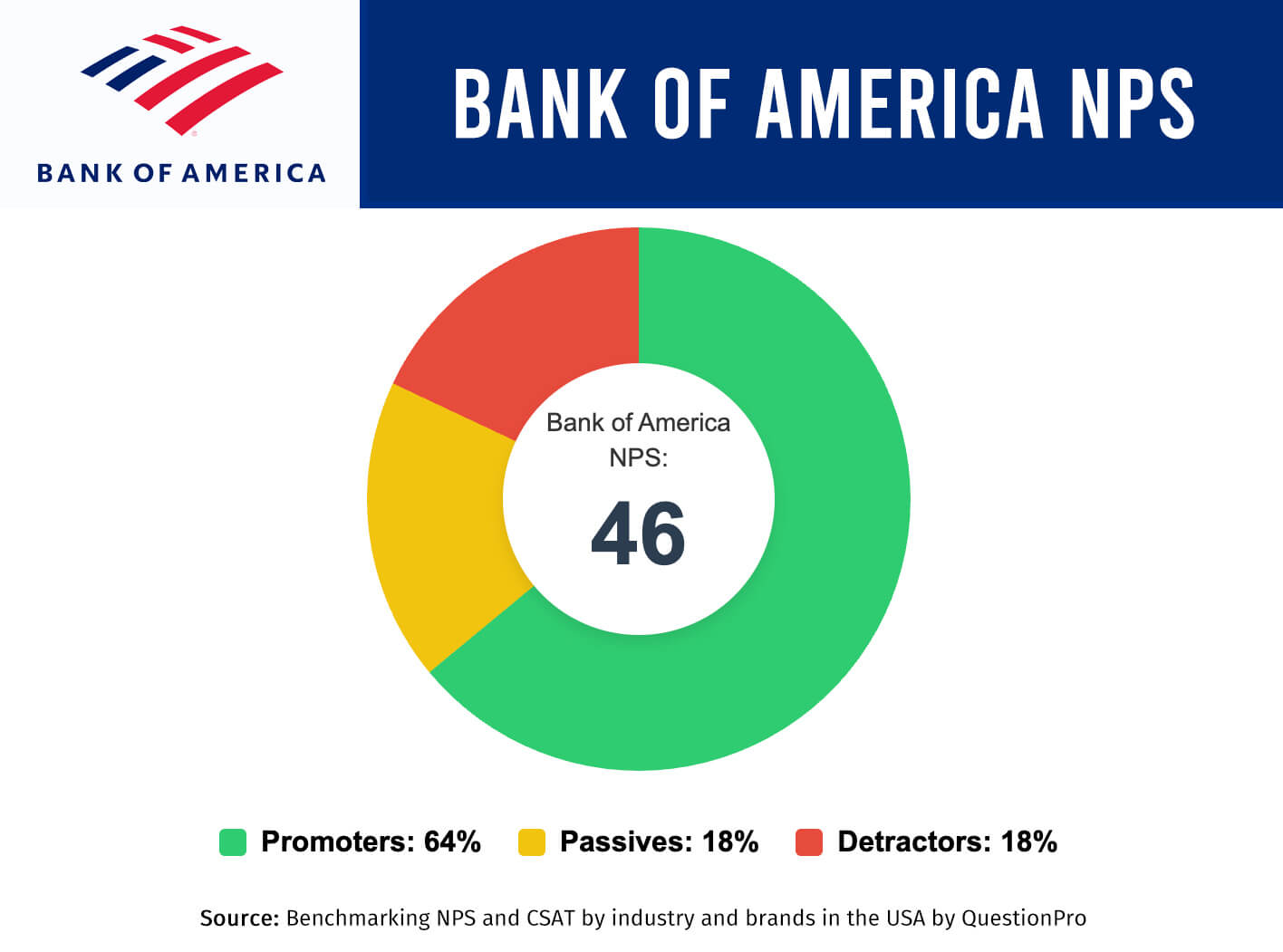
The full breakdown looks like this:
| Metric | Bank of America | Industry average |
|---|---|---|
| NPS | 46 | 41 |
| Promoters | 64% | Lower share |
| Passives | 18% | Higher share |
| Detractors | 18% | Higher share |
Bank of America’s promoter share of 64% is notably strong for a large national bank, where scale often makes personalized service harder to deliver consistently. For context on where this fits nationally, Bain & Company’s research on NPS across sectors found that a sustained 12-point NPS gain correlates with roughly double the industry’s average growth rate, which shows why banks treat every few points of NPS movement as commercially significant, not just a satisfaction footnote.
Want the full picture across banking, retail, and other sectors? Download QuestionPro’s latest NPS and CSAT benchmarking report for free.
What is driving Bank of America’s high NPS?
Three programs consistently show up in customer feedback as reasons Bank of America outperforms the industry average.
Preferred Rewards tied to real banking behavior
The Preferred Rewards program scales perks to how much a customer keeps and borrows with the bank, including interest rate discounts on loans and travel benefits. Customers who feel rewarded for consolidating their finances in one place are less likely to shop around, which shows up directly in promoter scores.
Branch and ATM accessibility
Bank of America operates one of the largest physical networks in U.S. banking, with over 15,000 ATMs and a wide branch footprint. For customers who still value in-person service, especially older account holders and small business owners, that accessibility removes a common source of frustration with digital-only competitors.
A mobile app built around Erica
The bank’s AI-powered virtual assistant, Erica, handles expense tracking, bill payments, and fraud alerts inside the mobile app. Customers increasingly judge their bank experience by app quality, and a well-reviewed assistant reduces the small daily frictions that quietly erode loyalty over time.
How does Bank of America’s NPS compare to other banks?
Bank of America’s score of 46 places it above the industry average, but it is not the top performer in every benchmarking cycle. Regional and relationship-focused banks, along with credit unions, frequently post higher scores because smaller customer bases make personalized service easier to deliver at scale.
That pattern holds across most industries, not just banking. Larger organizations tend to win on accessibility and product breadth, while smaller or niche competitors win on personal attention. Bank of America’s strategy of pairing scale with digital personalization, through Erica and Preferred Rewards, is a direct response to that tradeoff.
How to measure and improve your own NPS
Benchmarking against a leader like Bank of America only helps if you can measure your own score the same way. QuestionPro’s NPS software supports that process end to end.
- Create the survey first.
Use QuestionPro’s standard NPS question, then add an AskWhy follow-up to capture the reasoning behind each score, not just the number.
- Distribute it widely.
Send the survey via email, SMS, QR codes, or direct links, and use QuestionPro Audience if you need responses from people outside your existing customer base.
- Watch results in real time.
Promoters, passives, and detractors are sorted automatically, and the NPS score is calculated as responses come in.
- Act on the lowest scores first.
Detractor feedback usually points to a specific, fixable problem. Fixing it tends to move the score faster than chasing incremental gains among existing promoters.
Common mistakes when benchmarking NPS
A few mistakes distort NPS comparisons more than any single scoring error.
- Comparing across industries. A 46 in banking and a 46 in software mean different things, since baseline expectations vary by sector.
- Ignoring sample size. A score built on 50 responses is far less reliable than one built on 1,000.
- Treating one survey wave as the full picture. NPS should be tracked over multiple quarters to separate a real trend from normal fluctuation.
- Skipping the follow-up question. A score without a “why” behind it tells you almost nothing about what to fix.
QuestionPro’s Customer Experience platform is built to track these trends over time, so a single quarter’s dip does not get mistaken for a lasting decline.
Banks that treat NPS as a recurring health check, rather than a one-time report card, tend to catch service problems months before they show up in account closures.
Frequently Asked Questions (FAQs)
Yes. At 46, it sits five points above the 2025 banking industry average of 41. Scores above the sector average generally indicate stronger-than-typical loyalty and a lower risk of customer attrition compared to competitors.
NPS benchmarking reports are typically refreshed quarterly or annually. Scores can shift based on new product launches, service outages, fee changes, or shifts in how competitors are perceived during the same period.
Not necessarily. NPS measures the likelihood to recommend, not complaint volume. A bank can have a high NPS driven by strong promoters while still handling a steady stream of individual service complaints from passives or detractors.
Yes, and many do. Smaller institutions often score higher because personalized service scales more easily with a smaller customer base, even though they lack the accessibility and digital resources of a national bank.
Most US banks should aim to meet or exceed the sector average, currently 41, according to QuestionPro’s 2025 data. Institutions scoring above 50 are generally considered strong performers within financial services.
Bank of America isn’t the only company in the banking and credit unions industry with valuable lessons for those looking to improve their customer service and experience. Below, we recommend a few articles where you can learn how other major brands manage to maintain a high NPS and a loyal customer base — you’ll surely find some useful insights along the way.