
Participant observation is a qualitative research method where the researcher joins a group’s activities while also recording what happens. The researcher becomes part of the setting instead of standing apart with a clipboard.
That closeness gives access to details that surveys and interviews often miss. In this blog, we’ll break down what participant observation is, the types of researchers who use it, and how to conduct it. You’ll also get real examples and a pros-and-cons breakdown.
What is participant observation?
Participant observation is a qualitative research method in which the researcher studies a group by taking part in its activities while systematically recording behavior. The researcher plays two roles at once: participant and observer.
This dual role sets it apart from plain observation, in which the researcher remains outside the group and never joins in.
Three things make the method distinctive:
- The researcher spends time inside the group’s natural setting rather than a lab.
- Data collection blends participation with systematic note-taking.
- Findings capture routines, conversations, and unspoken norms that a distant observer would miss.
The trade-off is objectivity. Because the researcher is emotionally and socially involved, personal perspective can shape what gets noticed and how it gets interpreted. Good qualitative research practice names that risk upfront rather than pretending it doesn’t exist.
How does participant observation work?
Participant observation works by having the researcher spend extended time inside a group’s natural setting. Trust builds while behavior gets documented as it happens. The method blends three activities: joining in, watching closely, and writing it down.
Three things make this approach valuable for capturing real behavior.
- Access to unscripted moments. A team’s informal jokes during a meeting or a family’s habits during a celebration rarely surface in a survey.
- Trust that produces honesty. People act more naturally around someone they’ve come to know, especially in sensitive settings like healthcare or social work.
- Flexibility to follow leads. If something unexpected comes up, the researcher can spend more time exploring it instead of sticking to a fixed script.
Fieldwork can last a single afternoon or several years. Researchers now apply the method well beyond its anthropological roots, often inside broader field research projects.
What are the types of participant observation?
Participant observation splits into two independent choices. The first is whether the researcher’s identity is disclosed, and the second is how actively the researcher joins in.
Overt vs covert observation
Overt observation means the group knows a researcher is present and studying them. Covert observation means the researcher’s identity and purpose stay hidden.
- Overt: Fewer ethical questions, but risks changing behavior since people know they’re being watched.
- Covert: Avoids that risk, but carries serious ethical weight around consent, which is why institutional review boards scrutinize it closely.
Active vs passive observation
Active observation means the researcher joins conversations, activities, and rituals alongside the group. Passive observation means the researcher records behavior without engaging directly. Active involvement builds deeper rapport and insider understanding.
Passive observation preserves more distance. This distance can reduce the researcher’s influence on what unfolds, at the cost of some insider access.
The four participant observation roles
Combining disclosure and involvement produces four named roles that researchers use to plan a study. The table below summarizes each one.
| Role | Researcher identity known? | Involvement | Main trade-off |
|---|---|---|---|
| Complete observer | No | None | Minimal influence through direct interaction, but no insider access or participant explanation |
| Observer-as-participant | Yes | Limited | Some rapport and contextual insight, but participants may change their behavior when observed |
| Participant-as-observer | Yes | High | Rich contextual and insider access, but a greater risk of over-identification and researcher bias |
| Complete participant | No | Full | Deep access to group activities, but the greatest ethical concerns around consent, privacy, and deception |
How to conduct participant observation
Conducting participant observation takes five stages: choosing a setting, gaining access, deciding a role, collecting data, and writing it up. Here’s how each stage works in practice.
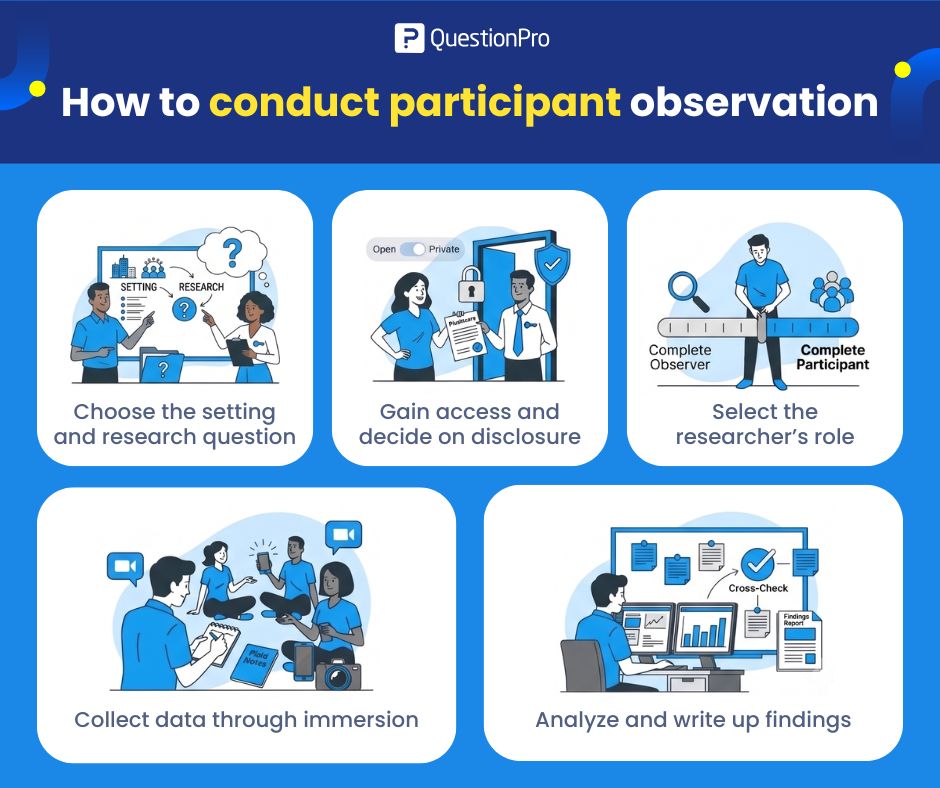
- Choose the setting and research question. Define what group, community, or environment the study will focus on and what question the fieldwork should answer.
- Gain access and decide on disclosure. Negotiate entry into the group and choose whether the study will be overt or covert, weighing the ethical implications of each approach.
- Select the researcher’s role. Pick a point on the complete observer to complete participant spectrum that matches the research goal and the setting’s practical constraints.
- Collect data through immersion. Use field notes, photography, video, or audio recording to document behavior as it happens, staying alert to details that seem routine to the group but matter to the study.
- Analyze and write up findings. Organize field notes into themes, cross-check patterns against the original research question, and report findings alongside the method’s limitations.
Participant observation examples
Concrete examples make the method easier to apply. Three cases show how differently it plays out depending on the setting and research goal.
A UX researcher studying how employees actually use a new internal tool might take a temporary role on the team, sitting in on daily standups and watching people work. This active, overt approach surfaces friction points that interview questions alone would miss.
A classic anthropological example involves a researcher living within a religious or cultural community for months or years, participating in daily rituals to understand values and social structure. This is full participant-as-observer fieldwork, built for depth over speed.
Public-setting studies, such as watching customer behavior in a coffee shop or analyzing conversations in online communities through netnography, typically use a passive, complete-observer approach. Direct interaction isn’t practical there, and passive observation keeps data closer to natural behavior.
What are the pros and cons of participant observation?
Participant observation trades speed and objectivity for depth and authenticity. Weigh both sides before choosing it over other qualitative methods.
Advantages:
- In-depth understanding of behaviors, relationships, and cultural practices that surveys can’t capture
- Trust and rapport that encourage participants to share openly
- Flexibility to follow unexpected findings in real time
Disadvantages:
- Time-consuming, often requiring months or years in the field
- Subjectivity and bias, since the researcher’s presence and perspective shape what gets recorded
- Difficulty taking notes while immersed in an activity, which risks losing detail
- Limited generalizability, since findings are tied closely to one specific group
What is the Hawthorne effect in participant observation?
The Hawthorne effect describes how people change their behavior simply because they know they’re being observed. It’s one of the biggest threats to the accuracy of data in any observation-based study, including participant observation.
Named after a 1920s workplace productivity study, the term describes a simple pattern: participants act more cooperative, careful, or performative once they know a researcher is present. According to Nielsen Norman Group’s research on observer bias, building rapport and spending extended time with participants both help reduce this distortion.
Covert and passive roles minimize the Hawthorne effect, since subjects don’t know they’re being studied in the first place. That protection comes at a cost. Covert research carries far more ethical complexity, so most researchers default to overt methods and manage reactivity through relationship-building instead.
Participant observation vs other qualitative methods
Participant observation overlaps with several other qualitative approaches. Knowing the boundaries between them prevents choosing the wrong method for a study.
| Method | Core approach | Best for |
|---|---|---|
| Participant observation | The researcher joins group activities while systematically observing and recording behavior | Developing a deep, contextual understanding of a specific group or setting |
| Ethnography | Examines a group’s culture, values, language, relationships, and social structure using multiple qualitative methods | Understanding broad cultural, community, or organizational patterns |
| Contextual inquiry | Observes and interviews users while they complete real tasks in their usual environment | UX research, product design, workflow analysis, and usability improvement |
| Netnography | Studies interactions, language, behavior, and community norms in digital environments | Digital consumer culture, online communities, brand conversations, and emerging trends |
Participant observation is often the foundation on which these other methods are built. Ethnography applies it at a broader cultural scale, while contextual inquiry adapts it for shorter, task-focused UX sessions.
How QuestionPro supports qualitative observation research
Running participant observation well means capturing messy, real-world data and turning it into something teams can act on. QuestionPro’s qualitative observation tools help researchers keep field notes, photos, and recordings in one place instead of scattered notebooks and devices.
Two capabilities matter most for fieldwork:
- Mobile data capture lets researchers log observations, images, and audio in real time rather than reconstructing details from memory later
- Text and theme analysis tools help organize field notes into patterns once fieldwork wraps up, speeding up the move from raw notes to reportable findings.
The practical benefit is continuity. Researchers avoid losing detail between observing and writing up, even across a study that runs for months.
Choosing the right role for your study
Participant observation rewards patience and honest reporting of its limits. The method’s strength is depth, not speed. Its greatest risk is a researcher who stops noticing their own influence on the group.
Three habits keep a study credible.
- Match the researcher’s role, overt or covert, active or passive, to what the research question actually needs.
- Document the Hawthorne effect and other sources of bias openly, rather than treating the data as neutral.
- Combine field notes with other qualitative data sources to strengthen findings before generalizing.
Handled carefully, participant observation still delivers insight that no questionnaire can replicate.
Frequently Asked Questions (FAQs)
Participant observation is a qualitative method. It produces descriptive data such as field notes, recordings, and behavioral patterns rather than numerical measurements. Researchers sometimes pair it with quantitative surveys for a fuller picture.
Length varies by research goal. A UX or workplace study might run for a few days or weeks. Classic ethnographic fieldwork in unfamiliar communities can extend for months or years to capture seasonal patterns.
Covert observation raises real concerns around informed consent and deception. Many institutions require review board approval before allowing it. Researchers typically justify covert methods only when overt observation would make the study impossible.
Non-participant observation keeps the researcher separate from the group, watching without joining in. Participant observation requires active involvement in the group’s activities, trading some objectivity for deeper insider access and context.
Yes. UX researchers, market researchers, and organizational consultants use it to study how people behave in workplaces, stores, and online communities. Many blend it with interviews or surveys for a complete view.