
Time to value is the amount of time it takes for a customer to experience the first meaningful value from a product or service. In SaaS and digital products, it is often measured from signup, purchase, or onboarding start to the moment a customer reaches a useful outcome.
For example, a survey platform customer may reach first value when they create a survey, send it, and view the first response. A customer success team may define value as completing onboarding, launching the first project, or seeing the first measurable result.
Time to value matters because customers do not only ask, “Does this product work?” They also ask, “How soon will this help me?”
What is time to value?
Time to value, or TTV, is a metric that measures how long it takes a customer to realize value after starting with a product or service. The value point should be tied to a real customer outcome, not just a completed setup step.
A good TTV definition has two parts:
- Start point: The moment the clock begins, such as signup, purchase, contract signing, onboarding start, or account activation.
- Value milestone: The first meaningful outcome, such as launching a campaign, creating a report, completing a workflow, publishing a survey, or seeing the first result.
It is not the same as onboarding completion. A customer may finish onboarding and still not feel value. The real goal is to help the customer reach the moment where the product proves it can solve their problem.
Why is time to value important?
Time to value is important because customers are most likely to lose interest when they cannot reach value quickly. A shorter TTV can improve onboarding, product adoption, trial conversion, customer satisfaction, and retention. Time to value also connects closely with customer retention metrics because customers who reach value faster are more likely to keep using the product.
For SaaS companies in the USA, TTV is especially important because customers often compare tools quickly during trials or implementation. If one product helps them reach a useful outcome faster, that product has an advantage.
A long TTV can create problems such as:
- Slow onboarding
- Low feature adoption
- Poor trial conversion
- More support requests
- Lower customer confidence
- Higher churn risk
- Delayed return on investment
A short TTV gives customers early proof that they made the right choice. It also gives customer success teams a clearer signal that onboarding is working.
What are the main types of time to value?
The main types of time to value include immediate, short, basic, exceeded, and long time to value. Each type describes how quickly a customer reaches value and how complex the product experience is.
| Type of time to value | What it means | Example |
|---|---|---|
| Immediate | The customer gets value almost instantly | A website speed test shows results right away |
| Short | The customer reaches value soon after signup or purchase | A user creates a simple form within minutes |
| Time to basic value | The customer sees the first useful outcome | A user launches the first survey and gets responses |
| Time to exceeded value | The product delivers more value than expected | A customer discovers automation that saves extra time |
| Long time to value | Value takes longer because of setup, training, or complexity | Enterprise software needs configuration and team training |
Long TTV is not always bad. Some products naturally take longer to implement. The problem starts when customers do not understand the path to value or do not see progress along the way.
How do you calculate time to value?
You calculate time to value by subtracting the customer’s start time from the moment they reach the first value milestone.
Time to value formula:
Time to value = Time customer reaches first value milestone minus Time customer starts
Example:
A customer signs up for a SaaS product on Monday at 10 AM. They complete setup, launch their first project, and view the first useful result on Wednesday at 10 AM.
Their TTV is:
Wednesday 10 AM minus Monday 10 AM = 48 hours
The hardest part is not the math. The harder part is choosing the right value milestone. A value milestone should reflect what customers actually care about.
For a survey platform, a value milestone could be:
- First survey created
- First survey launched
- First response collected
- First report viewed
- First insight shared with a team
Choose one value milestone that shows the customer has moved from setup to real use.
What are the best ways to measure time to value?
The best way to measure time to value depends on your product, customer journey, and value milestone. SaaS teams usually measure TTV through onboarding events, product usage, feature adoption, trial conversion, and customer feedback.
| Measurement method | What it shows |
| Signup to activation | How long it takes users to complete a key first action |
| Onboarding start to completion | How long customers need to become ready to use the product |
| Free trial to paid upgrade | How quickly users see enough value to pay |
| New feature release to adoption | How quickly customers start using new functionality |
| Purchase to ROI milestone | How long it takes customers to see business impact |
| Satisfaction after onboarding | Whether customers felt value arrived fast enough |
Customer feedback is important because usage data does not always explain the full story. A user may complete onboarding but still feel confused. A customer may use a feature once but not understand how it helps them.
You can also compare TTV with customer satisfaction metrics to understand whether customers felt value arrived fast enough. That is why TTV should be reviewed with both product analytics and customer feedback. Customer journey analytics can help teams connect feedback with behavior across onboarding, product usage, and support touchpoints.
What is the difference between time to value, activation, and onboarding?
Time to value, activation, and onboarding are related, but they measure different things. The difference matters because a customer can complete one step without reaching the next.
| Metric | Meaning | Example |
| Time to value | How long it takes a customer to reach a meaningful outcome | Time from signup to first useful report |
| Activation | Whether a user completes a key product action | User creates their first project |
| Onboarding completion | Whether setup, training, or guided steps are finished | User completes the setup checklist |
Activation often happens before value is fully proven. Onboarding completion is useful, but it should not be treated as success by itself. The strongest signal is when the customer reaches a real outcome they care about.
How can you reduce time to value?
You can reduce time to value by removing friction from the customer journey and guiding customers to one clear first-value action. The goal is not to show every feature right away. The goal is to help customers reach a useful outcome faster. A strong customer onboarding process can shorten the path from signup to first value.
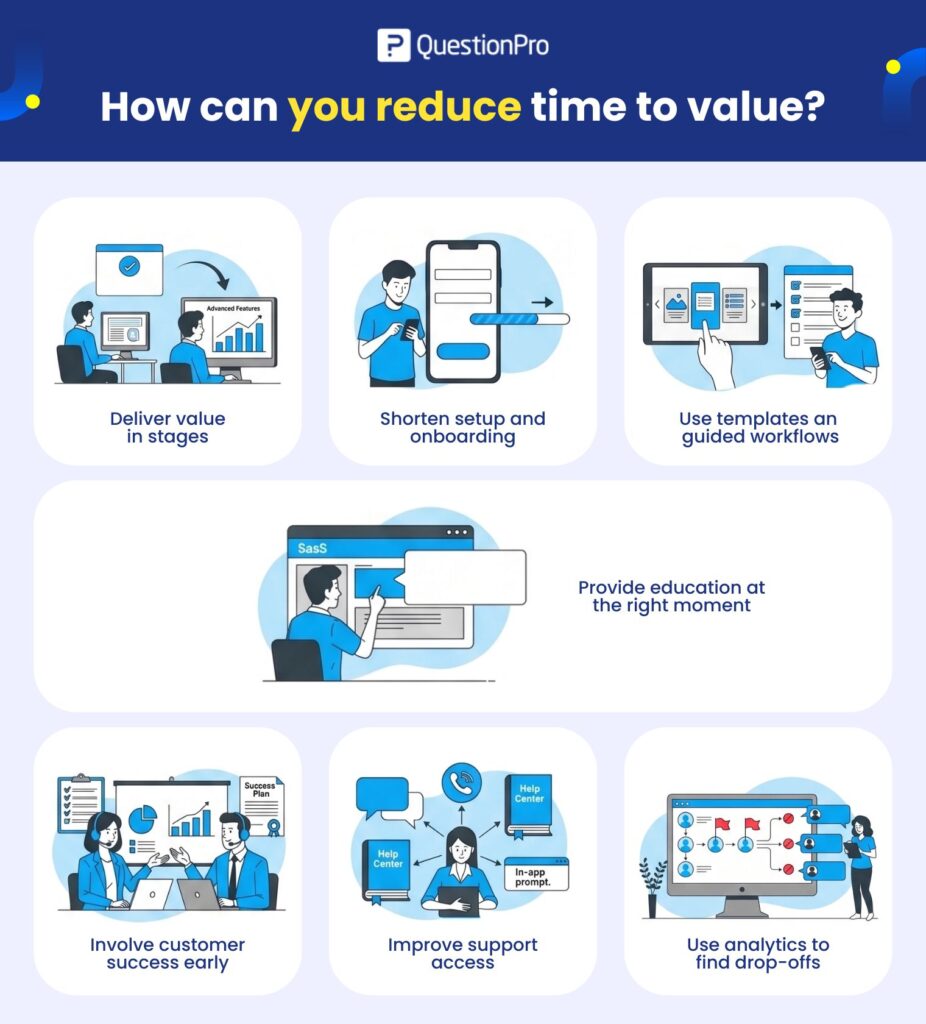
1. Deliver value in stages
Do not overwhelm new customers with every feature at once. Start with the fastest path to the first meaningful result, then introduce more advanced features later.
For example, a survey platform might first guide users to choose a template, add a few questions, and collect the first response before showing advanced reporting options.
2. Shorten setup and onboarding
Review every step between signup and first value. Remove unnecessary fields, reduce manual setup, and make the next step obvious.
If customers need training, split it into short sessions or quick guides instead of one long onboarding process.
3. Use templates and guided workflows
Templates help customers avoid starting from scratch. Guided workflows help them complete the first important task without guessing.
This is useful in SaaS products where users may not know the best setup path on day one.
4. Provide education at the right moment
Onboarding guides, short tutorials, case studies, and help articles can reduce confusion. But timing matters.
Give customers the information they need when they need it. A long resource library is not helpful if customers cannot find the right answer during setup.
5. Involve customer success early
Customer success managers can help customers define goals, choose the right first milestone, and avoid common setup mistakes.
This is especially useful for enterprise products where the path to value depends on the customer’s team, data, workflow, or use case.
6. Improve support access
Fast, clear support can shorten TTV when customers get stuck. Make it easy to reach support through chat, help centers, in-app prompts, or onboarding check-ins.
Support should not only fix issues. It should help customers keep moving toward value.
7. Use analytics to find drop-offs
Product analytics can show where customers stop before reaching the value milestone. Look for patterns in abandoned setup steps, unused features, low completion rates, and repeated support questions.
Then compare that data with customer feedback to understand why the drop-off happens.
How can QuestionPro help reduce time to value?
QuestionPro can help teams reduce time to value by collecting feedback during onboarding, product usage, and key customer journey moments. This feedback helps teams understand where customers get stuck before they reach value. Customer retention surveys can also help explain why customers slow down, disengage, or leave before reaching value.
Teams can use QuestionPro to collect:
- Onboarding feedback
- Product satisfaction feedback
- Customer support feedback
- Feature adoption feedback
- Post-training feedback
- Customer experience feedback
For example, if customers take too long to launch their first survey, a short onboarding survey can help reveal whether the issue is unclear setup, missing guidance, too many steps, or uncertainty about what to do next.
QuestionPro can also help teams review feedback patterns across touchpoints. This makes it easier to decide which onboarding, support, or product improvements can shorten TTV.
Final thoughts
Time to value is one of the clearest ways to see whether customers are reaching value quickly enough. It shows how long it takes customers to move from starting with your product to experiencing a meaningful result.
A strong TTV strategy starts with a clear value milestone. Then teams should measure how long customers take to reach that milestone, find where they get stuck, and remove friction from the path.
The best way to reduce TTV is not to rush customers through every feature. It is to guide them to the first outcome that proves your product can help.
Frequently Asked Questions
Time to value is the time it takes for a customer to experience the first meaningful benefit from a product or service. It starts at signup, purchase, or onboarding and ends when the customer reaches a useful outcome.
A good time to value depends on the product. A simple self-service tool may need minutes or hours. Enterprise software may need weeks. The key is whether customers see steady progress toward value.
No. Time to value is common in SaaS, but it also applies to services, apps, onboarding programs, consulting, and customer success. Any business can measure how long customers take to reach a meaningful result.
A shorter time to value can improve retention because customers see value sooner. When customers understand the product’s usefulness early, they are more likely to continue using it, adopt more features, and trust the solution.
A first value milestone is the earliest meaningful outcome that proves the product is useful to the customer. Examples include launching the first survey, viewing the first report, completing the first workflow, or solving the first support issue.