A transactional NPS survey measures how a customer felt about one specific interaction, sent right after that interaction ends. It doesn’t ask how someone feels about a brand overall. It asks about a single moment: a checkout, a support call, a delivery, a service visit.
That narrow focus is what makes the data useful. A customer who just closed a support ticket can tell you exactly what worked and what didn’t. The memory is still fresh. A quarterly brand survey can’t do that.
In this guide, we’ll learn how transactional NPS works and how to calculate it. We’ll also explore when to send it and how teams turn the scores into real fixes.
What is a transactional NPS survey?
A transactional NPS survey is an event-triggered Net Promoter Score survey. It’s sent immediately after a defined customer interaction, such as a purchase, support call, or delivery.
It uses the same 0-10 recommendation question as standard NPS. The question is scoped to one recent experience instead of the overall relationship. This distinction matters for accuracy: feedback collected close to the moment of an interaction is more reliable, since recall bias increases with time.
Common triggers include:
- Completing a purchase or checkout
- Closing a support ticket
- Receiving a delivery
- Finishing onboarding or setup
- Ending a trial or contract
Learn more: What a transactional survey is and when to use it
How is transactional NPS different from relational NPS?
Transactional NPS measures a single interaction, while relational NPS measures the overall customer relationship over time. Both use the same 0-10 scale and formula, but they answer different questions and shouldn’t replace each other.
| Transactional NPS (tNPS) | Relational NPS (rNPS) |
|---|---|
| Tied to one interaction | Reflects the overall relationship |
| Sent right after the event | Sent periodically, often quarterly |
| Flags specific, fixable issues | Tracks long-term loyalty trends |
| Drives short-term operational fixes | Informs strategic planning |
| Owned by frontline or ops teams | Owned by CX or leadership |
Most mature CX programs run both. Relational NPS shows whether loyalty is trending up or down. Transactional NPS shows why, by pointing to the exact touchpoint behind the trend.
Understand the differences: Transactional Vs Relational NPS
Transactional NPS vs. CSAT vs. CES: What’s the difference?
Transactional NPS, CSAT, and CES all measure single interactions, but they ask about different things and shouldn’t be treated as interchangeable.
- Transactional NPS asks whether the customer would recommend the company based on this one interaction. It’s a loyalty signal.
- CSAT (Customer Satisfaction Score) asks how satisfied the customer was with this specific interaction. It’s a satisfaction signal, not a loyalty one.
- Customer Effort Score (CES) asks how much effort it took to get something done. It’s a friction signal.
A customer can be satisfied, with a high CSAT, but still unlikely to recommend the company, showing a low tNPS. This often happens when the interaction felt effortful. Teams that track only one of the three usually miss part of the picture. Many programs pair tNPS with a single CSAT or CES follow-up question to capture both loyalty and friction at once.
How do you calculate a transactional NPS score?
Transactional NPS uses the standard NPS formula, applied to responses from a single touchpoint instead of the whole customer base.
Step 1: Ask the question.
How likely are you to recommend [Company or Product] to a friend or colleague, based on your recent purchase, support call, or delivery?
Step 2: Group responses.
- Promoters score 9-10 and were very satisfied with that interaction.
- Passives score 7-8 and were neutral or lukewarm.
- Detractors score 0-6 and were dissatisfied.
Step 3: Apply the formula.
Transactional NPS = % Promoters − % Detractors
Scores range from -100 to +100.
A worked example makes this concrete. A support team surveys 200 customers right after ticket closure: 45% respond Promoter, 40% Passive, 15% Detractor, giving a score of 45 minus 15, or 30. A second team surveys 200 customers after delivery: 30% Promoter, 35% Passive, 35% Detractor, giving a score of -5. Same company, same formula, two very different stories.
When should you send a transactional NPS survey?
Send a transactional NPS survey as soon as possible after an interaction with a clear start and finish. Waiting too long weakens accuracy, because customers start blending the memory with other experiences.
Good triggers include:
- Completing a checkout or payment
- Closing a support ticket
- Finishing a service visit or appointment
- Completing onboarding or implementation
- Ending a trial, subscription, or contract
For most touchpoints, sending within 24-48 hours captures the experience while it’s still specific in the customer’s mind. Support and delivery interactions benefit from same-day sends, since those moments are easy to forget by the next day. Mapping these triggers against a full customer journey helps identify which moments actually deserve a survey, instead of guessing.
If resources only allow for one or two transactional surveys to start, prioritize the touchpoint with the highest volume and the most direct link to renewal or repeat purchase. For a subscription business, that’s usually onboarding. For retail, it’s usually post-purchase or post-delivery. Start narrow, prove the workflow closes the loop reliably, then expand to additional touchpoints once the first one is running smoothly.
What are the main types of transactional NPS surveys?
Each type of transactional NPS survey targets one touchpoint. Using the wrong trigger, or combining two touchpoints into one survey, weakens the signal.
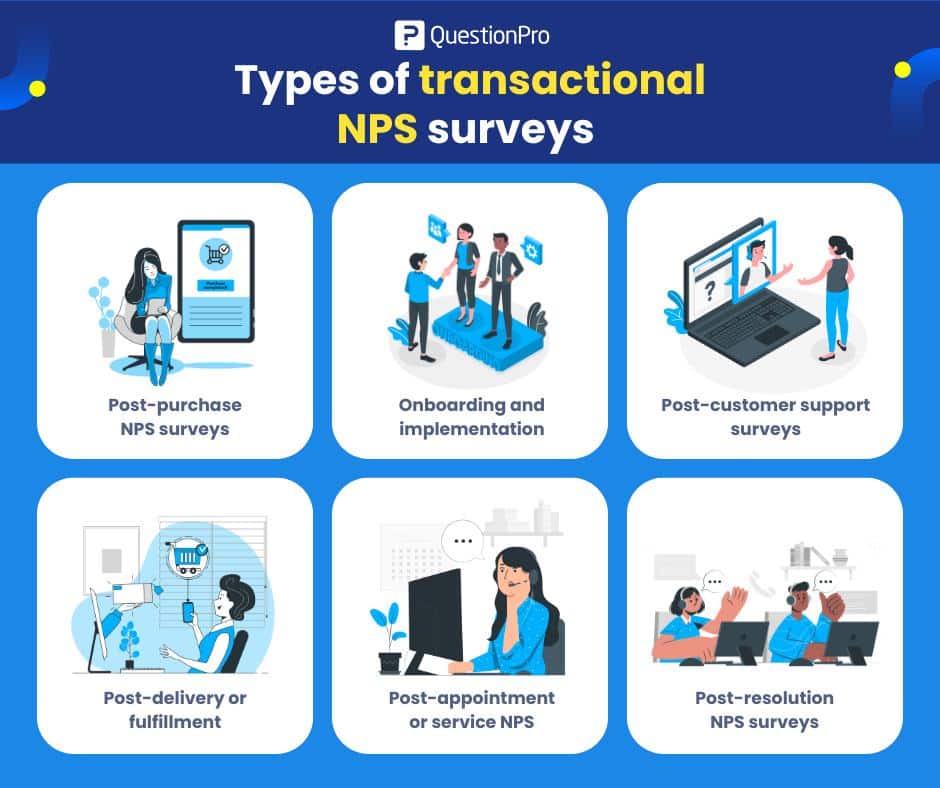
1. Post-purchase
Measures how checkout, payment, and fulfillment felt. Common in e-commerce and retail.
- Core question: “Based on your recent purchase, would you recommend us?”
- Follow-up: “How easy was checkout?”
A low score here usually points to checkout friction, unclear pricing, or a mismatch between the product page and what arrived.
See more: Post-purchase survey questions and templates
2. Onboarding and implementation
Captures first impressions during setup, which often determine whether a customer keeps using the product. Especially important for B2B and subscription businesses.
- Core question: “Based on onboarding, would you recommend our product?”
- Follow-up: “What part of setup felt most confusing?”
Send this one right after the customer completes their first meaningful action in the product, not on a fixed day count, since setup speed varies widely by account.
Related: Why onboarding surveys are crucial
3. Post-support
Evaluates issue handling, communication, and resolution quality right after a ticket closes.
- Core question: “Based on your support interaction, would you recommend us?”
- Follow-up: “Was your issue resolved to your satisfaction?”
This is usually the highest-volume transactional survey in a support organization, and the easiest one to tie back to a specific agent or ticket for coaching purposes.
4. Post-delivery or fulfillment
Focuses on delivery speed, accuracy, and condition. Common in retail, logistics, and food delivery.
- Core question: “How likely are you to recommend our delivery service?”
- Follow-up: “Did your order arrive on time and complete?”
Trigger this one on confirmed delivery, not on shipment, so the customer is rating what actually happened rather than a promise.
5. Post-appointment or service
Used in healthcare, financial services, and consulting to evaluate staff interactions and service quality.
- Core question: “Based on this visit, would you recommend our service?”
- Follow-up: “How was your interaction with our staff?”
In regulated industries like healthcare and financial services, keep the survey separate from any clinical or compliance forms so feedback doesn’t get lost in required paperwork.
6. Post-resolution
Measures satisfaction after a refund, complaint, or service recovery. Focuses on how the resolution was handled, not just the outcome.
- Core question: “Based on your refund or complaint experience, would you recommend us?”
- Follow-up: “What part of the resolution felt most helpful or frustrating?”
Scores here tend to run lower than other touchpoints by default, since the customer already had a problem. Judge this touchpoint against its own historical baseline, not against post-purchase or onboarding scores.
Learn more: Post-call survey benefits and usage
Can transactional NPS help before a purchase is even complete?
Transactional-style feedback isn’t limited to moments after an interaction ends. A growing use case sends a lightweight, tNPS-style check mid-journey, such as partway through a checkout flow or a multi-step signup, to catch friction before a customer abandons the process entirely.
This works differently from the six post-event types above. Instead of asking “would you recommend us based on what just happened,” it asks a scaled-down version, like a single effort or confidence question, at a point where the customer hasn’t finished the transaction yet. A drop in confidence mid-checkout is a leading indicator, not a lagging one, and can prompt an immediate intervention, like a chat prompt or a simplified next step, while the customer is still in the flow.
This is where transactional feedback is heading next: fewer static, after-the-fact surveys and more real-time, in-the-moment signals that let teams act before a sale or task is lost rather than only learning about the friction afterward. It’s a smaller-scale application, usually limited to high-value or high-drop-off flows, but it extends the same core logic that makes transactional NPS useful in the first place: feedback tied to a specific moment, not a general impression.
How many responses do you need to trust a transactional NPS score?
A transactional NPS score becomes reliable once a touchpoint has collected enough responses to smooth out outliers. As a working baseline, aim for at least 30 to 50 responses per touchpoint within a reporting period. Below that threshold, a handful of upset customers can swing the score by 10 points or more.
High-volume touchpoints like post-purchase or post-support usually clear this threshold within days. Lower-volume touchpoints, like post-appointment surveys at a small clinic, may need several weeks of responses before the score means anything. When volume is low, weight the open-ended follow-up answers more heavily than the score itself.
What factors influence transactional NPS scores?
A few consistent factors drive transactional NPS scores up or down:
- Clarity and ease of the interaction
- Speed of response, delivery, or resolution
- Quality and tone of communication
- Consistency of the experience across channels
Forrester’s 2025 Global Net Promoter Score Rankings found that North American NPS dropped to its lowest point since 2016, with far more brands declining than improving. That kind of stagnation is usually driven by friction at specific touchpoints, not a company-wide decline. Isolating those touchpoints is exactly what transactional NPS is built to do.
What mistakes should you avoid with transactional NPS surveys?
Most transactional NPS programs lose value through a handful of repeatable mistakes rather than bad questions.
- Surveying too often.
Sending a survey after every single interaction causes fatigue. Cap frequency at once per customer every 30 to 90 days, depending on interaction volume.
- Attaching surveys to vague or unclear moments.
If the customer isn’t sure what interaction they’re rating, the score isn’t reliable.
- Treating passives as neutral noise.
In transactional NPS, passives often signal unclear value or an experience that fell just short of expectations. They deserve a follow-up too.
- Never closing the loop.
Collecting scores without acting on them trains customers to stop responding.
- Comparing scores across unrelated touchpoints.
A 20 on post-purchase and a 20 on post-support don’t mean the same thing operationally.
- Reporting the score without the context behind it.
A single touchpoint number, shared with leadership without the open-ended themes behind it, invites the wrong fix. Pair every score with the two or three most common reasons behind it.
Best practices for running transactional NPS surveys
Transactional NPS delivers the most value when it’s designed with intention rather than sent on autopilot.
- Choose interactions that genuinely shape how the customer feels about the brand
- Send within hours of the experience, not days
- Keep the survey to the core question plus one follow-up
- Close the loop on detractors and passives, not just detractors
- Control frequency per customer to avoid survey fatigue
- Compare scores within the same touchpoint over time, not across touchpoints
How does QuestionPro support transactional NPS programs?
Running transactional NPS consistently takes more than a single question. It requires reliable triggers, clean data, and a way to route feedback to the right owner. Most teams outgrow spreadsheet-based tracking once they run more than one or two touchpoints at a time.
QuestionPro’s Customer Experience platform supports transactional NPS programs with:
- Event-based survey triggers tied to specific touchpoints, so surveys go out automatically after a purchase, ticket closure, or delivery
- AskWhy open-ended follow-up questions that capture the reason behind a score, not just the number
- Touchpoint and segment-level analysis to compare performance across teams, channels, or locations
- Real-time alerts and dashboards that surface low scores while the interaction is still recent
- Automated routing so detractor and passive responses reach the right team for follow-up
Turning transactional NPS scores into better customer experience
A transactional NPS score is a starting point, not an end point. The number tells you where friction happened. An open-ended follow-up tells you why. Your response tells the customer whether anyone was actually listening.
Teams that treat transactional NPS as an ongoing habit catch problems while they’re still small and cheap to fix. Review scores by touchpoint every week or month. Teams that only glance at the number after it drops are usually reacting to churn that’s already underway.
Frequently Asked Questions (FAQs)
It depends on the touchpoint and industry, not a fixed scale. A 30 on post-support might be strong for a high-friction industry like telecom. The same score after a simple checkout could signal a real problem.
Most programs cap it at once every 30-90 days per customer, even if they complete multiple qualifying interactions. Surveying every single transaction causes fatigue and drives down response rates without adding new insight.
It can flag early warning signs at the touchpoint level, especially repeated low scores from the same account. It’s not a full churn model on its own. It is often one of the earliest signals available before a customer stops responding entirely.
Yes, especially around onboarding, implementation, and support. A single bad experience with a champion or decision-maker can affect renewal. B2B programs typically survey fewer, higher-stakes touchpoints than high-volume B2C programs.
Response rates typically range from 5% to 20%, depending on channel and timing. In-product or embedded surveys usually outperform standalone email sends. Rates below 5% usually point to a timing or channel problem rather than a question-wording issue.