A brand attributes survey tells you how customers actually describe your brand, not how your marketing team hopes they describe it. Those two pictures rarely match perfectly, and the gap is often where the most useful insight sits.
Every response is useful data. Strong, positive scores confirm what marketing can lean on. Weak scores point to exactly where the brand experience is falling short, which internal opinions and gut feelings can never reliably show.
In this guide, we’ll cover what a brand attributes survey measures, how it differs from brand personality research, and sample questions you can adapt for your own brand.
What is a brand attributes survey?
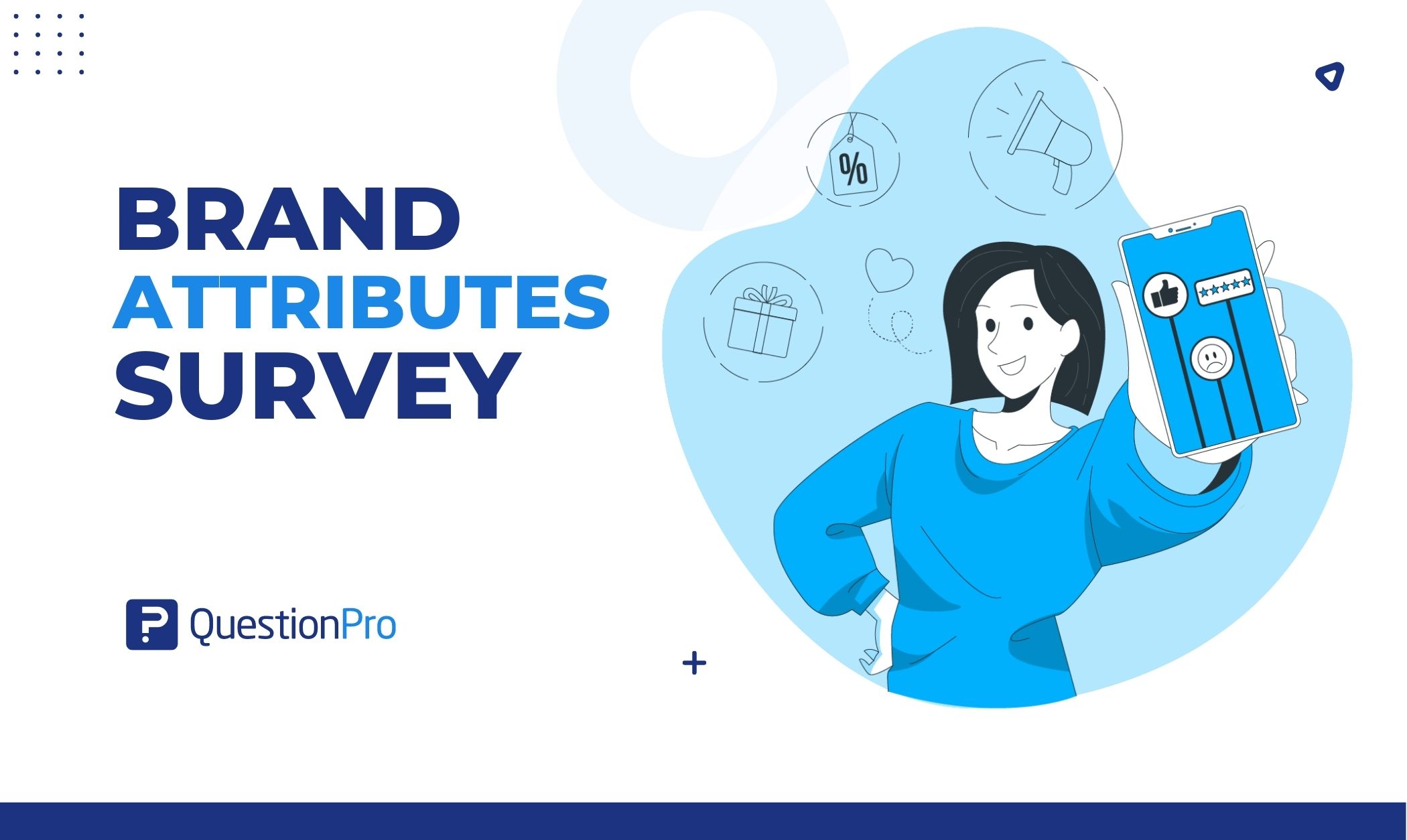
A brand attributes survey is a research method that measures how customers perceive a brand across specific traits such as trustworthiness, quality, innovation, and value. Respondents typically rate the brand on each trait using a rating scale, then explain their answers in their own words.
The results show where a brand’s actual reputation lines up with its intended positioning, and where the two have drifted apart. Marketing, product, and customer service teams all use this data differently, but the underlying question is the same: what do people really think of us?
Many teams run this alongside a branding questionnaire during a rebrand, or on a recurring basis to track perception over time. Small wording and design choices in the survey itself can also affect how honestly people respond, so it is worth reviewing the questionnaire design before launch.
Brand attributes vs. Brand personality: What’s the difference?
These two terms get used interchangeably, but they measure different things.
| Term | What it measures | Example |
|---|---|---|
| Brand attributes | Specific, individual traits customers associate with a brand | Trustworthy, affordable, innovative |
| Brand personality | The combined character that emerges when those traits work together | Friendly and approachable, or premium and exclusive |
Brand attributes are the building blocks. Brand personality is the overall impression those blocks create once combined. A brand attributes survey typically measures the individual traits, then a research team interprets the pattern to describe the personality that emerges.
Types of brand attributes to measure
Brand attributes generally fall into three categories, and a well-built survey usually samples from all three rather than leaning on just one.
- Functional attributes: Tangible, measurable qualities like price, durability, speed, and reliability.
- Emotional attributes: The feelings a brand evokes, such as trust, excitement, or comfort.
- Symbolic attributes: What using the brand signals about the customer, such as status or shared values.
A brand that only tracks functional attributes misses the emotional and symbolic reasons customers actually choose one option over a nearly identical competitor.
Gallup’s long-running brand research found that the emotional bond between a company and a customer, not the transaction itself, tends to predict long-term loyalty most reliably, based on decades of customer interviews.
Why run a brand attributes survey
A brand attributes survey earns its place in a research program for a few concrete reasons.
It identifies where product or service qualities matter most to customers, which helps prioritize development and marketing investment. It also tracks how perception shifts over time, which shows whether a rebrand, a campaign, or a customer service change actually moved the needle.
The results also inform decisions well outside the marketing department, including product roadmaps, distribution choices, and customer experience improvements. A brand’s perceived attributes rarely stay static, so a single survey is a snapshot, not a permanent scorecard.
How to conduct a brand attributes survey
Running a brand attributes survey well comes down to five steps.
- Develop the survey.
Write a mix of quantitative rating-scale questions and qualitative open-ended questions that map to the attributes you care about. - Pre-test the survey.
Run it past a small group similar to your target audience, then fix any confusing wording before the full launch. - Choose a survey method.
Decide between online, phone, or in-person distribution based on where your audience is easiest to reach. - Distribute the survey.
Send it with a short, honest explanation of why you are asking and how the results will be used. - Analyze and share the results.
Look for patterns across segments, then share findings with marketing, product, and leadership, including specific recommendations.
A representative sample matters more than a large one. A few hundred responses from the right audience beat a few thousand from the wrong one.
Sample brand attributes survey questions
Quantitative and qualitative questions each surface a different kind of insight, and a good survey uses both.
Quantitative brand attributes questions
These use a rating scale, typically five or ten points, so responses are easy to compare and track over time.
- How likely are you to recommend Brand Z to a friend or family member?
- Does Brand Z provide high-quality products or services?
- How satisfied are you with your overall experience with Brand Z?
- How well does Brand Z understand what customers like you need?
Qualitative brand attributes questions
Open-ended questions let respondents answer in their own words rather than picking from a list, which often surfaces language a brand team would never have thought to include as an option.
- What are the top three things you like best about Brand Z?
- What are the top three things you dislike about Brand Z?
- What are your honest thoughts on Brand Z’s marketing and advertising?
- How would you describe Brand Z to a friend who has never used it?
Common mistakes to avoid in brand attributes surveys
A few recurring mistakes quietly weaken the data a brand attributes survey produces.
| Mistake | Why it hurts your results |
|---|---|
| Only asking about functional traits | Misses the emotional and symbolic drivers behind real purchase decisions |
| Surveying only existing customers | Skews results positive and hides why non-customers chose a competitor |
| Skipping a pre-test | Confusing wording gets baked into hundreds or thousands of responses |
| Treating one survey as permanent | Perception shifts after campaigns, price changes, or service issues |
| Ignoring open-ended answers | Misses the specific language customers use, which rating scales alone cannot capture |
Running the survey on a consistent cadence, such as twice a year, catches these shifts before they show up as lost revenue.
How QuestionPro supports brand attributes research
QuestionPro’s Market Research Software is built to design, distribute, and analyze brand attributes surveys alongside broader market research programs. It supports multiple-choice, open-ended, and Likert scale question formats, which covers the quantitative and qualitative mix a brand attributes survey needs.
Built-in analysis tools, including cross-tabulation and statistical testing, help teams see how perception differs by customer segment, region, or tenure. Many brand teams pair this work with a customer journey map to see exactly where perception is formed and where it breaks down, or track advocacy alongside brand scores using Net Promoter Score.
A brand attributes survey works best as one input among several, not a standalone report that sits in a folder after the first read.
Frequently Asked Questions (FAQs)
A product survey focuses on feedback about a specific item, feature, or purchase experience. A brand attributes survey looks at the overall brand across every touchpoint, not just one product interaction.
Most brands benefit from running one every six to twelve months, or immediately after a major rebrand, product launch, or public relations event that could shift perception in either direction.
Yes. Even a survey of 100 to 200 customers can surface clear patterns, especially in the open-ended responses. Sample size matters less than reaching a fair cross-section of your actual audience.
No. Negative responses point to specific gaps, such as a weak customer service reputation, that a business can act on directly. They are often more actionable than uniformly positive scores.
Anonymity tends to produce more honest answers, particularly for negative or critical feedback, since respondents feel freer to be candid. If follow-up on a specific answer is needed later, an optional contact field works better than requiring identification upfront.