Brand management is the ongoing work of shaping how customers see your company, product, or service. It covers the promise a brand makes and the experience customers get every time they interact with it.
Most companies lose customers not because of price, but because the relationship quietly breaks down. A brand that understands what its customers value, and delivers on it consistently, earns trust that competitors struggle to copy.
In this article, we’ll explain what brand management means, why it matters, and explore a practical five-step process any team can use to manage a brand well.
What is brand management?
Brand management is the strategic process of building, monitoring, and protecting how a brand is perceived by its customers, employees, and the wider market. It combines research, strategy, and day-to-day decisions that shape the brand promise.
At its core, brand management asks one question: does the experience customers get match what the brand claims to offer? Every touchpoint, from a support call to a checkout page to a social post, either reinforces that promise or chips away at it.
This is different from a single marketing campaign. It is the long-term discipline that keeps a company’s reputation, voice, and customer relationships consistent as the business grows, adds products, or enters new markets.
Brand management vs. Brand marketing: What’s the difference?
Brand management and marketing get used interchangeably, but they answer different questions. Marketing asks how to reach and convert an audience right now. Brand management asks what the company stands for over time, and whether every team represents it the same way.
| Focus | Brand management | Marketing |
|---|---|---|
| Time horizon | Long-term, ongoing | Short to mid-term, campaign-based |
| Core question | What does the brand stand for? | How do we drive this quarter’s results? |
| Primary owner | Brand team or leadership | Marketing or growth team |
| Success measure | Brand equity, trust, consistency | Leads, conversions, campaign ROI |
| Example activity | Setting brand guidelines and tone | Running a paid ad campaign |
Neither discipline works well without the other. Marketing needs a clear brand to sell, and a well-managed brand needs marketing to reach new audiences in the first place.
Why brand management matters
A brand does more than drive a single sale. It reduces the emotional and financial risk a customer feels before they buy. Gallup’s research found that emotional factors drive about 70% of purchase decisions, with rational factors accounting for the rest. That means how a customer feels about a brand often matters more than the specs on the page.
Strong brand management pays off in ways that go beyond one transaction. Companies with consistent, well-managed brands tend to retain more customers, spend less to win new ones, and charge a premium because buyers already trust what they are getting. Good brand management also works alongside client management practices to keep individual customer relationships healthy as the company scales.
Poor brand management has the opposite effect. Mixed messaging, inconsistent service, and a damaged reputation become harder to repair with every bad experience a customer has.
The core elements of brand management
Brand management touches several distinct parts of a business, and neglecting any one of them weakens the whole system. These are the core elements every brand management strategy should cover:
- Brand identity
The name, logo, colors, and tone that make a brand recognizable.
- Brand positioning
The space a brand occupies relative to competitors in a customer’s mind.
- Brand equity
The added value a strong brand name gives a product beyond its function.
- Brand experience
What customers actually feel and encounter at each touchpoint.
- Brand communication
The messaging and channels used to share the brand’s story consistently.
Each element depends on the others. A distinctive identity means little if the brand experience contradicts it, and consistent communication cannot fix a positioning that never resonated with the target audience.
Brand management examples
Brand management shows up in ordinary, repeatable actions rather than one big campaign. A retailer that keeps its return policy, packaging, and customer service tone identical across every store and channel is practicing brand management. A software company that responds to a product outage with the same transparency it promises in its marketing does the same.
Well-known brands make this visible at scale. Nike ties its identity to performance and self-belief across ads, product design, and even its retail store layouts. Patagonia’s environmental commitments show up in its supply chain decisions, not only in its marketing copy. In both cases, the brand promise and the actual customer experience line up, which is exactly what brand management is meant to protect.
For most companies, the examples are smaller. A consistent tone across support tickets, a logo that looks the same on every channel, and a pricing page that never contradicts what a sales rep says on a call all count.
How to measure brand management success
A brand cannot be managed without being measured first. These are the metrics most teams track to see whether their brand management efforts are working:
- Brand awareness: Whether customers recognize your brand, prompted or unprompted.
- Brand equity: The added value your brand gives a product beyond its function.
- Net Promoter Score (NPS): A score measuring how likely customers are to recommend the brand.
- Sentiment score: The emotional tone of what people say about the brand online.
- Consistency audit score: How closely teams follow brand guidelines across channels.
Running a brand tracking survey on a regular schedule, quarterly, is common and lets a team catch a shift in perception months before it shows up in sales. Many companies also track brand equity directly, since it reflects the dollar value that trust and reputation add to a product.
A 5-step brand management process
Managing a brand well does not require guesswork. It follows a repeatable process that most experienced brand teams recognize, even if the details vary by company.
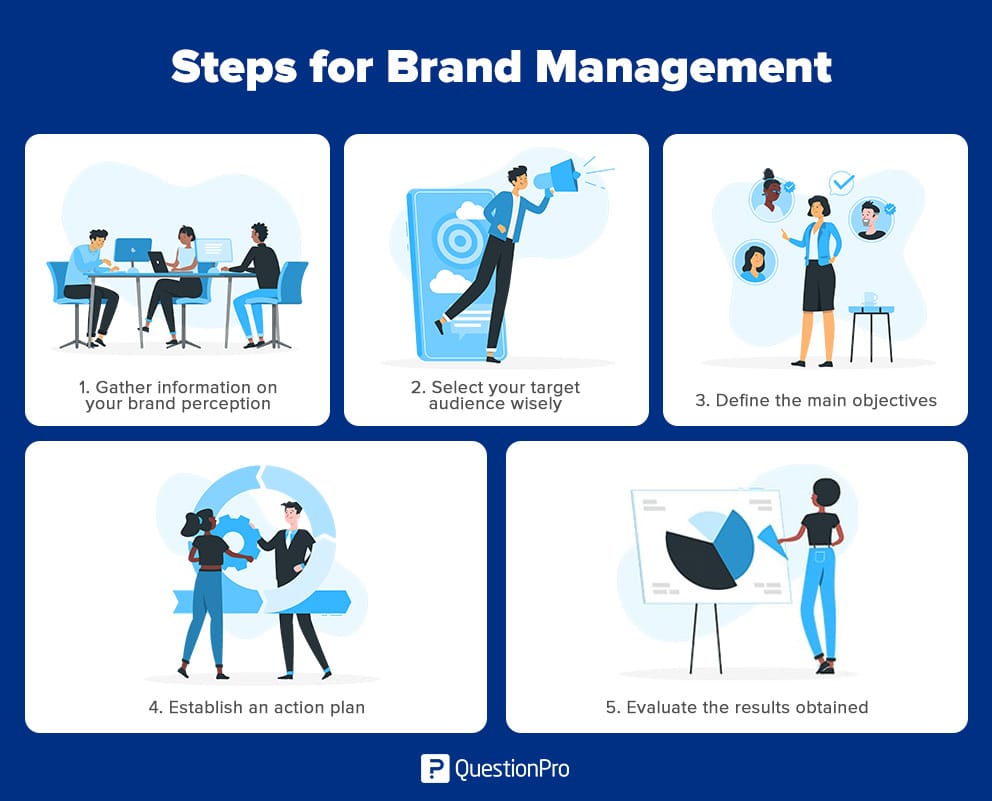
1. Gather data on current brand perception
Everything a company can learn from customers about their relationship with the brand feeds into marketing, workplace culture, and sales decisions. Regular brand awareness surveys and data collection give teams the evidence they need to adapt safely instead of guessing.
2. Define your target audience
A well-defined audience is easier to reach and easier to retain. Before setting objectives, most teams answer three questions about the customer they want:
- What type of business or budget does this customer have, and does it match what you offer?
- What buying behavior does this customer show: impulse-driven, research-heavy, or habitual?
- What outcome is this customer hoping the brand delivers for them?
3. Set clear brand objectives
A clear objective tells the team where it is trying to go. Common goals include improving trust, increasing perceived quality, and strengthening reputation in a specific market segment.
4. Build an action plan
An action plan turns brand objectives into specific decisions. Most plans define three things:
- Which channels will carry the brand message to the target audience.
- What tone and visual style will stay consistent across those channels.
- How the brand promise gets communicated at each customer touchpoint.
5. Evaluate the results
Before investing further in a brand direction, teams need evidence it is working with real customers. Recurring checks, similar to a brand health tracker, show whether perception is moving in the right direction or needs a course correction.
Common brand management mistakes to avoid
Even well-funded brand programs fail for avoidable reasons. Watch for these common mistakes:
- Treating brand guidelines as a one-time document instead of a living reference
- Letting sales, support, and marketing describe the brand differently
- Skipping regular perception research and relying on internal assumptions
- Rebranding reactively after a crisis instead of monitoring sentiment continuously
- Measuring only awareness while ignoring trust, loyalty, and sentiment
How QuestionPro supports brand management
Most of the work in brand management comes down to knowing what customers actually think, not guessing. QuestionPro Customer Experience software gives teams a way to run brand tracking, sentiment analysis, and perception surveys on a recurring schedule, then connect the results back to loyalty and retention.
That kind of ongoing measurement is what turns brand management from a slide deck into a repeatable process. Teams can see whether a specific change to messaging, service, or product actually shifted how customers feel, instead of assuming it did.
Brand management never really finishes
Customer expectations shift, new channels appear, and competitors adjust their own positioning. That means protecting a brand’s reputation is ongoing work rather than a project with a defined end date.
Companies that manage this well tend to share a few habits:
- They treat customer perception as data, not opinion.
- They revisit that data often enough to catch problems while they are still small.
- They hold every team, not only marketing, accountable for the brand’s promise.
Frequently Asked Questions (FAQs)
No. Branding is the process of creating a brand’s visual and verbal identity, such as its name, logo, and voice. Brand management is the ongoing discipline of protecting and growing that identity across every customer touchpoint, long after the initial branding work ends.
Costs vary widely by company size and channel mix. Small US businesses often spend a few thousand dollars a year on tracking and design tools, while larger companies can invest six or seven figures annually across research, agencies, and dedicated brand teams.
A brand manager or marketing leader typically owns brand management, but it works best as a shared responsibility. Sales, support, product, and HR teams all shape how customers experience the brand, so their daily decisions matter as much as official guidelines.
Most US brands run formal perception research quarterly or twice a year, with lighter sentiment checks monthly. Fast-moving industries, such as tech and retail, often review more frequently since expectations and competitor positioning can shift within a single quarter.
Brand awareness measures whether customers recognize a brand at all. Brand equity goes further, capturing the actual value that recognition and trust add to a product, often measured through willingness to pay a premium or choose the brand over a cheaper alternative.