A cannabis survey is a structured set of questions that collects opinions, habits and product feedback from cannabis consumers, budtenders or dispensary customers. Gallup’s 2026 Consumption Habits poll found that 17% of U.S. adults say they smoke marijuana, up from 7% in 2013. As more people buy legally, brands and retailers need better data than guesswork.
QuestionPro asked over 1,000 professional budtenders which strains they recommend for sleep, sex and stress. In this guide, we share those results, show how to read them, and walk through the questions and steps behind a cannabis survey you can run yourself.
What is a cannabis survey?
A cannabis survey is a research method that asks a defined group of people about cannabis use, preferences, purchases or experiences. The group might be consumers, dispensary shoppers, or the budtenders (retail staff who advise customers on products) who sit between brands and buyers.
Most cannabis surveys answer one of three questions. What do people use and why? How do they feel about a product or brand? How well does a store serve them? The goal decides who you ask and what you ask, so settle it before you write a single question.
How is a cannabis survey different from similar research?
Several terms get mixed up, and each points to a different method. A cannabis survey is the broad category. The others are narrower or serve a different purpose.
| Term | What it is | Typical use |
|---|---|---|
| Cannabis survey | Questionnaire sent to a defined group | Preferences, habits, product feedback |
| Cannabis poll | Short, often one-question snapshot | Quick opinion checks and headlines |
| Cannabis quiz | Entertaining questionnaire with a fun result | Engagement, such as the Hipster or Hippie cannabis quiz |
| Dispensary customer survey | Feedback on one store visit | Service, pricing and wait times |
| Public health survey | Government-run study with a national sample | Prevalence, such as SAMHSA’s NSDUH |
| Cannabis market research | Wider program that includes surveys | Sizing, positioning and competitor review |
A survey becomes market research when you combine it with other inputs such as sales data, focus groups or competitor tracking.
Why run a cannabis survey?
Cannabis is a fast-moving category where preferences shift by state, format and age group. A survey replaces anecdotes with numbers you can compare over time.
Here is what a well-run survey can tell you:
- Which products and formats your target buyers prefer
- How your brand ranks against competitors on awareness and trust
- What barriers stop people from buying more often
- Which budtender recommendations influence purchases
- Where in-store experience loses customers
Scale makes this worth doing. The Substance Abuse and Mental Health Services Administration reports that an annual average of 23.1% of U.S. adults used marijuana in the past year across 2022 to 2024. That is a large and varied audience to understand.
What did budtenders say is the best strain for sleep, sex and stress?
Budtenders named Blackberry Kush for sleep, Rainbow for sex and Strawberry Banana for stress. QuestionPro put three questions to over 1,000 professional budtenders, because they hear customer feedback all day and recommend products for a living.
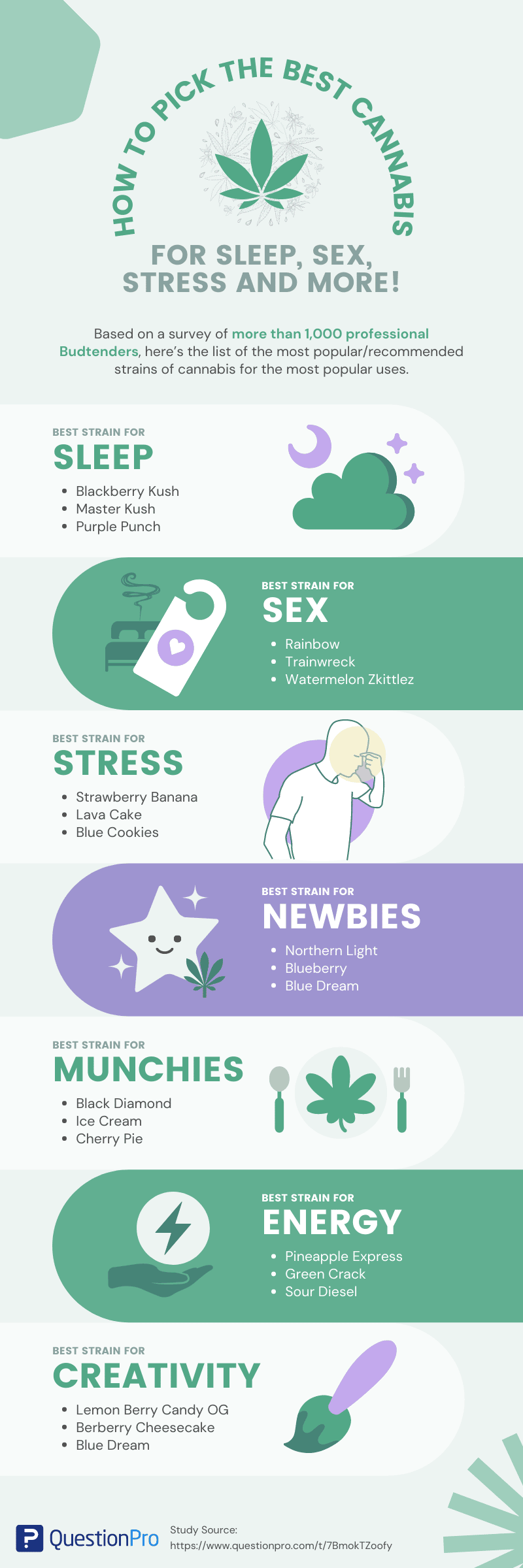
| Need | Top strain | Result reported |
|---|---|---|
| Sleep | Blackberry Kush | 18.42% of votes |
| Sex | Rainbow | 256 votes |
| Stress | Strawberry Banana | 237 votes |
Best strain for sleep
Blackberry Kush led, but the spread was tight, so no single strain dominated. Budtenders recommend by customer need, tolerance and format, so a top-three finish still signals strong demand.
- Blackberry Kush: 18.42% of votes
- Master Kush: 14.37%
- Purple Punch: 13.07%
Best strain for sex
Rainbow led with 256 votes. Trainwreck and Watermelon Zkittlez followed. Budtenders pick these for mood and sensation, and their answers reflect what customers report back, not clinical testing.
Best strain for stress
Strawberry Banana, nicknamed “Strawnana,” led with 237 votes. Stress relief draws strong interest from buyers, so this question matters to brands.
For a brand, this result suggests two things:
- Fruit-forward strain names may help shoppers recall a product.
- Stress is a use case worth testing in your own messaging research.
How should you read these results?
Treat them as professional opinion, not proof. Budtender picks show what trusted retail staff recommend and sell. They do not show what any strain does for any person.
Keep three limits in mind:
- The results do not publish fielding dates or exact question wording.
- The sex and stress results use vote counts, which cannot be compared with the sleep percentages.
- None of it is medical advice. Cannabis affects people differently, so anyone with a health concern should ask a licensed clinician.
Who should you survey: Consumers, budtenders or dispensary customers?
Survey the group closest to the decision you need to make. The right audience matters more than the biggest sample.
Use this guide to choose:
| Audience | What they can answer | Best for |
|---|---|---|
| Consumers | Habits, motivations, brand awareness, barriers | Product launches and positioning |
| Budtenders | What sells, what customers ask for, which brands they trust | Assortment and brand strategy |
| Dispensary customers | One store experience | Service, pricing and loyalty |
| Lapsed buyers | Why they stopped buying | Falling repeat purchase rates |
Many teams survey two groups and compare answers. A gap between what consumers want and what budtenders push is often the most useful finding.
Step-by-step guide to running a cannabis survey
A cannabis survey takes six steps, from goal to report. Skipping the early steps is the most common reason results turn out unusable.
- Set one clear objective.
For example: learn why first-time buyers do not return within 60 days. - Define the audience.
Set age, state, purchase frequency and format. Screen out anyone under the legal age in their state. - Write the questions.
Keep the survey short and the wording neutral. - Choose a sample source.
Use your customer list, a recruited panel, or a specialty audience of consumers and budtenders. - Field and monitor.
Watch completion rates and response times. Fix confusing questions early. - Clean, analyze and report.
Remove low-quality responses, then segment results by age, state and frequency.
What are good cannabis survey questions?
Good cannabis survey questions are neutral, specific and tied to one decision. Group them by what you want to learn.
Product and usage questions
These questions show what people buy and how often. Keep answer choices mutually exclusive.
- Which product formats have you bought in the past 90 days? (flower, vape, edible, tincture, topical, other)
- How often do you use cannabis? (daily, weekly, monthly, rarely)
- How likely are you to buy this product again? (5-point scale)
Purchase motivation and channel
Ask why and where people buy. One closed question on the main reason, followed by an open follow-up, gives you both a number and a story. An example: “What is the main reason you use cannabis?” with choices such as sleep, stress, pain, social use and enjoyment, then “Tell us more in your own words.”
Brand awareness questions
Measure awareness before perception. Use this order:
- Unaided recall: “Which cannabis brands can you name?”
- Aided recall: show a list and ask which brands they have heard of.
- Trust: ask which brand they trust most and why.
Sensitive and stigma questions
Cannabis is still illegal at the federal level, so some people hesitate to answer honestly. Promise anonymity in the first screen. Use ranges instead of exact numbers for frequency and spending. Offer “prefer not to say.”
Demographics and screening
Place these last, except age and state, which belong in the screener. Include these fields:
- Age band
- State
- Household type
- Purchase frequency
How do you avoid bias in a cannabis survey?
Bias enters through wording, sampling and respondent honesty. Fixing all three is what makes a result trustworthy.
Start with wording. A question such as “How much do you love our premium flower?” pushes people toward praise. Read about leading questions and rewrite anything that hints at the “right” answer.
Next, watch for response bias, where people answer to look good rather than to be accurate. Social desirability is strong on cannabis topics because of stigma. Anonymous collection and neutral phrasing reduce it.
Finally, check your sample. If only your most loyal customers respond, your results will skew positive.
How do you measure whether a cannabis survey is reliable?
A reliable survey has enough responses, a known margin of error and clean data. Use numbers, not impressions.
| Check | Benchmark | Why it matters |
|---|---|---|
| Sample size | About 385 responses for a ±5% margin at 95% confidence in a large population | Smaller samples widen uncertainty |
| Margin of error | Report it with every headline number | Shows how far results may drift |
| Completion time | Flag anyone finishing in under one third of the median time | Catches speeders |
| Straight-lining | Remove respondents who give identical answers to a long grid | Signals low effort |
| Attention check | One instructed-response question per survey | Filters inattentive respondents |
| Duplicates | Block repeat entries from the same person | Protects counts |
Gallup research shows the standard in practice. Its recent marijuana result comes from 1,200 adults surveyed July 1 to 19, with a margin of error of ±4 percentage points. Always report the sample size and dates beside your own results.
What are real examples of cannabis surveys?
Real examples show how goals shape design. Three formats cover most needs.
- Budtender recommendation survey: The QuestionPro study above asked one question per need and let budtenders name a strain. It works because budtenders know what customers ask for. Its weakness is the missing method detail, which a stronger version would publish.
- Dispensary experience survey: A store asks about budtender knowledge, product variety, pricing clarity, wait time, atmosphere and first-visit guidance. Six to eight rated questions plus one open comment keep it quick. A retailer could track the score monthly and link low scores to specific locations.
- Consumer usage and attitude study: A brand runs a longer survey on formats, frequency, brand awareness and barriers, then compares results year over year. The comparison is the point, so keep the core questions identical each wave.
What mistakes ruin a cannabis survey?
Most failures trace back to a handful of avoidable errors. Check this list before you launch.
- Asking for everything at once.
Long surveys lose people. Aim for under 10 minutes and cut any question you will not act on. - Skipping the age and state screener.
Legal age and rules vary by state, so screen first. - Leading with sensitive questions.
Start easy and build trust. - Mixing vote counts and percentages.
Pick one reporting format. - Reporting without a sample size.
A number with no base cannot be judged. - Treating opinion as fact.
Preference data is not evidence of health effects.
How can QuestionPro support cannabis research?
QuestionPro runs audience panels built for cannabis research. They cover consumers and budtenders, with more than 100,000 combined members. Registration checks screen out fraudulent answers, and member profiles carry over 300 data points for targeting.
You can field and analyze a study in one place:
- Recruit: The QuestionPro cannabis industry solutions and wider QuestionPro Audience service supply respondents.
- Analyze: Market research software handles cross-tabs, segmentation and dashboards.
- Go further: Read about cannabis industry business intelligence for the data-and-BI angle.
A final thought on running a cannabis survey
A cannabis survey is only as good as the question it answers. The budtender results show how much useful signal a short, focused survey can produce. They also show what a method note adds: dates, sample size and wording that let readers trust the number.
Start small. Pick one decision, ask the people closest to it, and publish your method with your results. That habit turns a one-off poll into research you can repeat and defend.
Frequently Asked Questions (FAQs)
No. Adult-use cannabis is limited to adults 21 and older in U.S. states that allow it, so add an age screener first. Surveying minors about drug use also triggers extra consent rules. Check your state laws and your institution’s research policy before fielding.
Aim for five to ten minutes, which is roughly 15 to 30 questions depending on question type. Rated and multiple-choice items take seconds each, while open-ended items take longer. Cut every question that will not change a decision.
Promise anonymity on the first screen, use frequency ranges instead of exact counts, and add a “prefer not to say” option. Place sensitive items after easier ones. Anonymous links and neutral wording reduce social desirability bias.
Yes, a survey itself is legal, but respondents may hesitate to admit use. Use anonymous collection, avoid asking for identifying details and keep the language neutral. Consider whether your analysis needs state-level splits before you promise respondents anything.
Run a core tracker once or twice a year and a short pulse after launches or price changes. Keep key questions identical each wave so you can compare trends. Add new items only when a decision requires them.