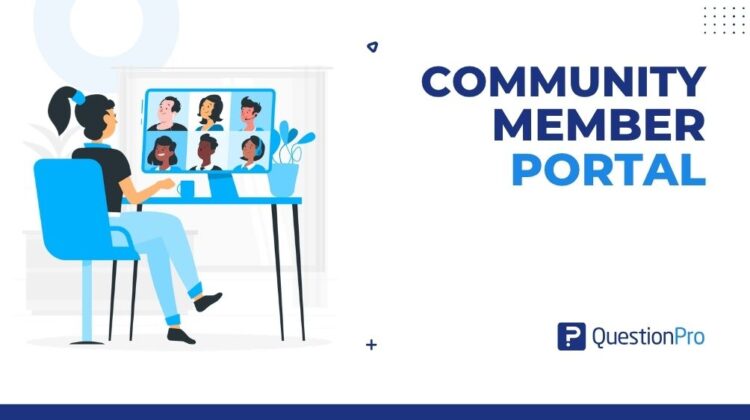
A community member portal turns a plain customer list into a living, branded space where people actually want to show up. Instead of sending one-off survey links into the void, you give members a home base to log in, share feedback, and see how their input shapes your business.
Companies that make this shift usually start with a simple customer community, then add a portal once engagement and feedback volume grow. The portal is what makes that community feel less like a mailing list and more like a real place.
In this blog, we’ll explain what a community member portal is, the benefits to know, the features to look for, and how to set one up and measure its effectiveness.
What is a community member portal?
A community member portal is a branded, login-based online space where a company’s customers, users, or research participants connect, share feedback, and access community tools in one place.
Members typically log in to a page that matches the brand’s look, then reach a dashboard showing surveys, discussions, polls, and rewards. Everything lives under one roof instead of being scattered across email, spreadsheets, and separate survey tools.
Portals are most common in customer communities and market research communities, sometimes called MROCs (market research online communities), where a business needs repeat, structured feedback from the same group of people over time rather than a single one-time survey.
Community member portal vs. General online community: What’s the difference?
Not every online community has a portal, and the two terms get mixed up often. An online community is the broader concept: any group of people connected by shared interest in a brand, product, or topic, whether that happens on social media, a public forum, or a private platform.
A community member portal is the structured, gated layer on top of that. It is where members actually log in, manage their profile, and use tools built specifically for that community.
- Online community: Can be public or private, may live across multiple channels, and is focused on connection
- Community member portal: Always gated and branded, lives in one place, focused on structured engagement and data collection
- Insight community / MROC: A research-focused type of member portal built for ongoing qualitative and quantitative studies with the same panel of participants
If your goal is ongoing, structured feedback rather than casual conversation, the portal is the piece that makes it possible.
Why does a community member portal matter right now?
Customer experience quality is under real pressure. In the United States, 25% of brands evaluated by Forrester saw their customer experience rankings decline in 2025, while only 7% improved. That gap between what companies think they deliver and what customers actually feel is widening across nearly every industry.
A community member portal gives a business a direct, owned channel to close that gap. Instead of guessing why satisfaction is slipping, you can ask the same engaged group of customers repeatedly and watch how their answers shift over time.
This is also why many teams eventually move from ad hoc surveys toward a dedicated insight community platform: one-time studies show a snapshot, but a portal-based community shows the trend.
Top benefits of a community member portal
A portal earns its place when it solves problems a basic mailing list or survey tool cannot. Four benefits show up consistently once a business makes the switch.
- Brand amplification.
A portal is an extension of the brand, not a generic third-party tool. A consistent look and feel across the login page, dashboard, and communication builds familiarity that supports brand loyalty and keeps members coming back.
- Member inclusion and engagement.
A portal gives members an actual place to go, not just an inbox that occasionally gets a survey link. Discussion boards and shared spaces mimic how real communities function, which tends to produce more thoughtful, more frequent responses.
- A wider research toolkit.
Quick polls, discussion topics, ideation boards, and open forums let members post their own ideas and react to each other’s, producing organic feedback that a single survey link never captures.
- Faster, more reliable decision-making.
Because a portal centralizes activity, an all-in-one dashboard can show engagement, sentiment, and response trends in real time, turning feedback into something leadership can act on quickly instead of waiting weeks to compile results.
The common thread across all four: a portal replaces scattered, one-off outreach with a single, structured relationship that compounds over time.
Key features to look for in a community member portal
Not every platform offers the same depth. Before choosing one, compare it against the features that actually drive engagement and usable data.
| Feature | Why it matters |
|---|---|
| Branded landing page | First impression that builds trust and recognition |
| Member dashboard | Central view of surveys, discussions, and activity |
| Panel management | Segment members and target the right group with the right ask |
| Discussion and ideation tools | Captures organic, peer-driven feedback |
| Gamification and rewards | Keeps participation consistent over time |
| Mobile access | Lets members participate wherever they already are |
How to set up a community member portal
Launching a portal is less about technology and more about sequencing. These are the core steps most teams follow.
- Define the purpose.
Decide whether the portal exists mainly for customer support, ongoing market research, or a mix of both.
- Choose a platform.
Look for panel management software built specifically for community portals rather than a generic survey tool.
- Recruit a founding group.
Start with your most engaged existing customers rather than trying to fill the portal all at once.
- Brand the experience.
Match the login page, colors, and messaging to the rest of the company so it feels familiar from the first click.
- Add engagement tools.
Turn on discussions, polls, gamification, and rewards before launch, not months later.
- Set a cadence.
Plan a regular rhythm of surveys, polls, and discussion prompts so the portal never goes quiet.
How to measure the success of a community member portal
A portal is only useful if it is actually being used. Track these areas from the first month onward.
| Metric | What it tells you |
|---|---|
| Active member rate | Percentage of members logging in and participating monthly |
| Response rate | How reliably members answer surveys and polls |
| Discussion activity | Volume and quality of unprompted member conversation |
| Member retention | Whether members stay active past their first 90 days |
Common mistakes to avoid with a community member portal
Most portals underperform for a small set of predictable reasons. Watch for these before and after launch.
- Launching without a content cadence: A portal that goes quiet for weeks loses members fast
- Skipping the incentive structure: Rewards do not need to be large, but they need to exist
- Ignoring mobile members:A desktop-only experience cuts out a large share of participants
- Treating it as one-way broadcasting:Portals work best when members can respond to each other, not just to the brand
- Never reviewing engagement data:A dashboard only helps if someone is actually checking it
Real-world example: A portal in action
Media company Gannett used QuestionPro Communities to expand its research program instead of managing separate one-off projects in each region. What changed once the portal was in place:
- Research ran across 10 U.S. markets from one connected platform
- Multiple study types launched without rebuilding infrastructure each time
- Leadership gained a clearer, ongoing view of audience sentiment by market
Examples like this show what makes a portal different from a single survey tool: it supports continuous, comparable research over time rather than a series of disconnected snapshots. Teams evaluating platforms can review similar case studies to see how other companies structured their rollout.
The real value is in the long game
A community member portal is not a quick engagement trick. It is infrastructure that pays off the longer a business keeps investing in it, because trust and participation both build over repeated interactions, not a single campaign.
The businesses that get the most out of a portal treat it the same way they treat any other core system: with a clear owner, a regular cadence, and metrics that get reviewed, not just collected.
Frequently Asked Questions (FAQs)
No. A support portal is built for ticketing and troubleshooting. A community member portal is built for ongoing engagement, feedback, and research, though some platforms combine both functions in one login experience.
Pricing varies widely based on member count, feature depth, and whether research tools like panel management are included. Most vendors price by active member tier rather than a flat monthly fee, so costs scale with community size.
There is no strict minimum, but most teams see meaningful value starting around a few hundred active members. What matters more than raw size is consistent engagement from that group.
Yes. Portal software has become far more accessible in terms of price and setup time, and a smaller, highly engaged member base often produces better-quality, more usable feedback than a large but disengaged one.
Yes. B2B companies use portals to gather structured, ongoing feedback from key accounts, beta users, or partner networks, typically with smaller but more specialized member groups than large consumer communities rely on.