Markets shift fast, and so do customer expectations. A continuous improvement process gives companies a repeatable way to get better at what they do instead of chasing one-off fixes.
Rather than a single project with an end date, the continuous improvement process is a habit. Teams build it into daily work, using feedback and data to make small, steady changes to products, services, and internal processes.
In this article, we’ll explain what the continuous improvement process actually means, the PDCA steps behind it, the methodologies teams use, and how to measure whether it’s working.
What is the continuous improvement process?
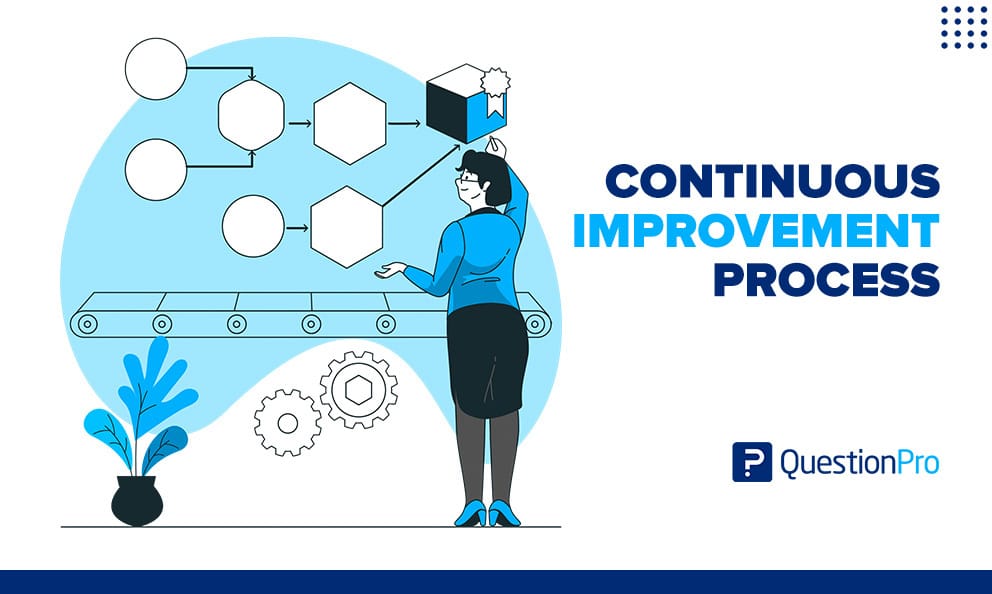
The continuous improvement process (CIP) is an ongoing effort to improve products, services, or internal workflows through small, incremental changes rather than one-time overhauls.
Teams evaluate current performance, gather input from customers and employees, test a change, and measure the result. Then they repeat the cycle. The process never technically “finishes,” which is what separates it from a standard improvement project with a fixed deadline.
CIP typically pulls in more than just product quality. It also touches business strategy, supplier relationships, and how well customer feedback surveys translate into real changes across the organization.
Continuous improvement vs. Process improvement vs. Continuous improvement culture
These three terms get used interchangeably, but they mean different things. Mixing them up leads to unclear goals and mismatched expectations across teams.
| Term | What it means | Scope |
|---|---|---|
| Process improvement | A one-time project to fix or redesign a specific workflow | Single process, defined end date |
| Continuous improvement process | An ongoing cycle of small changes applied repeatedly over time | One or more processes, no fixed end |
| Continuous improvement culture | An organizational mindset where every employee is expected to spot and suggest improvements | Company-wide, behavioral and structural |
A company can run a process improvement project without ever building a continuous improvement culture. The culture is what makes the process stick after the initial project ends.
Pros and cons of the continuous improvement process
Like any operating model, CIP comes with real upside and real trade-offs. Weighing both helps set realistic expectations before rolling it out.
Benefits:
- Higher productivity through the steady removal of waste and bottlenecks
- Stronger employee feedback loops and higher morale, since staff see their suggestions acted on
- Better adaptability when market conditions or customer needs shift
- Improved customer satisfaction as products and services keep pace with expectations
- Long-term profit gains from reduced waste and rework
Challenges:
- Fixed mindsets and resistance to changing established methods
- Unclear business goals, which make it hard to know what “improved” looks like
- Lack of transparency between teams running separate improvement efforts
- Slower visible results, since gains build up over months rather than overnight
McKinsey research found that organizations applying continuous improvement and rapid experimentation can lift productivity by 25 percent or more, largely through sustained operational discipline rather than a single fix. That kind of return is why most companies treat CIP as a long-term investment, not a quarterly initiative.
The 4 phases of the PDCA cycle
Most continuous improvement process steps follow PDCA, short for Plan-Do-Check-Act. It’s a repeatable, four-stage loop originally developed by Walter Shewhart and later popularized by W. Edwards Deming.
- Plan: Identify a specific problem or opportunity, dig into the root cause, and set a measurable goal for the change.
- Do: Roll out the change on a small scale, such as one team or one process, rather than company-wide.
- Check (Study): Compare the results against the goal set in the Plan phase using real data, not assumptions.
- Act: If the change worked, standardize and expand it. If it didn’t, adjust the plan and run the cycle again.
Each pass through PDCA is meant to be fast. Teams that try to perfect a change before testing it usually lose the speed advantage that makes continuous improvement effective in the first place.
Continuous improvement methodologies and tools
Several named methodologies structure how organizations run their continuous improvement process. Each one applies PDCA-style thinking but with a different emphasis.
- Kaizen
A Japanese philosophy of continuous, incremental improvement involving employees at every level, not just management.
- Six Sigma
A data-driven methodology focused on reducing defects and variation in a process.
- Lean methodology
An approach built around Toyota’s production system that targets waste reduction and workflow efficiency.
- Total Quality Management (TQM)
A company-wide approach that ties quality improvement to customer focus and employee involvement.
Teams that need to fix defects in a measurable, statistical way tend to lean on Six Sigma. Teams focused on cutting waste from a workflow often start with Lean. Organizations trying to build a company-wide habit of small daily improvements usually start with Kaizen.
Beyond the methodology, several tools support the day-to-day work of CIP:
- Benchmarking against competitors or internal baselines
- Pareto chart analysis to prioritize the highest-impact issues
- Cause-and-effect (fishbone) diagrams for root cause analysis
- Flowcharts to map current-state processes
- Control charts to track process variation over time
- Check sheets for structured data collection
- Affinity diagrams to group related ideas from brainstorming sessions
- Force field analysis to weigh forces for and against a proposed change
Companies also lean on surveys and polls, monthly training sessions, and structured think tanks to keep improvement ideas flowing from the people closest to the work.
How to measure a continuous improvement process
A continuous improvement process only works if teams can prove it’s working. Measurement turns anecdotal wins into evidence leadership can act on.
Start by tying each improvement cycle to a specific, quantifiable metric defined during the Plan phase, such as cycle time, defect rate, or customer satisfaction score. Track that metric before and after the change, not just at the end of the quarter.
Beyond hard numbers, qualitative signals matter too. Rising participation in employee experience measurement surveys, more improvement suggestions submitted per team, and faster time-to-implementation on approved ideas all indicate the process is becoming part of daily work rather than a one-time initiative.
Real-world continuous improvement examples
Seeing CIP in practice makes the concept easier to apply. A few companies illustrate different approaches to the same core idea.
Toyota built its entire production system around Kaizen, empowering line workers to stop production and flag problems immediately rather than waiting for a scheduled review. Amazon applies Lean principles across its fulfillment centers to cut waste and speed up shipping, while still prioritizing long-term customer satisfaction over short-term efficiency gains.
Apple relies heavily on ongoing user research to shape iterative product updates, and healthcare providers have used Six Sigma to shorten patient wait times without adding staff or equipment. Across industries, the pattern is the same: small, tested changes compound into major gains over time.
Common mistakes that stall continuous improvement
Even well-intentioned CIP efforts stall when a few avoidable mistakes creep in. Watching for these early prevents wasted effort later.
- Treating CIP as a one-time project instead of an ongoing habit
- Setting vague goals that make success impossible to measure
- Rolling out changes company-wide before testing them on a small scale
- Ignoring customer satisfaction survey feedback in favor of leadership assumptions
- Failing to assign clear ownership, so no one is accountable for follow-through
- Losing momentum after the first cycle instead of repeating the loop
Most of these come down to the same root issue: treating continuous improvement as an event rather than a system.
How QuestionPro supports the continuous improvement process
CIP depends on a steady stream of real feedback from customers and employees, and that’s where most companies struggle to keep the loop running. Collecting that feedback manually or sporadically breaks the Check phase of PDCA before it can inform the next Plan.
QuestionPro survey software gives teams a way to run recurring, customizable surveys and pull the results into reports that feed directly into improvement planning. Instead of guessing whether a change worked, teams can compare feedback data from before and after implementation and decide the next step with evidence rather than opinion.
Building continuous improvement into daily work
The companies that get the most out of CIP treat it as infrastructure, not a campaign. It shows up in how meetings are run, how feedback gets collected, and how quickly a good idea moves from suggestion to test.
Starting small is usually the right call. One team, one process, one measurable goal is enough to prove the model works before scaling it further.
Frequently Asked Questions (FAQs)
Most teams see early signals, like faster cycle times or fewer errors, within one or two PDCA cycles, often four to eight weeks. Larger, company-wide gains typically take two to three quarters of consistent application to show up clearly.
No. While CIP originated in manufacturing through Lean and Six Sigma, US service industries, including healthcare, software, retail, and financial services, now use the same PDCA-based approach to reduce errors and improve customer experience.
Continuous improvement refines what already exists through small, incremental changes. Continuous innovation creates new products, services, or business models. Most mature organizations run both in parallel rather than choosing one over the other.
Yes, though the process can be lighter. A small business might run a monthly team review instead of a formal Six Sigma program, but the same Plan-Do-Check-Act logic still applies at a smaller scale.
Pricing depends on features and team size. Survey and feedback platforms used to support CIP often range from free basic plans to a few hundred dollars per month for mid-sized teams, with custom enterprise pricing for larger organizations.