Multi-touch attribution is a marketing measurement method that assigns credit to multiple customer touchpoints before a conversion. It helps marketers understand how channels like paid search, email, social media, display ads, content, webinars, and direct traffic work together across the customer journey.
The old marketing problem still exists: which efforts actually help customers convert? The difference now is that marketers have more channels, more customer paths, and more reporting tools. That can help, but it can also make attribution harder.
A customer may click a search ad, read a blog, attend a webinar, open a nurture email, view a retargeting ad, and then request a demo. Multi-touch attribution helps show how those interactions contributed instead of giving all the credit to one step.
What is multi-touch attribution?
Multi-touch attribution is a way to assign conversion credit across more than one marketing touchpoint in a customer journey.
Customer touchpoints are any interactions a customer has with a brand before converting. Examples include an ad click, email open, website visit, sales call, webinar registration, social media interaction, review site visit, or direct mail response.
A conversion is the action the business wants the customer to take. It may be a purchase, demo request, lead form, signup, app install, subscription, or content download.
The goal of multi-touch attribution is to show how different marketing activities contribute to that conversion. Instead of asking, “Which one channel caused the sale?” it asks, “Which touchpoints helped move the customer toward the sale?”
How does multi-touch attribution work?
Multi-touch attribution works by tracking customer interactions before a conversion, choosing an attribution model, and assigning credit to each touchpoint based on that model.
The basic process looks like this:
- A customer interacts with several marketing channels.
- Those interactions are recorded as touchpoints.
- A conversion event is defined.
- An attribution model assigns credit to each touchpoint.
- Marketers review the results to understand channel contribution.
- Campaigns and budgets are adjusted based on what the model shows.
For example, a B2B buyer may first find a company through organic search, later click a LinkedIn ad, attend a webinar, open three emails, and finally book a sales call. Multi-touch attribution helps marketers see that the webinar and email sequence may have supported the final conversion, even if paid search or direct traffic got the last click.
Multi-touch attribution vs single-touch attribution: What is the difference?
Single-touch attribution gives 100% of conversion credit to one touchpoint. Multi-touch attribution shares credit across several touchpoints.
The most common single-touch models are:
- First-touch attribution: Gives all credit to the first known interaction.
- Last-touch attribution: Gives all credit to the final interaction before conversion.
These models are simple, but they can hide the role of supporting channels.
For example, last-touch attribution may give full credit to a branded search click, even though the customer first learned about the company through a podcast, webinar, or social ad. First-touch attribution may show awareness sources clearly, but ignore the campaigns that helped close the conversion.
Multi-touch attribution gives a broader view of the conversion path. It is especially useful for long buying cycles, B2B marketing, SaaS trials, ecommerce remarketing, and campaigns where customers interact with several channels before taking action.
What are the main multi-touch attribution models?
The main multi-touch attribution models include linear, time decay, U-shaped, W-shaped, custom, and algorithmic attribution. Each model gives credit differently.
| Attribution model | How credit is assigned | Best for |
|---|---|---|
| First-touch attribution | 100% to the first interaction | Awareness measurement |
| Last-touch attribution | 100% to the final interaction | Simple conversion reporting |
| Linear attribution | Equal credit to every touchpoint | A basic full-journey view |
| Time decay attribution | More credit to touchpoints closer to conversion | Shorter sales cycles |
| U-shaped attribution | More credit to the first and lead-conversion touchpoints | Lead generation campaigns |
| W-shaped attribution | More credit to first touch, lead creation, and opportunity creation | B2B funnel analysis |
| Custom attribution | Credit based on business-defined rules | Teams with clear funnel logic |
| Algorithmic attribution | Credit based on statistical or machine learning models | Teams with strong data volume and tooling |
First-touch and last-touch are included here for comparison, but they are single-touch models. The actual multi-touch models are the ones that share credit across multiple interactions.
Linear attribution
Linear attribution gives equal credit to every touchpoint in the customer journey.
If a customer has five touchpoints before converting, each touchpoint receives 20% of the credit. This model is simple and easy to explain, but it assumes every interaction matters equally.
Time decay attribution
Time decay attribution gives more credit to touchpoints that happen closer to the conversion.
This model is useful when recent interactions are likely to have more influence. It may work well for shorter buying cycles, retargeting campaigns, or limited-time offers.
U-shaped attribution
U-shaped attribution gives more credit to the first touchpoint and the lead-conversion touchpoint.
A common version gives 40% credit to the first interaction, 40% to the lead conversion, and divides the remaining 20% across the middle touchpoints.
This model is useful when you care about both awareness and lead creation.
W-shaped attribution
W-shaped attribution gives more credit to three major funnel moments: first touch, lead creation, and opportunity creation.
This model is often used in B2B marketing because it recognizes that turning a lead into a qualified sales opportunity is a major step.
Custom attribution
Custom attribution lets a team assign credit based on its own business rules.
For example, a company may give more credit to demo requests, sales conversations, webinars, or product trials because those actions are strongly tied to revenue.
Algorithmic attribution
Algorithmic attribution uses statistical models or machine learning to assign credit based on observed conversion patterns.
Google Analytics’ official guide to attribution models explains how attribution can evaluate touchpoints that contribute to key events. This type of model can be useful, but it depends heavily on data quality, tracking coverage, and enough conversion volume.
How do you choose the right multi-touch attribution model?
Choose a multi-touch attribution model based on your buying cycle, conversion goal, channel mix, and data quality.
Use this simple guide:
- Use linear attribution when you want a simple view of all touchpoints.
- Use time decay attribution when recent interactions matter most.
- Use U-shaped attribution when lead creation is a major goal.
- Use W-shaped attribution when you measure a longer B2B funnel.
- Use custom attribution when your team has strong knowledge of the funnel.
- Use algorithmic attribution when you have enough data and reliable tracking.
There is no perfect model. Different attribution models can produce different answers from the same data. That is why marketers should compare models instead of trusting one report without context.
How do you apply multi-touch attribution?
To apply multi-touch attribution, define the conversion event, map the customer journey, connect data sources, choose a model, and review the results regularly.
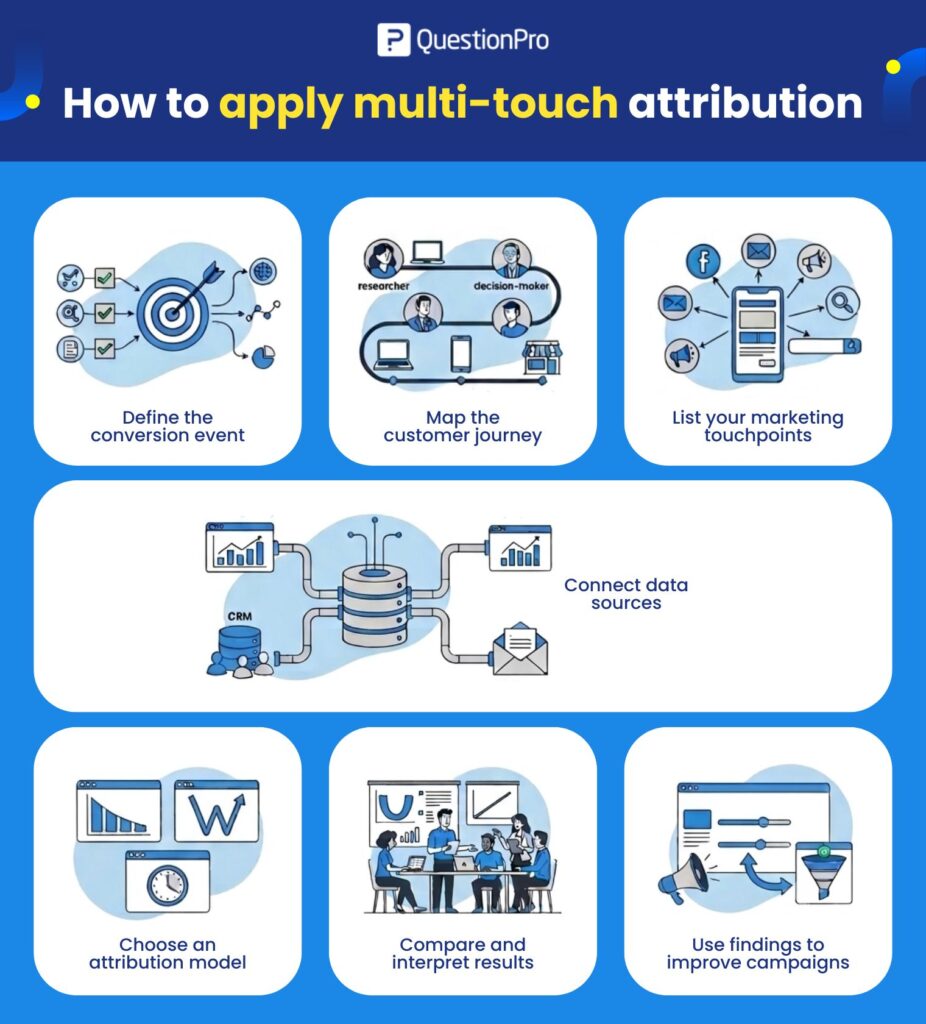
1. Define the conversion event
Start by deciding what action you want to measure.
Common conversion events include:
- Purchase.
- Demo request.
- Free trial signup.
- Lead form submission.
- App install.
- Subscription.
- Webinar registration.
- Quote request.
- Sales-qualified lead.
- Opportunity creation.
The model will not help much if the conversion event is unclear.
2. Map the customer journey
Map the path customers take before converting.
This includes awareness, consideration, evaluation, purchase, onboarding, and retention touchpoints. A customer journey analytics process can help teams connect behavior and feedback across these stages.
3. List your marketing touchpoints
Identify the channels and campaigns that may influence conversion.
Examples include:
- Paid search.
- Organic search.
- Social media ads.
- Email campaigns.
- Display ads.
- Retargeting.
- Webinars.
- Events.
- Direct mail.
- Landing pages.
- Review sites.
- Referral traffic.
- Sales outreach.
- Customer reviews.
- Content marketing.
Include offline touchpoints where possible. Many attribution models miss offline influence because it is harder to track.
4. Connect data sources
Bring together data from your marketing, sales, web analytics, CRM, and customer feedback systems.
This may include ad platforms, email tools, website analytics, CRM records, campaign tracking, call tracking, event attendance, and survey responses.
The model is only as useful as the data it receives. Missing or inconsistent tracking can lead to weak attribution results.
5. Choose an attribution model
Select the model that best fits your funnel and reporting goal.
For example, an ecommerce team may use time decay attribution for retargeting analysis. A B2B SaaS team may use W-shaped attribution to understand first touch, lead creation, and opportunity creation.
6. Compare and interpret results
Do not stop at one report.
Compare model outputs and look for patterns. If email looks strong in every model, that is useful. If paid social only looks strong in first-touch attribution, it may be better at awareness than closing.
Attribution should help teams ask better questions, not blindly move budget.
7. Use findings to improve campaigns
Use attribution results to adjust campaigns, messaging, budget, landing pages, and follow-up sequences.
For example, if webinars often appear before sales-qualified leads, the team may invest more in webinar promotion. If retargeting gets many final touches but few early touches, it may be supporting conversion rather than creating demand.
What are the benefits of multi-touch attribution?
Multi-touch attribution helps marketers see how channels work together instead of judging each channel in isolation.
Key benefits include:
- Clearer view of the customer journey.
- Better understanding of channel contribution.
- Less dependence on last-click reporting.
- Smarter campaign optimization.
- Better visibility into long sales cycles.
- Stronger alignment between marketing and sales.
- Better understanding of awareness, nurture, and conversion roles.
- More informed budget planning.
- Easier identification of high-value touchpoints.
For US marketing teams, this is especially useful when customers move across search, social, email, review sites, sales calls, mobile, and offline channels before converting.
What are the limitations of multi-touch attribution?
Multi-touch attribution has limits because it depends on tracking, model assumptions, and available data.
Common limitations include:
- Tracking gaps caused by privacy changes.
- Cross-device identity issues.
- Offline touchpoints that are hard to capture.
- Walled-garden platforms with limited data sharing.
- Missing CRM or sales data.
- Long sales cycles with many untracked influences.
- Model choice changing the final results.
- Attribution showing contribution, not guaranteed causation.
Causation means proving that one action directly caused another. Attribution can suggest influence, but it does not prove that a touchpoint caused the conversion by itself.
This is why marketers should treat attribution as a decision-support tool, not a perfect source of truth.
How can customer feedback improve attribution analysis?
Customer feedback can improve attribution analysis by explaining why people converted, not only which channels they touched.
Attribution reports can show that a customer clicked an email, attended a webinar, or visited a pricing page. They often cannot explain what the customer was thinking or what finally made the offer feel worth acting on.
Useful feedback methods include:
- Post-purchase surveys.
- Demo request surveys.
- Website feedback.
- Event feedback.
- Customer interviews.
- Lost deal surveys.
- Customer experience surveys.
- Onboarding feedback.
QuestionPro can support this part of the attribution process by helping teams collect feedback at key journey moments. For example, marketers can ask new customers which information helped them decide, which channels they remember, and what nearly stopped them from converting.
This feedback can make attribution analysis more grounded and less dependent on click paths alone.
What mistakes should marketers avoid?
The biggest mistake is treating multi-touch attribution as a perfect answer.
Avoid these mistakes:
- Using one attribution model without comparison.
- Ignoring offline touchpoints.
- Forgetting sales interactions in B2B journeys.
- Making budget cuts based on one report.
- Trusting attribution data without checking tracking quality.
- Treating all conversions as equal.
- Ignoring customer feedback.
- Confusing correlation with causation.
- Overvaluing channels that are easier to track.
- Underestimating brand, word of mouth, and dark social.
Dark social refers to sharing or influence that is hard to track, such as private messages, Slack groups, WhatsApp, screenshots, or direct recommendations.
A practical rule: if the report looks too clean, check what data is missing.
Final thoughts
Multi-touch attribution helps marketers move beyond last-click thinking and understand how different touchpoints contribute to conversion.
It is most useful when teams have clear conversion goals, reliable tracking, connected systems, and a realistic view of the model’s limits.
The goal is not to find a perfect attribution answer. The goal is to make better marketing decisions with a fuller view of the customer journey.
Frequently Asked Questions (FAQs)
The main purpose is to understand how multiple marketing touchpoints contribute to a conversion. It helps marketers see the role of awareness, nurture, and conversion channels instead of giving all credit to one interaction.
Multi-touch attribution is usually better for understanding complex customer journeys. Last-click attribution is simpler, but it often overvalues the final interaction and undervalues earlier touchpoints that helped create interest.
There is no single best model. Linear attribution is simple, time decay favors recent activity, U-shaped supports lead generation, and W-shaped works for B2B funnels. The right model depends on your business goal.
Multi-touch attribution can support marketing ROI analysis, but it does not prove causation by itself. It shows how credit is assigned based on a model, so results should be compared with experiments, feedback, and revenue data.
You need reliable touchpoint data, conversion events, campaign tracking, CRM records, and channel performance data. For better context, teams can also use customer feedback, sales notes, and survey responses.
US marketers often deal with privacy rules, cross-device behavior, long buying cycles, walled-garden platforms, and offline touchpoints. These factors can make it harder to connect the full customer journey accurately.