
Good survey questions are clear, neutral, and specific. A respondent should be able to answer one without pausing to guess what you actually mean. Get this right, and you have the single biggest factor separating a trustworthy survey from one that just produces noise.
Writing good questions is not complicated, but it takes a deliberate process. Before you draft a single one, it helps to know where it fits in the customer’s experience. It also helps to know which question type actually serves your goal.
In this blog, we’ll talk about what makes a survey question good, plus ten question types with real examples. We also explore some important tips to help you make smart surveys that get accurate and useful results.
What are good survey questions?
Good survey questions are well-designed, clear, and unbiased questions that collect reliable data from respondents. They are the foundation of any survey. The quality of a question directly determines the quality of the answer it produces.
A good survey question does three things at once:
- Asks about one specific idea, not several at a time
- Uses neutral wording that does not hint at an expected answer
- Arrives at a moment when the answer is still fresh for the respondent
Miss any one of those three, and the data becomes harder to trust. That holds true even if the question reads fine on the surface.
Start by mapping the customer’s journey
The fastest way to know which questions to ask, and when, is to map the respondent’s touchpoints first.
Once you have that map, put yourself in the respondent’s shoes at each stage. Ask what you would genuinely expect from the business at that exact moment. A question asked right after checkout should feel different from one asked three months into using a product. The respondent’s context has changed by then.
- Onboarding or first purchase: Ask about clarity and first impressions.
- Active use: Ask about specific features, friction points, or support experiences.
- Renewal or repeat purchase: Ask about loyalty, value, and likelihood to continue.
This process is sometimes called customer journey mapping. It gives your survey a natural structure before you write a single question, instead of bolting questions together afterward.
Characteristics of a good survey question
A good survey question shares a handful of traits, regardless of industry or audience. Here are the five that matter most.
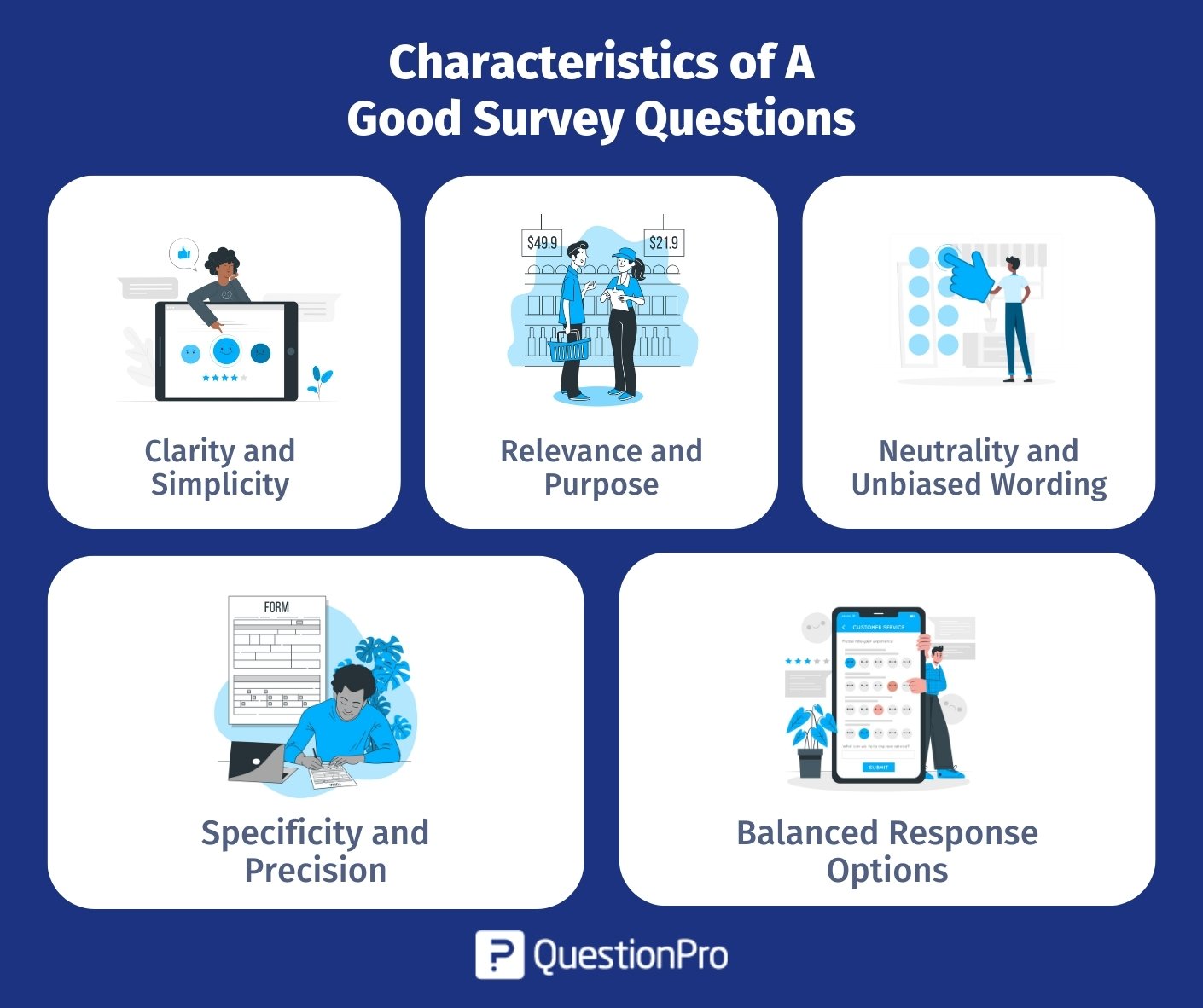
- Clarity and simplicity.
Plain, everyday language beats technical jargon. A respondent should understand the question on the first read.
- Relevance and purpose.
Every question should tie directly back to what the survey is trying to learn. Anything that does not earn its place adds length without adding insight.
- Neutrality and unbiased wording.
Neutral phrasing avoids leading language that nudges someone toward a particular answer.
- Specificity and precision.
One idea per question. A double-barreled question combines two ideas, which makes it impossible to know which part someone actually answered.
- Balanced response options.
Multiple-choice answers should cover every realistic response without overlapping categories.
Survey question types, with examples
Different research goals call for different question formats. Picking the wrong one is one of the most common reasons survey data ends up unusable.
| Question type | What it does | Example |
|---|---|---|
| Dichotomous | Two possible answers, usually yes or no | “Have you purchased our product in the last six months?” |
| Open-ended | Free-text answer in the respondent’s own words | “Please share any additional comments about our product.” |
| Closed-ended | Fixed answer options, easy to analyze | “How often do you visit our website? Daily / Weekly / Monthly / Rarely” |
| Likert scale | A range measuring attitude or agreement | “How strongly do you agree the interface is user-friendly?” |
| Ranking | Respondent orders items by preference | “Rank price, location, cuisine, and ambiance by importance.” |
| Rating scale | Bipolar adjectives measuring a feeling | “Rate our service: helpful to unhelpful, friendly to unfriendly.” |
| Matrix | Several rows answered against the same scale | “Rate ease of use, performance, and design, all on a 1-5 scale.” |
| Demographic | Basic respondent information | “What is your age range? 18-24 / 25-34 / 35-44 / 45+” |
| Conditional | Follow-up shown only based on a prior answer, using skip logic | “If you answered yes to Q3, describe your experience below.” |
| Net Promoter Score | A specialized loyalty question, scored 0-10 | “How likely are you to recommend us to a friend?” |
Net Promoter Score is worth a second look. One 0-10 score sorts respondents into promoters, passives, or detractors. Pair it with a short open-ended follow-up, since the score alone tells you how someone feels but not why.
How to write good survey questions
Once you know your question types, a handful of practical habits separate a strong question from a weak one. For a deeper walkthrough of wording fixes and bias traps, see our guide on how to write better survey questions.
Get the objective and wording right
Nail down what you are trying to learn before you draft a single question. Then keep the wording tight and neutral.
- Define clear objectives first.
Know exactly what the survey needs to answer, or you will end up with questions that feel relevant without actually informing a decision.
- Keep it concise.
Short, plain-language questions like “How satisfied are you with our customer support?” get answered more honestly than long, jargon-heavy ones.
- Stay neutral.
Avoid wording that nudges respondents toward a particular answer, such as praising your own product inside the question itself.
- Avoid double-barreled questions.
Asking about product quality and customer service in one question makes the answer impossible to interpret. Split it into two.
Structure the survey around the respondent
Once the wording is solid, shift your attention to how the survey feels to sit through from start to finish.
- Offer balanced response options.
Cover every realistic answer, including an “other” field, so nobody is forced into the wrong box.
- Use skip logic where it helps.
Branching respondents past irrelevant questions shortens the survey and keeps every question relevant to them.
- Include at least one open-ended question.
It gives respondents room to raise something your closed-ended questions never anticipated. That single question often surfaces the most useful feedback in the survey.
- Respect the respondent’s time.
Every extra question adds a small amount of drop-off risk, so keep the survey as short as its objective allows.
- Pilot test before deployment.
Run the survey past a small group first. Watch for confusion, skipped questions, or wording that reads differently than you intended.
Common survey question mistakes to avoid
A handful of structural mistakes account for most bad survey data. They are easy to miss once you already know what you meant to ask.
- Leading language: Words that hint at an expected answer, even subtly, bias the results before a single response comes in.
- Unrealistic reading level: Jargon or acronyms that feel obvious internally can confuse a general audience completely.
- Skipping the pilot test: A short read-through by people outside your team catches ambiguity you cannot see on your own.
- Trusting instinct over testing: Nielsen Norman Group’s research on survey design found that even small wording changes can shift how people respond. A pilot test beats a gut check every time.
How QuestionPro can help create good survey questions
QuestionPro is a complete survey software platform built to turn these principles into a working survey, not a blank page. The platform includes more than 30 standard and advanced question types. Options range from multiple choice and comment boxes to side-by-side matrix and Net Promoter Score questions.
Branching logic trims survey length automatically by routing respondents past questions that do not apply to them. Pre-built survey templates and a searchable question library save time and keep new surveys well-structured from the start.
Reporting and analytics tools turn finished responses into visualizations and statistical summaries. The insight from a well-written question does not get lost once the survey closes.
Good survey questions come down to respect for the respondent’s time
Every principle in this guide points to the same idea. A good question respects the person answering it and asks for exactly one thing. Get that right, and the data you get back is something your team can actually act on.
Before publishing, check that your questions are:
- Specific to one idea
- Free of leading or loaded language
- Backed by answer options that cover every realistic response
Frequently Asked Questions (FAQs)
Most effective surveys stay under 15 to 20 questions total. Beyond that range, U.S. respondents tend to rush through remaining questions or abandon the survey entirely, which lowers the reliability of everything that follows.
A good survey question is neutral and lets any honest answer feel equally valid. A leading question uses wording, tone, or answer choices that nudge respondents toward one particular response, which quietly distorts the resulting data.
Yes, at least one. A single free-text question gives respondents room to mention something your closed-ended questions did not anticipate, which often surfaces the most actionable feedback in the entire survey.
No. NPS is excellent for a quick loyalty snapshot, but it does not explain why someone gave that score. Pair it with a short open-ended follow-up to capture the reasoning behind the number.
Yes. Starting broad and moving into specifics, then closing with demographic questions, keeps respondents engaged. It also prevents early questions from quietly shaping how people answer the ones that follow.