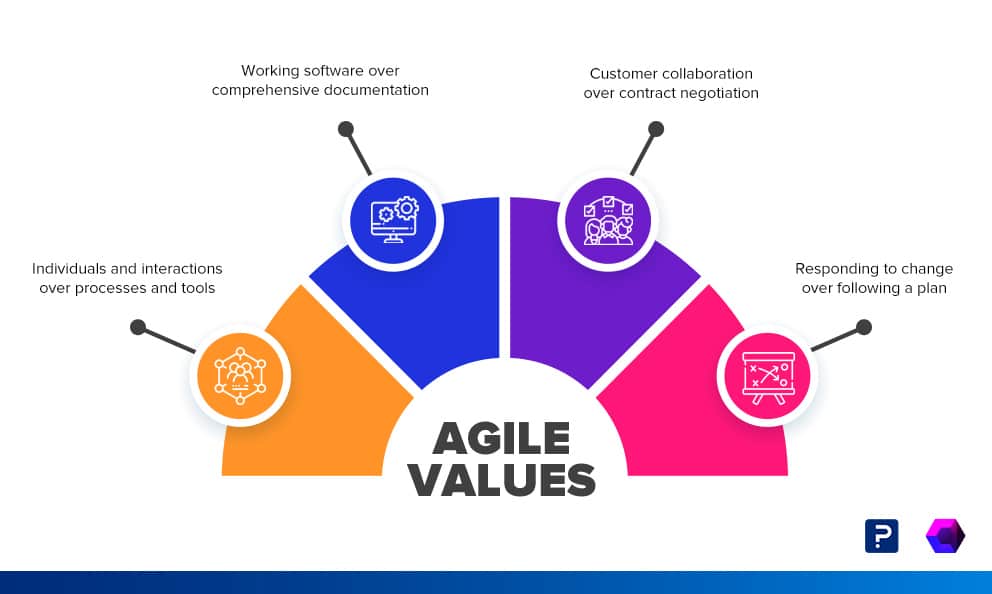
Agile values are the four guiding principles from the Agile Manifesto that shape how teams make decisions during software development and other collaborative work. They prioritize people and adaptability over rigid processes, and they still hold up decades after seventeen software practitioners wrote them down in 2001.
Teams often learn agile through ceremonies like standups and sprints without ever grounding those practices in the values behind them. Adobe’s overview of the Agile Manifesto notes that the four values and twelve principles together provide a foundation emphasizing collaboration, adaptability, and delivering value to customers, not a fixed set of rituals to perform. That gap is why some organizations run every agile ritual correctly and still feel bureaucratic rather than adaptive.
In this blog, we’ll cover each of the four agile values, how they apply beyond software teams, and where organizations tend to misapply them.
What are agile values?
Agile values are the foundational beliefs defined in the Agile Manifesto that prioritize human judgment and adaptability over strict adherence to process. They were written specifically to counter the heavyweight, documentation-first project management common in software development before 2001.
Unlike agile frameworks such as Scrum or Kanban, which prescribe specific practices, agile values describe a mindset. A team can follow every Scrum ceremony precisely and still violate agile values if decisions are driven by rigid process rather than by what actually serves the customer and the team.
The four core agile values explained
Each value expresses a preference, not an absolute rule. The item on the left is still valued, just less than the item on the right.
- Individuals and interactions over processes and tools.
People solve problems through direct communication faster than any tool or workflow can substitute for. Rigid processes matter less than a team’s ability to talk through a blocker together.
- Working software over comprehensive documentation.
A functioning product that customers can use and react to delivers more value than extensive specs that describe a product nobody has tested yet.
- Customer collaboration over contract negotiation.
Continuous input from the people using the product, gathered through an ongoing customer feedback loop, produces better outcomes than a fixed scope agreed upon months before development starts.
- Responding to change over following a plan.
Plans are useful starting points, but agile teams treat new information as a reason to adjust course rather than a deviation to resist.
These values are deliberately interdependent. Prioritizing customer collaboration without also valuing responding to change, for example, means gathering feedback the team has no intention of acting on.
Pros and cons of applying agile values
Pros
- Keeps teams focused on what customers actually need, not just what was originally planned
- Reduces time wasted on documentation that becomes outdated before it is used
- Improves team morale by trusting individuals over rigid oversight
- Makes it easier to pivot when market conditions or customer needs shift
Cons
- Can be misread as an excuse to skip documentation entirely, creating knowledge gaps
- Requires genuine customer access, which not every team or industry has
- Responding to change too freely can lead to scope creep without discipline
- Works best with experienced teams; newer teams sometimes need more process structure than agile values suggest
How agile values apply beyond software teams
Agile values started in software but now guide marketing, customer experience, and research teams that need to move quickly on incomplete information. A customer experience team running iterative product feedback cycles is applying the same underlying value, prioritizing direct customer input over a fixed research plan, that a software team applies when it adjusts a sprint based on user testing. HR teams reflect the same shift when they replace an annual review with an employee pulse survey, trading a once-a-year plan for continuous, responsive listening.
The principle of responding to change over following a plan is especially relevant to feedback-driven teams. A customer experience program that only reviews satisfaction data once a quarter is following a plan rigidly. One that adjusts its research questions as new patterns emerge is applying agile thinking, even without ever using the word “sprint.”
Common mistakes when applying agile values
The most common mistake is treating agile values as permission to skip planning altogether. The manifesto values working software over documentation, not documentation being unnecessary, and teams that drop planning entirely often lose the shared context a plan provides.
A second mistake is claiming to prioritize individuals and interactions while still measuring team performance through rigid, tool-based metrics. If velocity tracking software drives every decision, the team has quietly reverted to valuing process over people. This is the same trap that shows up in product feedback programs that collect comments but never route them to the people who can act on them.
The third mistake is confusing responding to change with reacting to every request. Agile values call for adapting based on genuine new information, not abandoning direction every time a stakeholder raises a new idea mid-sprint.
How to measure whether a team is living agile values
A team living these values shows specific behaviors: decisions get made through direct conversation rather than escalation chains, working increments ship regularly instead of waiting for a big launch, and plans visibly change based on real feedback rather than staying fixed regardless of what customers say.
If a retrospective consistently surfaces the same process complaints without any changes following, that is a signal the team has adopted agile ceremonies without adopting the underlying values. The same idea extends to using agile principles to drive employee engagement, where the value only shows up if feedback actually changes how a team operates.
A closing thought on putting agile values into practice
Agile values work best as a lens for decision-making, not a checklist to complete. When a team faces a tradeoff between following the original plan and adjusting based on new customer input, the values point toward the answer. Teams that keep coming back to these four preferences, rather than defaulting to whichever process is most familiar, tend to stay genuinely adaptive long after the initial agile training has worn off.
Frequently Asked Questions (FAQs)
No. The Agile Manifesto has four values and twelve supporting principles. The values are broad preferences, like people over process. The principles are more specific guidance, such as delivering working software frequently, that operationalize those values.
No. While the manifesto originated in software, the underlying values, prioritizing people, adaptability, and customer input, apply to marketing, research, customer experience, and other collaborative work that benefits from iterative feedback.
Agile is the underlying set of values and principles. Scrum is one specific framework, with defined roles and ceremonies, that teams use to implement agile values in practice. A team can be agile without using Scrum specifically.
Yes. Agile values describe a mindset, not a mandatory framework. A team that prioritizes direct communication, working output, and responsiveness to change is applying agile values, even if it uses lightweight or custom processes instead of Scrum or Kanban.
Programs that treat feedback as a continuous input to iterate on, rather than a static report reviewed once and filed away, reflect agile values in practice. A QuestionPro Employee Experience program built around frequent listening, rather than one annual survey, is a direct example of responding to change over following a plan.