Audience analysis is the process of studying the people you want to reach so you can match your message, product, or presentation to what they need. A marketer uses it to choose the right channel. A speaker uses it to pick the right examples.
Online data has made the work faster than ever, but more data does not mean more clarity. The real skill is turning demographics, beliefs, and context into decisions.
In this blog, we’ll cover the three types, a six-step process, sample questions, examples, and ways to measure results.
What is audience analysis?
Audience analysis is the process of collecting and interpreting information about a group of people, such as their demographics, values, attitudes, and circumstances, so you can communicate with them more effectively.
The term appears in two settings. In communication courses, it helps speakers shape a talk for a specific room. In marketing, it helps teams shape campaigns, content, and products for customers.
Communication textbooks, such as Penn State’s open text on audience analysis, describe the same core idea. Learn what your listeners need, expect, and believe before you speak. Marketing teams apply that idea at scale with surveys, analytics, and research panels.
Audience analysis comes after you define a target audience, the broad group you want to reach. The analysis then studies that group closely enough to act on what you learn.
Audience analysis is often confused with audience research, segmentation, and personas. These terms overlap, but each answers a different question.
| Term | Question it answers | Typical output |
|---|---|---|
| Audience analysis | Who are these people, and what do they need from me? | Insights on demographics, psychographics, and context |
| Target audience analysis | Which group should my brand focus on? | A prioritized group with clear traits |
| Audience research | Which methods will collect the data? | Survey, interview, or panel results |
| Audience segmentation | How do I split a large audience into groups? | Segments that share traits or behaviors |
| Buyer persona or audience profile | What does a typical member of one segment look like? | A semi-fictional profile |
| Market analysis | How big and competitive is the market? | Size, trends, and competitor view |
Target audience analysis, which many teams search for separately, is simply audience analysis applied to the group a brand wants to sell to. This guide covers both.
Why audience analysis matters
Audience analysis matters because people expect communication that fits them, and generic messages get ignored. Research found that 71 percent of consumers expect companies to deliver personalized interactions. It also found that 76 percent get frustrated when that does not happen.
The same report found that faster-growing companies draw 40 percent more of their revenue from personalization than slower-growing peers. You cannot personalize for people you have not studied.
A solid analysis gives you four practical gains:
- Sharper messaging: You speak to real needs instead of guesses.
- Smarter spend: You fund the channels your audience actually uses.
- Better product calls: You spot unmet needs before you build.
- Lower risk: You test growth bets against evidence, not instinct.
Types of audience analysis
There are three types of audience analysis: demographic, psychographic, and situational. Each looks at the audience through a different lens, and the strongest analyses combine all three.
| Type | Core question | Example data | Common sources |
|---|---|---|---|
| Demographic | Who are they? | Age, gender, income, education, location, occupation | Surveys, census data, customer records |
| Psychographic | What do they believe and value? | Values, attitudes, interests, lifestyle | Surveys, interviews, search trends, social listening |
| Situational | What is the context? | Audience size, occasion, prior knowledge, channel, attitude toward you | Event briefs, web analytics, observation |
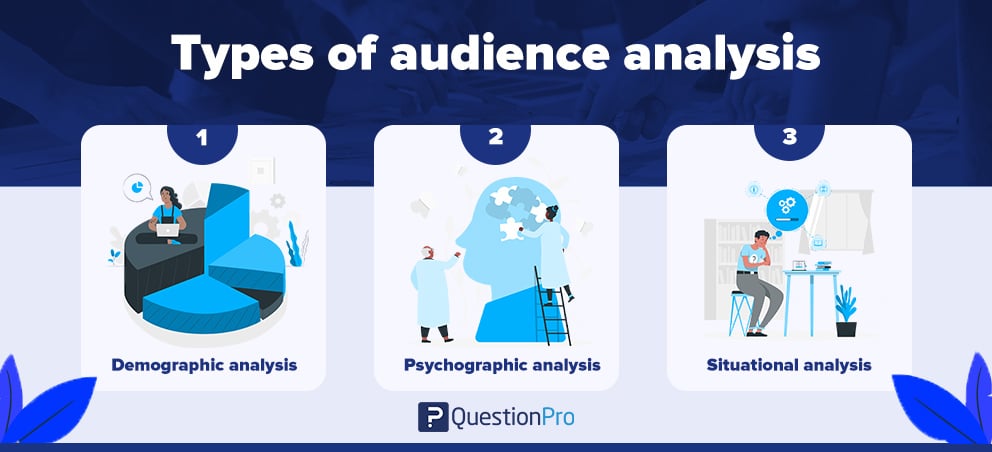
Demographic analysis
Demographic analysis describes who your audience is using measurable traits such as age, gender, income, education, location, and occupation. It is the easiest type to start with because the data is concrete and easy to verify.
Demographic data usually comes from surveys, customer records, and platform analytics. Public sources, such as the American Community Survey from the U.S. Census Bureau, add context about the wider population.
Each trait shapes how people hear your message:
- Age shapes media habits and shared reference points.
- Income and occupation shape what people can afford and how they talk about work.
- Education level affects how much jargon your audience will accept.
- Location shapes language, culture, and the rules that apply to them.
Ask sensitive questions, such as marital status or religion, only when they matter. Make them optional and never guess why someone skips them.
Psychographic analysis
Psychographic analysis explains why your audience behaves as it does by studying their values, beliefs, attitudes, and interests. Demographics are easy to check. Psychographics take more care because people define the same words differently.
Two people may both say they avoid junk food, yet disagree on what counts as junk food. Psychographic segmentation groups people by these traits so you can write for the mindset, not just the profile.
Two things are worth testing:
- Topic beliefs: Find the misconceptions, stereotypes, or oversimplified ideas your audience already holds about your subject.
- Brand perceptions: Learn what people already think of you, then focus on their needs instead of trying to manage your image.
Google Trends offers a free signal here. It shows what people search for over time, which hints at rising interests.
Situational analysis
Situational analysis studies the circumstances around your audience: how large it is, why it is there, what it already knows, and how it will meet your message. The same facts matter in a conference room and on a landing page.
For a speech, the key factors are audience size, the occasion, whether people chose to attend, their prior knowledge, and their attitude toward the speaker. For digital marketing, the factors are the size of your preferred audience, their attitude toward your company, what they already know, and the channels where they see your ads or use your product.
This type is harder when your audience is spread across regions, because you cannot watch people react. Web analytics, social listening, and short on-site surveys help fill that gap.
How to do an audience analysis step by step
You can complete an audience analysis in six steps: set a goal, define the audience, collect data, analyze patterns, build profiles, and apply and test the findings.
- Set a clear goal.
Decide which decision the analysis will inform, such as a campaign, a talk, or a product change. A narrow goal keeps the data relevant. - Define the audience.
Name the group using basic traits, then narrow it to one priority group for deeper study. - Collect data.
Combine first-party sources, such as surveys and customer records, with outside sources, such as search trends and social analytics. - Analyze for patterns.
Look for shared traits, needs, and behaviors, and compare segments to see where they differ. - Build audience profiles.
Turn the patterns into short profiles covering demographics, attitudes, and context so teams can use them. - Apply and test.
Adjust your messaging, channels, or content, then test the change and refine it based on results.
Audience analysis methods and data sources
The best method depends on the question you are asking. Surveys explain attitudes, while analytics show behavior.
| Method | Best for | Watch out for |
|---|---|---|
| Surveys built with survey software | Attitudes, needs, and demographics at scale | Biased samples and leading questions |
| Interviews and focus groups | The reasons behind answers | Small samples and higher cost |
| Social listening | Unprompted opinions and trends | Vocal minorities can skew the picture |
| Web and customer data analytics | Actual behavior of people who reached you | Misses people who never found you |
| Search trend data | Interest over time | Shows what people want, not why |
| Observation and inference | Live events and small rooms | Relies on judgment, so check your assumptions |
| Research panels | Reaching people outside your customer list | Needs careful screening |
Communication courses name three routes to the same goal. Speakers can observe the audience directly, infer traits from what they already know, or gather structured data. Marketers use the same three routes with different tools.
Audience analysis questions to ask
The right questions turn a vague audience into usable facts. Group them by type so nothing gets missed.
Demographic questions
- What is your age range?
- What is your highest level of education?
- What industry or occupation best describes you?
Psychographic questions
- What matters most to you when choosing this kind of product?
- Which statement best matches your view of this topic?
- What have you heard about our brand before today?
Situational questions
- Where do you usually learn about this topic?
- How familiar are you with it?
- What would make you act on this message?
Keep the survey short and make sensitive items optional. Short surveys protect completion rates and respondent goodwill.
Audience analysis examples and uses
Real audience analysis ties each finding to a decision. These three examples show how that works in marketing, public speaking, and product planning. They are illustrative scenarios, not case study results.
Marketing example: A day spa
A day spa could stop at asking who is likely to visit. A fuller analysis asks which stresses each group faces and which treatments fit them. That is how customer behavior turns into a plan.
- Finding: Busy professionals mention time pressure, while retirees mention joint pain.
- Decision: Promote short lunchtime sessions to the first group and longer therapeutic sessions to the second.
- Measure: Booking rate for each offer against the spa’s previous average.
Public speaking example: A conference talk
A speaker preparing a talk on data privacy asks the organizer who will attend. The answer is mostly mid-career managers who know the basics but doubt the topic matters to them. The speaker drops the definitions, opens with a costly breach story from their industry, and ends with three actions the audience can take on Monday.
Product example: Choosing a channel
A company learns that most of its customers are younger. It responds with a cheaper, more eco-friendly product line. That is a risk, but an informed one.
- If the audience skews younger: Change the product and price to fit their budgets and values.
- If the audience is less tech-savvy: An email newsletter may beat a social media campaign.
How to choose which type of audience analysis to start with
Start with the type that answers your most urgent decision, then add the others as budget allows. If you cannot name the decision, you are not ready to collect data.
| If your goal is | Start with | Why |
|---|---|---|
| Writing a speech or presentation | Situational, then demographic | Room size, occasion, and prior knowledge shape delivery most |
| Launching a campaign | Demographic, then psychographic | Targeting needs who they are and what moves them |
| Repositioning a brand or message | Psychographic | Perception problems are belief problems |
| Entering a new market | All three | You know the least, so cover every lens |
| Fixing low engagement on one channel | Situational | Context and channel fit are often the cause |
How to measure whether your audience analysis worked
An audience analysis works when it changes a decision and results improve against a baseline. Use these checks to judge it:
- Segment clarity: Your team can describe each segment in one sentence, and the segments differ on at least one behavior you care about.
- Sample quality: Set your confidence level and margin of error first. Common starting points are 95 percent confidence and a 5 percent margin of error, and the guide to determining sample size shows how to calculate the number of responses you need.
- Message lift: Test a tailored message against a generic one. Compare click-through rate, conversion rate, or response rate with your baseline.
- Prediction accuracy: Check whether segment predictions hold. A segment labeled price-sensitive should respond more strongly to discounts.
- Freshness: Re-run the analysis at least once a year, and again after a major launch, market shift, or channel change.
Common audience analysis mistakes
Most audience analysis fails for avoidable reasons: stereotypes, thin data, and no follow-through. Watch for these six:
- Assuming instead of asking.
Guessing why people hold a view invites stereotypes. Ask them. - Relying on demographics alone.
Two people with the same age and income can want very different things. - Using a small or biased sample.
Your own followers show only people who already like you. - Letting data go stale.
Habits shift, so a study from three years ago can mislead you. - Collecting without a decision.
Data with no decision attached sits unused. - Ignoring privacy.
Collect only what you need, explain how you use it, and follow the privacy rules that apply to you.
How QuestionPro Audience reaches people you cannot survey directly
Your customer list only covers people who already know you. QuestionPro Audience gives research teams a managed respondent panel for studying everyone else.
- Profile depth: Panelists share detailed background information, with more than 300 data points collected per member.
- Specialty panels: Niche groups include registered voters in the United States, small business owners, pet owners, home owners, and college students.
- Quality controls: Registration checks help screen out fraudulent answers, and a digital portfolio stops panelists from taking the same survey twice.
- Mobile response: Respondents can submit photos, videos, and mobile diary entries.
Researchers who want advanced analysis tools alongside sample can pair it with the QuestionPro Market Research Software.
Know the people before you speak to them
Audience analysis is less about collecting facts and more about removing guesswork. Every message, product, or talk carries assumptions about who will receive it. The analysis tests those assumptions before they cost you money.
Start small with your first cycle:
- Pick one goal.
- Choose one priority group.
- Run one short survey.
- Make one change you can measure.
Then repeat the cycle. Audiences keep changing, so the teams that treat analysis as a habit stay closest to the people they serve.
Frequently Asked Questions (FAQs)
Yes. Start with free sources: Google Analytics 4 for website visitors, native insights inside social platforms, and your own customer emails. Add a short survey of ten to twelve questions to fill gaps. Free data shows behavior, while surveys explain motives.
Review it at least once a year, and again after a product launch, pricing change, or shift in channels. Fast-moving audiences, such as teens or gamers, may need a refresh every quarter. Track a few core metrics monthly in between.
Often yes, with limits. Rules vary by state, and laws such as the California Consumer Privacy Act set requirements for businesses. Collect only what you need, disclose how you use it, and confirm requirements with your legal team.
No, but it can speed it up. AI can cluster open-ended survey answers, summarize themes, and flag segments. It still depends on real respondent data and human judgment. Simulated audiences should supplement, not replace, evidence from actual people.