First call resolution (FCR) is the percentage of customer issues fully solved during the first interaction with a support team, without a follow-up, repeat call, or escalation. For contact centers across the US, it is one of the most direct ways to see whether support is actually working or just generating more contacts.
A high FCR rate points to clear answers, well-equipped agents, and processes that hold together. A low rate usually points to something more specific: wrong routing, missing customer history, weak training, or policies that slow agents down before the issue is even close to solved.
What does first call resolution mean?
First call resolution means a customer’s issue is completely solved during their first interaction with the support team. The customer does not need to call back, wait for another team, repeat their problem, or reopen the same case later.
FCR is one of several contact center metrics that together tell you how well your support operation is actually performing.
The definition sounds simple, but how you measure it changes the number significantly. A case marked “resolved” in a CRM is not the same as a customer who actually got the answer they needed. That gap is where most FCR data goes wrong.
The most reliable way to define resolution: the customer confirms the issue is solved, not the agent. Many US contact centers use post-interaction surveys to capture this, rather than relying on ticket status alone.
What is the difference between FCR and first contact resolution?
These two terms are often used interchangeably, but they measure slightly different things:
- First call resolution tracks whether an issue was solved on the first phone call
- First contact resolution tracks whether an issue was solved on the first interaction across any channel, including chat, email, SMS, social media, or self-service
For teams running phone-only support, FCR and first contact resolution are the same metric. For omnichannel contact centers, which covers most US support operations today, first contact resolution is the more complete picture. A customer who starts on live chat and moves to email before getting an answer has not experienced first contact resolution, even if both interactions were handled well individually.
Choose the definition that matches how your customers actually reach you.
How do you calculate the first call resolution rate?
The first call resolution formula is:
FCR rate = (Issues resolved on the first contact / Total number of contacts) x 100
Example: Your team handles 1,000 contacts in a month. 720 of those are fully resolved without any follow-up.
720 / 1,000 x 100 = 72% FCR rate
Before you calculate, define what counts as an eligible contact. Some issues, such as bug fixes, back-ordered products, or cases requiring third-party input, cannot be solved in a single interaction no matter how good the agent is. Most teams exclude these from the denominator so the metric reflects what agents can realistically control.
Two ways teams typically measure FCR:
- Agent-reported: The agent closes the ticket and marks it resolved. Fast to collect, but prone to inflation since agents have an incentive to mark cases closed
- Customer-confirmed: A short post-interaction survey asks the customer directly whether the issue was solved. More accurate and directly tied to the actual experience
The customer-confirmed method is harder to scale but produces more trustworthy data.
What is a good first call resolution rate?
There is no universal benchmark, but most industry guidance puts a solid FCR rate in the 70% to 75% range. According to SQM Group’s 2025 benchmarking data, the cross-industry average sits at 70%, with world-class performance starting at 80%. Only around 5% of contact centers consistently hit that threshold.
FCR benchmarks by industry (2025):
- Retail: ~78% (simpler call types, faster resolution)
- Healthcare: ~71%
- Financial services: ~68% to 72%
- Telecom: ~50% to 65% (complex billing and technical issues)
- Technology support: ~60% to 70%
A 65% FCR in telecom is a different story than a 65% FCR in retail. The right target depends on your issue complexity, channel mix, and how you define resolution.
One caution worth noting: a rising FCR rate is not always a good sign. If simple questions are flooding your phone line because your self-service options are not working, FCR may look strong while the broader customer experience is getting worse. Always read FCR alongside customer effort score and CSAT to get the full picture.
Why does first call resolution matter for customer experience?
When customers have to contact support more than once for the same issue, trust drops. They have to repeat themselves, re-explain the context, and spend more time on something that should have been handled already. That experience sticks.
FCR matters because it sits at the center of three things contact centers are always trying to balance at once:
- Cost: Every repeat contact costs money. Research estimates each avoidable repeat call costs between $5 and $8. For a 500-agent operation, a 1% FCR improvement generates roughly $286,000 in annual savings from repeat contact reduction alone (SQM Group)
- Customer satisfaction: SQM Group’s research shows a consistent 1:1 relationship between FCR and CSAT. Every 1% improvement in FCR produces a 1% improvement in customer satisfaction scores
- Agent morale: Agents who resolve issues feel more effective. SQM Group found that a 1% FCR gain produces a 2.5% improvement in agent satisfaction, which matters in a sector where annual turnover runs 40% to 45%
FCR is also one of the clearest indicators of how well your support systems actually work. If agents cannot resolve issues on the first contact, the cause is almost always structural, not individual.
What causes a low FCR rate?
Low FCR is usually a process or system problem, not an agent performance problem. That distinction matters because it changes where you look for the fix.
Common root causes:
- Customers routed to the wrong department
- Skills-based routing gaps that send complex issues to generalist agents
- Agents without access to full customer history during the interaction
- Knowledge base articles that are outdated, incomplete, or hard to find mid-call
- Policies that require supervisor approval before an agent can resolve certain issue types
- Disconnected CRM, billing, or support tools that force agents to switch between systems
- Pressure to keep average handle time (AHT) low, which pushes agents to close interactions before the issue is fully solved
- Inconsistent definitions of what counts as “resolved”
That last point causes more FCR problems than most teams realize. If agents, supervisors, and reporting systems all define resolution differently, the metric becomes unreliable before anyone even tries to improve it.
How to improve first call resolution
Improving FCR comes down to removing the reasons customers need to contact support more than once. The fixes that make the biggest difference tend to involve routing, agent access, knowledge content, and how resolution is confirmed.
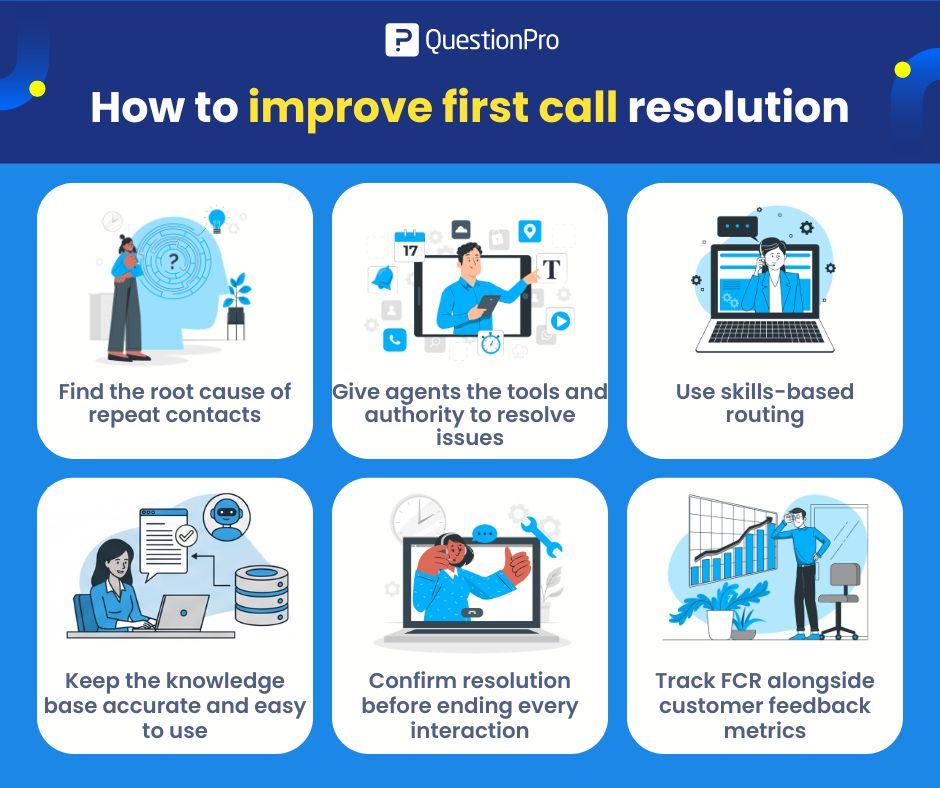
1. Find the root cause of repeat contacts
Start by pulling repeat contact data and looking for patterns. Do not assume the cause before you look.
Ask:
- Which issue types generate the most callbacks?
- Which teams or channels have the lowest FCR rates?
- Which cases get marked resolved but reopen within 7 days?
- Which policies require escalation that could be handled at the agent level?
- Where are customers transferred more than once?
This turns FCR from a score you report into a tool you use to find where the process breaks down.
Agents cannot solve problems they do not have access to fix. If resolving a billing dispute requires supervisor sign-off, or if customer history lives in a system agents cannot open during a call, FCR will stay low regardless of how well-trained the team is.
High-FCR contact centers consistently share these traits, according to SQM Group:
- Agents have authority to resolve most issue types without escalation
- CRM and support tools are accessible in a single view, not spread across multiple systems
- Customer history from all channels is visible during the interaction
Giving agents what they need to close issues independently has a faster impact on FCR than additional training alone.
3. Use skills-based routing
Skills-based routing directs incoming contacts to the agent or team most likely to solve that specific issue. A technical setup question goes to technical support. A billing dispute goes to a billing specialist. A cancellation request goes to a retention team.
One transfer is acceptable if it gets the customer to the right person quickly. Multiple transfers signal a routing problem.
Review your routing logic when:
- New products or features launch and create new contact reasons
- FCR drops in a specific queue without a clear explanation
- Transfer rates rise across certain issue categories
4. Keep the knowledge base accurate and easy to use
A knowledge base is only useful if agents can find the right article in under 30 seconds during a live interaction. If content is outdated, inconsistently formatted, or buried under navigation layers, agents will stop using it and start guessing.
Update knowledge base content based on repeat contact trends. If the same question keeps generating callbacks, the article covering that topic is missing something. Either a step is unclear, the resolution path has changed, or the content was never written for the specific situation customers are actually calling about.
According to Gartner’s 2025 Customer Service and Support Survey, AI-assisted agents who have real-time knowledge retrieval during calls improve FCR by 15% to 25% compared to unassisted agents handling the same issue types.
5. Confirm resolution before ending every interaction
This is the simplest FCR improvement most teams overlook. Before closing an interaction, the agent should ask directly whether the issue is fully resolved.
Useful confirmation phrases:
- “Did that answer your question completely?”
- “Is there anything about this that is still unclear?”
- “Before we wrap up, can I confirm this is fully resolved for you?”
This catches secondary questions the customer was hesitant to raise and prevents repeat contacts that come from confusion rather than an actual unresolved issue.
6. Track FCR alongside customer feedback metrics
FCR on its own can be misleading. A customer may get an answer on the first call and still feel rushed or poorly handled. Pair FCR with:
- CSAT (customer satisfaction score): Did the customer feel satisfied with the interaction?
- CES (customer effort score): How much effort did the customer have to spend to get help?
- NPS (Net Promoter Score): Is the customer likely to recommend the brand?
CSAT, CES, and NPS sit at different levels of the customer relationship. Used together, they give a more honest view of whether high FCR reflects genuine service quality or just fast ticket closure.
How QuestionPro CX supports FCR measurement
One of the most reliable ways to measure true FCR is through post-contact surveys sent immediately after each interaction. QuestionPro CX lets contact centers deploy short post-call or post-chat surveys that ask customers directly whether their issue was resolved and how easy the experience felt.
The resulting data feeds into FCR reporting as customer-confirmed resolution, which is more accurate than agent-reported data and directly tied to the actual experience. Results connect to dashboards that show FCR trends over time, by team, by channel, and by issue type.
For businesses that also want to track repeat contact patterns and close the loop on unresolved issues, QuestionPro’s closed-loop feedback system connects post-interaction data directly to action workflows.
First call resolution is a system problem, not just an agent problem
If your FCR rate is low, the answer is rarely “train agents harder.” It is almost always something in the system: routing logic that sends the wrong calls to the wrong people, policies that block agents from resolving issues independently, tools that are too slow or too fragmented, or a knowledge base that agents stopped trusting.
Fix the system and FCR improves. Keep coaching individuals without addressing the structure and the number stays where it is.
Start with repeat contact data. Find the patterns. Fix the most common reasons customers have to call again. Then measure whether the customer actually felt the issue was resolved, not just whether the ticket was closed.
Frequently asked questions
Not exactly. First call resolution applies to phone interactions only. First contact resolution covers the first interaction across any channel, including chat, email, and social media. For omnichannel US contact centers, first contact resolution is usually the more relevant metric to track.
Treating it as an agent performance issue when it is usually a system or process problem. Low FCR most often comes from poor routing, limited agent authority, disconnected tools, or an outdated knowledge base. Fixing the structure consistently outperforms individual coaching.
Yes. If basic questions dominate your call volume because self-service options are weak, FCR may look strong while the overall experience is poor. Always pair FCR with customer effort score and CSAT to check whether high resolution rates reflect genuine service quality.
Monthly is the standard for most teams, with weekly reviews for high-volume or high-risk issue categories. Teams managing product launches, service outages, or policy changes often monitor FCR daily during those periods to catch emerging problems early.
It can be, but not alone. If agents are evaluated only on FCR, they may rush interactions or close tickets before issues are fully resolved. Balance FCR incentives with quality scores and customer satisfaction feedback to avoid gaming the metric.
FCR measures whether the issue was resolved. Customer effort score measures how hard the customer had to work to get there. A resolved issue that required multiple calls, long holds, and repeated explanations will show good FCR but poor CES. Both metrics together give a more complete picture of service quality.