Marketing funnel surveys are structured questionnaires. They capture what people think and feel as they move from first contact to a final decision. Pair them with funnel analysis, the practice of mapping and measuring how visitors move through each stage of your funnel. Together, they give you both numbers and reasons: how many people dropped off, and why.
Teams in the USA work in crowded markets with rising acquisition costs. For them, that combination is often the fastest way to catch weak messaging, unclear offers, or trust gaps before they cost revenue. Behavioral data alone shows where people stopped moving forward. It rarely explains why they stopped.
This guide covers how funnel analysis and marketing funnel surveys work together. It also covers how to map your funnel, choose the right KPIs, and design stage-specific surveys that teams actually use.
What is funnel analysis, and how do marketing funnel surveys fit in?
Funnel analysis is the practice of mapping and measuring how people move through the stages of your marketing funnel. It tracks them from first visit to conversion, so you can see exactly where they slow down or leave.
It relies on behavioral data: page views, click-through rates, cart or form abandonment, and CRM activity. That data is precise about where drop-off happens, but it stays silent on the reason. Marketing funnel surveys close that gap. They ask people directly, at the moment they’re in a specific stage, what confused them or what almost stopped them.
| Aspect | Funnel analysis | Marketing funnel surveys |
|---|---|---|
| Data type | Quantitative, behavior-based | Qualitative, opinion-based |
| Source | Analytics tools, CRM records | Direct questions to your audience |
| Best question it answers | Where do people drop off? | Why did they drop off? |
| Typical output | Drop-off rates, conversion percentages | Reasons, objections, sentiment |
Used together, they turn a funnel from a static diagram into a working diagnostic tool.
Why do marketing funnel surveys matter for US marketing teams?
Marketing funnel surveys matter because behavior alone does not explain intent. Funnel analysis might show a drop in conversions, but only a survey explains why. In the US market, where buyers compare options quickly and switch with little friction, missing that context can cost real revenue.
Good funnel surveys help you do the following.
- Understand how people interpret your message
- Identify friction before it affects revenue
- Align marketing, sales, and product teams around real feedback
How do marketing funnel surveys differ from general customer surveys?
Marketing funnel surveys differ from general customer surveys because each one targets a single funnel stage instead of asking everyone the same broad questions.
General surveys often try to do too much at once. They mix awareness, evaluation, and satisfaction questions into a single flow, which produces noisy data and vague takeaways. Funnel stage surveys avoid that by design:
- Each survey matches one funnel stage
- Questions reflect the mindset at that moment
- Results point to a specific action, not a general impression
This is why they’re often called funnel stage surveys or customer journey surveys. The focus is context first, metrics second.
How do you map the ideal funnel journey before launching surveys?
Mapping the ideal funnel journey means laying out every stage and touchpoint a prospect moves through. Do this before you decide where to place a survey.
Before adding a single question, plan the journey itself.
- List every stage a prospect moves through, from first touch to purchase.
- Note the content or action tied to each stage, such as an ad view, a demo, or a pricing page visit.
- Mark where your sales team gets involved, whether through email prospecting or a discovery call.
- Flag the two or three moments where feedback would change a decision, not just confirm one.
A customer journey map is useful here because it documents these stages visually and gives your team a shared reference for where surveys, not just analytics tags, should sit.
What KPIs should you track alongside funnel survey data?
The right KPIs depend on the funnel stage, and each one has a blind spot that survey data fills.
| Funnel stage | KPI to track | What the KPI alone misses |
|---|---|---|
| Awareness | Website traffic, click-through rate | Whether the message was actually understood |
| Consideration | Time to convert, lead velocity | Which specific doubts are slowing the decision |
| Conversion | Conversion rate, form or cart abandonment | What almost stopped someone at the last step |
| Retention | Customer lifetime value (CLV), lead churn | Why a customer stays engaged or disengages |
Tracking these key performance indicators (KPIs) tells you the pipeline’s overall health. Once you know which ones matter for your funnel, check them against survey responses from the same stage before deciding what to fix.
How do awareness stage surveys improve first impressions?
Awareness stage surveys check whether people understand what you offer, not whether they’re ready to buy.
They target people who just encountered your brand, whether after viewing an ad, landing on a homepage, or seeing a social post. The goal is clarity, not persuasion. Here’s what these surveys help you check.
- Whether people understand what you offer
- What problem they think you solve
- Where confusion appears immediately
Simple questions work best here.
- What do you think this company does?
- What caught your attention first?
- How relevant does this feel to you?
In the USA, where audiences see thousands of messages daily, unclear positioning usually means an instant drop-off. A brand awareness survey shows whether your message survives first contact before it ever reaches the consideration stage.
What should you measure during the consideration stage?
During consideration, people compare options, read details, and look for proof, and this is where interest turns into intent or disappears quietly.
Funnel stage surveys at this point uncover what criteria people use to compare vendors. They also surface what information feels missing and what doubts are slowing the decision down. This is also where customer journey surveys reveal gaps between what marketing promises and what buyers actually expect.
| Common doubt | What it usually signals |
|---|---|
| “I’m not sure this fits our size” | Unclear differentiation from competitors |
| “The pricing page didn’t answer my question” | Pricing confusion or hidden costs |
| “I couldn’t tell if support is included” | Trust or data security concerns |
For B2B teams, this stage carries real weight. Forrester’s State of Business Buying research has found that a large majority of B2B purchases stall somewhere in the process. Internal stakeholders often can’t resolve exactly these kinds of doubts on their own. A short consideration-stage survey can surface the specific doubt before it stalls a deal internally.
How do conversion funnel surveys reduce last-minute drop-offs?
Conversion funnel surveys catch hesitation at the exact moment before someone acts, whether that’s a signup, a demo request, or a checkout.
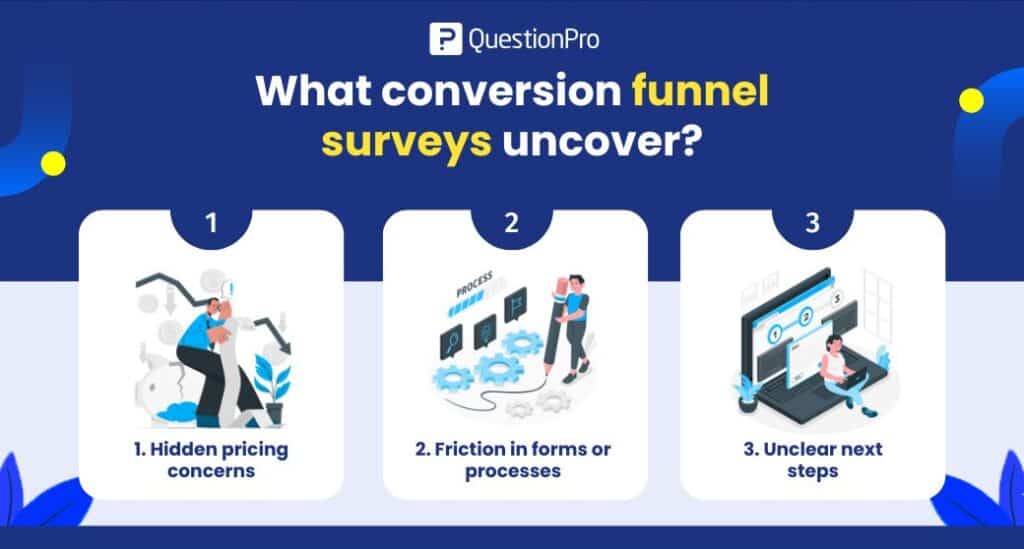
These surveys are short and targeted, built to capture doubt while it’s still fresh. They often uncover hidden pricing concerns, friction in a form or process, or an unclear next step. Effective questions include:
- What almost stopped you from completing this?
- Was anything confusing or unexpected?
- What would have made this easier?
Even a small insight here can lift conversion rates across the whole funnel. Fixing one unclear form field or one misleading line of copy often does more than a redesign. A website feedback survey is a practical way to capture this feedback right at the point of action.
Where do lead qualification surveys fit in the funnel?
Lead qualification surveys sit right after initial interest and before heavy sales engagement. They help you confirm whether a lead is actually a good fit.
Instead of long forms, these surveys focus on intent and readiness.
- What problem are you trying to solve?
- How soon are you looking for a solution?
- What role do you play in the decision?
For US-based sales teams, lead qualification surveys reduce wasted follow-ups and improve handoffs between marketing and sales. They also help prioritize leads without relying only on firmographics or guesswork, especially useful alongside customer segmentation data you may already be tracking.
How do you combine funnel surveys with behavioral data and competitor benchmarking?
Survey responses are most useful when checked against behavioral data and how competitors’ funnels perform, not read on their own.
Behavioral analytics tools show what people did. Combine that with CRM-collected data points, such as who opened an email and then visited your pricing page. Together, these give you a fuller picture of intent. From there, work through the following.
- Score each identified issue by how often it appears and how much revenue it likely affects
- Compare your funnel structure against a competitor’s where public data allows, since this can reveal whether a drop-off is specific to you or common across the category
- Treat this as an ongoing process rather than a one-time audit, since fixing one leak often surfaces the next one
The more data points you combine, the more likely you are to spot the real cause instead of the most visible symptom.
How should marketing funnel surveys connect to campaigns?
Marketing funnel surveys work best when tied to real campaigns, not abstract journeys. Campaign-specific surveys show how messaging performs in context, which is especially useful when testing new positioning, paid media messaging, or a content offer.
A good place to connect these insights is within the broader marketing campaign itself, not as a separate research project. Campaign-level feedback helps teams adjust quickly. That speed matters most in competitive US markets, where timing decides whether a fix arrives in time.
What makes marketing funnel surveys trustworthy and actionable?
Trustworthy funnel surveys follow a few simple rules. Each one keeps the data clean enough to act on:
- Ask one idea per survey
- Use plain language instead of internal jargon
- Avoid leading or loaded questions
- Combine a rating with one open-ended question
To support credibility, align your survey design with established research principles. The American Association for Public Opinion Research (AAPOR) publishes solid guidance on survey standards and ethics, especially relevant for research conducted in the USA.
When surveys are clean and focused, teams trust the results and actually act on them, which is the entire point of running one.
How do you use funnel survey and analysis data in practice?
The value of funnel survey and analysis data shows up in decisions, not dashboards.
- Rewrite landing page headlines or messaging that awareness surveys flag as confusing.
- Adjust ad targeting or creative based on where drop-off and survey feedback line up.
- Simplify pricing pages when consideration-stage surveys repeatedly flag pricing confusion.
- Prioritize issues by combining how often they’re mentioned with how much revenue the stage affects, then work the list in that order.
- Re-run the survey after changes to confirm the fix actually worked, not just that the change shipped.
The strongest teams review this data on a regular cadence and compare it with behavior analytics. When both tell the same story, confidence goes up. When they conflict, the survey usually explains why.
How does QuestionPro support funnel analysis and marketing funnel surveys?
QuestionPro supports both sides of this process: structured survey feedback at each funnel stage, and the analytics needed to make sense of it.
Here’s what you can do with QuestionPro.
- Trigger short, targeted surveys based on behavior, page visits, or campaign touchpoints, so feedback matches the right funnel stage
- Segment responses by audience type, source, or intent
- Combine quantitative ratings with open-ended feedback in the same survey
- Run reports, cross-tabulation, trend analysis, and text analysis on the responses you collect, so raw feedback turns into a prioritized list of fixes
- Share insights across marketing, sales, and CX teams from one platform
Because analysis and survey design live in the same survey software, it’s easier to connect feedback with campaigns, lead quality, and follow-up actions, which matters for growing teams in the USA that need speed and clarity.
Funnel data only pays off when someone acts on it
A funnel map or a KPI dashboard tells you that something is wrong. A well-timed survey tells you what to fix first. Neither one replaces the other.
Teams that treat funnel analysis and marketing funnel surveys as separate projects usually end up with a lot of data. Conversion rate barely moves as a result. Start with the stage losing the most people and add one short survey there. Let the answer decide your next change before you touch the next stage.
Frequently Asked Questions (FAQs)
Funnel analysis uses behavioral data like traffic and conversion rates to show where people drop off. A marketing funnel survey asks people directly why they left. Analysis finds the leak; the survey explains its cause, and both are needed to fix it.
Keep funnel stage surveys short, usually two to four questions. Conversion and consideration surveys work best with a single rating question plus one open-ended follow-up, since long surveys at these stages lower response rates and add noise.
Send it immediately after the action, whether that’s a completed signup, an abandoned form, or a finished checkout. Waiting even a day reduces recall accuracy, since respondents forget the specific hesitation that almost stopped them.
No. Funnel analysis shows where conversions drop using behavioral data alone, but it cannot explain intent or sentiment. Marketing funnel surveys fill that gap by capturing the reasoning a dashboard can never show on its own.
Review funnel analysis and survey data on a recurring basis, typically monthly for high-traffic funnels or quarterly for lower-volume ones. Re-run the review sooner after any major change to pricing, messaging, or the buying process.