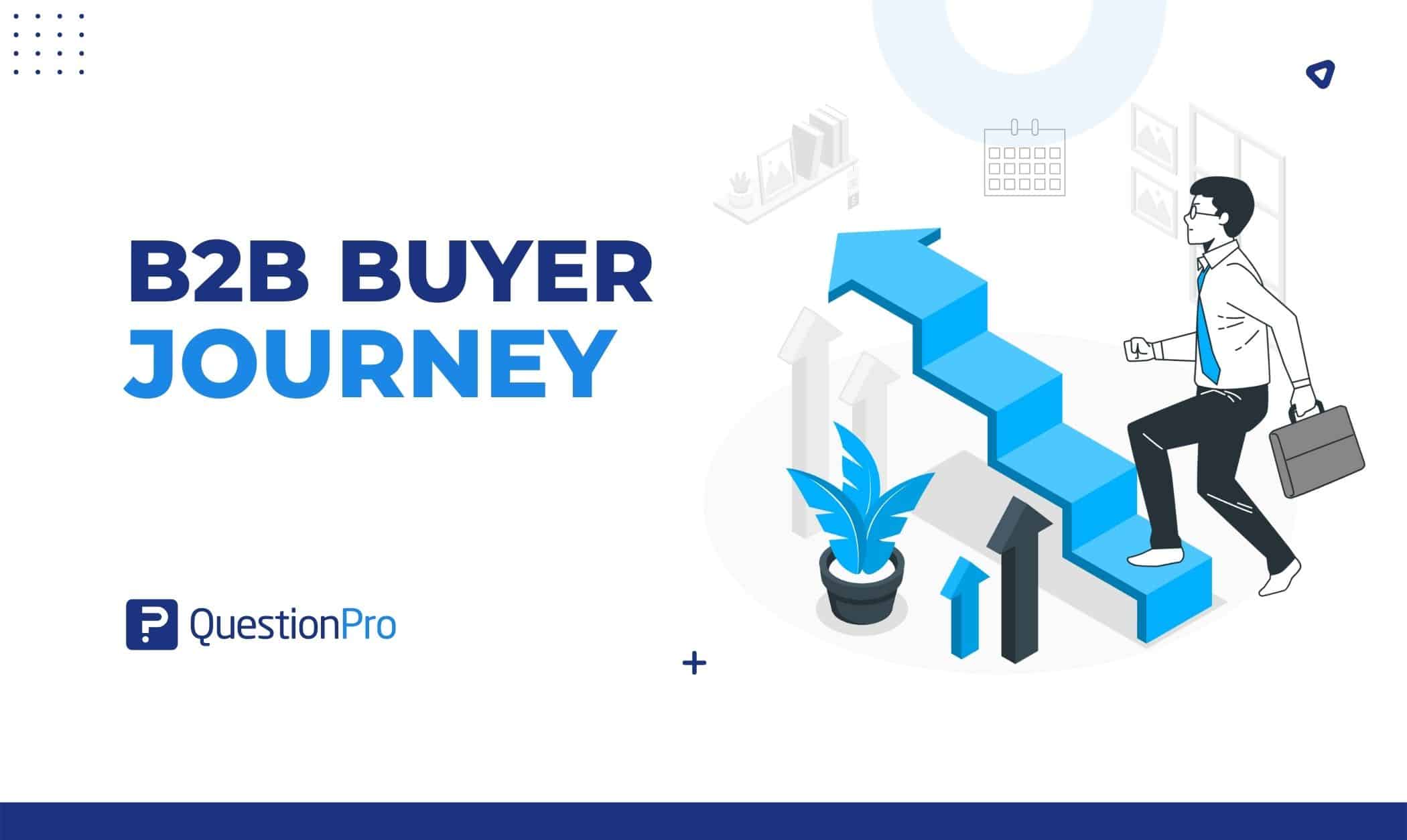
A B2B buyer journey is the path a business buyer follows from first noticing a problem to signing a contract. It covers every question they ask, every piece of content they read, and every colleague they pull into the decision.
That path rarely runs through one person anymore. Most B2B purchases now involve a small group of stakeholders who research independently, compare notes, and only talk to a sales rep once they already have an opinion.
Sales and marketing teams that understand this journey place the right content in front of the right person at the right stage. In this guide, we’ll break down the three stages of the B2B buyer journey, who sits on the buying committee, and how to map your own journey step by step.
What is a B2B buyer journey?
A B2B buyer journey is the process a business goes through to identify a need, research options, and choose a vendor to solve it. It differs from a single purchase decision because it plays out over weeks or months and touches several people inside the buying organization.
Buyers don’t wake up and decide to buy. They move through a sequence: naming the problem, learning what solutions exist, comparing vendors, and building internal agreement before anyone signs a contract.
Sales and marketing teams that map this sequence can meet buyers with the right message at each point. Instead of pushing a demo on someone who is still defining their problem, they can offer research, then comparisons, then proof, in the order the buyer actually needs them.
Mapping the journey starts with listing every customer touchpoint where a buyer interacts with your brand, since those touchpoints are what you’ll eventually plot onto the map itself.
B2B buyer journey vs. B2C buyer journey
B2B and B2C both use the word “journey,” which is where the confusion starts. The buyers behind each one behave in very different ways, and mixing up the two leads to content that misses the mark.
A consumer buying a laptop makes a personal decision on their own timeline. A company buying software has to justify the purchase to a budget owner, a technical reviewer, and often legal or procurement before anyone can sign off.
| Factor | B2B buyer journey | B2C buyer journey |
|---|---|---|
| Decision maker | A buying committee, often 3 to 10 people | Usually one person or a household |
| Typical timeline | Weeks to several months | Minutes to a few days |
| Primary driver | ROI, risk reduction, team fit | Personal preference, price, convenience |
| Content that influences the decision | Case studies, ROI calculators, demos, security documentation | Reviews, social proof, product photos |
Knowing which journey you’re mapping changes everything downstream, from the content you produce to the metrics you track. It also connects to the broader customer lifecycle, since the buyer journey is really just the front end of a much longer relationship.
Who’s involved? Understanding the B2B buying committee
A buying committee is the group of people inside a company who research, evaluate, and approve a purchase together instead of leaving the decision to one buyer. Most B2B software deals move through a version of this group before a contract gets signed.
A typical committee includes:
- The champion: The person who first identified the problem and is pushing the project forward internally.
- The economic buyer: The person who owns the budget and has final sign-off authority.
- Technical evaluators: IT, security, or data teams checking that the solution fits existing systems and policies.
- End users: The people who will actually use the product day to day.
- Gatekeepers: Procurement, legal, or finance reviewers who can slow down or block a deal on contract terms.
Buyers increasingly prefer to work through these steps without a sales rep. A Gartner sales survey found that 61% of B2B buyers prefer an overall rep-free buying experience, and that 73% actively avoid suppliers who send irrelevant outreach. Content built for a single generic “buyer” persona misses most of this group, which is why journey mapping has to account for more than one role.
The 3 stages of the B2B buyer journey
Most B2B buyer journeys still break down into three core stages, even as the committee behind each one has grown. Each stage represents a different question the buyer is trying to answer.
1. Awareness stage
At this stage, the buyer has noticed a problem but hasn’t defined it clearly yet. They’re asking, “What’s actually causing this, and how big of a problem is it?”
Marketing content works best here when it names the problem without pitching a product. Blog posts, industry benchmarks, and social content that build trust tend to outperform anything that looks like a sales pitch this early.
2. Consideration stage
The buyer now understands their problem and is actively researching solutions. Their question shifts to, “What are my options, and which one fits us best?”
Relevant content matters most here. Buyers are far more likely to shortlist vendors who address their specific evaluation criteria instead of publishing generic sales collateral. Comparison guides, expert webinars, and detailed product pages all help narrow that shortlist.
3. Decision stage
The committee has narrowed its options and is choosing a final vendor. The core question becomes, “Can we trust this vendor, and can we justify this internally?”
Case studies, live demos, and pricing transparency matter most here, since procurement and legal are often reviewing terms in parallel with the champion making the internal case. This is also where you’ll want a clear consumer decision journey reference if your buyer is also weighing a personal-use tool alongside the enterprise purchase.
A real-world example: Mapping a CX software purchase
Picture a mid-size logistics company where customer complaints are climbing and the operations director can’t tell which touchpoint is causing them. That’s the trigger for a real B2B buyer journey.
The table below shows how that journey might unfold across the three stages, and what a vendor’s team could offer at each point.
| Stage | What the buyer does | What helps them move forward |
|---|---|---|
| Awareness | Searches for “why are customer complaints increasing,” reads industry blogs | Educational content on customer experience trends, no product pitch |
| Consideration | Builds a shortlist of CX platforms, loops in IT and finance | Comparison guides, a customer experience platform walkthrough, ROI estimates |
| Decision | Runs a pilot, gets procurement and legal sign-off | Live demo, security documentation, references from similar-size companies |
Notice that the operations director never acts alone. IT checks integrations, finance checks the budget impact, and procurement checks the contract, all before the deal closes.
How to map your B2B buyer journey
Mapping the journey turns these stages from a theory into a working document your sales and marketing teams can actually use.
- Set one clear objective.
Decide what the map needs to solve, such as shortening the sales cycle or fixing a drop-off between consideration and decision. A single, specific goal keeps the exercise from sprawling. - Identify your buying committee roles.
List the champion, economic buyer, technical evaluators, end users, and gatekeepers you typically see in your deals, and note what each one cares about. - List every touchpoint.
Map out where buyers interact with you, including your website, sales calls, review sites, and social channels, so nothing gets left off the map. - Gather direct buyer research.
Send a short survey to recent buyers, win-loss interviews work well too, asking what almost stopped them from moving forward at each stage. QuestionPro’s survey software and ready-made B2B survey templates make this step faster to set up. - Plug pain points into each stage.
Attach the friction you uncovered to the specific stage where it happens, rather than treating it as one general complaint. - Test the map and revise it.
Walk through your own buyer journey as if you were the customer, then update the map based on where it breaks down. A journey mapping tool helps here since it keeps the map data-driven instead of a static slide that never gets touched again.
How to measure B2B buyer journey success
A journey map only earns its keep if you can see whether it’s actually shortening the path to a signed deal. Track a small set of metrics instead of trying to watch everything at once.
- Sales cycle length: How long it takes from first touch to closed deal, and whether that’s trending shorter.
- Stage-to-stage conversion rate: The percentage of buyers who move from awareness to consideration, and from consideration to decision.
- Content engagement by stage: Which assets get used at each point, so you can double down on what’s working.
- Buying committee coverage: How many of the typical roles your sales team actually engaged before the deal closed.
- Win rate change: Whether win rates improve after you update content or touchpoints based on the map.
Reviewing these numbers quarterly, rather than once a year, makes it easier to catch a stage that’s quietly losing buyers.
Common mistakes to avoid when mapping the B2B buyer journey
A few recurring mistakes can turn a useful map into a document nobody opens after the first workshop.
| Mistake | Why it hurts your journey |
|---|---|
| Mapping one buyer instead of a committee | Content ends up speaking to a persona that doesn’t reflect who actually influences the deal |
| Copying a generic template | Templates skip the specific pain points and touchpoints unique to your buyers |
| Skipping direct buyer research | Assumptions replace real data, so the map reflects guesses instead of behavior |
| Never revisiting the map | Buyer behavior shifts, and a map built two years ago stops matching reality |
| No shared ownership between sales and marketing | Each team optimizes for its own stage instead of the full path to purchase |
Avoiding these five issues keeps the map tied to real buyer behavior instead of internal assumptions.
A map that keeps working after the workshop
A B2B buyer journey map is only useful if someone keeps it current. The version you build this quarter should look different from the one you build next year, because your buyers, your competitors, and your product all keep changing.
Treat the map as a living reference that sales and marketing both check before building new content, not a slide that gets filed away after one meeting. That habit, more than any single template, is what actually shortens the path from first search to signed contract.
Frequently Asked Questions (FAQs)
It varies by deal size. Smaller purchases under $25,000 often close in a few weeks, while enterprise deals with multiple stakeholders and procurement review can take three to six months or longer.
Neither team should own it alone. Marketing typically leads awareness and consideration content, while sales owns decision-stage conversations, but both need visibility into the full map to avoid gaps between stages.
A sales funnel describes your internal pipeline stages and conversion rates from your team’s point of view. A buyer journey describes the buyer’s experience, questions, and stakeholders, independent of how your CRM happens to label each deal stage.
Smaller purchases, especially under a few thousand dollars, sometimes move through a single decision maker. Larger or higher-risk purchases almost always pull in additional stakeholders for technical or financial sign-off.
Review it at least twice a year, and sooner if you notice a drop in conversion at a specific stage. Buyer behavior, competitor positioning, and your own product all shift enough to make a stale map misleading.