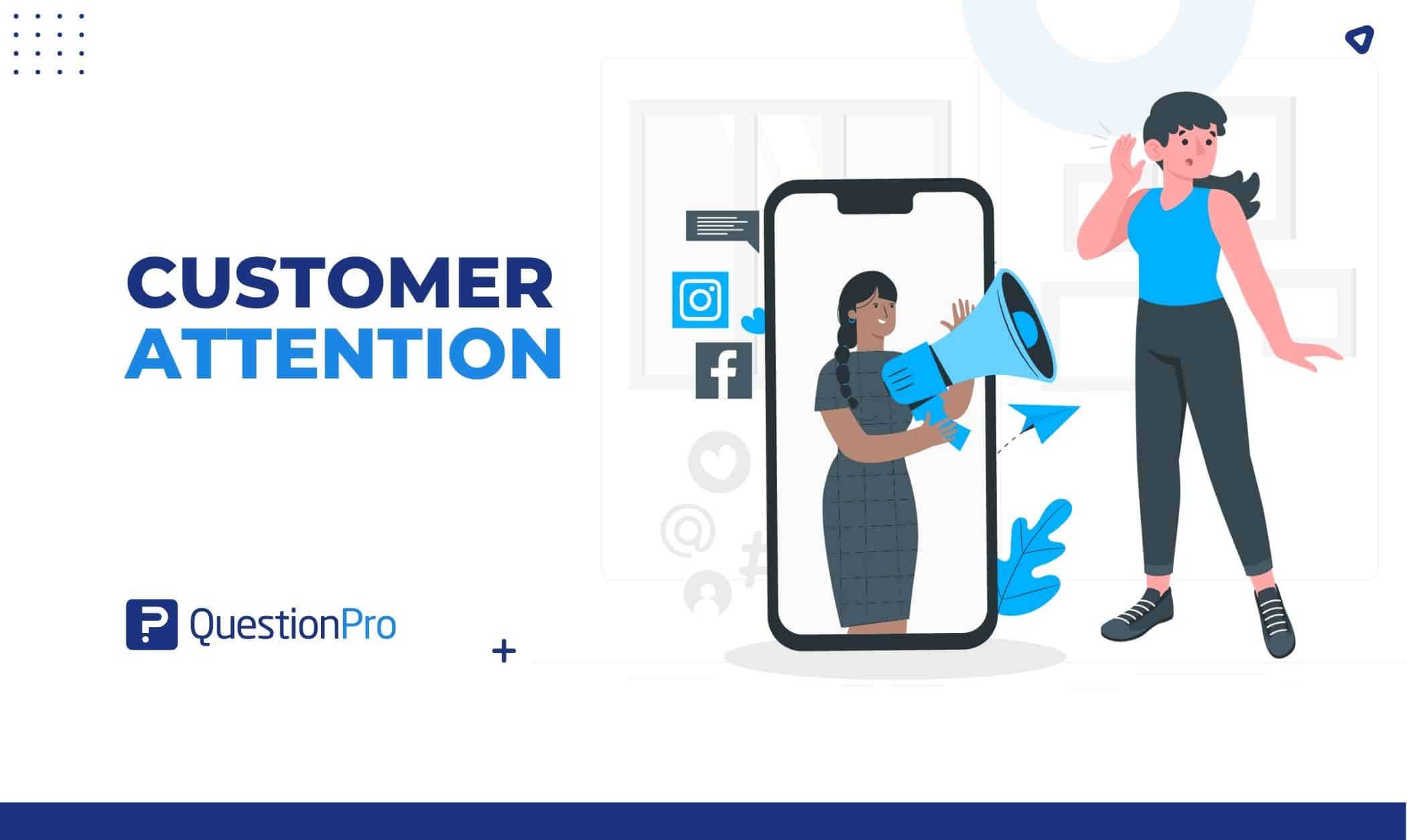
Customer attention is the focus a person gives to your brand, message, or product at a given moment. Every sale, review, and referral starts with it. If people never notice you, nothing else you do gets a chance to work.
Attention is also scarce. Customers move between apps, tabs, and notifications all day, and they ignore most of what reaches them.
In this guide, we’ll define customer attention, separate it from engagement, show real examples, and explain how to earn and measure it.
What is customer attention?
Customer attention is the amount of mental focus a customer gives to a brand, product, message, or experience. Marketers read it through three signals:
- Time: How long people look at something.
- Thought: How closely they consider it.
- Talk: Whether they mention it to others afterward.
Attention comes before every other customer behavior. A person must notice an ad before clicking it. They must notice a product before comparing it. They must notice a support reply before judging it.
The phrase also has a second meaning. Inside a company, customer attention can describe the care a business pays to the customers it already has. This guide covers both sides: how brands win attention, and how they keep paying it back.
Customer attention vs customer engagement, awareness, and customer care
Several terms sit close to customer attention, and people mix them up often. Attention is the earliest and lightest of them. The table shows where each one fits.
| Term | What it means | How it relates to attention |
|---|---|---|
| Customer attention | Momentary focus on a brand, message, or product | The starting point |
| Brand awareness | Whether people recognize or recall your brand | Attention that stuck in memory |
| Customer interest | Wanting to know more after noticing | Attention that lasted |
| Customer engagement | Ongoing action: clicks, replies, purchases, reviews | Attention turned into behavior |
| Customer care | A relationship-led effort to keep customers happy over time | Attention a company pays to its customers |
| Customer service | Solving a specific problem when a customer asks | Reactive attention to a request |
Attention leads to engagement, but it does not guarantee it. For what happens next, read our guide to customer engagement. Our breakdown of customer care vs customer service covers the care side.
Why is customer attention important for business?
Customer attention matters because it is the entry point to revenue. Brands that hold it earn more purchases, stronger loyalty, and cheaper growth.
- More value per customer.
Gallup reports that fully engaged customers represent an average 23% premium in share of wallet, profitability, revenue, and relationship growth compared with the average customer. Attention is where that engagement begins.
- Better retention.
Bain researchers Fred Reichheld and Christine Detrick found that in financial services, a 5% increase in customer retention produces more than a 25% increase in profit. Brands that pay attention to customer satisfaction spot problems before customers leave.
- A stronger reputation.
Customers who feel noticed talk about the brand, and word of mouth is the cheapest reach there is.
- A real competitive edge.
When products look alike, the brand that earns focus first often wins the comparison.
- Better team morale.
Employees who see customers respond to their work tend to care more about the next interaction.
How long does customer attention last?
On a single screen, not long. Gloria Mark, professor emerita of informatics at UC Irvine, reports that average attention on a screen was about two and a half minutes in early studies from the 2000s. By 2020, her research found the average was 47 seconds. She adds that the figure has held near 47 seconds for roughly five years.
Economist Herbert Simon explained the cause in 1971. He wrote that a wealth of information creates a poverty of attention. More content means each piece gets less focus.
This idea is now called the attention economy: human attention is a limited resource, and brands compete for it. A brand has seconds to show it is relevant. Attention also depends on interest, so people stay longer with content that solves a problem they have right now.
What are the three types of customer attention?
Psychologists describe three types of attention. Each one changes how you design a message.
- Selective attention is focusing on one thing while ignoring the rest, like a shopper scanning a shelf for one brand. Win it with a clear headline and a distinct first visual.
- Sustained attention is staying focused over time, like watching a demo or reading a comparison page. Win it by rewarding the reader at every scroll.
- Divided attention is splitting focus across tasks, like browsing while watching TV. Win it with short messages that make sense in one glance.
Real-world examples of customer attention
The brands below earn attention by making the customer the subject of the message. Each example is a public campaign or product habit.
Starbucks: The name on the cup
Baristas write the customer’s name on every cup. The act is small and personal, and it tells customers someone noticed them.
- Why it works: Personalization at the moment of purchase, with no ad spend.
Coca-Cola replaced its logo on bottles with first names. The campaign began in Australia in 2011 and reached the United States in 2014. Shoppers scanned shelves looking for their own names.
- Why it works: It triggers selective attention through personal relevance.
Spotify Wrapped: Attention through your own data
Each year, Spotify gives listeners a personalized recap of what they played. People share it without being asked.
- Why it works: The content is about the customer, so sharing it feels like self-expression.
A hypothetical: Paying attention after the sale
Imagine a US software company whose new users stall after sign-up. The team reviews time to value, the time a customer takes to reach a first useful result. It then sends a short onboarding email and a two-question check-in.
- Why it works: The company notices where customers drop off and responds fast.
Step-by-step guide to getting customer attention
These customer attention best practices work for most brands, from a local shop to a national retailer. Follow them in order.
- Know your audience.
Define your target audience and the places it spends time.
- Lead with a problem.
Open with the pain point your customer already feels, not your product name.
- Write headlines for people first.
Use the words customers type into search, and keep the headline descriptive.
- Make the first line complete.
A reader should understand what you offer and who it is for in one sentence.
- Tell one story across channels.
Keep email, social, website, and in-store messages consistent so repetition builds recall.
- Personalize where data allows.
Use a name, a past purchase, or a location to show you noticed.
- Add emotion and story.
People remember how a message felt. A short customer story or a human detail holds focus better than a feature list.
- Use short video when it explains faster than text.
A 30-second demo can show what a paragraph cannot.
- Invite customers to create.
Reviews, photos, and creator partnerships carry more trust than brand claims because they come from peers.
- Test and keep what wins.
Compare two headlines or subject lines and keep the stronger one.
How is AI changing the way brands capture customer attention?
AI makes it cheaper to personalize messages, answer questions at once, and read feedback at scale. It also makes generic content easier to produce, so more brands sound the same.
Used well, AI helps in three places. Personalization engines tailor subject lines and product suggestions to individual behavior. Chatbots reply the moment a customer asks. Text analysis sorts thousands of open-ended comments into themes a human team can act on.
The risk is sameness. A message written by a tool and published unedited rarely feels personal. Privacy also matters, because customers notice when personalization feels like surveillance. Use AI for speed and pattern-finding, and keep a person responsible for tone and for what data you use.
How to measure customer attention
No single number captures attention. Track behavior to see where focus rises or drops, then ask customers why. The table lists common signals.
| Signal | What it shows | Where to find it |
|---|---|---|
| Email open and click rate | Whether the subject line earns a first look | Email platform |
| Time on page and scroll depth | Whether visitors stay past the first screen | Web analytics |
| Video watch time | The point where sustained attention drops | Video or social analytics |
| Mentions and shares | Whether people talk about you | Social listening |
| Aided and unaided recall | Whether attention turned into memory | Brand awareness survey |
| Repeat visits | Whether interest lasted | Web or app analytics |
Compare each metric with your own trailing 90-day average, not an industry average. A move of 10% or more in either direction is a reasonable trigger to investigate. Treat that threshold as a starting rule and adjust it to your traffic volume.
How to decide where to focus customer attention first
You cannot win every audience on every channel at once. Prioritize with four questions.
First, which customer segment is most valuable to you? Start there. Second, where in the customer journey do people drop off most? Fix the biggest leak before adding reach. Third, which channel does that segment already use daily? Meet them there. Fourth, what is cheapest to test?
A simple rule keeps the work honest. Pick one segment, one channel, and one message. Run it for 30 days and compare the result with your 90-day baseline. Keep it if the metric moved by 10% or more, and drop it if not.
Common mistakes when chasing customer attention
Attention is easy to win badly. The risks below cost brands trust, and trust is harder to rebuild than reach.
- Clickbait headlines: An overpromise earns one click and loses the next ten.
- Off-brand stunts: Content that offends a group can draw attention and damage reputation together.
- Ignoring current customers: Chasing new audiences while existing ones go unanswered raises churn. Customer retention surveys show why people leave.
- Counting only reach: Views without action show that people noticed you, not that they cared.
- Copying competitors’ channels: A channel that works for another brand may not hold your audience.
- Never asking customers: Guessing what captures attention is cheaper than asking, and usually wrong.
How survey feedback shows what earns customer attention
Behavior data shows where attention drops. It does not show why. Survey feedback fills that gap by asking customers directly what they noticed, what they ignored, and what made them leave.
QuestionPro Customer Experience supports this on the service side of customer attention:
- It collects feedback from surveys, tickets, reviews, and digital behavior in one place.
- AskWhy pairs a score with the reason and comment in a single question.
- It tracks Net Promoter Score (NPS, how likely customers are to recommend you), customer satisfaction (CSAT), and customer effort score (CES, how easy a task felt). Our guide to NPS analysis explains how to read the results.
- Closed-loop feedback routes detractor responses to an owner for follow-up.
- AI sentiment and theme analysis groups open-ended comments, so patterns surface faster.
The result is a clear picture of which messages, moments, and touchpoints hold attention and which lose it.
Attention is only the first half
Customer attention is a loan, not a gift. A customer lends you a few seconds, and you repay it with something useful, relevant, and honest. Brands that do this earn more time on the next visit.
The brands that keep customer attention over years do two things. They earn it with messages that feel written for one person, and they pay it back by listening after the sale. Start with one segment and one message. Measure it against your own baseline, and let customer feedback tell you what to change.
Frequently Asked Questions (FAQs)
Attention span is how long a person can stay focused on a task, and it varies with context. Customer attention is the focus given to a specific brand or message. You cannot change a person’s attention span, but you can earn more of their attention.
Yes. Small businesses can use local relevance, personal service, and community ties that large brands struggle to copy. A US neighborhood bakery that remembers regulars by name builds attention that no national ad budget can buy.
Survey at key moments, such as after a purchase, onboarding, or a support contact, and keep each survey to a few questions. Track brand recall on a regular schedule, such as quarterly, so you can compare results over time.
Yes. Business buyers also ignore irrelevant messages, and B2B purchases often involve several decision-makers. Clear, specific content that speaks to each role earns attention faster than general claims about a product.
Compare the share of people who notice your content with the share who act on it. If views are high but clicks, replies, or purchases stay flat, your message earns notice but not interest, so revisit the offer and the next step.