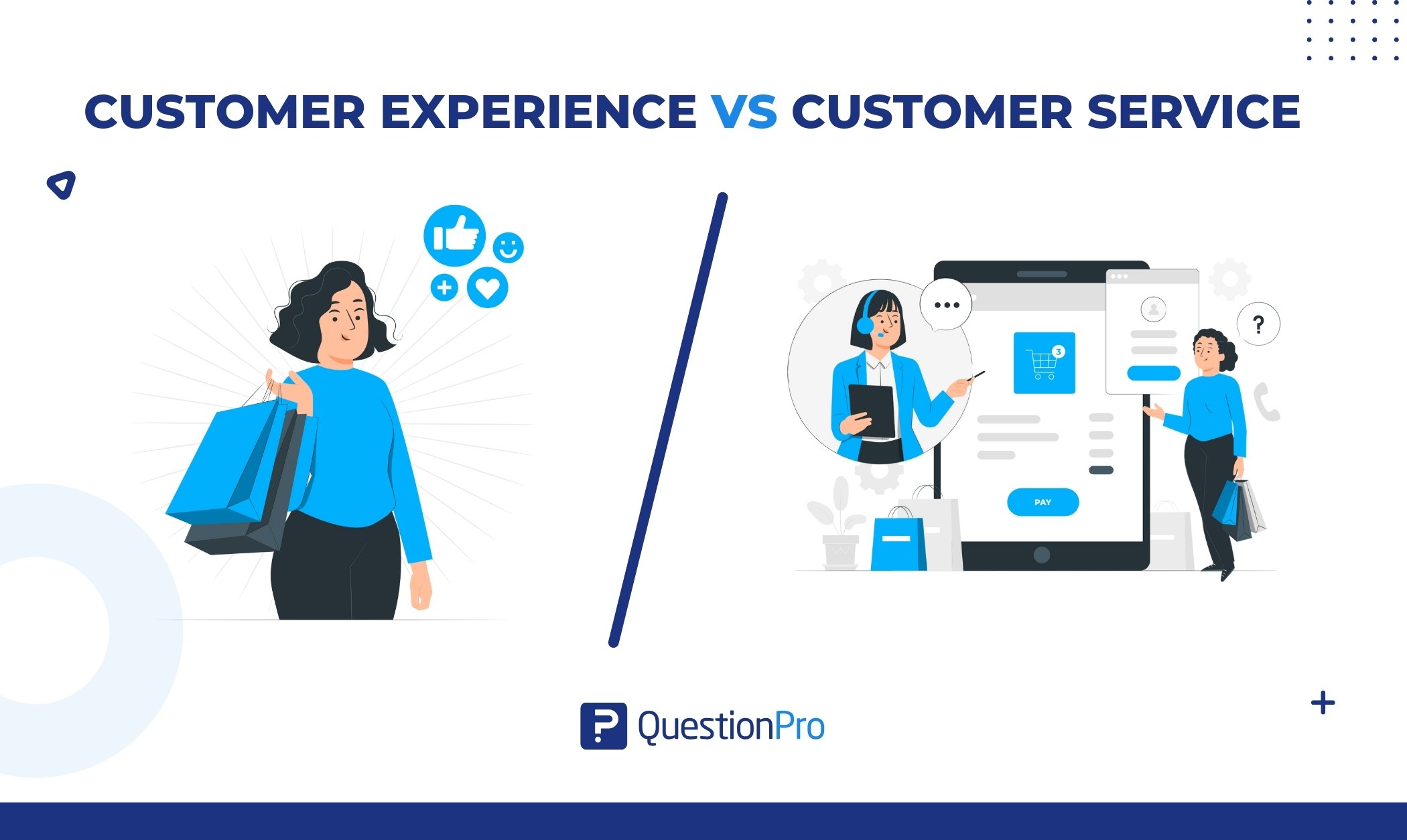
Customer experience vs customer service is one of the most searched comparisons in customer strategy, and the confusion is understandable. Both shape how someone feels about a brand, but they are not the same thing. Customer service is the direct help a business provides when a customer needs support. Customer experience is the overall impression a customer forms across the full relationship, from the first search result to the tenth renewal.
In this blog, we break down what separates the two and where they overlap. We also cover how US brands typically measure each one, and why a single support call can quietly make or break a much longer customer journey.
What is customer experience?
Customer experience is the overall impression a customer forms from every interaction they have with your brand, not only the moments when something goes wrong. It covers what customers see, click, buy, use, and remember, and it starts long before anyone contacts support.
QuestionPro’s overview of customer experience frames it the same way. CX is the sum of every touchpoint a customer has with a company, and each one shapes how that person perceives the brand going forward.
Customer experience typically spans:
- Brand discovery and advertising
- Website or app usability
- Sales conversations and pricing clarity
- Product or service quality
- Onboarding and setup
- Customer support interactions
- Billing and payment
- Delivery or fulfillment
- Follow-up communication and surveys
- Renewal or repeat purchase
A strong customer experience rarely happens by accident. It requires marketing, sales, product, support, and operations to remove friction at each of these points, not just the ones their department owns.
What is customer service?
Customer service is the direct support a business provides before, during, or after a purchase. It usually means answering a question, resolving a problem, or helping someone complete a task, and it is narrower and more transactional than customer experience.
Customers reach service teams through phone lines, live chat, email, help desk tickets, social media replies, in-person counters, self-service help centers, chatbots, and customer success check-ins. If an order arrives wrong and a customer contacts support, the response they get, however fast or slow, however warm or scripted, is customer service. That single interaction can either restore confidence or add to a customer’s growing list of reasons to leave. QuestionPro’s guide to customer service covers the channels and skills involved in more depth.
What is the difference between customer experience and customer service?
The main difference is scope. Customer experience covers the full relationship a customer has with a brand, while customer service covers specific support interactions inside that relationship. One is the whole movie; the other is a single scene, even when that scene is the one people remember most.
| Area | Customer experience | Customer service |
|---|---|---|
| Scope | Full customer journey | Individual support interactions |
| Timing | Before, during, and after purchase | Usually when help is needed |
| Nature | Proactive and strategic | Often reactive and issue-based |
| Main goal | Build a positive overall relationship | Resolve a specific question or problem |
| Teams involved | Marketing, sales, product, support, operations, leadership | Support, success, and frontline service staff |
| Common metrics | NPS, CSAT, CES, retention, churn, journey analytics | First response time, resolution time, service CSAT |
| Example | A smooth path across website, app, store, and email | A support agent solving a billing issue |
Customer experience is usually proactive: teams design better journeys before customers hit friction. Customer service is often reactive: teams respond once a customer already has a problem. That line blurs when a support team gets ahead of an issue, for example by warning customers about a known outage before they call in. The two functions stay connected, but they need separate ownership and separate scorecards to manage well.
How does great customer service shape the customer experience?
Great customer service improves customer experience by reducing friction during the moments customers remember most. When something goes wrong, the recovery often matters more to the relationship than the original mistake.
If a customer receives the wrong item, the product experience is already damaged. A service team that responds quickly, apologizes without excuses, fixes the problem, and follows up can repair a meaningful share of that damage. Speed matters most in these moments, which is part of why fast, clear recovery works so well.
A single service interaction tends to shape the wider relationship when it:
- Solves the problem on the first contact instead of bouncing the customer between agents.
- Explains what happened in plain language instead of hiding behind a script.
- Follows up after the fix to confirm the issue actually stayed resolved.
Good service still has limits. If the same billing error keeps triggering tickets month after month, no amount of agent training fixes it. The company needs to correct the underlying process, not just coach staff to apologize more smoothly.
What are some real examples of customer experience vs customer service?
Customer experience examples describe a full arc across many touchpoints. Customer service examples describe a single, specific support moment inside that arc.
Customer experience examples
- A shopper finds a product through search, reads honest reviews, checks out in under two minutes, gets on-time delivery, receives a useful onboarding email, and later completes a short feedback survey.
- A SaaS user starts a free trial, follows a short setup checklist, gets a helpful in-app tip on day three, and renews because the product fits their actual workflow.
- A retail customer gets consistent pricing, loyalty rewards, and return options whether they shop on the app, the website, or in a physical store.
Customer service examples
- A support agent resolves a billing dispute over live chat in one session.
- A restaurant manager corrects a delivery mistake and comps the next order.
- A live chat rep helps a shopper choose the right plan before checkout.
- A help center article walks a user through a password reset without a call.
- A customer success manager helps an account adopt a feature it was not using.
Both layers matter. A well-designed journey can still be undone by one poor service interaction, and excellent service can surface exactly what needs to change in the wider experience.
How do you measure customer experience vs customer service?
Customer experience and customer service need related but distinct metrics, because a strong score in one does not guarantee a strong score in the other.
| Customer experience metrics | What it captures |
|---|---|
| Net Promoter Score (NPS) | Likelihood to recommend, scored 0 to 10, with 9 to 10 as promoters and 0 to 6 as detractors |
| Customer Satisfaction (CSAT) | Percentage of customers who rate a touchpoint or the overall relationship as satisfied |
| Customer Effort Score (CES) | Ease of completing an action, usually rated on a 5 or 7-point scale |
| Retention and churn rate | Percentage of customers who stay versus leave over a defined period |
| Customer journey analytics | Behavior patterns across touchpoints, such as drop-off points in an app |
Customer service leans on a narrower, faster-moving set: first response time, resolution time, first contact resolution rate, ticket volume, and service-specific CSAT collected right after a support interaction. A team can post excellent response times and still contribute to poor customer experience if the same three issues keep generating new tickets every month. That is why service metrics and journey-level metrics should sit on the same dashboard, reviewed together rather than in separate reports.
What common mistakes blur customer experience and customer service?
The most common mistake is treating service metrics as a full proxy for customer experience, when they only cover a fraction of the journey.
Other frequent mistakes include:
- Giving one team ownership of “the customer” instead of assigning experience and service goals separately.
- Training agents to apologize better instead of fixing the process behind repeat complaints.
- Collecting feedback but never closing the loop with the customer who gave it.
- Measuring CSAT after support calls while ignoring friction earlier in the journey, like a confusing signup flow.
- Letting product, marketing, and support teams work from different, disconnected feedback sources.
Each of these mistakes is fixable once experience and service are measured on the same dashboard instead of in separate reports that nobody cross-checks.
How do you decide where to invest first: Experience or service?
Start with whichever function is currently losing you customers fastest, then work outward from there.
| What you are seeing | Where to focus first |
|---|---|
| Customers churn after months of quiet use, with no complaints filed | Customer experience: map the journey and find silent friction points |
| Support tickets are high and repetitive on the same two or three issues | Customer service: fix the root process, then retrain if needed |
| CSAT after support is strong, but overall NPS keeps falling | Customer experience: the damage is happening outside support |
| First response time is slow and customers mention it directly | Customer service: staffing, routing, or self-service gaps |
Ownership is the deciding factor either way. Service teams can resolve an immediate ticket, but fixing customer experience takes coordinated work across product, marketing, and operations, none of which a support queue can do alone.
How can QuestionPro Customer Experience help connect the two?
QuestionPro Customer Experience is built to connect service-level feedback with the broader customer journey, so a support ticket and a journey drop-off point stop living in separate systems.
The platform can help teams:
- Collect feedback across surveys, tickets, reviews, and digital touchpoints in one place.
- Track NPS, CSAT, and CES side by side instead of in separate tools.
- Use AskWhy to capture the score, the reason, and the open comment in a single question, instead of guessing what drove a low rating.
- Route detractor responses into closed-loop cases with an owner and a recommended fix.
- Build a customer journey map that shows where service interactions sit inside the wider relationship.
The goal is to stop treating a support ticket and a churn signal as two unrelated data points, since in most accounts they are early and late stages of the same story.
Bringing customer experience and customer service together
Customer experience and customer service are closely connected, but conflating them leads to the wrong fixes. Customer service is the support customers receive in specific moments. Customer experience is the full relationship built across every touchpoint that surrounds those moments. PwC’s research on customer experience found that roughly a third of customers will walk away from a brand they otherwise like after just one bad experience. That single number is a reminder that both layers carry real financial weight.
A few things worth remembering:
- Measure experience and service separately, then review them together.
- Fix root causes behind repeat complaints instead of retraining around them.
- Give experience improvements an owner outside the support queue.
When service teams solve issues well and the wider business fixes what caused those issues in the first place, customers get a smoother path from first contact to renewal. That is where customer experience and customer service actually work together.
Frequently Asked Questions (FAQs)
Customer service is one part of customer experience, not a separate discipline. It covers the direct support moments inside a much longer relationship. That relationship also includes discovery, onboarding, billing, and renewal, and all of it shapes how a customer feels about a brand.
Prioritize whichever is currently losing customers. If tickets pile up around the same two or three issues, fix service first. If customers quietly stop returning with no complaints filed, the friction is likely happening earlier in the journey, which points to a broader experience gap.
Yes. A support team can post fast response times and high satisfaction scores while other problems quietly drive customers away. Confusing pricing, a clunky signup flow, or inconsistent product quality can push people out before they ever contact support.
Monthly works for most teams, with a deeper quarterly review to catch slower-moving trends. Reviewing them separately hides the cases where strong service scores are masking a weaker overall journey that needs earlier intervention.
Yes. B2B relationships often run for years across procurement, onboarding, support, and renewal. A single support metric cannot capture how every stakeholder in that account feels about the vendor relationship as a whole.