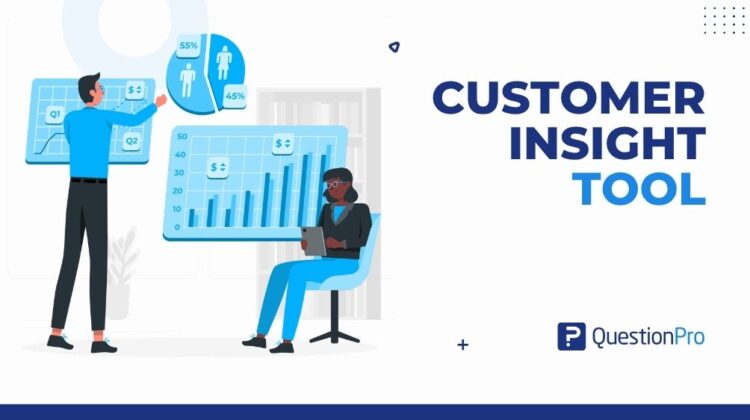
A customer insight tool is software that collects and analyzes customer feedback and behavior data to help businesses understand what customers want and why. It pulls signals from surveys, support tickets, reviews, and website behavior into one place instead of leaving teams to piece it together manually.
Most companies collect plenty of customer data already. The problem is rarely a lack of data. It is that the data sits scattered across CRM records, support tools, and spreadsheets, with nobody responsible for turning it into a decision.
This blog covers what a customer insight tool actually does, the features worth prioritizing, and how to choose the right one for your team.
What does a customer insight tool do?
A customer insight tool aggregates customer data from multiple sources, then applies analysis, like sentiment scoring or trend detection, to surface patterns a team can act on. The output is not just a dashboard of numbers. It is a clear answer to a specific business question, such as why churn increased last quarter.
These platforms typically pull from several channels at once: survey responses, support conversations, product usage data, reviews, and social mentions tracked through social listening. Combining them matters because any single source tells only part of the story. A support ticket shows a complaint. A survey shows how many customers share that complaint. Usage data shows whether it is actually affecting behavior.
Customer insight tools vs. Customer analytics vs. Market research
These three terms get used loosely, and the overlap causes teams to buy the wrong tool for the job.
| Category | Primary focus | Typical data source |
|---|---|---|
| Customer insight tool | Why customers feel and act the way they do | Feedback, behavior, sentiment |
| Customer analytics | What customers do, measured quantitatively | Usage events, transactions |
| Market research | Broader market and audience understanding | Surveys, focus groups, secondary data |
A customer insight tool usually sits between the other two. It combines the “what” from analytics with qualitative context from feedback, giving teams the “why” that raw usage numbers alone cannot explain.
Key features to look for in a customer insight tool
Not every platform needs every feature. The right mix depends on how your team plans to use the data.
- Multi-channel data collection.
Surveys, reviews, support tickets, and social mentions feeding into one system, rather than five disconnected tools.
- Sentiment and text analysis.
Automated processing of open-ended feedback saves hours of manual reading and tagging.
- Segmentation.
The ability to break insights down by customer type, tenure, or behavior, rather than one blended average.
- Real-time reporting.
Dashboards that update as new feedback comes in, instead of a static report generated once a quarter.
- Integration with existing systems.
Connections to your CRM or support platform so insight data does not live in a silo.
How to choose the right customer insight tool
Start with the decision you need to make, not the feature list. A tool chosen because it has the most dashboards rarely gets used well if it does not answer a specific, recurring question your team actually has.
Next, check the source mix against your own customer base. A platform built primarily for e-commerce reviews will not serve a B2B software company well, and vice versa. Then confirm the output is something your team can act on directly, whether that means flagging a product decision or triggering a follow-up outreach, rather than producing another report that sits unread.
Common mistakes when adopting a customer insight tool
A few patterns show up repeatedly when these tools underdeliver.
- Buying a platform before defining what business question it needs to answer.
- Collecting data across channels but never connecting it back to a single customer view.
- Treating the tool as a reporting dashboard instead of a trigger for action.
- Rolling the tool out without training the teams who need to actually use the insights day to day.
How to measure whether a customer insight tool is working
The tool itself is not the outcome. The measure of success is whether decisions actually change because of what the data shows.
Track how often insights lead to a documented action, how quickly a flagged issue gets addressed, and whether metrics tied to the insight, like retention or Net Promoter Score, move afterward. A platform generating reports nobody references is not delivering value, regardless of how sophisticated its analytics look.
How QuestionPro works as a customer insight tool
QuestionPro combines survey data, feedback analysis, and segmentation in one platform, which lets teams move from a raw customer comment to a specific, actionable insight without exporting data into a separate tool. Built-in customer satisfaction surveys and Net Promoter Score tracking give teams a consistent baseline to measure against over time.
For businesses managing insight collection alongside broader experience programs, this connects directly to Customer Experience Software, so feedback data and journey-level metrics live in the same system instead of two disconnected platforms.
Frequently Asked Questions (FAQs)
No. A CRM stores customer records and transaction history, while a customer insight tool analyzes feedback and behavior to explain why customers act the way the CRM data shows.
Pricing ranges widely, from a few hundred dollars a month for small business plans to enterprise contracts running into the tens of thousands annually, depending on data volume and features.
Yes. Even a lightweight setup combining survey feedback and basic segmentation can reveal patterns a small team would otherwise miss by reviewing feedback manually.
Most current platforms use AI for sentiment analysis and theme detection across open-ended feedback, which significantly reduces the manual work of reading and categorizing responses by hand.
A survey tool collects responses to specific questions. A customer insight tool goes further, combining survey data with other sources and applying analysis to surface patterns across all of it.